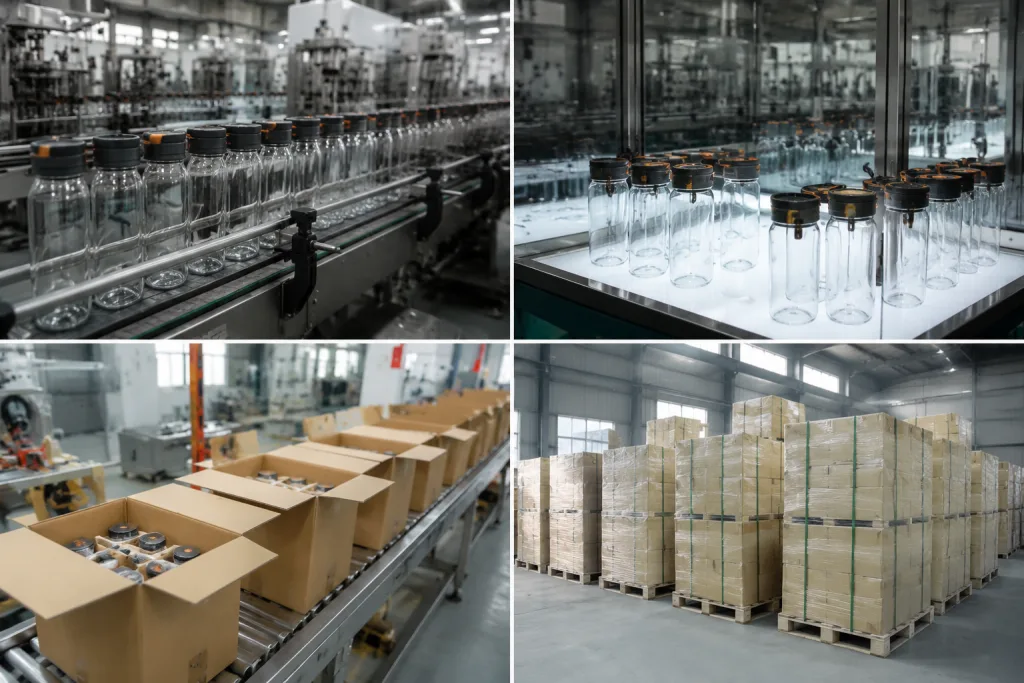
Key Takeaways
- Borosilicate glass bottles usually start at 1,000-3,000 pcs MOQ, with 30-45 days lead time after sample approval.
- A 2.0-2.5 mm wall and 3.3 borosilicate glass are common spec points for a bulk fitness water bottle program.
- For custom logo work, ask for 1-color silkscreen or laser on glass, and confirm cap torque and dishwasher cycle limits.
- A reliable factory in Zhejiang should show AQL 2.5 inspection, REACH paperwork, and monthly output above 200,000 units.
If you source from a borosilicate glass sports water bottle factory, do not treat glass as a commodity. It is the wrong question to ask. Wall thickness, thermal shock tolerance, cap torque, and pack-out method all hit landed cost and complaint rate. On the line, we check 2.5 mm, not “about thick enough.” A Zhejiang supplier can quote in 30 minutes, but you still need to know what sits inside that number.
For fitness brands and gym chains, the job is plain: buy a bottle that takes daily abuse, prints cleanly, clears REACH and food-contact checks, and still ships on schedule. We ship a lot of bulk gym water bottle orders from Zhejiang, and the buyer usually flags the same issue first—spec drift between sample and PO. If you want a program that does not turn into a claims file, start with the questions buyers should ask before PO release.
What buyers should ask first
Start with the boring questions. They save money. What glass grade is in the line? Is it 3.3 borosilicate or a mixed formula? What are the wall thickness, neck finish, and hot-cold shock range? If the supplier cannot answer in millimeters and degrees, you are not ready to compare prices.
For a bulk sports water bottle program, I would ask for these specs in writing. We run these checks on a caliper and a thermal test rack, so the numbers have to be clear:
- Glass material: borosilicate 3.3
- Wall thickness: 2.0 mm, 2.5 mm, or 3.0 mm
- Capacity tolerance: ±3% or better
- Leak test: 100% or lot-based
- Drop test height: 1.0 m or 1.2 m with defined pass/fail criteria
Do not stop at the bottle. Ask about cap material, gasket grade, and whether the bottle is suitable for carbonated drinks, hot tea, or only cold water. We have seen buyers ask for a custom fitness water bottle, then the buyer flagged the closure because it was built for desk use, not a gym bag. That is the wrong question to ask later. A real factory in Zhejiang should send a spec sheet, not a sales paragraph.
Good sourcing starts when you can compare two samples on paper, not by feel in your hand.
For a distributor fitness water bottle or distributor sports water bottle program, this matters even more because you need repeatability across reorders. If the first lot is 480 ml and the second turns into 505 ml, your retail pack and barcode data are off. We ship that kind of order only after mold wear checks and fill-line checks, and QC pulled the sample if the neck finish drifted by even 0.5 mm. In China, the math works when the factory controls it.
How MOQ and pricing really work
Most buyers ask for the price first, but the real question is what sits under that number. A borosilicate glass sports water bottle factory usually builds the quote from glass cost, cap structure, printing method, and packaging. A plain custom shaker bottle in clear glass with one-color print can land at a different level from a matte-coated custom logo shaker bottle with a stainless cap, silicone sleeve, and gift box. We had a buyer flag a PO typo once — the sleeve spec was missing, and the quote shifted fast.
The factory numbers are usually straightforward. For standard shapes, MOQ often starts around 1,000 pcs for a stock mold and 3,000 pcs for a new color or cap variant. Sample lead time is usually 7-12 days. Mass production often runs 30-45 days after sample signoff, and a busy Zhejiang line will only move faster if the schedule is already clear. A serious export plant should state monthly output, not hide it. If a factory says 200,000-300,000 units/month, that tells you more than a polished website ever will. QC pulled the sample last week and found a cap torque issue at 1.8 N·m; that is the kind of detail that matters.
Price swings come from details, not magic. A bulk shaker bottle with a PP lid and no sleeve may sit at USD 1.20-1.80 EXW, while a customized shaker bottle with a premium closure and printed carton can move above that. A bulk gym water bottle with a silicone sleeve and laser logo may cost more than a plain bottle, but it cuts slip complaints on the line. For distributors fitness water bottle programs, stable pricing matters more than chasing the lowest quote by USD 0.10. The math does not work if you ignore sleeve cost, carton strength, and breakage.
Always confirm whether the price includes:
- Individual carton or bulk pack
- Logo setup fee
- Color matching for Pantone references
- Test reports and export documents
- Replacement allowance for breakage
If the supplier is in China, especially Zhejiang, ask for FOB terms separately from EXW. First-time buyers often compare the wrong price, then get hit by inland freight, port charges, and extra packaging. We see this go sideways when the buyer only checks the unit quote and skips the truck fee from the factory gate to Ningbo.

Which customization is worth paying for
Not every customization pays for itself. We see the money go to grip, leak resistance, logo wear, and packability. Fancy decoration looks nice on a sample, then the sell-through tells a different story.
For branding, buyers usually choose silkscreen, pad print, UV print, laser engraving, or embossed and debossed mold marks. On glass, laser gives a clean permanent mark, but it usually stays to one color and a small area. Silkscreen gives stronger color and holds up well on a custom gym water bottle or custom fitness water bottle line. If you are ordering a custom logo shaker bottle for retail or a distributor shaker bottle for promotions, we ask for scratch resistance after 50-100 wash cycles; QC pulled the sample after 60 and the weak ink showed fast.
Functional parts matter more than people think. You can specify cap color, a carry loop, a silicone sleeve, or measurement marks for a customizable shaker bottle. If your customers train indoors and commute, a customizable sports water bottle with a sleeve often moves faster than a bare glass bottle because it feels safer in hand. For gyms, a customizable gym water bottle with one-color print is easier to reorder than a complicated multi-part set. The buyer flagged it once on a 3,000-piece PO because the sleeve color code was missing.
Be careful with “custom made shaker bottle” requests. Shaker hardware needs a mixer ball, screw geometry, and seal design, and that adds tooling risk. If you want a customized shaker bottle for supplements, ask for shake test criteria: 20-30 seconds of mixing, no visible leakage, and no cap pop under repeated inversion. That is not glamorous. It is the right question to ask. We’ve seen this go sideways when a 24 mm seal looked fine on paper but failed on the line after a 1.2 kg drop test.
The best factories in Zhejiang will tell you what is customizable and what is not. That honesty is worth more than a cheap quote from China that ignores technical limits. A clean answer saves a bad PO typo and a lot of back-and-forth.
What quality checks protect your order
Quality control for glass drinkware should be specific. A decent factory sets incoming inspection, in-process checks, and final random inspection under AQL. For export orders, AQL 2.5 is the normal baseline for major defects, and we usually tighten leakage and print checks when the brand is premium. On one 50,000-piece run, QC pulled the sample and found two mouth chips before packing; that saved a headache at the port.
Ask for these controls before you approve the PO:
- Visual inspection for bubbles, stones, and scratches
- Dimensional checks for mouth finish and body diameter
- Heat shock test and cold-water stress test
- Cap seal test with defined torque value
- Drop test with filled and empty bottle conditions
For a bulk sports water bottle, the failure usually shows up at the closure, not the glass wall. A gasket that is 0.3 mm oversize, a weak thread, or a poor liner can turn a clean bottle into a leaker. “Tight fit” is the wrong question to ask. Ask for torque values, and get the range in writing; 1.2-1.8 N·m is a common target, but the line should set the spec for your cap.
Ask for compliance documents too. If you sell into Europe or North America, expect food-contact declarations, REACH support, and, where relevant, ASTM or ISO test references. We ship a lot of these files with the first sample set because the buyer flagged missing paper on a 12,000-piece order and the release got stuck for 9 days. A supplier in China that hesitates on documents is usually hiding something.
For distributor gym water bottle programs, request carton drop testing and barcode verification as well. We’ve seen this go sideways on warehouse intake: crushed outer cartons, a wrong label position, or an FNSKU typo on the PO that sends the whole pallet into receiving holds.

When a glass bottle makes business sense
Glass is not the answer for every fitness channel. It works when the buyer wants a cleaner brand story, no odor carryover, and a retail shelf that looks worth the price. For yoga studios, wellness chains, and corporate wellness kits, a customized fitness water bottle in borosilicate glass often beats a basic plastic bottle because the margin story is easier to sell.
Use glass when taste neutrality and presentation matter. Skip it for hard-use programs with frequent drops and no sleeve. If the order is a bulk gym water bottle for lockers, travel, and commuting, we usually push a sleeve, a stronger closure, or a move to stainless steel. This is the wrong question to ask: “Can glass work?” The better question is where the bottle will live after QC pulled the sample and the buyer flagged the first scratch on the transit test.
A practical way to segment the line is this:
- Retail: custom sports water bottle with bold branding, gift box packing, and a higher shelf price
- Gym chain: customizable gym water bottle with durable print, repeat-order specs, and a 500 MOQ per color
- Distributor channel: distributor fitness water bottle or distributor shaker bottle with fixed carton count and stable case marks
- Supplement or training line: bulk shaker bottle with mix function, tight seal, and a cap that survives 3,000 open-close cycles
If you are buying from a borosilicate glass sports water bottle factory in Zhejiang, check the plant’s export history first. A factory that already ships to Europe and North America usually knows carton drop tests, label rules, and document flow. That matters more than a polished 3D render. We have seen this go sideways when a supplier could make the sample but missed the shipping mark typo on the PO; the line caught it after packing, and the rework ate two days. China has plenty of capable factories, but the good ones show process control instead of making big promises.
Send your bottle spec and get a quote
We can review your target capacity, logo method, and carton spec, then quote a practical production plan from Zhejiang.
Frequently asked questions
What MOQ should I expect for a custom borosilicate bottle order?
For a standard mold, expect 1,000 to 3,000 pcs MOQ depending on logo, color, and cap choice. A custom shaker bottle with a new lid or sleeve often pushes higher because tooling and assembly cost more. If you only need a sample run, many factories in Zhejiang will offer 1-2 prototype pieces, but that is not a production commitment. For export buyers, the real question is not just MOQ; it is whether the factory can repeat the same cap fit, print position, and carton count on the second order.
Can I get a custom logo shaker bottle with dishwasher-safe print?
Yes, but you should specify the print method and the wash test. Silkscreen on a custom logo shaker bottle is common, but ink systems vary. Ask for a test after 50 or 100 dishwasher cycles and define what counts as failure: fading, chipping, or edge lift. Laser engraving is more durable on glass, but it is usually one-color and less decorative. If you want a custom gym water bottle for retail, durability is usually worth more than a bright print that wears off in six weeks.
How do I compare quotes from different factories in China?
Compare on the same spec sheet, not on the title line. Check glass grade, wall thickness, cap material, gasket type, logo method, carton spec, and included tests. A supplier in China may quote a lower EXW price but exclude inner boxes, drop tests, or export documents. For a bulk gym water bottle order, even a USD 0.15 difference can disappear once you add better packaging or a leak-proof cap. Ask each factory to confirm MOQ, lead time, and monthly output in writing.
What documents should a distributor ask for before payment?
At minimum, ask for commercial invoice, packing list, product spec sheet, and applicable compliance declarations. For Europe, REACH support is important. For North America, food-contact declarations and test references matter. If you are a distributor sports water bottle buyer, also request carton dimensions and net/gross weight so your warehouse can plan intake correctly. For branded retail, ask for print proof approval and a pre-production sample signed by both sides before mass production starts.
Is borosilicate glass better than standard glass for gym use?
Yes, usually. Borosilicate handles thermal shock better and is less likely to crack from temperature changes than ordinary soda-lime glass. That matters if your customers switch from cold water to warm beverages or wash bottles in hot water. Still, glass is glass: a hard drop can break it. If you are sourcing a customizable sports water bottle for active users, ask for a sleeve, a tested cap seal, and clear usage guidance. The right design reduces breakage more than any marketing claim.