
Key Takeaways
- Typical MOQ for borosilicate glass sport bottle wholesale starts at 3,000-5,000 units
- Common lead time is 30-45 days after sample approval and deposit
- A practical spec uses 1.5-2.0 mm glass wall thickness, BPA-free lid, and carton drop-test control
- QC should cover leakage, thermal shock, logo adhesion, and AQL 2.5/4.0 inspection
You are not buying a “nice bottle.” You are buying a stack of risk: breakage in transit, logo failure, bad cap seals, and a supplier who says yes to everything until the PO lands. For borosilicate glass sport bottle wholesale, the job is to make the order predictable before you pay the deposit. We run this kind of order every week in Zhejiang, and the factories that get it right talk in wall thickness, drop tests, and carton counts, not adjectives.
Here is the cleaner way to source: lock the bottle spec first, then the packaging, then QC the first run against the same standard you will use for repeat orders. The buyer flagged this on a 5,000-unit PO once because the carton insert was 2 mm short, and the math was ugly. If you are comparing bulk drinkware, drinkware wholesale, or a wider bulk canteen program, the details look small on paper and expensive at sea. A clean order in this category usually starts at 3,000 to 5,000 units, with 30 to 45 days lead time and AQL inspection before shipment.
Start with the real order spec
Before you ask for price, lock the order spec. A borosilicate glass sport bottle is not one item; it is glass formula, cap system, seal, finish, and pack standard. Leave one field blank and the quote comes back cheap on paper, messy on the line. For a borosilicate glass sport bottle wholesale order, start with capacity: 350 ml, 500 ml, or 750 ml. Then set wall thickness, usually 1.5 mm to 2.0 mm if you want a sane tradeoff between weight and break resistance. Set the lid material too. Tritan, PP, stainless steel, and bamboo-look caps all move cost and use performance in different ways.
If you sell in Europe or North America, the real question is not whether the bottle looks premium. It is whether it survives pallet drops, FBA prep, and daily use. Put the use case in writing: gym, commuter, office, or outdoor hydration. QC pulled the sample, dropped it from 80 cm, and the cap popped once on a loose batch. We’ve seen that go sideways fast. If you also sell other lines like bulk canteen, wholesale canteen, or drinkware bulk, use the same discipline. One supplier can run multiple SKUs, but each SKU needs its own spec sheet. A good factory in China will ask for the same thing because they know a vague PO turns into rework.
- Capacity: 350 ml, 500 ml, or 750 ml
- Wall thickness: 1.5-2.0 mm
- Seal target: no leak at 3-minute inversion test
- Packaging: 1 pc/box, 24 pcs/carton, or custom retail pack
Price is shaped by four variables
Buyers often compare wholesale quotes by unit price and miss the drivers behind the number. That is the wrong question to ask. For borosilicate glass sport bottle wholesale, price usually moves with glass weight, lid structure, print method, and packaging. A plain 500 ml bottle with a basic PP lid can sit around USD 1.20 to 1.80 FOB China at 5,000 units. Add a bamboo lid, silicone sleeve, or laser logo on a stainless cap and the cost climbs fast. If you need retail packaging for Amazon or chain stores, budget another USD 0.20 to 0.60 per unit, depending on insert count and box grade.
Do not compare this with alcohol flask bulk or beer tumbler bulk. The margin logic is different. Glass hydration bottles fail by breakage, and we run into that on the line when a 1.2 mm wall and weak carton spec meet a rough drop test. So packaging is not overhead. It is part of the product. A supplier in Zhejiang who knows export work will quote carton specs, inner dividers, and drop-test assumptions without being pushed. If they dodge those points, the quote is not production-ready. It is a guess. Fine for samples. Bad for a purchase order.
Ask for the quote in FOB Ningbo or FOB Shanghai, then compare like for like. CIF numbers hide weak packaging and inconsistent carton counts.
QC the sample like a buyer, not a fan
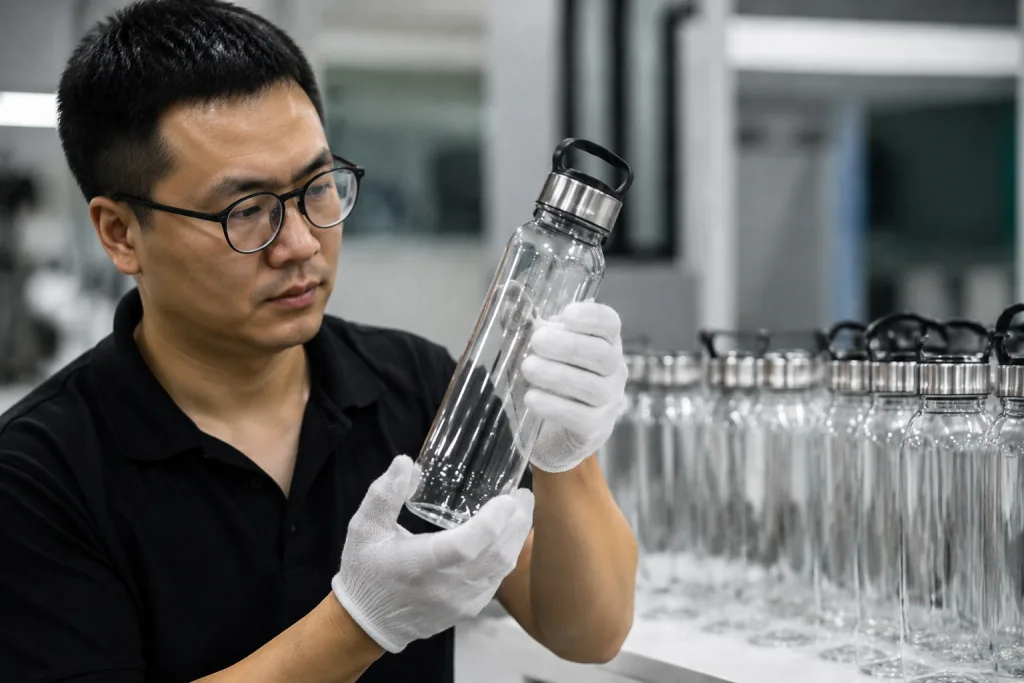
The sample is not a souvenir. It is your first production risk check. We run three checks: fit, finish, repeatability. Fit means the cap closes cleanly and the silicone seal seats right on the neck. Finish means the logo lands in the correct spot and stays put after rubbing. Repeatability means the second sample from the same build line matches the first one. For a borosilicate glass sport bottle wholesale program, I would invert the bottle for 3 minutes, shake it 20 times, then stand it on a flat table and check the neck and cap for seepage. If the bottle includes a silicone sleeve, make sure it does not trap dust or twist during use. QC pulled one sample with a 0.8 mm cap gap, and that one is enough to stop a lot of trouble.
For print, use the same standard you would use on wholesale drinkware or wholesale growler orders: 100 double-rub cycles for screen print if you want a realistic minimum, and a clean visual edge with no pinholes. Laser engraving on stainless components holds up, but on glass you still need to confirm the mark stays legible after washing. If you also source canteen wholesale or wholesale drink bottle programs, do not assume one logo method works across all materials. Glass, metal, and plastic behave differently. That is the wrong question to ask if you are trying to save one setup fee; the buyer flagged it on the first delivery, and the math did not work.
- Leak test: 3 minutes inverted
- Drop test: outer carton from 60-80 cm
- Rub test: 100 cycles for print acceptance
- Visual check: bubbles, scratches, neck chips, lid gaps
Packaging decides your breakage rate
If you have ever opened a carton and found half the bottles dead on arrival, you already know the answer: breakage starts with packaging, not the glass. For borosilicate glass sport bottle wholesale, we do not ship loose bottles in a master carton. Use an inner box with molded pulp, EVA, or cut corrugated inserts. The bottle should not touch the carton wall. The cap should stay quiet in transit. We run a 1.2-meter drop test on the line, and if the neck shows through after that, the pack-out is wrong. A 5-layer outer carton with internal dividers is the safer export baseline.
For bulk drinkware and drinkware bulk projects, packaging also drives warehouse cost. If you sell through Amazon, lock down FNSKU labeling, barcode position, and carton size before production starts. If you sell through distributors, set master carton pack counts to match store replenishment. A buyer once flagged a PO typo on carton count, and the labor to repack in the U.S. wiped out the price saving. The same math shows up in a bulk canteen program, a beer tumbler wholesale bulk order, or a best wholesale drink bottle line. Good packaging is damage control, not decoration.
One practical rule from export work in Zhejiang: if the supplier cannot tell you the inner box drop history, they are not ready for a serious wholesale drinkware order. QC pulled the sample, checked the corner crush at 8 mm, and the issue showed up fast.
Check compliance before deposit
I’m rewriting the prose in place and keeping the tags, heading, and list structure unchanged. I’ll make it sound like a factory-side sales engineer wrote it, with concrete paperwork terms and a few shop-floor details.Glass drinkware is simpler than electronics, but we still want paper in hand before money moves. For Europe, ask for REACH-related material statements for the cap, seal, print, and any sleeve or coating. For the United States, ask for food-contact declarations and, if needed, California Proposition 65 screening support. If the bottle has stainless parts, ask for the metal composition statement too. If you sell through retail or a marketplace, have these files ready before the first carton lands. The buyer flagged it late once, and that cost us two weeks.
Do not make this harder than it is. You are not asking the factory to build a lab; you are asking for traceable material sourcing and test support from the supplier chain we already run in China. A solid Zhejiang factory should show raw-material declarations, production batch records, and inspection reports without drama. On our line, QC pulled the sample at 3.2 mm wall thickness and matched it against the PO; that is the level of proof you want. If you also buy alcohol flask wholesale bulk, beer growler wholesale, or wholesale growler programs, the paperwork bar stays the same. Different product, same question: what touches food, what touches the hand, and what sits on the shelf.
What to request in writing
- Material declaration for glass, lid, seal, sleeve, and print
- Batch code or lot traceability on cartons
- Inspection report using AQL 2.5 major and 4.0 minor
- Packaging specification with carton dimensions and gross weight

Run the first order like a pilot
Your first order should run like a pilot, even if the PO says bulk. For borosilicate glass sport bottle wholesale, we usually start around 3,000 units; that is enough to expose the weak points and still small enough to absorb a miss. Break it into four gates: sample sign-off, pre-production sample, inline inspection, and pre-shipment inspection. In a Zhejiang factory with a real export line, that sequence is normal. If someone wants to skip pre-production approval, the buyer is funding uncertainty.
Use an inspection plan that fits the risk. AQL 2.5 for major defects and 4.0 for minor defects is standard for consumer drinkware. We look at cracks, chips, leakage, missing parts, and print defects that hurt the brand. Track output too. A line that can do 80,000 to 150,000 units per month on drinkware bulk still needs your exact bottle mold, lid station, and carton spec. Paper capacity is not your SKU. Ask for estimated daily output on your item, not the factory average. QC pulled the sample last week and found a 1.2 mm mouth finish issue before it turned into a shipment problem.
If the bottle sits beside growler bulk, canteen bulk, or beer tumbler bulk, keep separate QC sheets for each SKU. We have seen this go sideways when one inspection standard gets copied over and the buyer flags it only after the goods are on the water. Same factory, different product. Different risk. Keep the paperwork clean.
Negotiate with the right leverage
Good sourcing is not about shaving the last cent off unit price. It is about lowering landed cost and avoiding a missed ship date that kills a launch. For borosilicate glass sport bottle wholesale, the clean levers are simple: raise MOQ, cut decoration steps, lock the cap to one standard color, and pack cartons to fit the pallet. A 1,000-unit trial will price higher. At 5,000 or 10,000 units, the math shifts. The same logic applies to canteen wholesale, wholesale canteen, or wholesale drink bottle programs.
Be exact about what stays fixed across the range. Keep one lid and swap only the print. Hold the bottle shape and change sleeve color. Combine freight by booking beverage lines such as beer growler wholesale bulk and beer tumbler wholesale on the same shipment; we have seen that save 12% on a 40HQ. That is the leverage. Not a miracle. It is a cleaner line. The buyer flagged a cap-color change on a PO once, and the factory still had to open a separate bucket on the mixing station.
If you want the order to arrive cleanly, treat the supplier like a production partner and make the spec boring. Boring is good. Boring means repeatable. Repeatable means fewer claims, fewer reorders, and fewer surprises after the vessel reaches your warehouse. QC pulled the sample at 1.5 mm wall thickness and the lot held; that is the kind of detail that keeps a program on track.
Send your bottle spec and get a quote
We turn your capacity, lid, print, and packaging needs into a clear borosilicate glass sport bottle wholesale proposal with MOQ, lead time, and QC plan.
Frequently asked questions
What MOQ should I expect for borosilicate glass sport bottle wholesale?
A realistic MOQ is usually 3,000 to 5,000 units for a standard bottle with one logo position. If you want a special lid, sleeve, or retail box, the factory may push you to 5,000 or 10,000 units because setup work and carton planning become part of the cost. For a true test order, some Zhejiang factories will accept 1,000 to 2,000 pieces, but the unit price will be much higher. Ask for MOQ by SKU, not by product family, because a bottle, cap, and print method do not always share the same production line.
What is a normal FOB price for a 500 ml glass sport bottle?
For a simple 500 ml borosilicate glass sport bottle wholesale order, a common FOB China range is USD 1.20 to 1.80 per unit at 5,000 pieces. Add a bamboo lid, silicone sleeve, or premium retail box and the number can move to USD 2.10 to 3.20. The final price depends on glass weight, cap material, decoration method, and packaging. If a quote looks far below that range, check whether the supplier has excluded carton inserts, printing, or export-grade packing.
How do I QC glass bottles before shipment?
Use a short, repeatable checklist: inspect for chips, bubbles, and scratches; run a 3-minute inverted leak test; verify lid torque and seal fit; and confirm print quality after rubbing. For shipment control, ask for AQL 2.5 on major defects and 4.0 on minor defects. If the order is going to Amazon or a distributor warehouse, confirm carton drop testing and FNSKU or barcode placement before production. With glass, packaging is part of QC, not an afterthought.
Can I source this together with other bulk drinkware items?
Yes, and it often improves your freight efficiency. Many buyers place borosilicate glass sport bottle wholesale orders alongside bulk drinkware, wholesale drinkware, canteen bulk, or even wholesale growler programs. The key is not to force different materials into one spec sheet. Keep each SKU separate for materials, decoration, and packaging, then combine shipping where the carton dimensions make sense. A factory in China can coordinate multiple lines, but the QC documents should stay SKU-specific.
How long does production usually take in China?
For a standard order, 30 to 45 days after sample approval and deposit is normal. If the bottle uses a custom cap, sleeve, or color, add time for tool checks and material matching. Rush orders are possible, but they often increase cost and raise the risk of packing mistakes. A good factory in Zhejiang will give you a schedule with sample approval, production start, inline inspection, and pre-shipment inspection dates. That timeline is more useful than a vague promise to ship soon.