Key Takeaways
- Borosilicate glass failures are usually spec failures, not material failures; lock wall thickness at 1.8-2.2 mm and neck tolerance at ±0.5 mm.
- For export orders, expect MOQ around 3,000 units and lead time of 25-35 days from approved sample.
- Ask for AQL 2.5 for critical defects, 4.0 for major defects, and documented drop-test and thermal-shock criteria.
- If you also buy canteen custom or custom growler programs, align closure, coating, and carton specs so one factory can build all SKUs consistently.
When you buy a borosilicate glass sport bottle custom, the weak point is usually not the glass. The trouble starts between design, forming, decoration, assembly, packing, and export. We’ve seen a sample pass on the bench and then fail in bulk because the neck finish drifted by 0.6 mm, the silicone sleeve shrank after curing, or the carton crush test was never written into the PO.
If you source custom drinkware from China or Zhejiang, treat this like a production-control job, not a product-picking exercise. The better canteen manufacturer is the one that shows process control on paper and on the line, not the one with the nicest render. At BottleForge Industrial in Zhejiang, standard export runs start at 3,000 units per SKU, with 25-35 days for most borosilicate builds once artwork and specs are frozen. That is the level of clarity you need before you sign off the order.
Where borosilicate bottles fail
The first failure mode is simple: the bottle looks fine, then the dimensions drift. Borosilicate glass handles heat, but a sport bottle still fails when the neck finish is off by 0.3 mm, the shoulder sits uneven, or the base thickness varies enough that the bottle rocks on a flat table. For a borosilicate glass sport bottle custom, “high quality glass” is useless. We need numbers, and we need them on the PO.
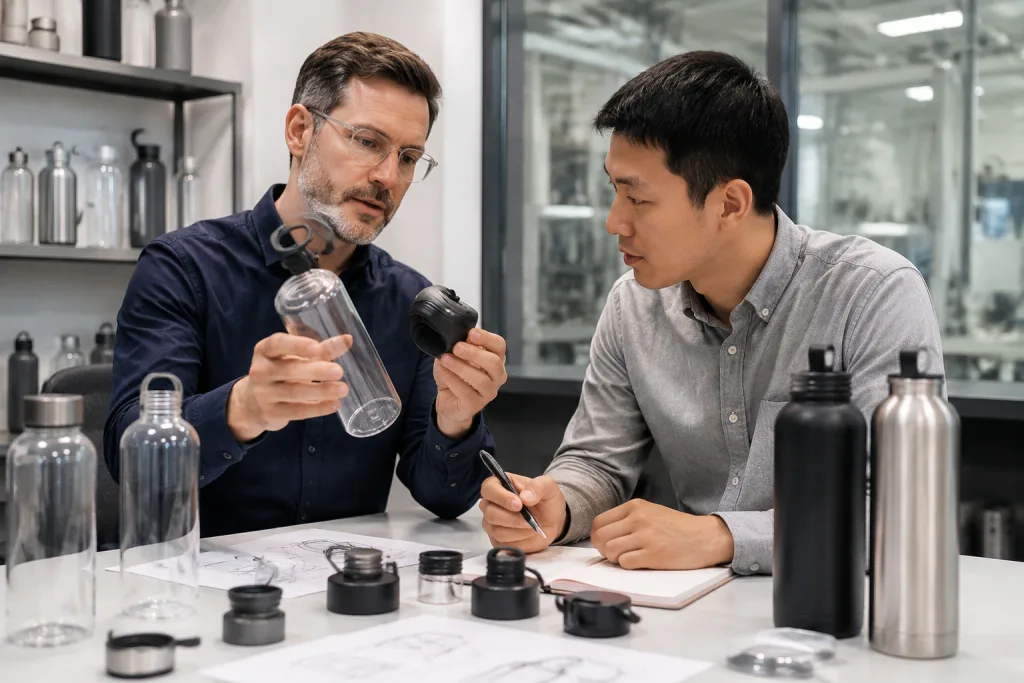
Spec wall thickness at 1.8-2.2 mm for most 350-600 ml bottles, with base thickness usually 2.5-3.5 mm if you want better impact resistance. Ask the canteen factory for tolerance on height, diameter, and mouth finish. If the bottle uses a stainless lid or bamboo cap, check thread engagement with a go/no-go gauge, not by hand. QC pulled a sample once and the cap bound on the third turn; that carton was dead on arrival.
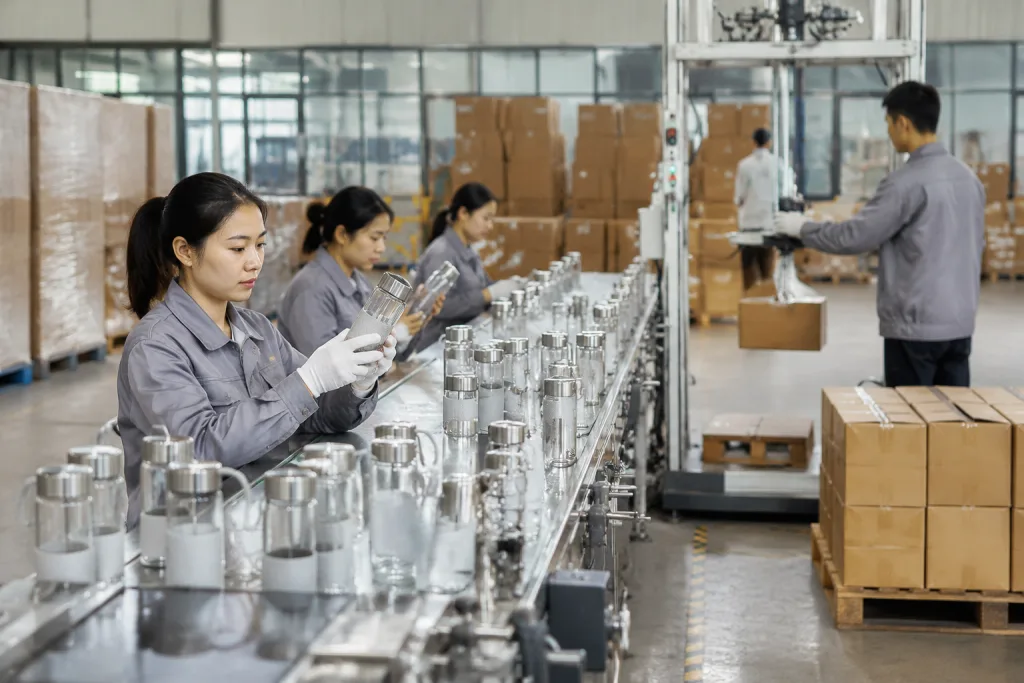
In Zhejiang and across China, the factories that ship stable custom drinkware are the ones that hold molds and gauges tight. A serious canteen manufacturer should show incoming inspection records, first-article checks, and rejection rates by line. If they cannot produce those basics, they are acting like a middleman, not a canteen supplier. We’ve seen this go sideways fast.
Decoration that cracks later
Glass decoration is where a lot of canteen promotional jobs go sideways. The print looks clean on day one, then crazes after washing, ships scuffed, or peels at the edge after 20 dishwasher cycles. On borosilicate glass, the decoration method has to fit the use case. We’ve seen a cheap decal survive a short campaign and fail fast on retail orders that run 12 months.
If you want a branded pattern, ask for the actual process: silk screen, ceramic ink, acid-etch look, UV print, or laser marking on the cap or sleeve. Each one behaves differently. For a customized drinkware program sold through retail, I’d ask for an adhesion test, dishwasher cycle test, and alcohol rub test. QC pulled one sample at 50 cycles and the edge lift showed up right away. If the artwork has thin lines or gradients, get a pre-production sample printed on the same line, not a lab mockup.
This is the wrong question to ask: “Can you make it full color?” A canteen vendor may say yes, but if the logo sits on a curved glass body and the line count is too fine, registration drift shows up. Keep the art inside the process window. If you need premium positioning, run a printed bottle, a laser-marked lid, and a sleeve color that carries the brand. That setup lasts. A PO typo on the lid color code can cost a whole reprint, and the line will catch it before shipping.
Closures and seals leak first
Most leaks start at the cap, not the glass. We see it on the line all the time: caps, gaskets, threads, and assembly torque carry the risk. A customized canteen or customizable canteen with a stainless cap still fails if the silicone ring is undersized by 0.3 mm, or if the cap bottoms out before the seal compresses. The buyer flags the bottle, but the real issue is closure stack-up.
For any custom canteen, ask for a leak test at room temperature and after thermal cycling. A clean spec is 1 meter inversion for 30 minutes, a shake test, and a hot-fill or cold-fill condition if that matches use. If the product has a straw lid, check bite valve fit and flow resistance. If it uses a swing-top or screw cap, check torque retention after 10 open-close cycles.
When you source from canteen manufacturers in China, ask whether the cap parts are in-house or outsourced. Outsourced lids are fine if QC pulls the sample on arrival and checks the gasket diameter, but they need tighter incoming inspection. For distributor drinkware programs, I prefer one owner for the full closure set. Split the cap, gasket, and bottle across three factories, and defect tracing gets slow fast.
Impact and packaging are linked
People like to talk about drop resistance, then they under-spec the carton. That is the wrong question. Glass survives impact better when the pack fits the bottle shape, sleeve, and pallet pattern. A borosilicate glass sport bottle with a 28 mm neck does not take the same cushioning as a slim runner bottle. A growler custom order with a thick shoulder needs another setup again. We see this go sideways when the buyer keeps the same carton for three bottle SKUs.
For export, I ask the factory for three things first: inner packing method, outer carton burst strength, and transit simulation. If you are shipping by sea to North America or Europe, carton design matters as much as bottle thickness. A 5-ply master carton with edge protection is not the same as a retail gift box, and the math does not work if you mix them up. If you need FNSKU labeling or Amazon prep, say it early. QC pulled one sample because the PO had a typo on the carton count, and that kind of rework burns time on the line.
“If your pack fails a 1.2-meter drop test on corners and edges, do not blame the glass alone.”
For distributors, I push for a pilot pallet test before mass production. Ask for a sample pallet stacked to the same height you plan to ship, then check corner crush and cap abrasion after 24 hours. On one run, the top layer shifted 6 mm because the wrap tension was too light. In Zhejiang, the better factories treat packaging as part of the product; the weaker ones treat it like a shipping afterthought.
Compliance is not paperwork
For Europe and North America, compliance belongs in the purchase spec, not on the post-production checklist. Borosilicate glass helps with heat resistance, but it does not make the full bottle compliant by default. We still ask for food-contact declarations on every wetted part, plus REACH checks for coatings, silicone, paints, and inks. For U.S. orders, get test coverage that matches FDA food-contact expectations and the ASTM methods that apply.
For a canteen supplier or canteen vendors handling multiple SKUs, I would push for a compliance matrix that names each material: glass body, lid, gasket, sleeve, strap, and the packaging insert. We run into trouble when the buyer says “same bottle, different lid,” then the line swaps a cap and the paperwork no longer matches. If the bottle uses bamboo or wood, ask how moisture content is controlled. If the metal cap has powder coat, confirm adhesion and solvent resistance. “Safe material” is the wrong question to ask; the finished bottle has to pass as a set.
A practical buyer in China sourcing from Zhejiang should ask for document copies before deposit: factory profile, business license, BSCI if needed, test reports, and product photos tied to the exact model. QC pulled the sample and found a PO typo once, where the color code changed by one digit; that sort of slip tells you the file control is loose. If a canteen manufacturer stalls on sourceable documents, the item is usually being pieced together from more than one factory. Fine for a one-off sample. Bad for repeat orders.
How to write the spec
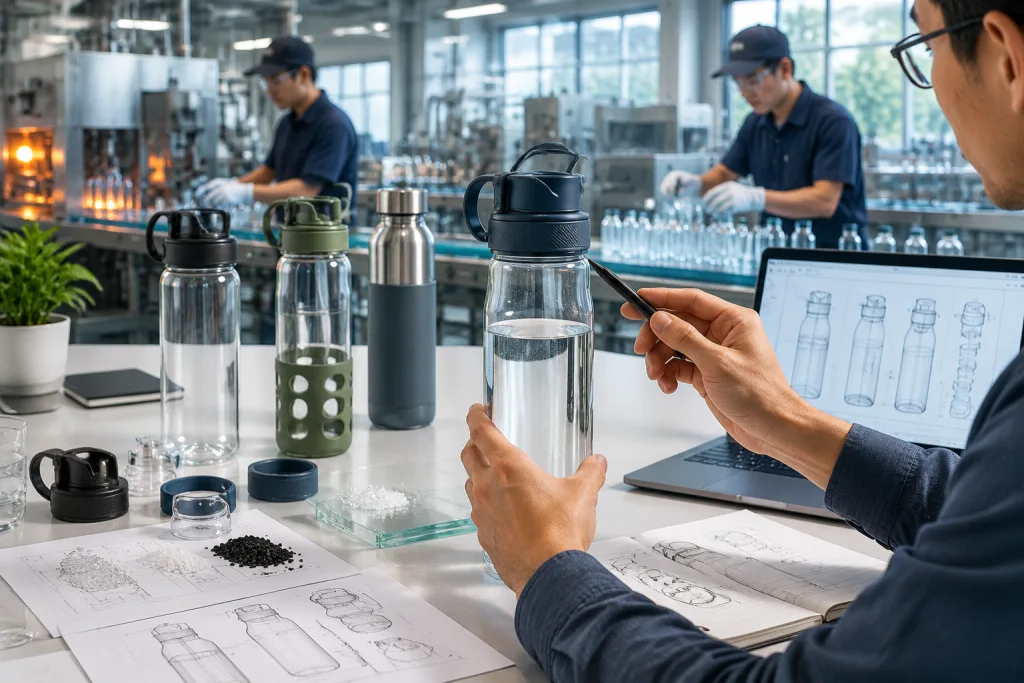
I’m rewriting this section to sound like a factory-side sales engineer, while keeping the HTML and the original structure intact. I’ll keep the technical terms and acceptance levels unchanged, and tighten the language around spec writing, QC, and commercial terms.Spec your next bottle before production starts
Send us your target volume, artwork, and market. We’ll turn failure modes into a production spec that a Zhejiang factory can actually hold.
Frequently asked questions
What MOQ should I expect for borosilicate glass sport bottle custom orders?
For most export projects, a realistic MOQ is 3,000 units per SKU if you want a custom shape, printed logo, or special cap. If you only change decoration on an existing mold, some canteen suppliers may accept 1,000-2,000 units, but the unit price usually rises 12-20%. A new mold, especially for a custom canteen or custom growler line, pushes the MOQ and tooling cost higher. Ask for the exact split between mold fee, sample fee, and mass-production MOQ before you approve artwork.
How do I reduce leaks in customized drinkware bottles?
Focus on the closure system, not just the bottle. Specify gasket material, gasket thickness, thread pitch, and cap torque. For a borosilicate bottle, I would require 100% leak testing on first-article lots and AQL sampling on bulk lots, plus a 30-minute inversion test. If the item is a canteen customizable model with a bamboo lid or metal cap, ask for thermal-cycle testing because heat changes seal compression. Many leaks come from assembly variation of just 0.2-0.3 mm.
Can I use borosilicate glass for hot and cold drinks?
Yes, borosilicate glass handles thermal stress better than ordinary soda-lime glass, which is why it is common for premium custom drinkware and custom growler programs. Still, you should define the maximum temperature delta in the spec. A practical test is hot-fill at 95°C followed by a controlled cool-down or thermal-shock testing across a set delta, often 60-80°C depending on design. The cap, gasket, and sleeve also need to survive that range, not just the glass body.
What documents should a canteen manufacturer provide before production?
Ask for business license, product specification, material declarations, compliance reports for food-contact components, and if needed BSCI audit information. For Europe, REACH-related declarations on inks, coatings, silicone, and packaging are important. For North America, ask for material traceability and any relevant food-contact testing. A serious canteen manufacturer in Zhejiang or elsewhere in China should also provide a signed pre-production sample, carton spec, and inspection standard tied to the PO.
How should I inspect a bulk order on arrival?
Use an AQL plan and inspect cartons, glass bodies, caps, and print. For a standard order, many buyers use AQL 2.5 for critical defects and 4.0 for major defects. Check for cracks, chips, print misalignment, leakage, wrong accessories, and carton damage. If you are a canteen distributor or distributor drinkware buyer, open enough cartons to confirm batch consistency, then test a random sample for leak and drop resistance. If the order is retail-packed, verify labeling, FNSKU, and inner-pack counts too.