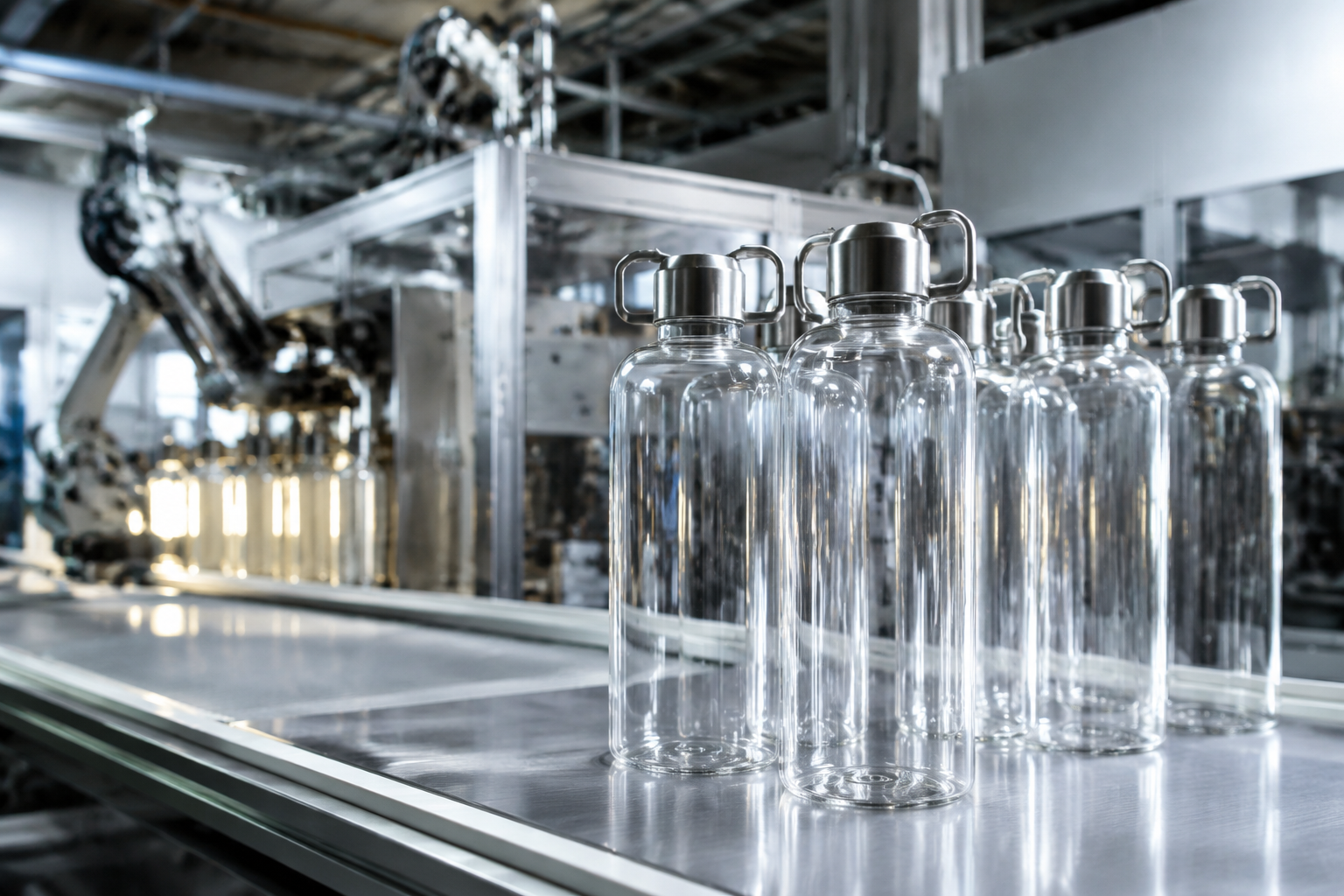
Key Takeaways
- Choose 2.0-3.2 mm borosilicate walls for a better balance of weight and break resistance.
- Expect MOQs of 1,000-3,000 units and lead times of 25-40 days from Zhejiang factories.
- Ask for REACH, LFGB, and drop-test data before you approve drinkware wholesale.
- Use the right closure and decoration for your channel; low-cost print often fails faster than the bottle.
If you are buying borosilicate glass reusable water bottle wholesale for retail, gifting, or private label, the first mistake is treating glass like a commodity. It is not. The real calls are wall thickness, closure system, decoration method, and whether the bottle can survive export handling, Amazon inbound, or a distributor warehouse with forklifts moving all day. Get those four wrong and you pay for breakage, rework, or stock that sits.
In Zhejiang and across China, the factories that do this well talk in specs, not slogans: 2.0 mm to 3.2 mm wall thickness, MOQ from 1,000 to 3,000 pieces per SKU, and lead times around 25 to 40 days depending on mold and print complexity. We’ve seen buyers fixate on the photo and miss the carton drop test; that’s the wrong question to ask. If you want wholesale drinkware that sells and ships cleanly, you need a sourcing framework, not a prettier product shot.
Start with the use case
Before you quote a price, lock the use case. A borosilicate glass reusable water bottle for retail is a different job from a bottle for hospitality, corporate gifts, or subscription boxes. On our line, a 500 ml clear bottle with a stainless lid and silicone sleeve usually covers the shelf buyer. For outdoor or fitness channels, we often add a heavier cap, a carry loop, or a sleeve with a deeper grip; the buyer flagged slippery hands on a 1,000-piece sample run, and the math changed fast.
The same split applies across beverage categories. A buyer sourcing bulk drinkware for water does not want the same build as someone ordering a bulk growler or beer growler wholesale. Those bottles need thicker glass, wider necks, and closure systems that can handle carbonation or a rough truck ride. If your program also covers bulk canteen, canteen wholesale, or drinkware bulk, keep each end use on its own SKU. We’ve seen this go sideways when one spec sheet tries to cover three jobs; QC pulled the sample, found a 2 mm neck mismatch, and the PO typo started the whole mess.
Decision point: set volume, closure, and channel first. A 450 ml retail bottle and a 1,000 ml wholesale canteen order should not share the same carton pack, print area, or breakage target.
Pick the right glass spec
Borosilicate glass is the right call for a reason: it handles thermal shock better than soda-lime glass and gives the bottle a cleaner premium story. For most wholesale drinkware programs, 2.0 mm to 3.0 mm wall thickness is the working range. At 2.0 mm, the bottle feels lighter and looks sharp, but it is less forgiving in transit. At 3.0 mm or above, you add weight and freight cost, yet you get better perceived durability and fewer returns.
Ask the factory for three numbers, not one. First, glass composition and whether it is true borosilicate. Second, wall thickness tolerance, ideally within ±0.2 mm for stable production. Third, thermal shock range, commonly tested around 120°C difference for borosilicate. We have seen buyers get burned by a PO typo that said “borrsilicate” and nobody caught it until QC pulled the sample; that is the wrong question to ask if the spec sheet is vague.
- Lightweight retail bottle: 2.0-2.2 mm wall, lower freight cost
- Balanced wholesale bottle: 2.5-2.8 mm wall, best all-round choice
- Premium heavy-feel bottle: 3.0-3.2 mm wall, stronger shelf presence
This matters across adjacent formats too. A wholesale growler or beer growler bulk order usually needs a stronger build than a standard hydration bottle; we run thicker bases on 1L growlers when the buyer flags pallet drop risk. The same logic applies if you are comparing a beer tumbler wholesale run to a beer tumbler bulk promotional order. Lighter is cheaper, but only if it still passes your buyer’s handling reality.
Compare closure and finish choices
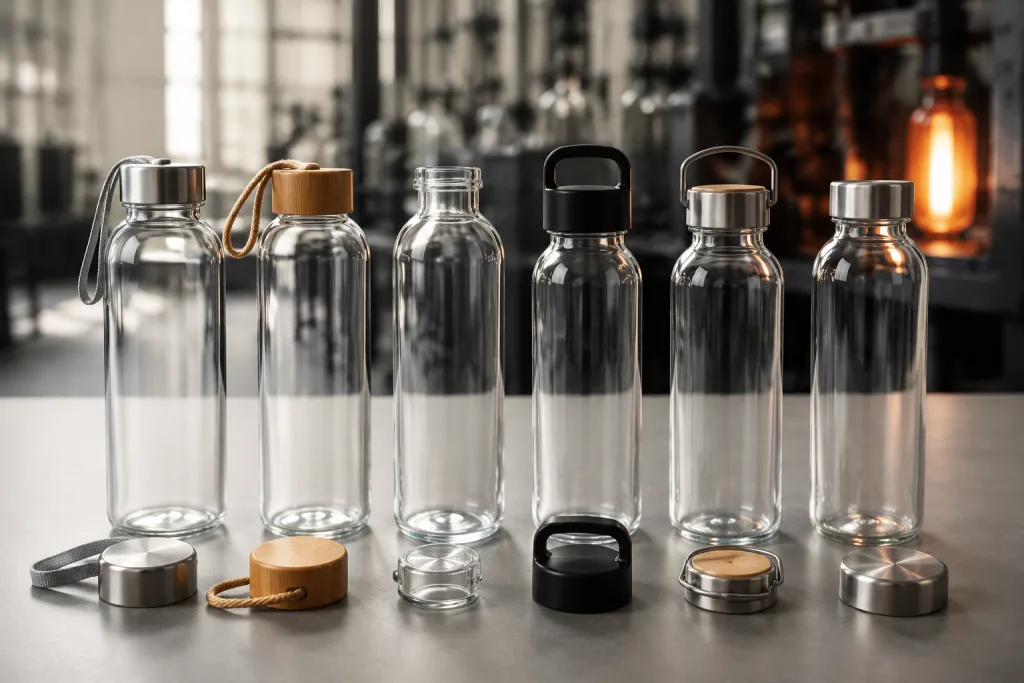
The bottle body gets the photos, but the cap decides whether the buyer keeps the order or sends a complaint. For borosilicate glass reusable bottle wholesale runs, we usually see stainless screw caps, bamboo-accent caps, plastic sport lids, and flip-top closures. Stainless fits premium retail and corporate gifts. Plastic sport lids are lighter and cheaper, but we check thread fit and seal performance on the line, because a 2 mm mismatch turns into a leak fast. If you are doing wholesale drinkware for supermarkets or online, a cap that closes the same way every time beats a fancy shape.
Finish changes the cost sheet too. A frosted body, screen print, laser logo, or decal each fails in a different place. Laser engraving on a lid stays clean. Screen print on glass can work, but QC pulled the sample for ink adhesion and wash resistance when the bottle is meant for repeat use. One buyer flagged a PO typo on the logo position, and that was a headache nobody needed. For buyers comparing custom branding routes, use the decoration that survives your channel, not the one that looks best in a render. If you need branded reference material, review silkscreen vs laser engraving.
In practice, leakage and decoration failures create more complaints than glass breakage. A cap spec is not optional.
For broader programs like canteen bulk, wholesale canteen, or even alcohol flask wholesale and alcohol flask wholesale bulk, the rule stays the same: the closure is part of the product, not an accessory. We ship that way, and the math works better.
Read the real factory numbers
When you source from Zhejiang or any other part of China, do not stop at catalog photos. Ask for the line speed, packing method, and whether the sleeve station sits before or after QC. A real factory gives you numbers. On a borosilicate line we run, monthly output for a straight bottle can land at 120,000 to 180,000 units, while a shaped bottle with logo spray often drops 15% to 25% because the line slows at decoration and final inspection.
For this category, the trade terms are usually clear. MOQ often starts at 1,000 pieces for stock molds and moves to 3,000 pieces for custom colors or special caps. FOB for a plain borosilicate bottle usually sits around USD 1.20 to 2.80, depending on size, cap, sleeve, and print; gift boxes push it up fast. We’ve seen buyers chase a rock-bottom quote, then the PO typo shows “inner carton” omitted and the math falls apart. Check what is missing: lid material, carton spec, or test report.
Use the factory call to separate real wholesale drinkware suppliers from trading claims. Ask for BSCI if you need social compliance, and ask whether the bottle can pass REACH for Europe or LFGB if your market needs food-contact proof. QC pulled the sample on one recent order because the cap torque was off by 0.3 N·m; that is the kind of detail a real plant tracks. If you are building a broader China sourcing program, see sourcing custom drinkware from China.
Check compliance before price
I’m rewriting the section in-place and keeping the HTML exactly as-is. I’ll make it sound like a factory sales engineer wrote it, with tighter compliance language and a few concrete sourcing details.For Europe and North America, compliance comes before the purchase order, not after. On a borosilicate glass reusable water bottle wholesale program, we ask buyers to confirm food-contact declarations, REACH material statements, and migration tests whenever the bottle has coatings, inks, silicone, or plastic lids. If the shipment is going to Germany or wider EU retail, LFGB is a normal ask. For U.S. programs, buyers still want lab reports tied to material safety and performance; on the line, we ship with that file set in hand, not as a cleanup job later.
Glass by itself does not clear the risk. The cap gasket, sleeve dye, coating, and print ink can be the part the buyer flags. If you are comparing drinkware wholesale options with different lid builds, ask for a full BOM in writing. We want glass, cap, gasket, sleeve, and packaging called out by spec and material grade, not by looks. If the supplier cannot send that, the audit trail is weak. That is the wrong question to ignore.
For repeat programs, lock the inspection standard before production starts. AQL 2.5 for major defects and AQL 4.0 for minor defects is a common setup, though the channel can push that tighter. If your order includes beer growler wholesale, beer growler wholesale bulk, or alcohol flask in bulk items, the same paper trail applies. QC pulled the sample, saw a 0.8 mm lid gap on one lot, and that kind of miss becomes a claim if you do not catch it at source. Glass breaks in transit; paperwork should stop the breakage from turning into a dispute.

Build a carton and shipping plan
Glass is won or lost in pack-out. We have seen a perfect inspection batch land broken because the carton spec was thin and the divider flexed on the line. For wholesale drinkware, push for an inner box or molded divider, especially once the bottle goes above 500 ml. Master cartons need drop and compression tests, not a promise on the quote sheet.
The clean way is to lock pack detail at RFQ stage. You need bottle quantity per inner box, inner boxes per master carton, carton gross weight, and carton dimensions. Those four numbers drive ocean freight, air freight, and warehouse handling. A 24-piece carton with weak dividers can cost more in claims than a 12-piece carton with proper protection. We’ve seen buyers flag this after the first damage report, and the math does not work in their favor. That matters for premium SKUs sold as a best wholesale drink bottle in retail or gifting channels.
- Inner protection: molded pulp, corrugated divider, or foam sleeve
- Outer protection: 5-ply or 7-ply master carton based on weight
- Labeling: UPC, FNSKU, country of origin, carton mark
- Packing test: 1.0 m to 1.2 m drop test before mass shipment
If you buy adjacent formats like growler bulk, growler wholesale, or beer tumbler wholesale bulk, the shipping plan needs more discipline because heavier glass breaks with less abuse. We run these packs with a tape-reinforced bottom and a 6 kg target carton weight before we greenlight the line. A China factory in Zhejiang that ships daily should give you the pack spec, the test result, and the carton label proof. If they only say “no problem,” that is the wrong question to ask.
Request a borosilicate quote this week
Send your target size, lid style, artwork, and annual volume. We will map the spec, MOQ, and lead time before you waste time on weak quotes.
Frequently asked questions
What MOQ should I expect for borosilicate glass reusable water bottle wholesale orders?
For standard molds, expect 1,000 to 3,000 pieces per SKU. A plain bottle with a stock lid may start at 1,000 units, while custom color lids, sleeves, or packaging often push MOQ to 3,000. If you want multiple SKUs in one run, some Zhejiang factories can mix them, but the minimum per color or cap style still applies. For seasonal retail, ask whether the factory can reserve 30 to 45 days of production time so you do not lose your launch window.
What is a realistic FOB price for wholesale drinkware in this category?
For a borosilicate glass reusable water bottle wholesale order, a realistic FOB range is often USD 1.20 to 2.80 per unit for standard sizes and basic decoration. A silicone sleeve, premium lid, frosted finish, or gift box can raise it above USD 3.00. Very low quotes usually omit something important: thicker carton, quality lid, proper testing, or labor for decoration. Always compare like for like, especially when the same supplier also quotes bulk drinkware or drinkware wholesale across multiple bottle styles.
How do I know the bottle is really borosilicate and not just regular glass?
Ask for material declaration, lab report, and thermal shock data. True borosilicate should have a stated composition and performance profile, not just a marketing claim. In practice, you want the supplier to confirm the glass type, wall thickness, and test method. A serious factory in Zhejiang or elsewhere in China should be able to provide the paperwork within 24 to 72 hours. If they cannot, treat the product as unverified until proven otherwise.
Can I use these bottles for beer growler or alcohol flask wholesale programs?
Sometimes, but only if the shape, closure, and target fill volume match the use case. A standard hydration bottle is not a growler. For beer growler bulk or beer growler wholesale bulk programs, you usually need thicker walls, a larger mouth, and a closure that manages pressure and transport. Alcohol flask bulk and alcohol flask wholesale items often use different ergonomics and finish requirements too. Do not force one bottle design into every category just because it is glass.
What tests should I request before approving mass production?
At minimum, request dimensional checks, leak testing, drop testing, and carton compression testing. For Europe-bound programs, ask for REACH-related material statements and, where relevant, LFGB or migration data for food-contact parts. For branded bottles with print or coating, include rub resistance and dishwasher durability if the end user will wash them repeatedly. A good AQL plan, such as 2.5 for major defects, helps keep the shipment consistent across a 10,000-unit or larger run.