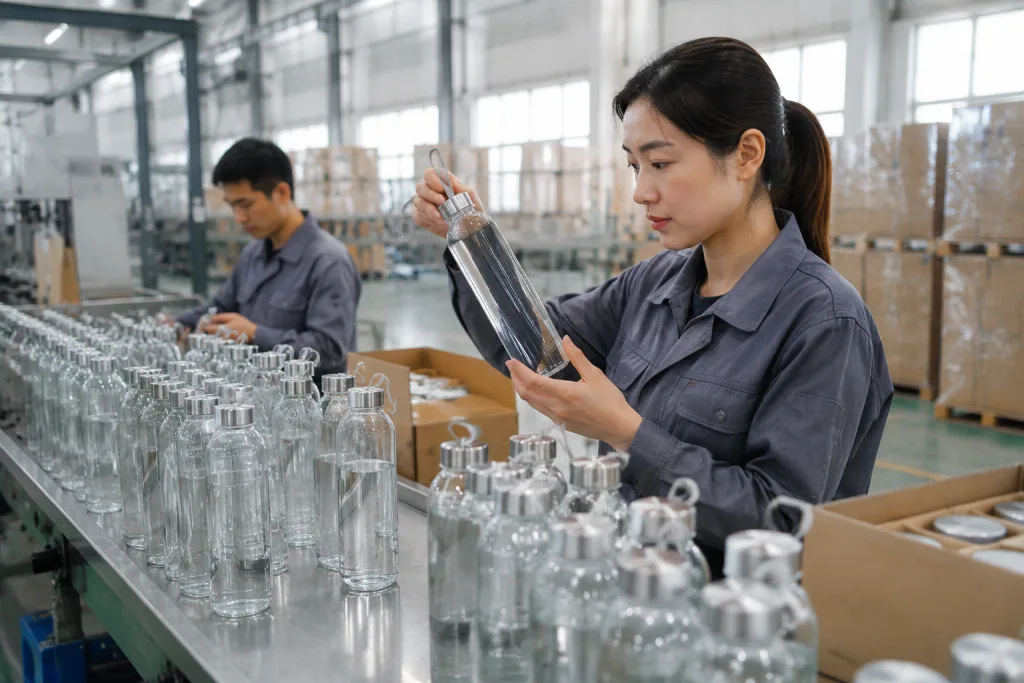
Key Takeaways
- Typical MOQ for a borosilicate glass reusable water bottle private label run starts at 1,000-3,000 units per SKU.
- A 2.5-3.0 mm wall and 480-650 g bottle weight usually balance strength and cost.
- FOB China pricing for a basic private-label bottle often lands at USD 2.10-4.80 per unit depending on cap, sleeve, and print.
- A qualified canteen manufacturer should support REACH, food-contact testing, and 30-45 day lead times after sample approval.
If you are sourcing a borosilicate glass reusable water bottle private label program, the first question is not “glass or not.” It is whether your market can live with breakage, what branding level you need, and whether the supplier can hold tolerances that keep lids, sleeves, and cartons running at scale. We see this on the line all the time: a 0.5 mm shift in bottle mouth or cap fit can turn a clean order into a mess. In Zhejiang and across China, plenty of factories can quote a low FOB price. Fewer can keep wall thickness consistent, pass REACH, and ship a clean private-label finish on time.
The better move is to treat this as a sourcing decision, not a catalog choice. Compare glass grade, closure system, decoration method, and package strength before you talk about logo placement. A real canteen factory will ask for your target retail price, channel, and carton test requirement first; that is the right order. We’ve seen buyers skip that step, then the buyer flagged it when sleeves rubbed ink or cartons failed a 1.2 m drop test. If you are a canteen distributor or brand owner, that order saves samples, lead time, and rework.
Start with the market job
Before you compare samples, lock the job your bottle has to do in your channel. A borosilicate glass reusable water bottle private label program can sit in premium retail, corporate gifting, wellness subscriptions, or distributor drinkware bundles. Each one changes the spec. We once had a buyer push for a simple cap on a gift order, and the line said fine because the box did the selling; the retail team later came back asking for drop protection, a tighter closure, and an outer carton that could survive e-commerce handling. Different job, different build.
Start with three checks: who uses it, where it ships, and how it is sold. If you ship through Amazon or DTC, carton compression and edge crush matter as much as the bottle. If the order goes through a canteen distributor network, repeatability beats one perfect sample, and QC pulled the sample against the same 500 ml spec on the line. For a custom drinkware program, decide if this bottle stands alone or sits inside a family with a custom growler or customizable canteen. That choice changes mold sharing, logo placement, and how much stock you are willing to carry.
Practical rule: if your retail price is under USD 18, keep decoration simple and skip over-built closures. If your target is USD 20-35, you can justify a premium sleeve, laser logo, and a better carton insert. I’d push back on buyers who start with artwork first; the math does not work if the channel and price band are still loose. In Zhejiang, the factories that get this usually ask about the route to market before they quote.
Choose the right glass spec
The glass spec decides whether your program feels premium or fragile. For a borosilicate glass reusable water bottle private label order, 2.5-3.0 mm wall thickness is the working range we run. Below 2.2 mm, breakage risk jumps and the claim rate follows. Above 3.2 mm, the bottle gets heavy fast, and freight costs do the same. A 500 ml bottle usually finishes at 480-650 g, depending on shape and base thickness.
Borosilicate earns its place because it handles thermal shock better than soda-lime glass. That matters when a buyer wants warm tea in the morning and chilled water after lunch. Still, glass is glass. Do not sell it as abuse-proof. If your market expects gym carry, add a sleeve, a thicker base, and a cap that does not loosen in transit. We had a buyer flag a 1.2 mm rim tolerance on a 500 ml sample, and QC pulled the sample back for a second measurement. Ask for the dimensional report, rim finish consistency, and a packed-unit drop test, not just a pretty bottle.
- Best for premium hydration, office use, and clean-label wellness brands
- Less suitable for outdoor abuse unless protected by silicone or neoprene
- Common sizes: 380 ml, 500 ml, 650 ml, 750 ml
- Ask for food-contact documentation and supplier QC sheets
If your line also includes a customized growler or customized drinkware set, keep the glass family dimensions aligned so cartons and master cases stay on one pallet pattern. A PO typo on carton height can add a full repack day, and that math does not work.
Lock the closure and seal
Most bottle complaints are not about the glass. They are about leaks, squeaks, weak gaskets, and caps that back off in transit. For private label, the closure system protects the brand. A simple stainless steel cap with a food-grade silicone gasket is often enough for premium hydration. If you want an insulated look or a more active-style profile, you can move to bamboo-style toppers or a loop cap, but each extra part adds assembly time and another failure point. On one line we had a buyer flag a cap that passed visual checks but failed after a 1.2 m drop, and that was with a 38 mm neck finish.
Ask your canteen supplier for torque data and gasket material details. Silicone should be food-grade, odor-free, and stable under normal washing. For hot-fill or tea use, check whether the cap and seal hold up under temperature swings without warping. We run sample tests at 30-50 open-close cycles; that sounds small, but it catches stripped threads and soft gaskets before you place an order. QC pulled the sample on a 28 g cap once and found the seal lip had deformed after the fourth wash.
“A bottle that looks premium but leaks in a tote bag is not premium. It is a return.”
For canteen customized programs, buyers often underweight the cap. That is the wrong question to ask. The cap is what your customer touches every day, and if it feels thin, the whole custom canteen feels thin even when the borosilicate body is clean and clear. The best canteen factory partners will quote two or three lid options so you can compare unit cost against durability instead of guessing, and we have seen PO typos on gasket specs turn into a full rework at the line.
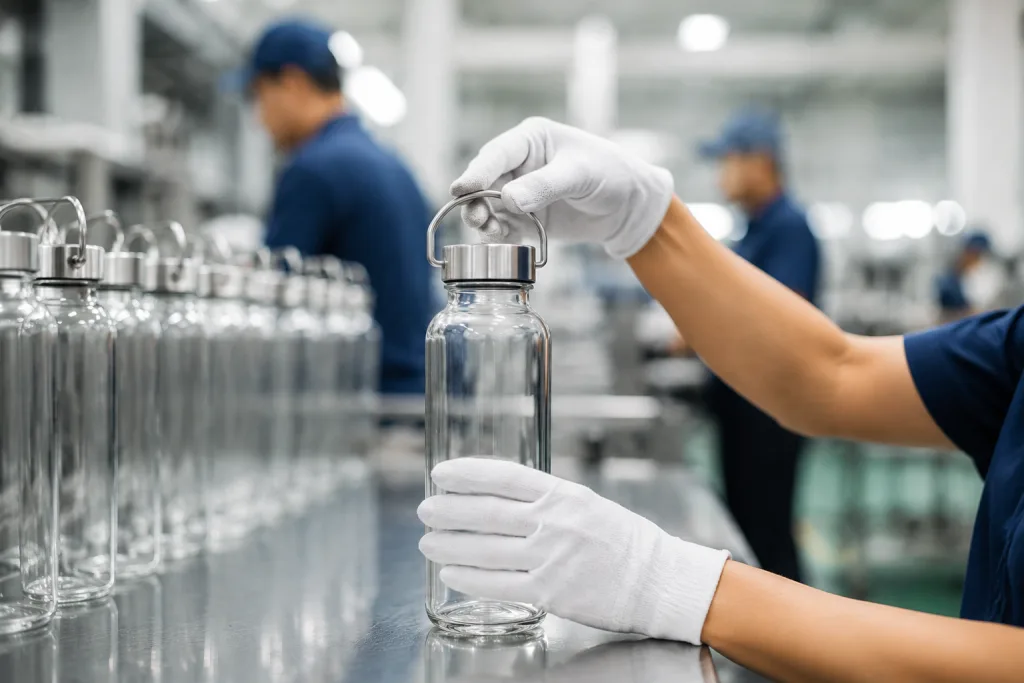
Branding should fit the material
Glass gives you a cleaner branding canvas than most plastics, but sloppy artwork shows up fast. For a borosilicate glass reusable water bottle private label run, pick the decoration method around target price and order quantity. Silkscreen is the workhorse for solid-color logos and usually gives the best unit cost once you are past 3,000 pcs. Laser engraving looks sharp on metal caps or sleeves, but on clear glass the buyer often says, “we can’t read it from 1 meter.” UV print carries more detail, yet scratch resistance needs a real test, not a sales promise.
If you are buying for a distributor canteen program, keep the artwork simple unless the end customer pays for premium branding. One-color print is enough for a 500 ml canteen promo run, and it keeps setup clean on the line. For a retail brand, a small logo and a clean neck label usually sell better than a crowded layout. We’ve seen the wrong question asked here: not “how much can we print,” but “what survives 20 washes and still looks on-brand.”
- Silkscreen: best for 1-2 spot colors and stable repeat orders
- Laser: best on metal parts, not always the first choice on clear glass
- UV print: more flexible, but test abrasion and dishwasher behavior
- Frosted or etched effects: premium look, but check MOQ and yield
In China, a canteen vendor worth using will show print tolerance samples, not just a mockup. We run this check with a line gauge and a 0.2 mm registration limit, because a small shift turns into a buyer flag at inspection. In Zhejiang, better plants keep decorated-sample libraries so you can compare line weight, color hold, and logo placement before mass production.
Price it with hidden costs
The quote you get for a borosilicate glass reusable water bottle private label order is only one slice of landed cost. We see buyers chase a low FOB China number, then lose the margin to breakage, oversized cartons, extra inserts, or customs hold time. On a 500 ml bottle run, the real stack is bottle, closure, decoration, inner protection, master carton, inspection, and freight. If the supplier cannot split those lines, the quote is not usable.
For a basic 500 ml bottle, FOB China often starts around USD 2.10-2.80 with plain packaging. Add a better cap, printed carton, sleeve, or custom insert, and USD 3.20-4.80 is the normal band. We had a buyer flag a PO typo once—carton size was written as 38 mm instead of 38 cm—and the freight math broke immediately. A Zhejiang factory may also quote tooling or decoration setup fees if you want a special carton or logo placement off the standard line. Those charges are normal; the only question is whether they are one-time or on every reorder.
Use these questions before you approve PO terms:
- What is the MOQ per color and per decoration?
- Is the quoted price based on EXW, FOB, or DDP?
- How many units are packed per carton, and what is the gross weight?
- What breakage allowance did the factory assume?
If you are comparing canteen suppliers, line up the same incoterm, the same packaging, and the same inspection standard. QC pulled the sample on one order at AQL 2.5 and found two cracked bottles in a 48-carton test, which changed the whole landed cost view. Compare like for like, or the numbers will lie to you.
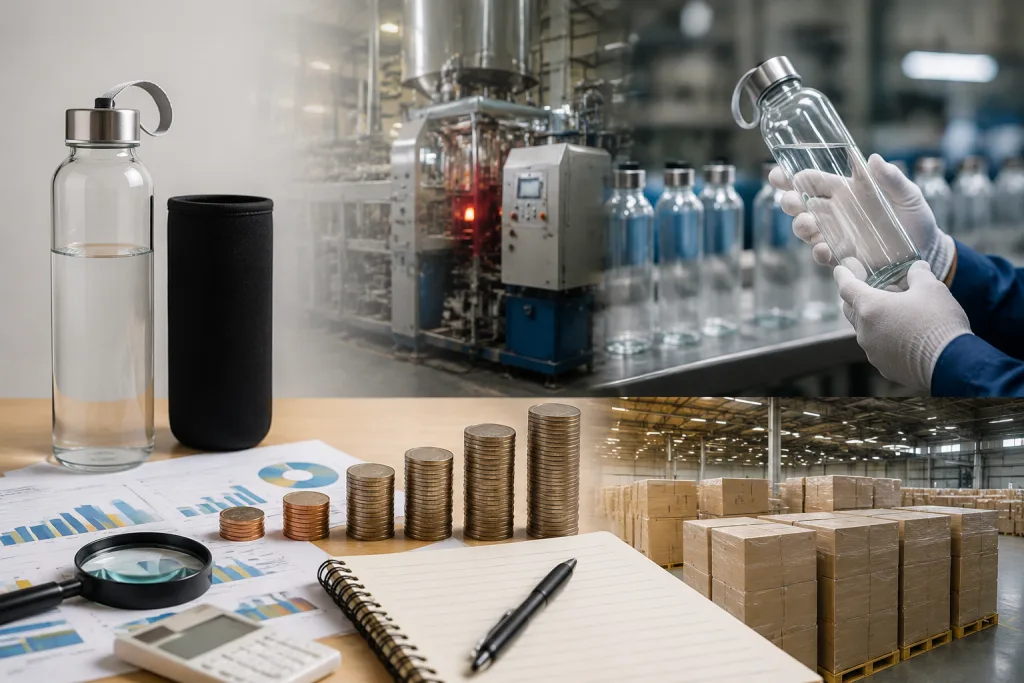
Verify factory capability and QC
A private-label borosilicate bottle is only as good as the plant behind it. Ask the factory how many lines it runs, not just whether it “can do it.” We usually want monthly capacity, sample lead time, and the size of the polishing and annealing setup. A solid China plant should spell out 100,000-300,000 units per month across glass drinkware lines, with samples in 7-10 days and production in 30-45 days after approval.
QC has to show up on the floor. Look for incoming raw-material checks, in-process checks on finish and wall thickness, and carton checks under AQL. We’ve seen this go sideways when a buyer only asked for “good quality” and skipped the defect map. A common commercial standard is AQL 2.5 for major defects and 4.0 for minor defects, but the right threshold depends on your channel. Retail chains usually want tighter control; distributors need a clear line between cosmetic flaws and rejects.
Ask for compliance proof too. REACH matters for Europe, and food-contact declarations matter for North America. Some buyers ask for ISO or BSCI during vendor approval, and that paperwork can save a week of back-and-forth on the first PO. A carton typo or a missing declaration will stall the file. The product is only half the job.
When you audit a glass bottle factory, check whether it can hold the same reorder spec three times in a row. One sample is easy. QC pulled the sample, the buyer flagged the print density, and the next run had to match the same glass clarity, logo opacity, and carton fit. That is the real test.
Build your private-label bottle the right way
Send your target price, market, and logo file. We’ll quote a borosilicate glass reusable water bottle private label program with clear MOQ, lead time, and QC terms.
Frequently asked questions
What MOQ should I expect for private label glass bottles?
For a borosilicate glass reusable water bottle private label run, the usual MOQ is 1,000-3,000 units per SKU. If you add multiple print colors, special caps, or custom cartons, the MOQ can move to 5,000 units. A good canteen supplier should tell you whether MOQ is tied to decoration, packaging, or glass shape. If you only need a sample run for market testing, ask for mixed color or mixed logo options, but expect a higher unit price. In China, especially Zhejiang, the most efficient factories often price better once you commit to a repeat order, not just a trial order.
Is borosilicate glass safe for hot and cold drinks?
Yes, borosilicate glass is built for better thermal shock resistance than ordinary glass, which is why it suits tea, chilled water, and daily hydration. That said, safe use still depends on design. A 2.5-3.0 mm wall, a reinforced base, and a quality silicone gasket reduce failure risk. Do not market it as indestructible. If your buyers want rough handling or outdoor use, add a sleeve or suggest a custom growler style with stronger protection. For Europe and North America, make sure your supplier can provide food-contact compliance and a clear usage guide.
What decoration method works best on glass?
For most custom drinkware programs, silkscreen is the best starting point because it balances cost, repeatability, and visual clarity. Laser engraving is better for metal lids or accessories than for transparent glass bodies. UV print can deliver more detail, but you need abrasion testing if the bottle will be washed often. If you are building a canteen promotional or distributor drinkware line, simple one-color branding usually gives the best margin. For premium retail, a clean logo with a frosted effect can look stronger than a full-wrap graphic, especially on borosilicate glass.
How long does production usually take in China?
A standard private-label order in China usually takes 30-45 days after sample approval and deposit, assuming the glass shape is standard and packaging is ready. Sample development is often 7-10 days. If you need new molds, special cartons, or complex printing, add 10-20 days. In Zhejiang, experienced canteen factories are often faster on repeat orders because they already have tooling, print references, and packing SOPs. If your launch date is fixed, ask the supplier to confirm raw-material availability, line schedule, and shipping booking before you approve the PO.
How do I reduce breakage in transit?
Start with the packaging, not the pallet. Use a fitted inner tray, keep bottle-to-bottle contact off, and specify a master carton that can pass drop testing. For e-commerce or distributor canteen programs, ask for 3-5 layer outer cartons and corner protection. A 500 ml bottle with a 2.5-3.0 mm wall usually travels better than a thinner build. You should also define your acceptable damage rate before production. Many B2B buyers target less than 0.5% breakage in packed goods, but that only works when the factory and freight forwarder both follow the same packing spec.