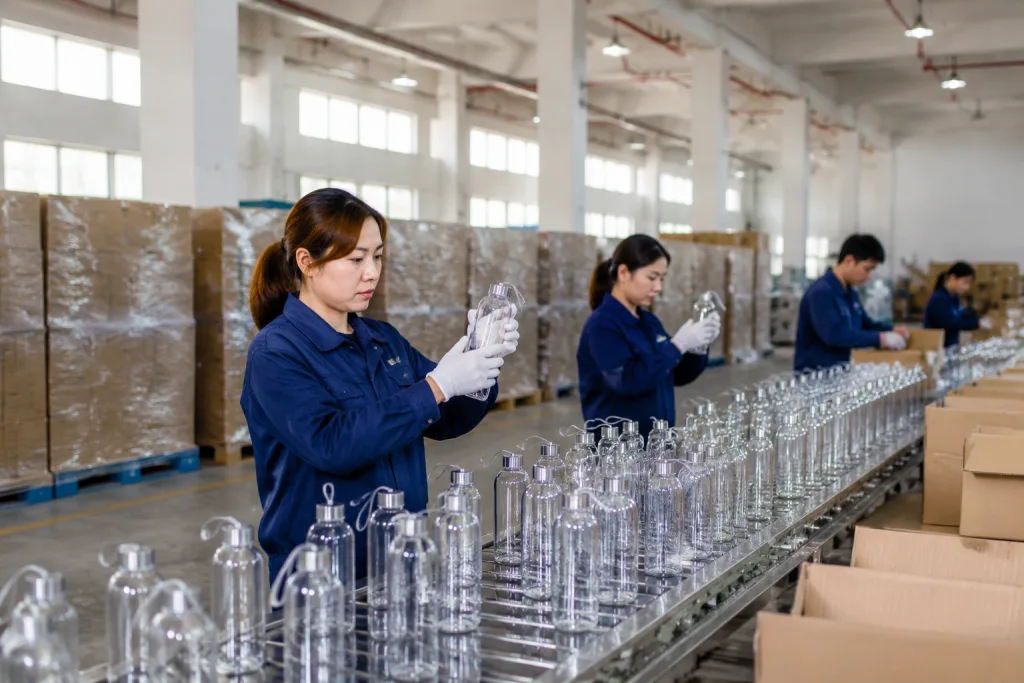
Key Takeaways
- A serious borosilicate glass reusable water bottle factory should quote 2.0 mm wall thickness, not vague “thick glass” claims.
- Typical MOQ starts around 3,000–5,000 units per SKU, with 35–45 days lead time after sample approval.
- For Europe and North America, ask for REACH, LFGB where relevant, and AQL 2.5 inspection terms in writing.
- Custom packaging, silicone sleeves, and logo methods change cost fast; expect FOB China pricing to move by 8–20%.
If you buy drinkware at scale, borosilicate glass looks simple until the first sample run. One line quotes a 2.0 mm wall, another sends 1.5 mm, and both still call it “heat resistant.” That is where margin starts to leak. A real borosilicate glass reusable water bottle factory gives you measured specs, not showroom talk.
For Europe and North America, the bottle is only half the job. You need REACH-ready materials, stable MOQ, repeatable glass thickness, and carton packs that survive FOB movement out of Zhejiang. We have seen a 500-unit PO get held up because the buyer flagged a neck finish typo, so this is the right question to ask before you place the order.
What buyers should ask first
Start with the questions that tell you whether the supplier runs a factory or just brokers orders. Ask where the borosilicate tube or formed bottle is made, how many pieces the line ships per day, and whether the neck finish and wall thickness stay within spec on repeat orders. A real borosilicate glass reusable water bottle factory answers with numbers, not promises. At BottleForge Industrial in Zhejiang, one line is built around monthly output in the hundreds of thousands of units, with MOQ often set at 3,000 pieces per design and sample lead time at 7 to 10 days. QC pulled the sample on a 2.0 mm body and checked the rim gauge twice. That is the level buyers should ask for.
Then move straight to compliance and pack-out. For Europe, ask for REACH declarations and migration test support; for North America, ask which third-party lab reports they can provide. If they say “food grade” but cannot name the test standard, stop there. That is the wrong question to dodge. You are buying a controlled custom drinkware program, and the carton drop test, label copy, and import file all need to hold up when the buyer flags it.
- Ask for exact wall thickness: 1.8 mm, 2.0 mm, or 2.2 mm.
- Ask for daily output and monthly capacity.
- Ask for MOQ per color, logo, and package.
- Ask for test reports before you discuss price.
Borosilicate specs that matter
With glass bottles, the spec sheet beats the hero photo. Borosilicate holds up better under thermal shock than soda-lime glass, but that edge disappears fast when the line runs loose. Ask for the glass composition range, annealing curve, and target wall thickness. For a reusable water bottle, 1.8 mm to 2.2 mm is the normal band; thinner than that needs a clear reason, and thicker changes weight, freight, and breakage behavior. We ran one sample at 2.0 mm and QC pulled the sample after a 90 cm drop test showed a side-wall chip. On premium orders, an extra 50 to 90 grams moves the freight math.
You also need to define the closure and accessory stack. A canteen custom project with a bamboo cap, stainless lid, or silicone sleeve is not just a look choice; it changes leak testing, drop performance, and unit cost. A customizable canteen can look identical in renderings while hiding three different parts inside. Ask the canteen manufacturer to split bottle cost, lid cost, sleeve cost, and print cost. The buyer flagged a PO typo once—“bambbo” on the cap line—and that tiny error changed the packing list. We’ve seen this go sideways when suppliers blur the quote. Separate the numbers, or the comparison is useless.
Use these numbers in your RFQ
State neck finish, capacity, total height, glass thickness, and tolerance. A 500 ml bottle should stay within ±10 ml in filled volume if you want consistent shelf presentation. Give the supplier the AQL target too; we usually see AQL 2.5 on finished glass lots. If the supplier cannot confirm tolerances, you are probably looking at a canteen factory that sells on appearance and hopes the process holds. Ask for the caliper reading from the line; 1.9 mm and 2.1 mm are not the same once cartons hit a 12-day sea leg.
How to judge a factory fast
You do not need a factory tour to spot a weak line, but you do need to ask like a process engineer. Request photos or video of forming, annealing, inspection, and packing. A proper canteen factory should show line checks for scratches, bubbles, rim chips, and lid torque. Ask for the AQL sheet, not a promise. For export drinkware, AQL 2.5 on major defects is a workable starting point, with tighter limits if your retail channel is unforgiving.
Then ask how the factory handles customization. A canteen customizable program with one logo color is easy; a canteen customized with embossing, sleeve color matching, and gift box printing is a different job. Same with custom growler and customizable growler requests. If the supplier treats all of these as one operation, expect delay on the line. Good canteen manufacturers split tooling, decoration, and packing into separate steps. Bad ones collapse everything into “we can do it.” We’ve seen that go sideways more than once.
Practical rule: if the supplier cannot tell you the reject rate for rim cracks, print misalignment, and lid leakage, they are not ready for serious distributor drinkware programs.
For distributor canteen or distributor growler business, repeatability matters more than one perfect sample. Ask for evidence of past refill orders, carton drop test results, and whether the factory can reserve 3,000 to 5,000 pcs of capacity for seasonal reorders. In Zhejiang and across China, the better plants plan around batch stability, not just first-order excitement. QC pulled the sample, then checked the rim with a 0.2 mm feeler gauge; that is the kind of detail that tells you the factory can ship at scale.

Pricing without the noise
Price quotes for borosilicate glass look tidy until you split the line items. A plain 500 ml bottle may sit at one number, then a silicone sleeve adds cost, a custom logo adds cost, and a printed box adds cost. If you are comparing canteen custom offers, ask for an itemized FOB quote from China. On our line, a 500 ml bottle can move from a plain spec to a full custom pack by 15% to 30%, and the buyer flagged the gap only after the logo screen was signed off.
Watch the “cheap” quote from canteen distributors or canteen suppliers that skips testing, carton strength, or pallet layout. Glass freight damage gets expensive fast. A carton that saves 0.08 USD can burn you if breakage rises by 1% to 2%; we’ve seen that go sideways on a 10,000-piece order. If you sell through retail or FBA, box size also changes storage fees and carton loading. Ask for master carton size, inner pack count, and pallet load before you approve the final proof; QC pulled the sample, and the 5 mm carton wall showed up on the gauge.
- Plain bottle price
- Lid and accessory price
- Logo/decor price
- Retail box or shipper box price
- Testing and documentation cost
A canteen promotional order is priced one way; a brand launch order is priced another. The first can run simpler print and bulk packaging. The second needs cleaner box graphics and tighter QC. Say that on the first email, or the factory will quote the cheapest reading of the spec. We run into PO typos on pack count all the time, and that one digit can throw the whole quote.
Checklist for samples and approvals
Sample approval is where a lot of B2B programs go off track. We see it on the line all the time. Use a short, written checklist before you sign off. Ask for one pre-production sample that matches the final glass, final lid, final print method, and final packaging. Do not approve a hand-finished sample if mass production will run on a different machine. That is the wrong question to ask, and it turns into a fight later when a canteen vendor calls the gap “normal factory variation.”
Check the sample the way the buyer will use it, not on a desk. Fill it with hot water and cold water. Watch for stress marks, fogging, and condensation around the body and closure. Invert it for 24 hours for the leak test. Pull the sleeve on and off a few times; if it walks out of position after 10 cycles, the fit is off. For customized drinkware going to a retail chain, add a photo sign-off for artwork and carton marks. For a custom growler or customized growler in beverage channels, we run a closure torque check and a shipping vibration test before release.
Keep the approval note short and exact: approved color, approved print location, approved carton spec, approved drop test standard, approved AQL. QC pulled the sample, checked the label code, and wrote it into the file. That note becomes the control point when the order starts. Without it, every small difference turns into a new round of back-and-forth.
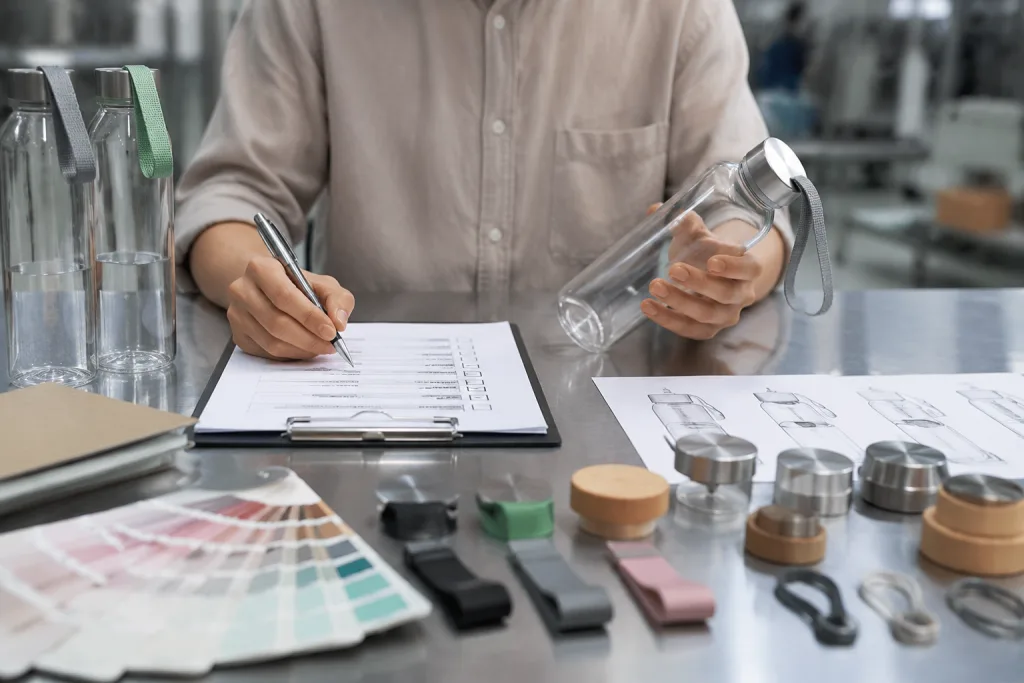
When to choose glass over metal
Borosilicate glass is not the answer for every buyer, but it is the right call when clarity, taste neutrality, and premium shelf appeal matter. If your customer wants a reusable bottle that does not hold yesterday’s coffee smell, glass wins. We run this comparison on the line all the time: office programs, wellness sets, tea kits, and gifting SKUs usually sell better in borosilicate than in metal. The trade-off is fragility, so you need carton tests, clear handling notes, and a buyer who accepts that reality.
For distributors, the decision usually comes down to channel. A canteen distributor selling into hospitality may care more about the clean look and easy logo placement, while a sports retail program may lean toward lighter bottles. A glass line still works for lifestyle packs and hydration kits. If you need a canteen promotional item, glass looks more premium than a 304 stainless option or a low-cost plastic one, but the math does not work unless you budget for transit protection. We had one buyer flag a PO typo on the carton spec, and that 1 mm gap in the insert was enough to cause breakage in transit. China has factories that make both the bottle and the pack; the real question is whether they understand the use case, not just the print.
Ask your canteen manufacturer where they would place the product: office desk, home use, gifting, tea infuser, or specialty beverage. If they answer fast and with specifics, they know the market. If they just say “good quality,” they do not.
Request a factory quote with exact specs
Send your capacity, logo, packaging, and compliance needs. We’ll quote the right borosilicate glass reusable water bottle factory program, not a guessed price.
Frequently asked questions
What MOQ should I expect from a borosilicate glass reusable water bottle factory?
For a standard export-ready SKU, expect about 3,000 to 5,000 pieces per design. If you add custom color sleeves, printed boxes, or multiple logo placements, MOQ can move to 5,000 to 10,000 pieces. Small test runs below 1,000 pieces are possible, but unit pricing usually rises 20% to 40%. A serious factory in Zhejiang or elsewhere in China should state MOQ clearly by component, not hide it inside one blended quote.
How long does production usually take?
After sample approval and deposit, common lead time is 35 to 45 days for a normal borosilicate bottle order. If your order includes special packaging, new tooling, or busy-season scheduling, plan for 50 to 60 days. Sample making usually takes 7 to 10 days, and artwork confirmation can add another 3 to 5 days if you are slow on approvals. Good planning matters more than squeezing the last cent from the quote.
What certifications should I ask for?
At minimum, ask for food-contact test support and REACH-related documentation for Europe. If you sell into the U.S. or Canada, ask what third-party reports the factory can provide for materials and coatings. For some programs, LFGB is also useful for buyer confidence. If the bottle includes a silicone sleeve, bamboo part, or printed logo, each material may need separate compliance review. A factory that works with export drinkware should handle this without confusion.
Can I order a customized canteen with my brand colors?
Yes, but confirm where the color lives: sleeve, lid, box, or print ink. A customizable canteen often means the base glass stays the same while accessories and packaging change. Brand-color sleeves, spot-color logos, and printed cartons are the easiest path. Full-body glass tinting or special coating may require higher MOQ and extra lead time. Ask for a Pantone reference and a physical color swatch before final approval.
How do I reduce breakage in shipping?
Use inner protection, drop-tested cartons, and clear pallet stacking limits. For glass drinkware, good packaging can cut transit damage by 1% to 3% or more versus weak pack-out. Ask for carton compression data, five-layer or seven-layer master cartons as needed, and corner protection if the shipment is long-haul ocean freight. If you are shipping to FBA or a distributor warehouse, make sure the outer carton size and labeling fit the receiving rules before production starts.