Key Takeaways
- A borosilicate glass reusable water bottle custom project should start with 6 hard specs: volume, wall thickness, lid type, print method, carton size, and test standard.
- For most B2B orders, MOQ starts around 3,000 pcs and lead time is usually 35 to 45 days after sample sign-off.
- Use one RFQ, one pre-production sample, and one PO with line items for bottle, lid, logo, insert, and master carton.
- Ask for REACH, LFGB if needed, drop test data, and AQL 2.5/4.0 inspection terms before you approve bulk.
If you are buying a borosilicate glass reusable water bottle custom, the real risk is not the glass itself. The gap is between what you wrote in the RFQ and what lands on the first bulk shipment. Borosilicate looks straightforward, but buyers still get tripped up on wall thickness, lid fit, print wear, drop test results, and pack-out details that only show up when you move from sample to PO.
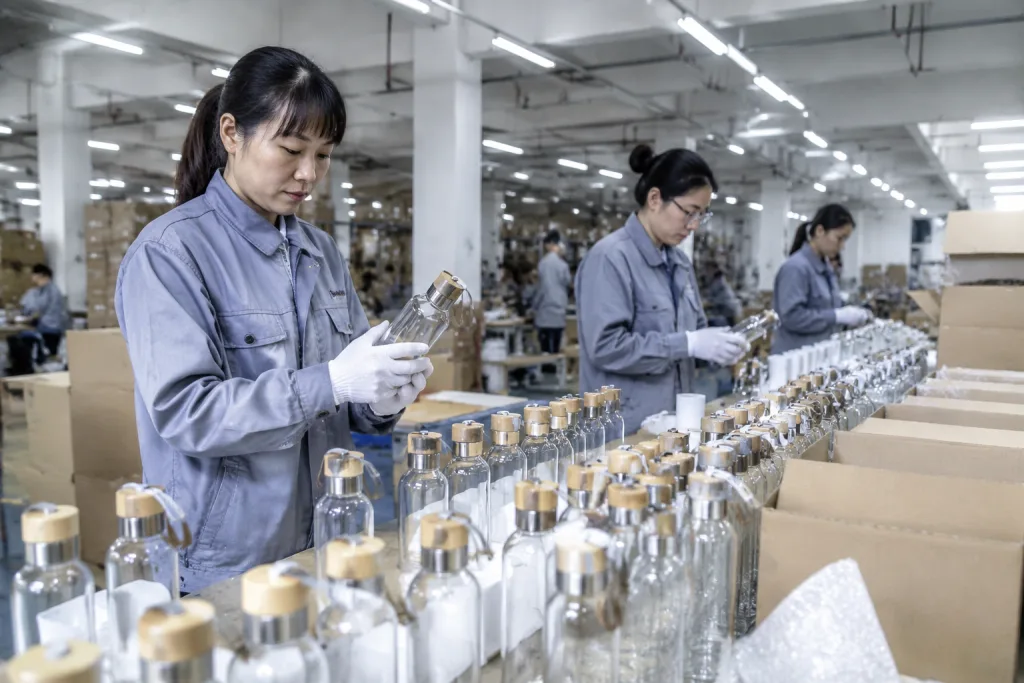
For a clean result, treat the project like an industrial sourcing job, not a branding exercise. In Zhejiang and across China, a serious canteen factory will quote faster when you give exact bottle volume, neck finish, decoration method, carton spec, and test standard. That is how you keep custom drinkware under control, whether you need a custom canteen, a custom growler, or a reusable glass bottle for retail, promotion, or distributor programs. Our Hangzhou team runs 120,000 units per month, with 3,000 pcs MOQ on standard glass lines and 35 to 45 days for bulk after sample approval.
Start With the Bottle Spec
Before you ask for a price, lock the bottle spec like a production engineer. A borosilicate glass reusable water bottle custom order needs volume, height, diameter, mouth opening, and wall thickness. For retail buyers, 350 ml, 500 ml, and 750 ml are the usual SKUs. On borosilicate, 1.5 mm to 2.2 mm wall thickness is standard for hand-held bottles; if you want fewer breakages in distributor drinkware programs, don’t shave glass just to save 0.10 USD. We’ve seen that math fail on the line.
Spell out the lid too. A bamboo cap with a stainless steel liner acts differently from an all-PP closure, and a silicone seal changes leak performance. If you are buying for a custom canteen or customized drinkware line, state whether the bottle is for cold fill only, warm drinks up to 100°C, or dishwasher use. A canteen manufacturer in China will usually ask for a 2D drawing or a reference sample; send it. QC pulled a sample at 1.8 mm and the buyer flagged a loose cap, so we cut the revision loop from three rounds to one.
- RFQ line items: bottle volume, glass thickness, lid material, logo position, packaging method
- Typical target: 500 ml, 1.8 mm wall, 28 mm neck finish, leakproof lid
- Ask for: BS/ASTM-style drop data, REACH declarations, carton dimension sheet
Do not overcomplicate the first quote. A clear spec sheet lets a canteen supplier or canteen vendor compare the same thing against the same thing and gives you a real FOB China price, not a loose estimate that shifts after the first sample. We had one PO where “500ML” turned into “500 ml” on the revised file; small typo, big delay.
Write the RFQ Like a Buyer
Your RFQ needs to read like a buying document, not a brand pitch. Put the quantity by SKU, destination port, Incoterm, target price, logo method, and packing spec in the first pass. If you want a borosilicate glass reusable water bottle custom order for Europe, state REACH and food-contact requirements right away. For North America, ask whether the bottle and lid system can pass retailer compliance checks and carton drop tests. We’ve seen buyers miss that point, then the line has to stop and re-quote.
List every component as a separate line item. Bottle body, lid assembly, silicone gasket, sleeve if any, individual box, master carton, barcode label. That split matters because a canteen distributor or distributor growler buyer may need three pack setups: single-pack for e-commerce, 6-pack for warehouse clubs, bulk inner cartons for wholesale. If you leave it open, the factory will default to its standard pack, and that is usually the wrong one. QC pulled a sample last week and found the carton spec typo before shipment; the buyer had written 12 pcs/ctn, then corrected it to 24.
Be direct on decoration. Screen print, laser engraving, and decals carry different pricing, and the gap is not small. A canteen customizable project with one-color silk screen may land at 0.18 to 0.35 USD per unit on larger runs, while multi-color art or full-wrap graphics goes higher. If you are checking custom drinkware vendors in China, ask them to break out tooling, decoration, and packaging in the quote. The math does not work any other way. We run quotes on a 1,000 pcs MOQ all the time, and the cleanest comparison is always line-by-line.
Good RFQ behavior saves days, not hours. In Zhejiang, the factories that reply fastest are the ones that can quote from a drawing and a packing spec without chasing ten follow-up questions.
Lock the Sample Before Bulk
Once you have a price, move to samples fast. For a borosilicate glass reusable water bottle custom program, the sample stage is where 80% of avoidable problems show up: lid torque too loose, logo color off by one shade, bottle base unstable, or carton too thin for export. Ask for at least two physical samples if the project includes both retail and promotional packaging. One stays as the approval sample. The other goes into shipping tests.
Define what approval means. A sample is not approved because it looks good on a desk. It is approved when it passes your checklist: fill line accuracy, leak test after 24 hours, print rub test, and packaging fit. If you need a canteen customized for a distributor canteen program, ask the supplier to mark the sample with date, batch number, and the revision code; we’ve seen a PO typo send the wrong revision into production, and that gets expensive fast. Nobody wants a later argument over which version got signed off.
For glass, ask for breakage-related tests even at the sample stage. A practical spec is a 1.0 m to 1.2 m drop on padded or simulated retail handling surfaces, plus thermal resistance confirmation if the bottle will see hot fill. Borosilicate handles heat shock better than soda-lime, but the closure and seal still decide whether the product works. QC pulled the sample on a cracked neck at 1.1 m once, so this is the right question to ask. A canteen factory that knows this will not overpromise. Good sign.
- Sample checks: leak, torque, print adhesion, base flatness, visual clarity, carton fit
- Sample control: revision number, approval date, signer name, reference photos
- Buyer tip: keep one sealed golden sample for future disputes

Turn the Sample Into a PO
Your purchase order should match the approved sample line for line. If you want fewer disputes, list the commercial details the line will run on: product name, SKU code, quantity, unit price, MOQ exception if any, lead time, packing method, carton drop requirement, and the sample reference number. We see buyers lose a week here. They approve one version by WeChat, then send a PO that drops the gasket spec or shifts the carton count, and the factory has room to reinterpret the job.
For custom canteen and customized drinkware orders, split the PO into line items. That keeps pricing clear and helps your receiving team match goods later. A buyer once flagged a PO typo on the lid color code, and QC pulled the sample to confirm it before the line packed 3,000 pcs.
- Bottle body: borosilicate glass, 500 ml, 1.8 mm wall
- Lid assembly: bamboo top with PP liner, silicone gasket
- Decoration: 1-color silk screen, one side
- Packaging: individual box, 24 pcs master carton, barcode label
Use the PO to lock your quality terms as well. Put AQL 2.5 for major defects and 4.0 for minor defects if that matches your buying standard. State whether pre-shipment inspection is done by your team, a third party, or the canteen supplier’s QC records. A good canteen vendor will already have in-process checks for glass thickness, logo placement, and carton compression. We run a caliper on wall thickness at 1.8 mm, and if the buyer pushes for “close enough,” that is the wrong question to ask. In Zhejiang, stronger exporters will also share production photos before packing, which saves a week of back-and-forth.
If you are a distributor growler buyer or moving into custom growler projects later, keep the same PO discipline. The format should work across your whole customizable drinkware range, not just one SKU. We have seen this go sideways when a team changes only the artwork code and forgets the carton spec.
Control Quality in Bulk
Bulk production is where the contract gets tested. Glass is not hard; consistency is. Ask for the first article off the line before full packing starts. Check diameter, finish, print registration, and lid fit. If you are sourcing from a canteen manufacturer in China, ask for photo proof of the first 50 pcs and the first carton build. That is standard control, not overkill. We have seen a 0.8 mm neck shift turn into a lid leak on the last pallet.
For batch quality, run a practical inspection package: incoming glass check, in-line visual inspection, final AQL sampling, and carton drop review. A clean bulk order for a borosilicate glass reusable water bottle custom project should stay within 1-2% visible cosmetic variance if the tooling is stable. QC pulled the sample, and the logo sat 3 mm off center; the buyer flagged it right away. Hand-made or semi-hand-made glass will move a bit, but logo placement and seal fit should not drift. For canteen promotional runs, cosmetic tolerance can be looser; for retail, keep it tight.
Ask the factory for packing photos with carton count, outer carton marks, and pallet layout. Buyers often fixate on the bottle and forget the shipping box. Then the freight team finds crushed corners, weak tape, or a missing FNSKU label on an Amazon-bound order. A reliable canteen supplier knows packaging is part of the product. We ship a lot out of Zhejiang, and the exporters that do Europe and North America all check this on every shipment. The math does not work any other way.
Quality control is cheaper before the container closes. After that, every mistake becomes a freight problem, a claim, or a discount request.
Price the Total Landed Cost
Do not buy on unit price alone. For custom drinkware, especially glass, the landed cost can jump once you add cartons, freight, insurance, duties, and inland delivery. A borosilicate glass reusable water bottle custom project that looks attractive at 1.35 USD FOB can land much higher after a 2-ply export carton and sea freight. That is normal. Compare landed cost per sellable unit, not factory price per bottle.
Ask your canteen factory to split the quote into bottle, lid, print, packaging, and extras like silica gel or hangtag. We run this on the line every week, and the buyer flags the same issue: one missing line item can blow up the margin. If you work with canteen suppliers or canteen distributors across multiple channels, request separate pricing for standard wholesale, customized canteen retail packs, and canteen promotional sets. One SKU often needs three price tiers. The same logic applies to a custom growler or customized growler program if you later expand the line.
Use planning numbers that hold up. Standard MOQ on many glass lines is 3,000 to 5,000 pcs per color or print version. Add two colors and your effective MOQ doubles fast. Lead time is usually 35 to 45 days after sample approval, plus ocean transit. QC pulled the sample last Friday and found a 1.2 mm print shift; that kind of miss costs a week. China sourcing works best when you lock specs early and stop late design changes. Zhejiang factories can move fast, but the approval path has to stay clean.
Choose the Right Supplier Type
Not every supplier works the same way, and your buyer job changes depending on whether you are dealing with a bottle factory, a bottle supplier, or a bottle vendor acting as a trading layer. Factories are the better fit when you need mold control, stable repeat orders, and QC you can trace back to one line. Suppliers and vendors help when you want mixed SKUs, smaller pilot runs, or one shipment with 3 to 5 customizable drinkware items.
If you are sourcing a borosilicate glass reusable water bottle custom program for retail or a distributor rollout, ask who owns the mold, who does the printing, and where final packing happens. We run this check on every RFQ because one PO typo on carton marks can turn into a 12-day delay. In Zhejiang, that detail matters. It changes lead time and traceability. A factory may give better unit math but less room on tiny runs. A vendor may ship faster on mixed orders and still add margin. The wrong question is “which one is best?” The real question is which one fits your channel.
Ask direct questions: Can you provide BSCI? Can you support REACH documentation? What is your monthly output in pcs? What is your sample turnaround, 5 days or 10 days? If the answer is vague, keep looking. QC pulled the sample on a 26 mm neck finish once and found the quote had no tolerance called out, so the buyer flagged it and walked. A serious export partner answers with numbers, not adjectives.
Use the RFQ-Sample-PO Rhythm
The cleanest buying process is simple: RFQ, sample, PO, bulk. No side quests. On RFQ day, send the spec sheet, artwork, and the documents the buyer actually asked for. On sample day, check the wall thickness, cap fit, and leak test before you say yes. On PO day, copy the approved sample line by line. On bulk day, pull the first cartons, check the shipping marks, and hold release until QC signs off. We run this sequence on borosilicate glass reusable water bottle custom orders all the time, and it keeps a custom canteen, customizable canteen, or canteen promotional job from drifting off spec.
This rhythm works for distributor drinkware accounts that need the same bottle in Q1 and Q3. The first order tells you what the factory can hold at 500 pcs MOQ. The second order tells you whether the line can repeat it. The third order tells you if you have a real supplier or a middleman with a glossy deck. That is the wrong question to ask late; ask it before you wire the deposit. In Zhejiang, we see both good factories and weak traders in the same lane, and the PO typo on one of the loudest jobs last year was enough to expose who was paying attention.
Keep every approval file: drawings, photos, test notes, sample codes, PO, and inspection report. Put the cap torque note in the same folder. When the next order comes, you can compare the 12-day sample lead time with the 18-day bulk schedule and see what changed. That is how smart B2B buyers protect margin without standing over the line.
Send your RFQ with exact bottle specs
Get a clean quote, a real sample, and a bulk PO that matches production. We handle borosilicate glass and custom drinkware from Zhejiang, China.
Frequently asked questions
What MOQ should I expect for a borosilicate glass reusable water bottle custom order?
For most factory-direct projects in China, expect 3,000 to 5,000 pcs per SKU or per color. If you add a second logo version or a different lid, the effective MOQ can rise to 6,000 pcs or more. Some Zhejiang factories will quote lower for stock molds, but you should confirm whether the lower MOQ changes unit price, lead time, or packaging options. For a serious B2B launch, 3,000 pcs is a realistic starting point.
How much does a borosilicate glass reusable water bottle custom cost?
For a basic 500 ml bottle, FOB China pricing often starts around 1.20 to 1.80 USD depending on thickness, lid, and decoration. A bamboo lid, silicone gasket, and one-color logo can push it higher. Packaging changes matter too: individual box, insert card, or retail-ready carton all add cost. If you need canteen promotional packing or Amazon-ready labeling, budget for those extras separately so you do not underquote your landed cost.
What tests should I ask for before bulk approval?
Ask for leak testing, closure torque checks, visual inspection, print rub resistance, and carton drop tests. For glass, request heat-shock or thermal resistance confirmation if the bottle will handle hot liquid. For Europe, request REACH documentation; if your channel needs food-contact proof, ask for it early. AQL 2.5 for major defects and 4.0 for minor defects is a common commercial standard for bulk inspection, especially when buying from a canteen manufacturer in China.
Can I use the same process for a custom canteen or custom growler?
Yes. The sourcing flow is almost identical: define the spec, request a sample, approve a PO, and inspect bulk. The difference is in the body material and closure system. A custom canteen or custom growler may use stainless steel or thicker glass, but the commercial controls stay the same. If you are building a broader customizable drinkware range, keeping one RFQ template saves time across product lines and makes supplier comparison easier.
How long does production usually take in Zhejiang or China?
Once the sample is approved, bulk production is usually 35 to 45 days for a standard glass bottle order, assuming no tooling changes and normal packaging. If you need new molds, special coatings, or multiple print positions, add time. Ocean freight adds another 20 to 40 days depending on destination and season. Good Zhejiang factories will give you a clear schedule and update you before delays turn into a missed ship date.