Key Takeaways
- Typical MOQ for borosilicate glass bottles is 1,000-3,000 pcs per SKU, with 25-35 day lead times after sample approval.
- Wall thickness matters: 1.5-2.0 mm is common for refillable bottles; go thicker only if weight and freight still work.
- Ask for AQL 2.5 major / 4.0 minor, plus hot-cold shock and drop tests before you approve mass production.
- A Zhejiang factory running 50,000-120,000 units/month can still miss details if you do not lock cap torque, carton spec, and finish tolerances.
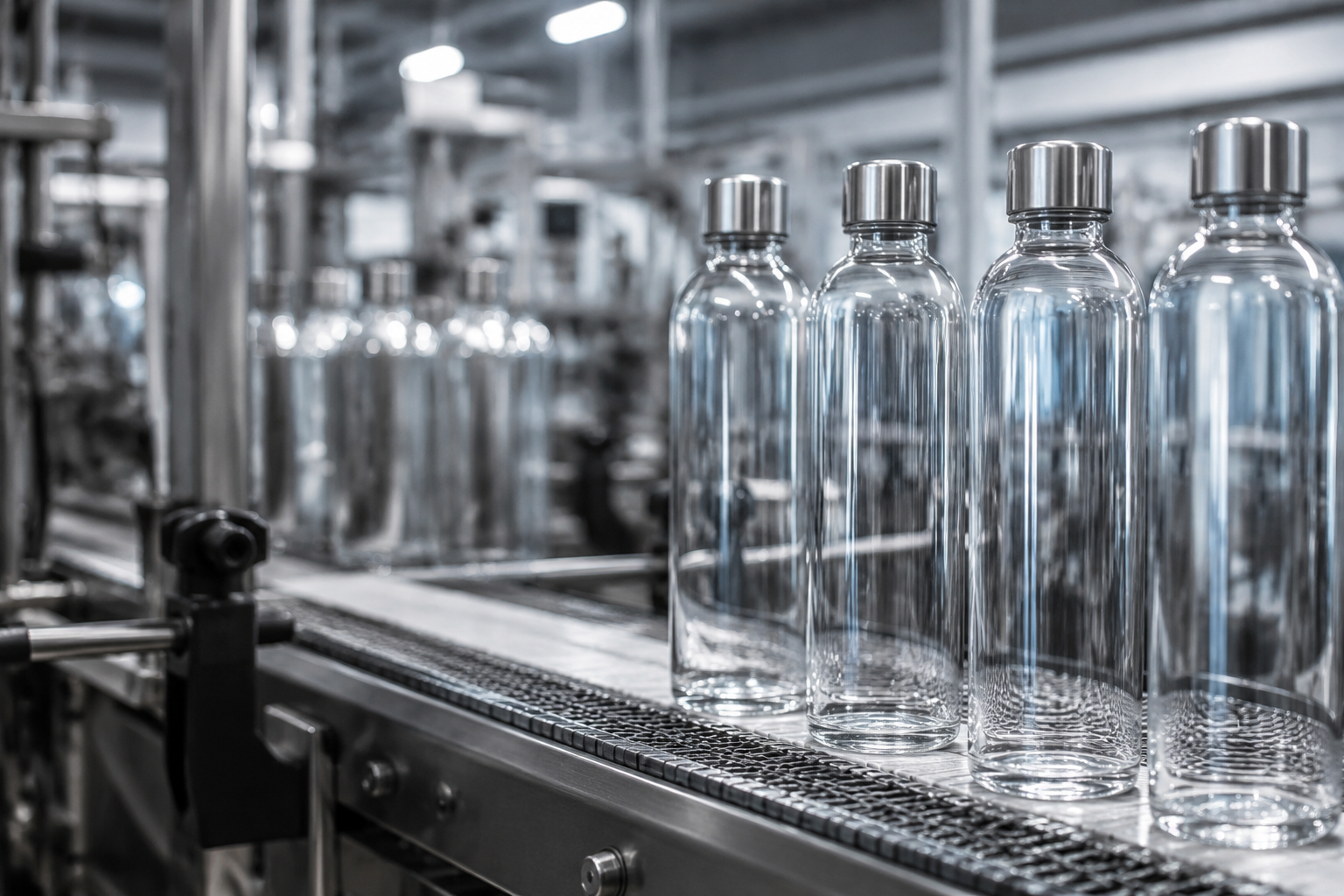
If you buy borosilicate glass refillable water bottle wholesale, selling it is usually not the hard part. The real fight starts in transit, daily use, and inspection. Glass looks simple until QC opens a carton and finds a scratched body, an out-of-round neck, a cap that backs off on a shaker table, or a bottle that survives visual check and then cracks in a hot-fill test. We’ve seen that eat margin fast.
For procurement managers and brand owners, the job is to lock down the failure points before the first run. In Zhejiang and across China, the better factories already work this way: they track forming tolerance, annealing, closure torque, and drop test performance at the line. If those details stay out of the PO, you are buying hope, not bulk drinkware.
Where glass bottles usually fail
Most problems in borosilicate glass refillable water bottle wholesale do not start with the glass formula. They start where buyers leave gaps: neck finish, annealing, lid fit, print adhesion, and packaging. We’ve seen a bottle look clean on the sample table and still crack after one cold-to-hot cycle because the wall was uneven or the annealing curve was rushed. QC pulled the sample, checked the caliper, and the 0.3 mm swing was already there. So “it passed inspection” means nothing unless the test list is written out.
The first failure mode is dimensional drift. If the mouth diameter moves by even 0.5 mm, a stainless cap can seal on one line and leak on the next. The second is surface damage. Light scratches on borosilicate are not just cosmetic when the carton sits 6 layers high. The third is impact failure from weak padding. If the supplier uses thin trays or loose dividers, a 1.5-meter drop test tells the truth fast. We’ve had buyers push back on this check, then the first carton split at destination. The math does not work.
- Specify mouth tolerance, not just bottle capacity.
- Require annealing and thermal shock data, not verbal assurance.
- Lock packaging with a drop-test standard before production.
In Zhejiang, stronger factories treat these as routine controls. We run this kind of job with a go/no-go ring gauge on the neck and a packed-carton drop check before the line is released. A lot of China suppliers can make a decent bottle; fewer can ship 20,000 pieces with stable QC. That is the gap you are paying to close.
Spec the glass before the quote
If you want a usable quote for drinkware wholesale, lock down the body, finish, and target performance before you ask for price. We’ve seen the wrong question go to RFQ first, and then the sample on the line turns into a mess of changes. A vague drawing is cheap to send and expensive to clean up. Give capacity, wall thickness, neck type, and the use case up front: still water, infused drinks, or carbonated fill. Those specs do not swap cleanly.
For most refillable water bottle programs, borosilicate wall thickness at 1.5-2.0 mm works. Below 1.5 mm, QC pulls more breakage in drop handling and freight loss goes up. Over 2.0 mm, the bottle gets heavy fast, carton count drops, and the landed cost moves the wrong way. State outer diameter, height, neck OD/ID, and thread type in millimeters. If you want a silicone sleeve, call out hardness and coverage area; otherwise the sleeve comes in loose or ends up cosmetic only. We had a buyer flag a PO once because the sleeve note just said “full cover” — that was useless.
What to put on the spec sheet
- Capacity: 350 ml, 500 ml, 750 ml, or 1,000 ml.
- Wall thickness: 1.5-2.0 mm target, with tolerance band.
- Closure: bamboo lid, stainless lid, or PP lid with gasket.
- Test set: thermal shock, leak test, torque test, and carton drop test.
For bulk drinkware or wholesale drinkware programs, a clean spec sheet is not just for engineering. It keeps the quote honest. When we ship a supplier full measurements and test points, they stop hiding margin in guesswork. That is the right play. One typo on a PO can cost a week; one solid spec can save three rounds of sample fixes.
Closure issues kill repeat orders
Most returns in bottle programs come from closures, not glass. A lid that backs off by hand after shipping is a defect. A gasket with a raw-rubber smell can sink a retail launch in one week. A bamboo cap that cups in humidity can open a leak path even when the bottle body passes drop test.
Be exact here. For a bulk canteen or canteen wholesale program, ask for closure torque data, gasket material declaration, and seal performance after 24 hours of inverted storage. If the spec includes stainless steel, check the grade and finish. If it includes bamboo, ask how moisture content is controlled before assembly. We run this check on the line with a torque tester and a 24-hour rack. The buyer flagged it later, and the math does not work that way.
Do not approve a bottle because the cap “feels tight.” Approve it because it held at least 24 hours inverted, with no visible leakage, under the declared torque range.
If you are sourcing a best wholesale drink bottle candidate for DTC or retail, cap quality often decides the reorder. The bottle body can be borosilicate, but the customer judges the full unit. QC pulled the sample, found a 0.3 mm gap on the seal land, and that was enough to stop the lot.
Packaging is part of the product
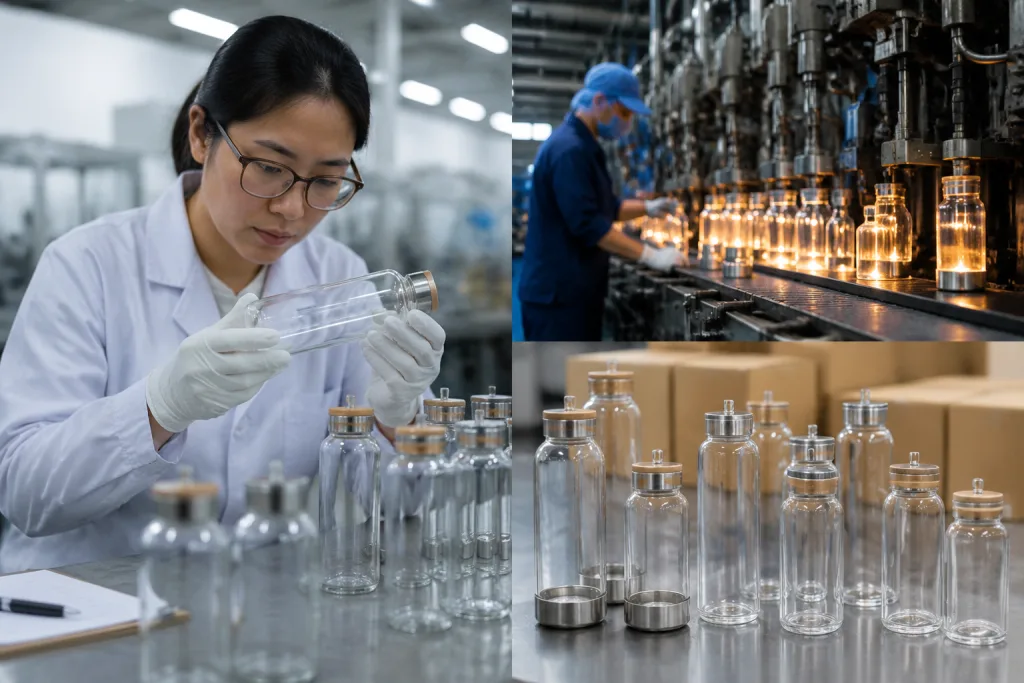
Glass packaging is not a shipping afterthought. It sits in the product spec. We see this go wrong on drinkware bulk orders all the time: a decent bottle goes into a carton that is too light, too loose, or built with mixed dimensions. If the bottle can shift 3 mm in the box, QC will find chips, scuffs, or a cracked shoulder after the drop test.
For wholesale runs, lock down the inner pack, master carton, and pallet pattern before the line starts. Ask for corrugated grade, divider type, and the result of a 1.2-1.5 meter drop test on full cartons. On one PO, the buyer flagged a barcode sitting on the curved shoulder, and the scanner kept missing it. For export to Europe and North America, keep carton copy plain and compliant; put care warnings where the buyer can read them without opening the box.
- Use inserts that hold the neck and base separately.
- Require master carton burst strength or ECT data.
- Confirm pallet height before FCL or mixed cargo shipping.
China can turn packaging changes fast. That speed cuts both ways. We have seen a carton downgrade add $0.18 a unit and wipe out the margin on a growler wholesale or bottle program. One bad box spec, and the math stops working.
Compliance questions buyers skip
For Europe and North America, compliance is not paperwork theater. It is how you keep a shipment alive when a distributor asks for proof on day 18. With borosilicate glass, ask for the material declaration, REACH status for every contact part, and a food-contact statement the factory can stand behind. If the bottle has inks, coatings, or silicone, those parts need their own check too. We run into PO typos here all the time, and the buyer flags it only after the sample is packed.
For a wholesale canteen or wholesale growler line, the supplier should hand over test reports or at least a clean list of what was tested, the lab name, and the date code. If the seller says ISO or BSCI, ask for the current certificate copy and scope. Do not use those certificates as a product verdict; they tell you the factory has a management system, not that the 500 ml bottle passed. QC pulled the sample on one line last week and found a 1.2 mm finish chip, which is the kind of detail that matters.
Buyers usually mention ASTM-style thermal shock expectations, internal leak checks, and carton drop testing. Fine. But this is the wrong question to ask if you do not also define pass/fail in writing. Use a simple acceptance sheet: leak-free, no crack after the heat test, carton intact after a 76 cm drop. If the supplier cannot explain how they reject a bottle, the line is not under control.
Bulk pricing makes sense only with control
Price for borosilicate glass refillable water bottle wholesale needs to be read from the BOM, not a headline quote. Glass weight, lid structure, decoration, and packing all move the number. A plain 500 ml bottle with a basic cap lands in one cost band; a printed bottle with sleeve, infuser, and custom box sits in another. On China EXW or FOB terms, the spread comes from unit weight and finishing steps. We run this math every week on the line.
For planning, buyers often like the sample price and then get hit by mold cost, print setup, and packaging. The buyer flagged it. So ask for separate lines: bottle body, lid, gasket, print, sleeve, and export carton. One Zhejiang factory shipping 50,000-120,000 units per month can still miss the mark if the BOM is not split out. If you want a bulk growler, beer growler bulk, or beer tumbler wholesale program later, this is the right place to keep control. A PO typo on the carton size can cost more than the print itself.
For larger runs, savings come from fewer defects, fewer replacements, and fewer claims. QC pulled the sample and found one chipped rim in 36 pieces. That is the number that matters. The unit price looks good on paper, but the landed defect rate decides whether the order holds up.

How to brief the factory
Your supplier brief needs to read like a production sheet, not a brand deck. Put SKU, capacity, target market, closure type, finish, packaging, and test requirements first. Then list the commercial points: MOQ, target FOB price, sample timeline, and who signs off on each step. If you want a canteen bulk or alcohol flask bulk crossover line, spell out which SKU is for water, which is for beer, and which is for spirits. The factory should not guess. We’ve seen that go sideways on a 500 pcs trial run.
Useful brief items include:
- Artwork files in vector format and Pantone references.
- Sample approval photos for body, lid, label, and carton.
- Target lead time: 25-35 days after sample sign-off.
- Inspection standard: AQL 2.5 major, 4.0 minor.
If you are sourcing a beer growler wholesale or beer growler wholesale bulk line, ask whether the glass thickness and closure system can take cold filling and repeated handling. For a beer tumbler bulk or beer tumbler wholesale bulk SKU, the issue is usually chipping in transit, not thermal shock. QC pulled the sample, and the rim had a 1.2 mm chip after a 90 cm drop test. Good suppliers in Zhejiang will tell you that upfront. The weak ones say yes to everything.
The special case of multi-use drinkware
Some buyers bundle water bottles, growlers, tumblers, and flasks into one sourcing program because it cuts vendor count from 4 to 1. That works only when you split the spec by use case. A bottle for water does not need the same closure, wall profile, or compliance file as an alcohol flask wholesale item. A growler bulk order is not the same as beer growler in bulk for a craft launch, and neither matches a retail-ready refillable bottle. We’ve seen the buyer flag this on the PO when one line item used the wrong neck finish.
The clean approach is shared core controls plus SKU-specific add-ons. Shared controls: glass grade, visual defect limit, carton drop standard, and color tolerance. SKU-specific controls: capacity, neck finish, gasket compound, and decoration durability. For an alcohol flask wholesale bulk line, add cap retention and a leak test at 45 degrees. For beer tumbler in bulk orders, call out rim finish and stackability. For wholesale growler programs, check handle strength if the bottle has a loop or molded grip. QC pulled the sample on a 2.2 mm rim once, and the math failed fast.
That is how you keep a broad bulk drinkware program from turning into a quality mess. One supplier can run 3 or 4 categories, but only if the paperwork keeps each SKU separate and the line follows it.
Send your bottle spec and get a quote
We’ll check wall thickness, closure, packaging, and MOQ before production so you avoid the usual QC traps in Zhejiang and China sourcing.
Frequently asked questions
What MOQ should I expect for borosilicate glass refillable water bottle wholesale?
For most Zhejiang and China factories, MOQ starts around 1,000-3,000 pcs per SKU for a standard bottle, and can move to 5,000 pcs if you want custom mold work, special color, or complex decoration. If you need a printed box plus sleeve plus custom lid, expect the factory to push higher. For first orders, 1,500-2,000 pcs is often a realistic compromise. Lead time is usually 25-35 days after sample approval, not counting shipping. If the supplier claims 7-10 days on a fully custom bottle, they are usually talking about stock items or a partial assembly.
What tests should I require before mass production?
Ask for a defined test set: dimensional check, leak test, lid torque test, thermal shock, and full-carton drop test. For glass, thermal shock is the one many buyers forget; it shows whether the annealing and wall consistency are good enough for real use. For packaging, a 1.2-1.5 meter drop test on a packed master carton is a practical minimum. For quality control, specify AQL 2.5 for major defects and 4.0 for minor defects. If the factory has an in-house lab, ask for photo or video evidence of the test setup, not just the pass/fail result.
How do I compare FOB prices fairly?
Compare on the same BOM and pack-out. A $0.92 bottle with a weak cap, thin carton, and no print is not the same as a $1.18 bottle with a stainless lid, gasket, and 1-color logo. Break the quote into body, lid, decoration, sleeve, inner pack, and export carton. Then compare weight, because freight on glass can erase small unit savings fast. For high-volume programs, even a 20-30 gram difference can matter. Ask whether the quoted price includes mold amortization, sample shipping, and export paperwork, or whether those are separate charges.
Can one factory handle bottles, growlers, and flasks together?
Yes, but only if the factory has separate tooling and assembly control for each SKU type. A factory that makes bulk canteen, wholesale growler, and alcohol flask in bulk items may still be weak on one closure system or decoration method. Do not assume capability transfers across categories. Ask for recent production photos, monthly output, and which SKUs they run regularly. A good factory in Zhejiang may produce 50,000-120,000 units per month across lines, but your bottle needs its own process sheet. Shared sourcing is efficient; shared specs are not.
What documents should I ask for from a China supplier?
At minimum, ask for business license, current ISO or BSCI certificate if they claim one, food-contact/material declaration, and test reports for the specific product or components. For Europe, ask about REACH-related compliance for contact parts and any ink or coating declarations. For North America, ask for any applicable food-contact statements and the packing list details needed for customs and marketplace labeling. If you are selling on Amazon or similar channels, add barcode and carton label confirmation early. A supplier that can send the right docs within 24 hours usually runs a more disciplined export operation.