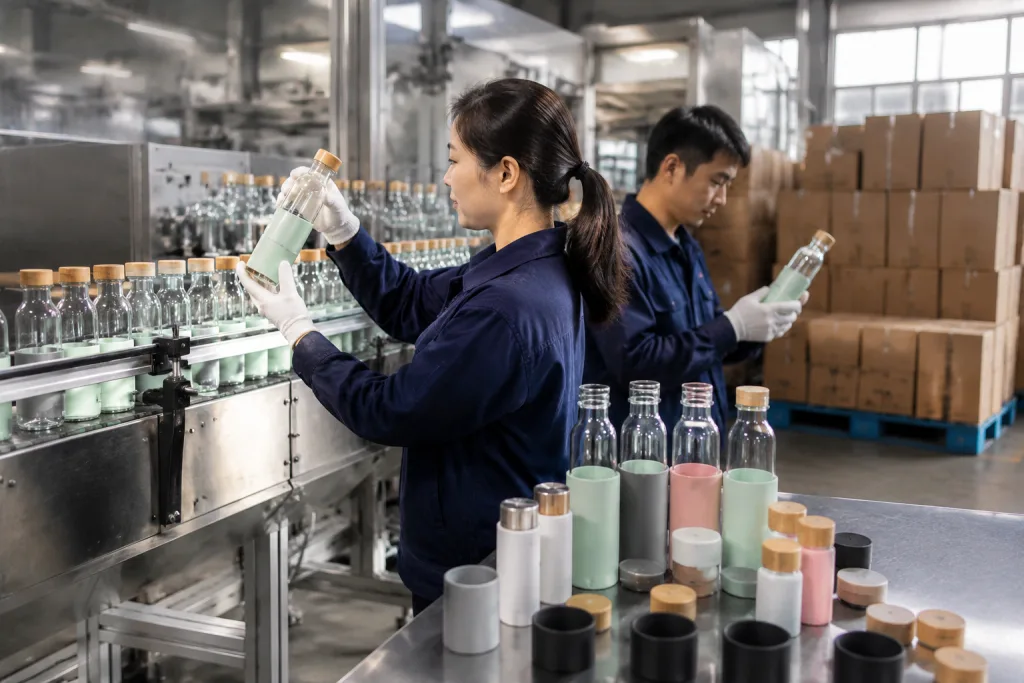
Key Takeaways
- Typical MOQ for a borosilicate glass refillable water bottle factory is 3,000-5,000 pcs per SKU, with lead time around 30-45 days after sample approval
- For retail-ready borosilicate glass, specify 1.8 mm-2.2 mm wall thickness, 500-750 ml capacity, and an outer carton drop test of 80 cm
- Expect FOB Zhejiang pricing to vary from USD 2.10-4.80 per unit depending on lid, sleeve, and decoration
- A proper QC plan should combine AQL 2.5 major and 4.0 minor defects with leak, thermal shock, and pack-out checks
You are not buying a bottle. You are buying a repeatable result: the right glass thickness, the right closure, the right decoration, and a shipment that lands on time without cracked cartons or a customs mess. That is why a borosilicate glass refillable water bottle factory is a different conversation from a generic custom drinkware quote. The sample photo looks neat; the line tells the truth.
If you are a procurement manager, brand owner, or distributor, the job is to turn one product idea into a controlled order. In Zhejiang and across China, the better factories talk in MOQ, wall thickness, drop tests, REACH, and export packaging, not showroom language. We run this sort of order every week. A solid canteen manufacturer should walk you from artwork to carton label with the numbers on the table.
Start with the buyer’s use case
I’ll keep the HTML structure intact and rewrite the prose to sound like a factory-side sales engineer, with concrete buyer details and cleaner trade language.Before you ask for a quote, pin down how the bottle will be sold and used. A borosilicate glass refillable water bottle for a wellness brand is a different job from a gym distributor program or a gift-box order. If the customer wants desk use, a clear bottle with a silicone sleeve and bamboo cap works. If the bottle is for outdoor resale, we run a different cap, a carry loop, and a stronger carton. The factory should not guess that part.
A proper buyer brief gives us capacity, target retail price, decoration method, carton count, and destination market. A clean spec looks like this: 550 ml, 1-color logo, 24 pcs per export carton, Amazon US packaging, and REACH paperwork. If you buy through a canteen distributor or as a canteen supplier for another channel, say it at the start. That changes labels, barcodes, and whether we ship it as a custom canteen, customizable canteen, or customized drinkware pack. The line asks for sales channel first for a reason; it keeps yield and margin in line.
Ask for these specifics up front:
- Capacity: 350 ml, 500 ml, 550 ml, or 750 ml
- Glass spec: borosilicate 3.3, wall thickness 1.8 mm-2.2 mm
- Closure: screw lid, flip lid, bamboo lid, or stainless lid
- Packaging: inner box, master carton, drop-test target
Lock the product structure
I’ll rewrite the section in place, keeping the HTML exactly intact and tightening the sales-engineer tone. Then I’ll do a quick pass to make sure the phrasing sounds like a real factory-side buyer discussion, not generic copy.The first mistake is approving the look before the structure. A borosilicate bottle can pass a quick visual check and still fail on the line if the neck finish is off by 0.5 mm, the lid liner is not food-grade, or the sleeve fit is loose. We run this every week: a 500 ml bottle needs body tolerance within ±1.5 mm, and the lid torque has to be checked before release. If the lid bites too hard, the buyer flags comfort complaints. If it sits loose, you get leaks and chargebacks.
For custom drinkware programs, structure also changes decoration. A straight-wall bottle gives us a clean silkscreen or pad print area; a curved shoulder cuts the print window and pushes you toward laser engraving. If you are building canteen customized retail sets, ask for the print window in mm, not a pretty mockup. A borosilicate glass refillable water bottle factory in China should hand over a technical sheet with the drawing, capacity line, and max safe fill level. That is standard export work. We once saw a PO with “500ML” typed as “50OML”; the buyer caught it before sampling, and the whole schedule held for 4 days.
If the factory cannot give you a dimensional drawing, it is not ready for a commercial order.
For custom canteen or customizable canteen projects, push for a sample that matches the final structure, not a random stock piece. A 2 mm shift in shoulder shape changes sleeve fit, carton packing, and tray stability, and that is the wrong place to gamble. QC pulled the sample with the caliper on this one, and the difference was obvious at once.
Price the order like a distributor
I’ll keep the HTML structure intact and rewrite only the prose so it sounds like a factory-side sales engineer, with tighter pricing detail and a more natural export tone.Price only works when you know what sits inside the unit. A plain 500 ml borosilicate bottle with a PP lid usually lands around USD 2.10-2.60 FOB Zhejiang at 3,000 pcs. Add a stainless lid, silicone sleeve, and one-color print, and the number moves to USD 3.20-4.80. If you want a custom growler format or a customized growler for a beverage brand, the structure gets heavier fast. That is normal. A quote that hides packaging, tooling, or artwork setup is the wrong question to ask.
Ask the canteen supplier to split the price into bottle, lid, sleeve, decoration, and carton. If you are comparing canteen manufacturers, compare the same spec line by line. A distributor canteen order at 10,000 pcs can beat a 3,000 pc custom drinkware order on unit price, but only when the spec stays fixed. We run this math every week in Zhejiang. On the line, the clean suppliers give you FOB, sample charge, and a real production lead time; the weak ones send one number and hope you do not push back.
Price drivers worth checking:
- Lid material: PP, bamboo, stainless, or mixed build
- Decoration: one color, two color, laser, or full-wrap print
- Accessory set: sleeve, brush, tea infuser, or box insert
- Carton spec: 5-ply or 7-ply export carton

Sample before you commit
Do not skip the sample stage because the sketch looks clean. A commercial sample has to prove three things: the bottle looks right, the lid works, and the pack survives transit. For a canteen custom order, ask for a pre-production sample and a decoration sample. One confirms the shape and closure. The other confirms print size, color, and placement. We had a buyer flag a logo shift of 2 mm once; on a retail shelf, that is enough to look sloppy.
Review samples like a buyer, not like a designer. Fill the bottle with 95°C water, close it, invert it for 10 minutes, and check for seepage. Then run a thermal shock check from hot water to cool water and see how the glass reacts. Borosilicate handles that better than soda-lime glass, but the lid and liner often fail first. QC pulled the sample, checked the cap torque at 18 N·cm, and found the weak point in the closure, not the tube. That is why a borosilicate glass refillable water bottle factory should test the full assembly, not just the glass body. If you sell to canteen distributors or drinkware channels, one bad sample can burn a whole season.
Put sample approval in writing. Use the signed sample as the production reference. We run into this every year: the warehouse says the lid shade is “close enough,” or the carton insert has a small typo and nobody wants to own it. Close enough is not enough.
Run QC before goods leave Zhejiang
Production QC has to be boring and numeric. On our line, we check raw glass, forming stability, lid fit, print adhesion, and carton strength before release. For normal export orders, ask for AQL 2.5 major and 4.0 minor, plus photos of the inspection report. If the order is over 5,000 pcs, push for line checks every 2 hours and one final random inspection before packing. That is standard China factory discipline when the buyer is paying attention.
For borosilicate glass, the weak spots are edge chips, bubbles in the shoulder, print scuffing, and cap sealing. We reject visible chips at the mouth every time; that is a safety issue and a return risk. Ask for three tests at minimum: leak test, torque test, and drop test. A common commercial drop target is 80 cm for the packed carton and 1 m for the individual product sample. If you sell customized canteen sets, put sleeve alignment and accessory count on the inspection sheet. One missing straw brush in 1 out of 50 sets turns into a customer service headache fast.
Minimum QC documents to request:
- Inspection report with AQL result
- Full pack-out photos by carton
- Material declaration for glass, lid, and liner
- REACH or food-contact declaration for Europe

Plan packaging for export reality
I’ll rewrite the section to sound like a factory-side export note, keeping the HTML exactly intact and tightening the packing advice with concrete details.Manage the order like a repeat program
The best buyer setup is not one shipment. It is a repeat program that gets smoother every quarter. Once the sample is approved and the first order ships, lock the final spec into a production sheet: 2.0 mm glass thickness, logo file, PMS color, lid SKU, carton dimensions, and inspection standard. That sheet becomes the control doc for the next canteen promo run or custom drinkware reorder. Without it, every PO turns into a fresh argument.
If the factory performs well, ask for a capacity plan. A mid-size borosilicate glass refillable water bottle factory in Zhejiang may run 200,000-350,000 units per month across several bottle lines, so your slot depends on planning. On a 10,000-piece reorder, the question is simple: do they reserve raw material, confirm label lead time, and keep one reference sample on file? QC pulled the sample on our last run, and the buyer flagged a lid typo before shipment. That is the gap between a steady partner and a random canteen supplier when you scale into a distributor drinkware network or start a custom growler line later.
Repeat buyers should also set service rules: one contact person, one approved sample, one inspection record, and one packing standard. If you are a canteen manufacturer buyer, that is how you keep the program stable while changing artwork seasonally. We run this way for a reason. China rewards clear orders, and Zhejiang factories move faster when the PO stops changing after the line is booked.
Get a clean quote from Zhejiang today
Send your size, lid, logo, and carton spec. We will return a production-ready quotation, sample plan, and lead time for your order.
Frequently asked questions
What MOQ should I expect for borosilicate glass refillable water bottles?
For most export-ready orders, expect 3,000-5,000 pcs per SKU and per color. If you need a new lid, custom sleeve, or special carton, some borosilicate glass refillable water bottle factory teams may ask for 5,000-10,000 pcs to keep pricing workable. A simple stock shape with one-color logo can sometimes start lower, but once you add canteen customized packaging or a special accessory, the economics change fast. In Zhejiang, factories will usually quote better once they see a repeat program instead of a one-off sample order.
What is a realistic FOB price for a custom glass bottle?
A basic 500 ml borosilicate bottle with a simple PP lid may land around USD 2.10-2.60 FOB Zhejiang at moderate volume. If you add a silicone sleeve, bamboo or stainless lid, and one-color print, the range often moves to USD 3.20-4.80. For a custom canteen or customized growler format, expect higher pricing because of larger glass weight and stronger packaging. Always ask for a line-item quote so you can compare canteen suppliers on equal terms, not just headline price.
How do I check quality before shipment?
Use a written QC plan with AQL 2.5 major and 4.0 minor, plus leak, torque, and drop tests. For borosilicate glass, check mouth chips, bubbles, print scratches, and lid seal performance. A good canteen factory in China should provide photos, an inspection report, and carton counts before final payment. For export orders, ask for 80 cm packed-carton drop testing and random sampling from different packing lines. That is especially important if you are buying for a canteen distributor or distributor drinkware channel.
Can I customize the bottle for Amazon FBA?
Yes, but you need the carton and label plan before production starts. For Amazon FBA, the factory should confirm FNSKU placement, inner box dimensions, carton weight, and barcode readability. A 500-750 ml custom drinkware item often needs one bottle per box and 12-24 pcs per master carton, depending on fragility and target freight cost. If you are building a custom growler or canteen promotional set, ask the supplier to keep the master carton within your inbound receiving rules so you do not get repacked on arrival.
What documents do I need for Europe or North America?
At minimum, ask for food-contact declarations, REACH-related material statements for Europe, and any test report required by your retailer or marketplace. Some buyers also request ASTM-related or ISO-based test references for internal compliance. If the canteen vendor is experienced, they should understand lid materials, ink declarations, and packaging composition. For North America, your own compliance team may also want California Proposition 65 screening depending on the channel. The earlier you ask, the faster the factory can align the bill of materials.