Key Takeaways
- Ask for thermal shock testing of at least 120 °C on borosilicate components, not just visual approval
- Specify leak testing at 20 kPa and drop testing at 1.0 m for filled samples
- For a typical Zhejiang canteen factory, MOQ often starts at 3,000–5,000 units and lead time runs 25–35 days
- Use AQL 2.5 for critical defects and 4.0 for minor defects when you order customized drinkware
If you are buying output from a borosilicate glass plastic water bottle factory for retail, Amazon, or distributor programs, the SKU can look simple and still blow up your margin. The first sample passes, then the cap starts weeping after hot-fill, the sleeve scuffs in carton drop tests, or a buyer treats a 65 °C bottle like a gym bottle and the glass cracks. The problem is not the shape. It is loose specs and weak QC.
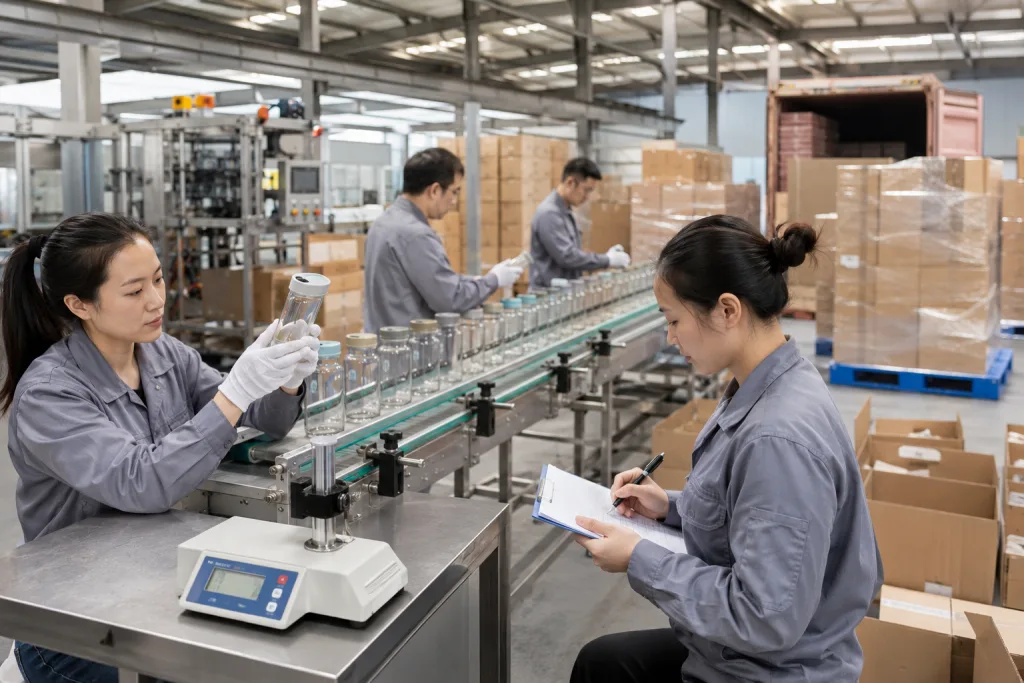
At our Zhejiang factory, we see the same faults repeat, and that helps. We run cap torque checks, leak tests, and carton drop tests on the line, and the failure pattern is usually obvious once you inspect the seal, closure, and decoration together. A PO typo on the closure material or gasket size is enough to create a headache. This is the wrong question to ask: “Can you make it?” The better question is whether the control plan holds from sample to ship.
Where the product usually breaks
Most problems start before the bottle leaves the canteen factory. Buyers approve a clean sample, then the production run slips on wall thickness, cap torque, or gasket hardness. For borosilicate glass plastic water bottle factory orders, the glass is rarely the weak link; the interface between materials is. A 2.0 mm wall that samples well can come out at 1.7 mm in mass production if the line does not hold forming temperature and weight. That gap shows up in transit breakage and customer returns.
The usual failure modes are boring, and they cost money:
- Cap leaks because liner compression is too low or torque is not set on the torque meter.
- Glass cracks at the neck because the molded plastic collar is too tight.
- Condensation or fogging shows up because the assembly goes into packing before full cooling.
- Print rubs off because the decoration method was never matched to the plastic resin.
If you buy from canteen suppliers, skip generic claims like “food grade” and “high quality.” Ask for the material stack: borosilicate grade, PP or Tritan resin, gasket compound, and decoration method. We run this check on the line with a caliper and a torque tester, because the buyer flagged a 0.3 mm collar issue on a previous PO and the math did not work. A serious custom drinkware factory in China will show you the control points; a weak one will only show polished samples.
Glass and plastic do not fail the same way
Borosilicate glass earns its keep because it takes thermal shock better than soda-lime glass, but it still breaks when you push past spec. If a buyer pours from a kettle or drops in ice after a hot rinse, the bottle needs to survive a real swing, not a brochure claim. Write the thermal shock test around the actual use case. A 120 °C differential is a workable baseline for a lot of custom drinkware jobs, while a 2.0 mm wall on a slimmer bottle may need a tougher target if the geometry is tight.
The plastic side is where a lot of canteen custom jobs go sideways. A PP cap can look fine on the line and still warp after hot wash cycles at 80 °C. If the bottle uses a sleeve or base, the resin can craze, whiten, or go brittle after UV exposure in warehouse storage. That matters for promotional canteen runs and distributor orders that sit 90 days before the buyer even opens the carton. Put the resin grade, masterbatch, and dishwasher spec in writing; the math does not work any other way.
Do not let the factory set the performance target after sampling. You set the target first, then ask the canteen manufacturer to prove it.
For canteen customized and custom canteen runs, lock the glass thickness, neck finish, cap torque range, and gasket hardness before tooling. We have seen one 0.3 mm mold tweak change the crack pattern after 2,000 or 3,000 cycles, and QC pulled the sample only after the buyer flagged it. A PO typo on the torque spec can turn into scrap.
Leakage is a spec problem
Leakage is the fastest way to turn a good-looking bottle into a bad order. On the line, we usually trace it back to tolerance stack-up: glass neck, cap thread, liner thickness, and gasket compression all have to land together. If one piece is loose, the sample can pass a hand-tight check and still fail after carton vibration. We’ve seen that go sideways in a 2,000-piece run, so an inverted-water test alone is the wrong question to ask.
Write the leak requirement like an engineer. Ask for a 100% air-pressure leak test on critical closures, or at minimum a statistically valid sampling plan with AQL 2.5 for critical defects. Add a 24-hour inverted hold test and a hot-fill check if the bottle will hold tea, coffee, or infused water; QC pulled the sample at 85°C, and that one detail caught a bad seal before shipment. For distributor canteen and canteen distributors, one clean line in the spec sheet saves a lot of after-sales cost.
- Set cap torque range, for example 0.8–1.2 N·m for a threaded sports-style closure.
- Specify gasket material and hardness, such as silicone at 50–60 Shore A.
- Require assembly with controlled compression, not manual “feel.”
- Ask for vibration testing if the bottle ships as packed sets.
Leakage often gets blamed on the customer. In practice, it is usually a bad spec from the buyer side or an untrained canteen vendor treating one sample as production control; we had a PO once with the cap thread typoed as M28 instead of M28.5, and the math did not work. That is a factory-floor problem, not a sales story.

Decoration fails faster than the bottle
Print and branding failures are easy to miss. A logo can look clean on day one and still scratch off in a week if the ink stack or surface prep is wrong. We’ve seen the buyer flag this after a 500-piece sample run, and then the PO typo turns into a second round of plates. For canteen promotional runs, reseller kits, and custom growler projects, the bottle has to survive shipping, washing, and daily handling.
On glass, ask the factory straight which method they run: screen printing, low-temperature decal, or laser marking. Each one has a different cost and a different failure point. On plastic parts, pad print works for small graphics, but if the resin is too slick or the flame treatment is uneven, the ink lifts fast. If you need a customizable canteen for retail, ask for abrasion testing at 50 rub cycles at minimum; 100 is the safer call when the unit sits on shelves and gets picked up all day.
Pricing moves with decoration complexity. A plain unit may sit at USD 1.80–2.40 FOB from China depending on size and packaging, while a decorated customized canteen can add USD 0.15–0.60 per piece. That looks small until you multiply it by 20,000 units; the math does not work the same way. In Zhejiang, factories shipping 200,000 units/month usually keep decoration steadier because the line repeats the same setup every day, and QC pulled the sample before carton pack. Smaller workshops can still do it, but you need tighter incoming checks and in-process checks, or the first batch comes back with rubbed logos and a reprint bill.
Packaging is part of the product
Many buyers treat packaging as a logistics issue. For fragile drinkware, packaging is part of the product. If the insert is loose, the glass neck chips. If the carton wall is too thin, a pallet shift turns into edge damage that shows up two weeks later at the distributor. We have seen that go sideways on a 24 oz bottle run, and the margin disappears in rework.
Set the drop plan for the packed unit. A normal target is a 1.0 m drop on all six sides for retail-ready cartons, plus corner and edge checks on master cartons. If your bottle includes a plastic canteen or sleeve component, make sure the insert clears the print by at least 3 mm. Ask the canteen factory for packed gross weight, carton dimensions, and pallet pattern before mass production starts. That gives your freight forwarder and receiving team real numbers, not guesses.
For export orders into North America and Europe, ask for compliance documents tied to the actual packaging: REACH statements for ink and ink carrier where relevant, and food-contact declarations for the relevant components. A BSCI audit does not improve a carton, but it does show the line can hold process discipline. QC pulled the sample box, checked the fold score at 0.8 mm, and found the best factories send packaging drawings, not just a phone photo of a sample.
QC only works when it matches the risk
Quality control is where buyers either stay in control or get surprised at the dock. “Inspect all goods” sounds safe. It isn’t. On a borosilicate glass plastic water bottle factory order, we run QC by risk: leakage, cracks, sealing face damage, and contamination sit in the critical bucket. Print shift, warped caps, and color drift go in major. Packaging scuffs stay minor if the bottle still ships clean and saleable.
Use AQL by defect class, not one number for everything. A common starting point is AQL 2.5 for critical and major defects, then 4.0 for minor defects. On a 5,000 pcs chain order, that split saves time and catches the defects that actually trigger claims. If you are ordering customized growler or customized drinkware for a chain or distributor program, add first-article approval, in-line inspection, and pre-shipment inspection. The buyer flagged it once with us on a 1.5 mm neck-finish mismatch, and the line stopped until QC pulled the sample. That is normal. A weak factory will push back on inspection cost because the process is already shaky.
Ask for these documents before you release the order:
- Material declaration for glass, plastic, and gasket.
- Incoming inspection records for resin and caps.
- In-process checks for neck finish, wall thickness, and torque.
- Final inspection report with defect photos and lot numbers.
That is how you tell a real canteen manufacturer from a trading layer. You are not buying a promise. You are buying repeatability, and the math does not work any other way.
How to spec the order cleanly
If you want clean output, write the PO like a production brief. Start with use: hot water, cold water, tea, retail shelf, gym, or distributor gift pack. Then lock the material stack, the closure, the decoration method, and the carton spec. We run orders this way on the line. If you need canteen customizable or canteen customized SKUs, keep the variant count low. Every extra cap color, sleeve color, or logo position gives QC one more place to mix parts.
A practical spec for a custom canteen or custom growler program should include:
- Glass grade and wall thickness, such as 1.8–2.2 mm.
- Plastic resin type and color standard.
- Leak, drop, and thermal shock test methods.
- Packaging structure and carton test requirement.
- Inspection standard, typically AQL 2.5/4.0.
For custom drinkware buyers, the point is not to ask for 20 line items. Ask for five that control the build, then make the canteen supplier quote against them. We had a buyer flag a PO typo once—“carton” became “cotton”—and the whole pack spec went sideways until we checked the drawing against the sample. If a factory in China cannot confirm those numbers, keep looking. In Zhejiang, the better shops tell you straight what they can hold and what they cannot. That is worth more than a polished sample and a vague promise.
Spec your next order before the sample
Send your target use case, MOQ, and test requirements. We’ll turn it into a production-ready custom drinkware spec from Zhejiang, China.
Frequently asked questions
What MOQ should I expect from a borosilicate glass plastic water bottle factory?
For a typical Zhejiang canteen factory, MOQ is usually 3,000–5,000 units per design if you want custom logo work and mixed packaging. Simple stock-color runs can sometimes start lower, around 1,000–2,000 units, but once you add customized drinkware decoration, custom molds, or special cartons, the order size rises. If you need multiple SKUs for distributor canteen programs, ask whether the factory can combine colors under one tooling set. That can reduce your effective MOQ and keep setup costs under control.
How do I test whether the bottle will leak in real use?
Use more than one test. Ask for a pressure leak test at 20 kPa or your factory’s validated equivalent, then add an inverted hold test for 24 hours and a vibration check for packed samples. If the bottle will hold hot water, also test after thermal cycling, because a closure can seal fine at room temperature and fail after heat expansion. For canteen distributors and retail buyers, the most useful evidence is a signed test report tied to the production lot, not just a sample video.
Is borosilicate glass safe for hot and cold filling?
Yes, if the product is engineered correctly. Borosilicate handles thermal shock better than ordinary soda-lime glass, but safety still depends on wall thickness, neck design, and how the plastic parts manage expansion. A common practical target is a 120 °C thermal shock differential test for the glass component, though your final spec should match the actual use case. If your buyers will pour boiling water, specify that in writing and require test results before mass production. Do not assume the factory’s standard sample already covers it.
What documents should I ask for before shipment?
At minimum, ask for material declarations, final inspection records, and a packing list that matches the carton count. For Europe and North America, also request REACH-related declarations for the relevant materials, food-contact statements, and if applicable a BSCI audit summary. If the order is branded as custom drinkware or canteen promotional, ask for print adhesion or rub-test evidence too. The point is to tie paperwork to the actual lot, not to a generic factory certificate from two years ago.
Can I source custom canteen and custom growler styles from the same factory?
Yes, many canteen manufacturers can handle both if the material systems are similar and the decoration lines are set up for mixed formats. The key is to confirm whether the factory is a true canteen manufacturer or only a canteen vendor assembling sourced parts. If you need a customizable growler and a customized canteen in one program, keep the resin, cap family, and carton spec as close as possible. That helps the factory reduce changeovers and lowers your defect risk, especially on larger distributor drinkware orders.