
Key Takeaways
- A borosilicate glass plastic water bottle custom order usually starts at 3,000-5,000 units MOQ and 25-35 days lead time in Zhejiang, China.
- Choose borosilicate wall thickness around 1.8-2.2 mm for a safer balance of weight and impact resistance.
- For branded sales, screen print and laser engraving hold up better than cheap full-wrap labels on custom drinkware.
- Ask for REACH, food-contact declarations, and AQL 2.5 inspection terms before you approve mass production.
If you are buying a borosilicate glass plastic water bottle custom, the real decision is not the logo. It is the build: glass-only, glass with an outer shell, or a hybrid bottle that protects the glass without killing the premium feel. Get that wrong and you pay for breakage, freight damage, or a product that looks good in a sample but fails in distribution. QC pulled the sample on a 2 mm wall crack before we even packed the carton.
For B2B buyers, especially if you manage retail, corporate gifting, or a distributor program, you need a bottle that can survive handling, clear compliance checks, and still leave room for margin. In Zhejiang, China, we see the same thing every week: buyers start with aesthetics and end up fixing durability, MOQ, and decoration limits. The wrong question is “does it look premium?” Ask what the line can hold, then check the cap, the print method, and the pack-out. A PO typo on the closure spec can turn into a 12-day delay fast.
Start With the Product Structure
The first decision is the structure. It sets cost, shipping risk, and how buyers judge the bottle on a shelf. A borosilicate glass plastic water bottle custom program usually comes in three builds: bare glass with a plastic cap, glass with a protective plastic sleeve, or a double-wall style where the outer plastic body is the visual shell. For retail orders, the sleeve version usually wins. We run those with a 1.8 mm wall a lot. It keeps the premium glass look and takes more abuse in carton handling and on a desk.
Do not lump every “glass bottle” program together. Borosilicate handles thermal shock better than soda-lime glass, but it is still glass, and the buyer flagged it for a reason when the sample cracked in a 60°C-to-cold-water test. If the bottle goes into gyms, offices, or travel kits, the sleeve matters. A 1.8 mm wall is a common baseline; 2.0-2.2 mm feels sturdier, but the math changes fast because you add 30-60 grams per unit and that shifts carton count and ocean freight.
If you are sourcing for a canteen distributor or a distributor drinkware program, ask the factory for breakage assumptions by structure, not just a sample photo. This is the wrong question to ask if you stop at appearance. A serious canteen factory in Zhejiang should show packaging trials, carton drop testing, and pallet stacking logic; QC pulled the sample, checked the 3-side compression result, and that is where the real decision sits.
Choose the Right Closure System
The cap is not an accessory. It is a working part of the bottle, and it is often where a custom order first blows up. For a borosilicate glass plastic water bottle custom project, the closure sets leak control, dishwasher tolerance, and the final product look. A PP cap with a silicone gasket is the basic workhorse. If you want a more retail-ready feel, a Tritan lid or a metal-threaded top lifts the perceived value, but tooling and assembly cost go up fast.
For a canteen customizable line, I push buyers to start with use case. Office and gift programs usually accept a simple screw cap. Fitness, school, and travel users need quicker opening and a better grip. If the bottle is sold as a custom canteen or custom drinkware SKU, the cap has to fit the channel. A promo item with a weak cap looks cheap even when the glass is fine. We’ve seen buyers approve the bottle body first, then the line gets stuck on the cap because the hand feel is wrong. That is the wrong question to ask.
- Silicone seal thickness: 1.5-2.0 mm for stable compression
- Leak test target: 30 minutes inverted at room temperature
- Torque range: confirm with the canteen manufacturer before mass production
Ask for closure samples in the same production material, not a hand-made substitute. QC pulled the sample on one Zhejiang run because the trial cap was molded in a different resin, and the buyer flagged it right away. A canteen supplier that cuts this corner can make the sample look right and the mass order behave badly. That happens a lot when speed is chasing customization.
Decoration Should Match the Channel
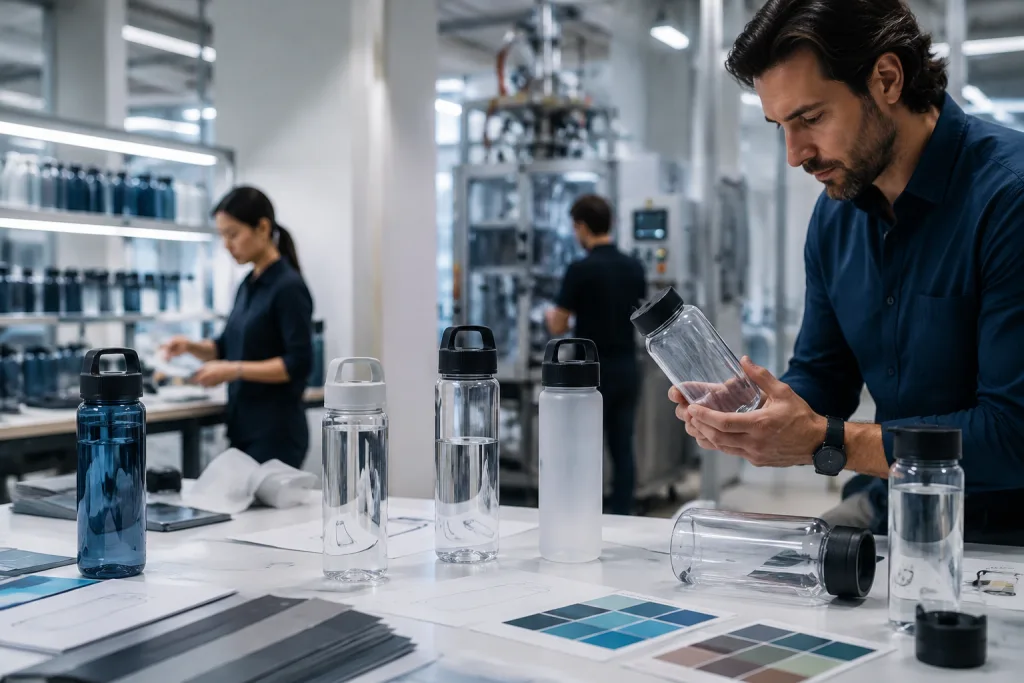
Decoration is where a lot of buyers burn budget. If the channel is corporate gifting, a clean one-color logo often beats a full-wrap print because it looks more settled and holds up better against scuffs. For a borosilicate glass plastic water bottle custom run, we usually see screen printing, pad printing, UV printing, and laser engraving on a metal or secondary part. Each one fails in a different way, so the channel decides the process.
Screen printing is still the workhorse for canteen custom projects that need the same logo on 5,000 or 20,000 units. It is cost-efficient, often USD 0.08-0.25 per color depending on setup and coverage, and it runs well on flat or lightly curved areas. UV printing gives sharper detail, but the line needs tighter control. Laser engraving lasts, but it only makes sense when the bottle has a metal ring or metal lid component. On glass, we usually talk about frosting or etching effects, not true engraving.
If you are building canteen promotional stock for trade shows or distributor canteen bundles, keep the artwork simple. Gradients and tiny type go sideways on curved glass; QC pulled a sample once and the 3 mm text had already blurred at the edges. A good supplier says that before quotation, not after the first sample. That saves margin on customized drinkware.
Buy the decoration for the channel, not for the sample table.
For European and North American buyers, confirm ink compliance and rub resistance every time. If the bottle is for resale, ask for adhesion and dishwasher test results, not just a pretty photo. We ship to buyers who check AQL 2.5 on decoration as well, and the math does not work if the print starts peeling after 30 washes.
Work the MOQ and Pricing Early
MOQ is not a side note. It decides whether the job is a real order or just sampling talk. A typical borosilicate glass plastic water bottle custom order from a canteen factory in Zhejiang starts at 3,000 units for a standard build and can go to 5,000 units if you want two lid colors or a special mold. We run the line this way because resin, glass tubes, and cap parts all have to be booked before production starts.
For pricing, a plain bottle with a basic cap and one-color logo usually lands around USD 1.20-2.30 EXW, depending on size, thickness, and packaging. Add a protective sleeve, premium lid, or retail box and you can add USD 0.35-1.10 fast. The buyer flagged a “cheap” quote once, then found the carton spec was wrong and the pallet count did not work for export. That is the wrong question to ask.
If you are a canteen distributor, ask for a full landed-cost breakdown: unit price, tooling if any, packaging, carton master count, and loading efficiency. A canteen manufacturer in China should tell you how many units fit in a 20GP or 40HQ container before you confirm the PO. We check this with a tape measure and carton sample, because the math does not work any other way.
Check Compliance and Testing
Compliance is where buyers sleep well or get stuck with a delayed booking. For Europe, REACH and food-contact declarations matter. For North America, ask for FDA food-contact confirmation and, where relevant, Prop 65 coverage for decoration or imported parts. This bottle is not just glass and plastic; it is ink, gasket, cap, sleeve, and packaging. We ask for a material list by component, down to the cap liner.
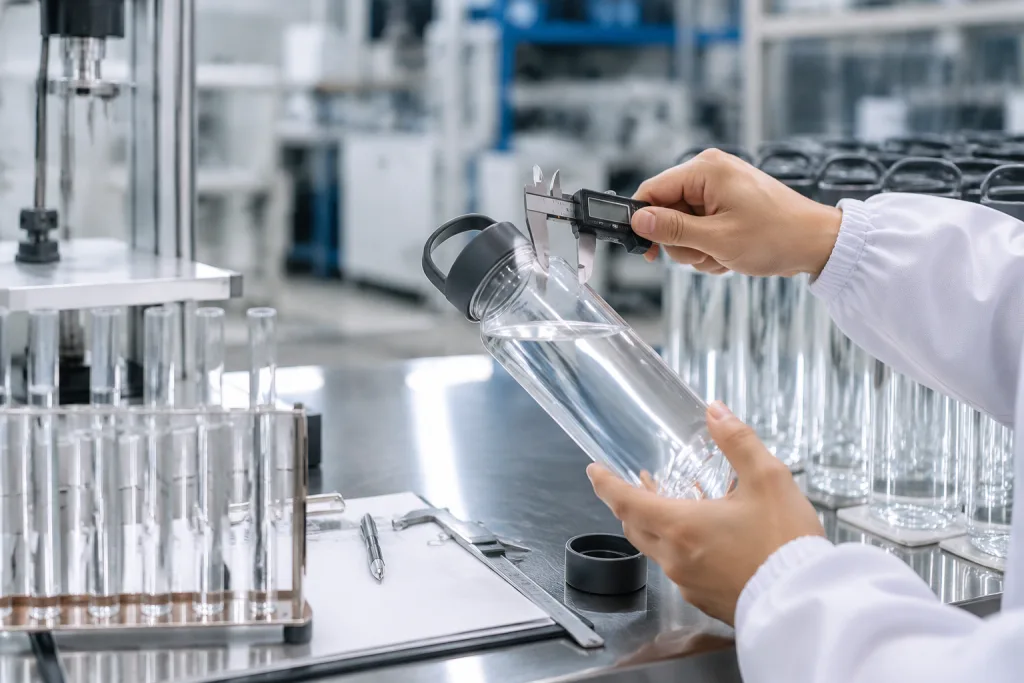
Ask for an inspection plan built around AQL 2.5 for major defects unless your program needs tighter control. For premium retail, we run AQL 1.5 on appearance and 2.5 on function. Ask for drop test criteria, leak test procedures, and thermal shock limits in writing. Borosilicate glass handles heat better than standard glass, but it still cracks if the carton or pallet work is sloppy.
Good canteen manufacturers in China already keep process documents for this. If a supplier cannot show batch traceability, incoming material checks, or photo records from production, that is a warning sign. On one line, QC pulled the sample and found a 2 mm print shift before packing; that kind of catch saves a claim later. Zhejiang factories that export every week usually know how to handle compliance files because Europe and North America ask for them on every shipment.
If your order is branded as customized canteen or customized drinkware for retail resale, keep the paperwork with the product spec sheet. We saw a PO once with the model code typed wrong by one digit, and customs still matched it to the spec pack because the documents were clean. That is the right way to run it.
Packaging Can Make or Break Margin
Packaging is not decoration. It is margin control and breakage control. A borosilicate glass plastic water bottle custom order should be packed for the route it will actually take: carton handling, pallet compression, and shelf display at the end. We ship enough mixed cartons to know this. A plain egg-crate insert can work for domestic moves, but export buyers usually need a stiffer inner structure, especially when the bottle has a sleeve and a premium lid.
For e-commerce or FBA-style fulfillment, the unit carton has to survive a drop test and barcode scanning. We had a buyer flag a 2 mm box gap on the line, and that tiny mismatch turned into crushed corners. If you are building an Amazon-ready line, line up FNSKU labels, carton marks, and master carton size before the PO goes out. For retail, a clean outer box often sells better than a loud logo on the bottle itself. That is the right question to ask for a customizable growler or custom growler line.
- Inner carton drop test: 76 cm is a sensible starting point
- Master carton count: set it around 20GP/40HQ pallet loading, not guesswork
- Label placement: keep scannable areas flat and unwrapped
Packaging is also where a canteen vendor proves export sense. We run compression checks at 5-layer board spec, and the buyer usually notices the result before they notice the print. A factory in Zhejiang shipping to Europe and North America should recommend carton strength, transit wrap, and barcoded retail packing without guessing.
Choose a Supplier You Can Scale With
Not every supplier can run a real custom program. A canteen supplier that only sells stock items may quote fast, then stall when you ask for mold tweaks, Pantone matching, compliance papers, or mixed packaging. We’ve seen that go sideways. You want a partner that runs like a canteen factory, not a middleman. The gap shows in sampling, revision speed, and how they hold the line during production.
Look for a plant that can push 200,000 to 500,000 units per month across drinkware lines and still keep custom jobs under control. For a borosilicate glass plastic water bottle custom order, 25-35 days after sample approval and deposit is a sane lead time, sea freight not included. If a supplier offers much less and cannot explain the process, ask how many molding, printing, and packing steps stay in-house. QC pulled the sample on a 2 mm print offset before it became a PO fight.
For buyers running multiple channels, a canteen distributor or distributor growler program lives on consistency, not shiny claims. You need repeatable color, stable lead times, and straight talk when a resin batch shifts. The buyer flagged a lid tolerance issue at 0.3 mm, and that saved a full run. The best canteen manufacturers will tell you when a requested change hits price, timeline, or failure rate. That is not hesitation. That is the right question to ask.
In Zhejiang and across China, the stronger factories are usually the ones that explain trade-offs in plain language and back them with data from the line. We ship with that mindset every week. That is the supplier you can scale with across custom canteen, customizable canteen, and broader custom drinkware programs.
Request a factory quote with real specs
Send your size, lid style, artwork, and target market. We will quote MOQ, lead time, and packing for your China or Zhejiang program.
Frequently asked questions
What is the usual MOQ for a borosilicate glass plastic water bottle custom order?
A practical MOQ is usually 3,000-5,000 units, depending on lid type, print colors, and packaging. If you want multiple cap colors or a new mold, the number can rise. For standard export programs from a canteen factory in Zhejiang, 3,000 units is a common starting point. Smaller orders are possible, but the unit price often rises by 15-30% because setup costs are spread over fewer pieces.
How much does a custom bottle like this cost?
For a simple borosilicate glass plastic water bottle custom project, expect roughly USD 1.20-2.30 EXW per unit for standard specs. Add USD 0.35-1.10 for upgraded lids, sleeves, or retail packaging. Decoration adds more: one-color screen printing can be inexpensive, while multi-color or special finishes increase cost. Freight, duties, and carton specs are separate, so always ask for a full landed-cost estimate.
Is borosilicate glass actually better than regular glass?
Yes, for thermal shock resistance and premium positioning. Borosilicate handles temperature changes better than standard soda-lime glass, which makes it a better base for custom drinkware sold for office, hospitality, or gifting use. It is still glass, so impact protection and packaging matter. A 1.8-2.2 mm wall is a useful commercial range for balancing strength and weight.
What compliance documents should I request?
For Europe, request REACH-related material declarations and food-contact documentation. For North America, ask for FDA food-contact support and confirmation that inks, seals, and plastics are suitable for the intended use. Also request an AQL inspection plan, leak test method, and batch traceability. If your bottle has multiple materials, every part should be covered, not just the glass body.
Can I use this as a canteen promotional item or retail product?
Yes, but the build should match the channel. For canteen promotional use, a simple logo and cost-controlled lid work well. For retail, especially distributor canteen or distributor drinkware programs, you need better packaging, stronger decoration, and tighter inspection. If you are targeting e-commerce, make sure the carton and labels are FNSKU-ready and that the product survives drop testing before you scale.