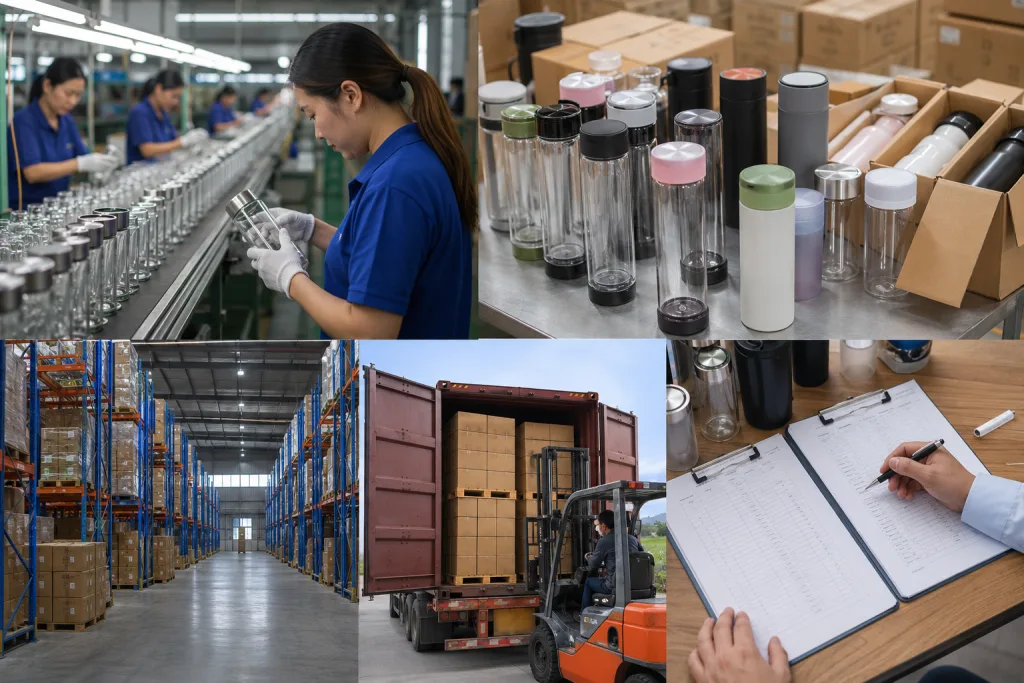
Key Takeaways
- A workable MOQ for a custom glass-insulated bottle usually starts at 1,000-3,000 pcs per SKU, depending on print and packaging.
- Sample approval should lock 6 items at minimum: bottle body, lid, gasket, artwork, carton, and drop-test standard.
- For bulk thermos programs, ask for lead times in days, not vague weeks; 25-35 days is common after sample sign-off.
- A good PO should separate product, decoration, packaging, test standard, and freight terms like FOB Ningbo or FOB Shanghai.
If you are buying drinkware for outdoor retail or promo programs, the hard part is not finding a bottle. It is telling a real borosilicate glass insulated water bottle supplier from a factory that only looks flexible on email. We see this on the line all the time. You need clean specs, real lead times, and a production path that holds up through sampling, artwork sign-off, and bulk inspection without surprise cost.
In Zhejiang and across China, the good thermos and bottle programs run on process, not talk. A serious supplier thermos quote should show capacity, MOQ, packaging, and test standards before you issue a PO. QC pulled the sample at 300 ml and found a cap torque issue once; that kind of miss is why we push RFQ, sample, then bulk. If you want a custom thermos or a customized thermos with retail-ready packing, that step order is the right question to ask. It saves rework in China.
Start with the RFQ spine
Your first RFQ should read like a buying brief, not a marketing request. A proper borosilicate glass insulated water bottle supplier will send back dimensions, wall structure, vacuum spec if it applies, cap options, and decoration methods. Ask only for “custom thermos pricing,” and you’ll get a sloppy quote that buries the real cost drivers. We’ve seen that go sideways on the first round.
Give the supplier a clean line list. For each SKU, state capacity, target retail market, color, logo method, packaging, and whether you need a promotional thermos, distributor thermos, or premium factory thermos line. On one RFQ last month, the buyer flagged a PO typo on the logo position, and QC pulled the sample again. Ask for compliance papers up front: REACH for Europe, FDA food-contact declaration for North America, and if the factory exports through Zhejiang or another China trade hub, request BSCI or an equivalent audit status when your customer needs it.
- Capacity: 350 ml, 500 ml, or 750 ml
- Body material: borosilicate glass, 1.8 mm to 2.2 mm wall thickness
- MOQ: 1,000 pcs, 2,000 pcs, or 3,000 pcs per color
- Lead time: 25-35 days after sample approval
- Trade term: FOB, CIF, or DDP if your distributor thermos program needs landed pricing
Do not mix unrelated products in the same RFQ. A supplier thermos factory that also makes stainless drinkware may quote cross-category pricing, but the sheet still needs a clean split. Ask for unit price at 1,000, 3,000, and 5,000 pcs. That is the right question to ask; it shows whether you are talking to a real manufacturer thermos operation or a trading layer that cannot hold cost when the line hits scale. We run that check with a 3.2 mm gauge on the cap fit, and it catches weak quoting fast.
Lock the sample before bulk
Sampling is where most thermos custom programs go wrong. The sample is not a demo piece; it is the reference for bulk production and the paper trail behind the order. A customized thermos sample should lock structure, finish, closure torque, logo placement, and accessory fit. We run this on the line with a signed sample sheet, photos, and measured tolerances. If the PO says 0.3 mm and the sample shows 1.0 mm, the math does not work.
For borosilicate glass bottles, check the parts that fail first: lid seal, silicone ring hardness, base stability, and carton protection. QC pulled the sample and we saw the base ring shift after a 1.2 m drop test, so the buyer flagged it before bulk. Ask the supplier for two rounds if needed: a white sample for structure and a decorated sample for print and packaging. A China factory can turn a white sample in 5-7 days and a full sample in 7-12 days, depending on artwork complexity. We’ve seen it slip when the logo file arrives as a low-res JPG.
Do not approve a sample until you can confirm 3 things in hand: no wobble, no ink bleed, and no loose closure after 50 open-close cycles.
For promotional thermos orders, the sample should show the final print method. Silkscreen is usually cheaper for 1-color logos, while laser engraving or metallic labels fit a premium spec better. If the buyer wants thermos promotional packaging, ask the factory to include the insert, barcode, and carton mark on the sample. That avoids a common China headache: approved product, wrong retail pack. One PO typo on the carton mark can turn a clean sample into a messy shipment.
Write the PO like a buyer
Your PO is where the deal turns binding. A good PO line item for a thermos manufacturer should never stop at “glass bottle, 2,000 pcs.” That is the wrong question to ask. Break out the commercial and technical details that move cost, lead time, and rejection risk.
We run orders this way on the line: bottle body, lid, spare gasket, printed logo, inner carton, master carton, test standard, spare parts rate. For a customizable thermos, include the approved sample date and sample code. For a thermos customized with retail packaging, state whether the carton is 3-ply or 5-ply and whether the drop test is 1 meter, 1.2 meters, or 1.5 meters. QC pulled the sample once and the buyer flagged a missing sample code; that PO typo cost two days.
- Line 1: borosilicate glass bottle, 500 ml, clear body, 2.0 mm wall
- Line 2: PP lid with silicone gasket, color matched
- Line 3: 1-color logo, silkscreen, one position
- Line 4: individual carton, English print, barcode zone
- Line 5: outer carton, 12 pcs per master carton
Ask the manufacturer thermos supplier to confirm whether over- or under-delivery is acceptable. A normal tolerance is +/- 5%, but some distributors thermos programs need exact counts for retail sets. We’ve seen this go sideways when the buyer assumed 2,000 meant 2,000 on the nose. If you source through Zhejiang or other export-heavy regions in China, keep the PO language simple, measurable, and matched to the proforma invoice line by line.

Check the factory, not the brochure
Any supplier thermos can make a brochure look polished. The real question is whether the thermos factory can hold quality across repeat production. If you are buying from a borosilicate glass insulated water bottle supplier, ask for monthly output, number of production lines, and in-house test equipment. We once saw a PO typo turn “20,000 pcs” into “2,000 pcs”; the line kept running, and the buyer flagged it only after samples were packed. A factory that ships 200,000 units per month is not the same operation as one that outsources half the work.
For outdoor retailers, reliability matters more than price cuts that look good on paper. Ask how the factory handles breakage, how it controls print registration, and whether it uses AQL inspection at final check. For bulk thermos orders, a standard inspection plan is often AQL 2.5 for major defects and 4.0 for minor defects, but the channel risk should set the bar. QC pulled the sample on one run and found a 1.8 mm print shift; that sort of miss kills a promo batch fast. If the product is a promotional thermos for a short campaign, you may accept slightly looser packing tolerances. If it is a long-selling SKU, you should not.
Also check the paperwork trail. A manufacturer thermos operation should provide invoice, packing list, commercial contract, and test declarations without delay. We run export docs every day in Hangzhou, and the clean files still matter because customs does not care about sales talk. In Zhejiang, a lot of export capacity is strong on speed, but you still need proof. If the answer is vague on compliance or production capacity, treat it as a warning, not a detail to sort out later.
Price the bulk thermos correctly
Price matters only after the quote is stripped down to the same terms. We’ve seen a thermos supplier send USD 1.20 on paper, then the number jumps to USD 1.85 once logo, carton, inserts, and freight handling hit the sheet. That is why bulk thermos comparison has to be clean. Ask each supplier thermos partner for one format: unit price, decoration fee, packaging fee, test fee, and export term.
For outdoor retail, compare landed cost by program stage. A 500 ml borosilicate glass bottle can sit at USD 1.10-1.60 ex-works in quantity, while a fully packed promotional thermos with custom carton and barcode lands higher once the line adds inserts. If you need thermos bulk pricing for a chain rollout, ask for 3 price tiers and a surcharge schedule for lids, spare parts, and rush production. The math does not work if the buyer flags a missing lid cost after PO release.
Be exact on freight terms. FOB Ningbo or FOB Shanghai is cleaner for China sourcing than a vague all-in quote, because you can separate logistics and see where the money goes. If your buyer wants a thermos distributors program for North America, ask for master carton dimensions and pallet count too. We had one PO typo on pallet height turn into a cube problem at loading, and that sort of miss burns a week.
What to compare across quotes:
- Unit price at 1,000 / 3,000 / 5,000 pcs
- Decoration cost per logo color or engraving pass
- Packaging cost for retail-ready or bulk pack
- Inspection standard and defect allowance
- Lead time in calendar days, not business days
Protect the first shipment
Your first bulk shipment is where small mistakes turn into freight claims. Before the cargo leaves the thermos factory, ask for final inspection photos, carton drop-test proof, and a packing list that matches the PO line by line. We once caught a PO typo on carton count at 3,600 units; fixing it after booking would have cost a week. If the order is for a thermos distributor or a national promo run, do a pre-shipment inspection. The math does not work any other way.
Tell the supplier thermos team exactly how the first shipment gets checked. Count sample cartons, confirm logo orientation, and verify that spare gaskets or inserts are inside if they were ordered. For a customized thermos program, the first shipment should trace back to the approved sample code, not a “same as sample” promise. QC pulled the sample on the line with a 30 mm logo print, and that is where arguments stop before the box is sealed.
If you work with Zhejiang suppliers, ask for warehouse staging photos and the pallet label format. A serious factory thermos or manufacturer thermos partner will not push back. We run this check on a 12-day dispatch window versus 18 days when labels are wrong, and the buyer flagged it every time. For distributors thermos channels, that discipline is the difference between a clean repeat order and a refund request.
Plan the repeat order now
I’m rewriting the section to sound like a factory-side sales engineer, keeping the HTML intact and stripping the AI-ish phrasing. Next I’ll tighten the reorder logic, add one concrete shop-floor detail per paragraph, and keep the section heading unchanged.Request a quote with exact PO line items
Send your capacity, artwork, packaging, and target quantity. We’ll return a clean bulk thermos quote with sample timing and export terms.
Frequently asked questions
What MOQ should I expect for a custom borosilicate glass bottle?
For a custom thermos or borosilicate glass insulated water bottle, MOQ is usually 1,000-3,000 pcs per SKU. Plain stock items can start lower, but once you add logo, special lid color, or retail cartons, 2,000 pcs is more realistic. If you need multiple colors, many thermos suppliers will ask for 500 pcs per color as the minimum split. The exact MOQ depends on whether the factory is running one line or multiple lines in China and whether the order needs separate packaging.
How long does sample and bulk production take?
A normal schedule is 5-7 days for a white sample, 7-12 days for a decorated sample, and 25-35 days for bulk after sample approval. If your order needs new tooling, carton development, or compliance paperwork, add another 5-10 days. A serious thermos factory in Zhejiang or another China export base should give you these numbers in writing. If the answer is only “fast,” you do not yet have a reliable supplier thermos partner.
What should I include in the PO line items?
Your PO should break out the bottle body, lid, gasket, logo method, packaging, master carton count, test standard, and trade term. For a thermos customized program, also include the approved sample code and artwork version. If you are buying bulk thermos for retail, list barcode placement and carton print language. This prevents disputes about what was actually ordered versus what was assumed in email. It also makes inspection and re-ordering much easier.
Which compliance documents do buyers usually request?
For Europe, buyers often ask for REACH-related declarations and food-contact confirmation. For North America, FDA food-contact declarations are common, and some programs also want California Proposition 65 review depending on the product and channel. If the thermos manufacturer has BSCI or another social audit, that can help with retail onboarding. Ask for test reports before mass production, not after shipment. A real manufacturer thermos or factory thermos partner should already know these documents are part of the deal.
How do I compare two supplier thermos quotes fairly?
Compare only after normalizing the same terms: same capacity, same decoration, same packaging, same inspection standard, and same Incoterm. A quote for USD 1.25 without cartons is not better than USD 1.45 with retail pack. For distributor thermos or promotional thermos programs, ask each thermos supplier to quote at 1,000, 3,000, and 5,000 pcs. That shows you where the real scale advantage sits and which manufacturer thermos can support repeat orders.