Key Takeaways
- RFQ first: a proper private label brief should define 1 lid style, 2 print locations, and a 3,000-unit MOQ.
- Sample before bulk: approve 2 decorated samples and one drop-test sample before issuing the PO.
- Expect real factory numbers: 25 to 35 days for bulk production, 10 to 15 days for samples, and 1,000 to 3,000 pcs per color depending on lid tooling.
- For borosilicate glass insulated water bottle private label projects, specify wall thickness, vacuum performance, and decoration method in the PO, not just the product name.
If you are buying for outdoor retail or a promo run, the hard part is not finding a bottle. It is finding a borosilicate glass insulated water bottle private label that makes it through transit, prints cleanly, and does not turn into a support mess after launch. In Zhejiang and across China, plenty of suppliers can fire off a quote in 1 day; fewer can hold wall thickness within 1.8 mm to 2.0 mm, keep the lid fit stable, and repeat the same decoration across a 5,000-unit run. We’ve seen the buyer flag a loose cap on sample day, and that one issue was enough to kill the PO.
The better way to buy is to treat it like a sourcing job, not a catalog order. Start with the RFQ, lock the sample spec, then turn that exact spec into the bulk PO. That is how you avoid vague terms like custom thermos or thermos customizable and get something your distributor thermos channel can sell with confidence. A serious factory thermos partner should put numbers on the table: 3,000 MOQ, 25 to 35 days lead time, and a QC plan tied to ASTM, REACH, and food-contact checks. QC pulled the sample on our line last week because the lid print was off by 0.3 mm; that is the kind of detail that saves a launch.
Start with the buyer brief
I’ll rewrite the section in-place, keeping the HTML structure and the existing numbers/capacity points intact. Then I’ll make sure the tone sounds like a factory-side sales engineer, not generic marketing.Do not send a supplier a line like “need custom thermos for retail.” That gets you a loose quote and three more emails later. For a borosilicate glass insulated water bottle private label run, the brief needs the use case, target retail price, capacity, color, lid type, print method, carton spec, and whether the buyer is running an outdoor retail line, a promo order, or a distributor thermos program. Leave those blanks open, and the factory will fill them with whatever is easiest on the line in Zhejiang that week.
Keep it to one page and make it hard to misread. Put the commercial facts first: expected quantity, target FOB range, ship-to market, and whether you need EU or North America compliance support. Then add the build details: borosilicate glass body, double-wall or vacuum-insulated sleeve construction, lid seal material, and e-commerce packaging. We ran one sample with a loose lid spec and QC pulled the sample after a 2 m drop test; the buyer flagged the carton, not the bottle. A serious thermos supplier will tell you if 3,000 pcs is realistic or if 5,000 pcs cuts unit cost by 8% to 12%. The math does not lie.
- Capacity: 350 ml, 500 ml, or 600 ml
- Target MOQ: 3,000 pcs
- Target FOB: USD 3.20 to USD 6.80 depending on lid and print
- Lead time: 10 to 15 days sample, 25 to 35 days bulk
Write an RFQ the factory can use
Your RFQ needs to read like a production sheet, not a vague inquiry. If you want a custom thermos or customizable thermos program, spell out the build in plain terms instead of asking the supplier to define “premium.” State the use case: hydration, tea, or coffee. For a borosilicate glass insulated water bottle private label job, say whether the inner bottle is glass, whether there is an outer sleeve or shell, and which parts can be printed, seen, or replaced. We’ve seen buyers skip that detail and then fight over a PO typo on the sleeve color.
Push the supplier to answer with numbers. Ask for unit price at 3,000, 5,000, and 10,000 pcs; sample charge; mold or tooling cost; packing cost; and carton dimensions. Ask for certification status, not sales talk. For Europe, request food-contact declarations and REACH alignment. For the US, ask for ASTM-related material testing or migration data where applicable. If the thermos manufacturer cannot answer cleanly, move on. The math has to work. In Zhejiang, the better line will tell you what they can ship and what they need from you.
PO line items to include in the RFQ stage
- Product name and capacity
- Body material and thickness
- Lid structure and seal material
- Print method and logo size
- Carton and master carton spec
- Requested incoterm: FOB Ningbo or FOB Shanghai
Compare samples, not promises
Once you have quotes, order samples from the two or three suppliers that look real. Pay for them. Free samples usually come with slow samples. A proper sample set for a customized thermos program should include a plain prototype, a decorated sample, and, if possible, a stress sample with the same lid seal and print method you plan to use in bulk. If a supplier says they are a thermos factory, ask for the sample lead time in days, not “soon.” We see 10 to 15 days when glass and lid parts are already in stock.
Check the sample like a buyer, not a fan. Measure the neck finish, lid torque, gasket fit, and print edge blur. On borosilicate glass, inspect clarity, bubble count, and wall thickness across the tube; QC pulled one lot at 1.8 mm and another at 2.3 mm, and the buyer flagged it fast. For a promotional thermos with logo work, run 50 rub cycles and see what lifts. For retail, drop-test the packed sample from 80 cm and check the carton insert. This is where weak claims fall apart. A supplier may call it a thermos customized for tea, but if the cap leaks at 45 degrees, the math does not work.
Approve the sample only after you have one physical reference and one signed spec sheet. That pair becomes the standard for bulk.
Turn the sample into a purchase order
The bulk PO should lock the approved version, not repeat ad copy. We see buyers send a PO with quantity and unit price, then leave out artwork, carton marks, and tolerance. That is the wrong question to ask. The line then runs on the last internal revision, and the result misses the signed sample. Attach the sample photos, Pantone callouts, and carton dieline to the PO.
For a borosilicate glass insulated water bottle private label order, the PO needs print position, label SKU, shipping marks, and spare-part terms. We run cartons through a 1.0 m or 1.2 m drop test, depending on the channel. If the buyer flagged Amazon or retail, the FNSKU or SKU barcode goes into the PO before packing starts. A supplier thermos partner in China should turn that into a production order without guessing.
- SKU code and product description
- Approved sample reference number
- Color, logo, and Pantone code
- Packaging style and barcode format
- Accepted defect rate and AQL level
- Shipment window and destination port
Manage bulk production in Zhejiang
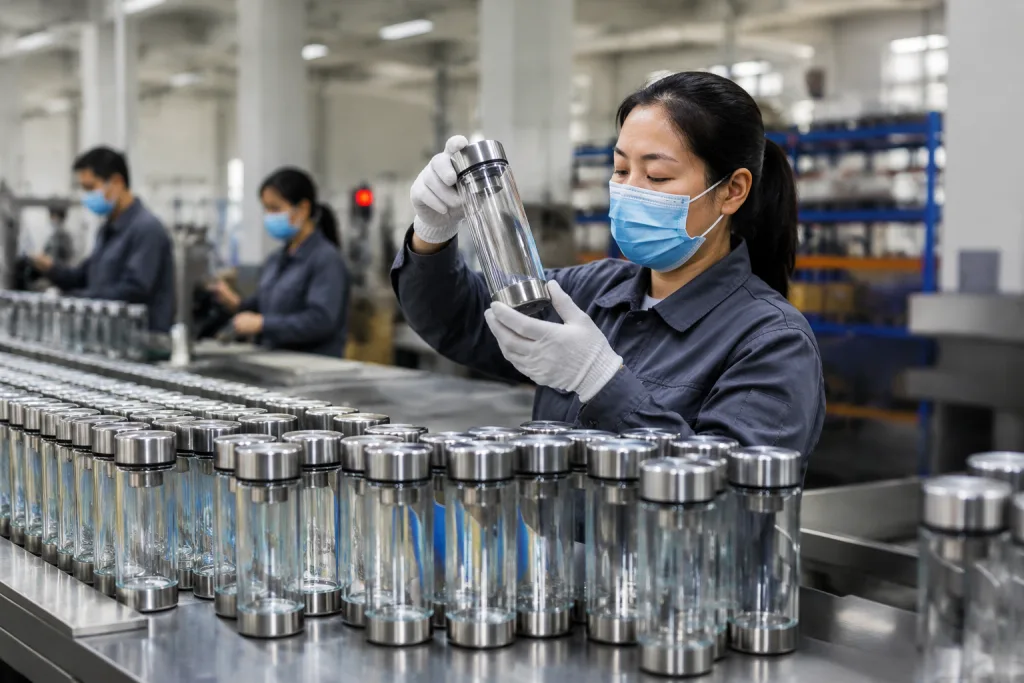
Once the PO is confirmed, get the production schedule in writing. A Zhejiang thermos factory should break the job into component arrival, printing, assembly, inspection, and packing. We ship 3,000-piece orders on time only when each step has a date. If the lids land two days late, the whole line waits. The useful answer is not “we are busy”; it is “7 days for components, 5 days for printing, 8 days for assembly, and 5 days for final packing.” Then you can manage the job.
During bulk production, ask for midline QC photos and one pre-shipment inspection. We usually run AQL 2.5 for major defects and AQL 4.0 for minor defects on retail bottles, then tighten it if the channel is unforgiving. Check random units for logo placement, lid sealing, vacuum performance if applicable, and carton count accuracy. QC pulled the sample last month and found one carton short by 2 pcs; that is the sort of miss you catch before the truck leaves. A distributor order can absorb a small packaging error better than a branded launch, but the process should stay the same. We’ve seen this go sideways when the buyer flagged a PO typo and the carton mark ran with the wrong SKU for a full shift. The factories that win repeat business show inspection records instead of arguing about them.
If the supplier offers a bulk discount, do the math against defect risk. Dropping from USD 4.20 to USD 4.00 on 10,000 units saves USD 2,000, but one bad print run can burn through that fast. A 1.2% rework rate on 10,000 units is 120 bottles, and the math no longer works. A sensible supplier thermos relationship is built on repeatable output, not the lowest line on the quote.
Price, lead time, and channel fit
Buyers usually ask for the unit price first. That is the wrong question to ask. For a custom thermos, the channel decides the spec, and the spec decides the price. A simple promotional run with one-color logo printing and a plain gift box can land at USD 2.80 to USD 4.00 FOB at 5,000 pcs if the build stays basic. A retail-ready glass-insulated bottle with an upgraded lid, sleeve, and printed carton usually sits at USD 4.50 to USD 7.50 FOB. If you want full private label support, we add USD 0.15 to USD 0.40 per unit for carton artwork changes, barcode setup, or extra inserts. QC pulled one sample here last week and found the carton size was off by 3 mm; that kind of miss shows up fast on the line.
Lead time changes with the order file. In Zhejiang, a reorder can move in 25 days. A new thermos custom project with fresh artwork, new packaging, and compliance papers usually needs 35 to 45 days after sample approval. We run into this every season: the buyer flags the PO, then the PO has a typo on the sleeve code, then the clock slips. For spring outdoor programs, 2 weeks before ship date is already too late. Get sample approval first, issue the PO, then book space early. That is how thermos programs stay on margin instead of getting crushed by emergency freight.
For category teams, the clean comparison is landed cost against sell-through risk. A lower unit price from a thermos vendor is not cheaper if the return rate rises 2% because the lid feels weak or the glass insert shows scratches on arrival. We have seen this go sideways with a 1,200 pcs test order: the first carton passed, the second one did not stack cleanly in the warehouse. The right supplier is the one that holds the same spec on reorder, not just the first shipment.
Send your RFQ and lock the spec
We can quote a borosilicate glass insulated water bottle private label program from sample to bulk, with clear MOQ, lead time, and packaging control.
Frequently asked questions
What MOQ should I expect for borosilicate glass private label bottles?
For a borosilicate glass insulated water bottle private label order, a realistic MOQ is usually 3,000 pcs per model and 1,000 to 3,000 pcs per color, depending on lid tooling and packaging. Some factory thermos suppliers can go lower for stock lids, but custom artwork and carton changes often push the real floor up. If you need multiple SKUs, ask for a mixed-order policy before you approve samples, because splitting into 3 colors can turn one 3,000-unit job into three expensive mini-runs.
How long does sampling usually take?
Sampling normally takes 10 to 15 days if the thermos manufacturer already has the glass body and lid parts in stock. If new decoration, new color, or a different carton is required, allow 15 to 20 days. For a more complex custom thermos build, the first decorated sample may take two rounds, so plan time for revision. Always request one plain sample and one logo sample so you can separate structural issues from print issues.
What price range is normal for bulk orders?
For bulk, simple promotional thermos styles can start around USD 2.80 to USD 4.00 FOB at 5,000 pcs. Better retail-ready versions with upgraded lids, sleeves, and decorated cartons usually fall between USD 4.50 and USD 7.50 FOB. If the project needs custom inserts, special coatings, or extra compliance paperwork, add USD 0.15 to USD 0.40 per unit. A quote that is far below this range usually means hidden compromises in packaging, gasket quality, or print durability.
Which compliance documents should I request?
Ask for food-contact declarations, REACH-related material statements for Europe, and any relevant migration or material test reports your market requires. For North America, many buyers also request ASTM-related test references where applicable, especially for materials, coatings, or packaging performance. If your distributor thermos channel needs extra documentation, ask for carton specs, barcode verification, and country of origin papers upfront. A serious supplier thermos partner in China should be able to organize these without guessing.
What should I include in the PO line items?
Your PO should include SKU, capacity, approved sample reference, logo file version, Pantone codes, packaging spec, barcode type, AQL target, shipment window, and incoterm. For a thermos customized private label job, also list carton count, spare parts policy, and any test standard the factory must follow. This prevents the supplier from working from memory. In Zhejiang, the best factories use the PO as the production control document, not just the sales document.