Key Takeaways
- A 0.5 mm 304 inner wall usually keeps FOB pricing lower than 0.6 mm, but 0.6 mm is a better fit for premium custom thermos retail sets
- MOQ for printed thermos custom orders often starts at 3,000 units, while laser-engraved promotional thermos runs can be negotiated from 1,000 units
- Borosilicate glass insulation gives cleaner taste and better clarity, but stainless thermos bodies handle impact better for outdoor retailers
- AqL 2.5 general inspection and 100% leak testing matter more than glossy photos when you buy thermos bulk from China
If you are buying for outdoor retail or a promo run, the hard part is not finding a thermos. It is telling a clean sample from a bottle that will survive freight, drops, and repeat filling without coming back as a complaint stack. A borosilicate glass insulated water bottle factory in Zhejiang should give you hard numbers: wall thickness, vacuum retention, coating method, carton spec, and a realistic MOQ that matches your launch, not your mood board.
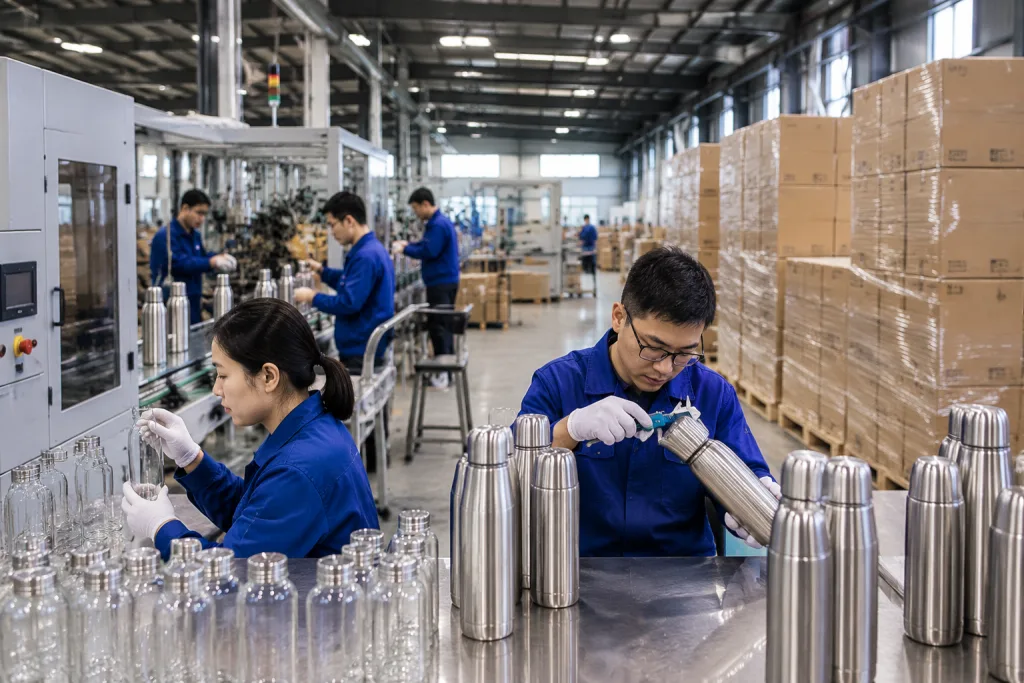
For stainless thermos programs, the same rule applies. You are not buying a story; you are buying a spec sheet that has to ship cleanly from China, pass REACH where needed, and hold margin at FOB pricing. At BottleForge in Hangzhou, Zhejiang, our factory thermos line runs 180,000 units per month, with standard MOQ starting at 3,000 pieces and common lead time at 25-35 days after sample approval. We run the line by numbers, and QC pulled the sample if the lid torque is off by even 0.5 N·m. If you read the specs line by line, you buy better bulk thermos stock and cut rework fast.
Start With the Inner Wall
The first spec that decides the job is the inner wall material. For a stainless thermos, the usual call is SUS304 or SUS316. SUS304 is the workhorse for most factory thermos runs because it keeps the price in check and holds up for tea, coffee, and cold water. SUS316 costs more, about USD 0.35-0.80 per unit depending on volume, but it handles salt and acidic drinks better. We’ve shipped enough beach and cycling orders to know this is where the buyer either pays once or pays later in complaints.
Wall thickness comes next, and this is where low-quote chasing bites back. A 0.5 mm inner wall is standard for bulk thermos production; 0.6 mm gives a heavier feel, resists dents better, and sounds cleaner when you tap it on the line. For promotional thermos orders, I would not spend on 0.7 mm unless the client wants a retail-grade customized thermos with a 12- to 24-month program. QC pulled the sample once and found a thin-wall batch that rang dull on the bench. The buyer flagged it immediately, and the PO had already gone through with the wrong thickness in the notes.
For a borosilicate glass insulated water bottle factory, the same rule applies, only the failure mode changes. Borosilicate glass handles thermal shock better than ordinary soda-lime glass, but the wall and liner design still drive breakage rates. If your buyer wants a premium custom thermos look with a clear body, ask for glass thickness, sleeve coverage, and drop-test data, not just capacity. That is the right question to ask. One sample we checked at 2.8 mm looked fine on paper and failed after a 1.2 m drop because the sleeve stopped short at the shoulder.
Vacuum and Heat Retention
Insulation is where a thermos stops being a commodity bottle. The vacuum gap between the inner and outer walls has to stay even, or you get thermal bridges and dead spots. We quote heat retention at 20°C ambient with a 95°C fill, because that is the cleanest factory-side comparison. A decent 500 ml stainless model should still be above 70°C after 6 hours and above 55°C after 12 hours, and the lid plus mouth opening will move that number. A 38 mm mouth cools faster than a narrow neck. That is physics, not sales talk.
If you are buying a distributor thermos program for outdoor shops, test the lid seal with water, not promises. A screw-top lid with a silicone gasket usually seals better than a push-button cap, while a straw lid is convenient but gives up retention. On the glass side, a borosilicate glass insulated water bottle factory should show both hot and cold retention data and tell you whether the lid was tuned for sealing or easy drinking. We have seen buyers accept “long-lasting insulation” on a PO, then QC pulled the sample and the numbers fell apart. Ask for the test temperature, the start fill, and the timing, or you are guessing.
For thermos bulk orders, ask how many samples went into retention validation. Three bottles is thin data. Ten to fifteen units gives a better read on process spread, especially when you are comparing thermos suppliers or planning a private-label launch. On one line we checked a 12-unit set and found a 4°C swing after 6 hours because two lids had gasket flash; the buyer flagged it before shipment. That is the wrong question to ask if you only want a headline figure. Ask for the spread, not just the average.
Cap, Seal, and Leak Risk
The lid is where the complaints start. A custom thermos can look perfect in the render and still fail if the cap thread depth is shallow or the silicone ring is too soft. On one line, QC pulled a sample that leaked at 45 degrees after a 600 mm drop test because the gasket groove was 0.3 mm off. For a hiking pack or retail shelf, the lid torque needs to feel firm, not like you need a wrench. The silicone gasket should be food-grade and pass LFGB or FDA expectations, depending on the market. For Europe, REACH compliance for inks, coatings, and silicone is not optional.
Leak testing should sit in the spec, not in a sales promise. We run 100% cap-up and cap-down leak tests on lots above 5,000 pieces, plus a sample pressure test for carbonated or high-shake transport cases. The buyer flagged a lid logo once because the pad print sat 1.2 mm too close to the vent slot, and the cap started seeping after a week in transit. For promotional thermos orders, shortcuts show up fast. A thermos promotional order only works if the recipient can drop it in a backpack and keep the laptop sleeve dry.
For a thermos distributor or thermos vendor buying for multiple retail accounts, lid standardization matters. One lid family across 350 ml, 500 ml, and 750 ml sizes cuts carton complexity and spare-part headaches. It also makes your customized thermos program easier to repeat next season without retooling every SKU. We’ve seen this go sideways when a PO typo changed one cap code by a single digit, and the wrong stopper arrived on the line.
Decoration That Survives Use
Decoration should be chosen by abrasion, not by looks. Silk screen still gives the best landed cost for flat logos and one- or two-color brand marks. Laser engraving costs more at the start, but it does not peel, and we see it win on premium stainless thermos runs. If you need a full-color sleeve, you are usually moving into heat transfer or water transfer, which pushes MOQ up and gives you more color drift from batch to batch.
For custom logo work, ask your supplier thermos team for the ink spec, curing temperature, and rub-test results. A printed logo that survives 50 rubs with alcohol is usable; 100 rubs is better for retail. On brushed stainless, laser gives the cleanest edge. On powder-coated bodies, screen print is fine if the coating is cured right. We run the line with a simple rub block, and the buyer flagged it when a logo smeared after 30 strokes. For a thermos custom launch, I would take a plain, durable mark over a busy graphic that chips after one season.
This is where Zhejiang factories split by maturity. A serious thermos factory will show digital proofs, Pantone matching tolerance, and a reject threshold for print offset, plus a 0.3 mm line-width check on curved surfaces. A weaker thermos manufacturer will show a pretty mockup and hope you do not ask how they control it. We've seen that go sideways on a PO with a wrong Pantone code, and the math does not work when you reprint 5,000 units.
Capacity, Shape, and Shelf Fit
Capacity is a merch call, not a spec line. 350 ml fits office desks and gift sets. 500 ml is usually the safest retail pick because the price lands right, it carries well, and buyers reorder it. 750 ml moves better in outdoor channels where the user wants fewer refills. If you are building a thermos distributors catalog, keep the range tight. We ship cleaner when the lineup stays short, and a 12-SKU spread will blow up carton counts, barcode setup, and stock control.
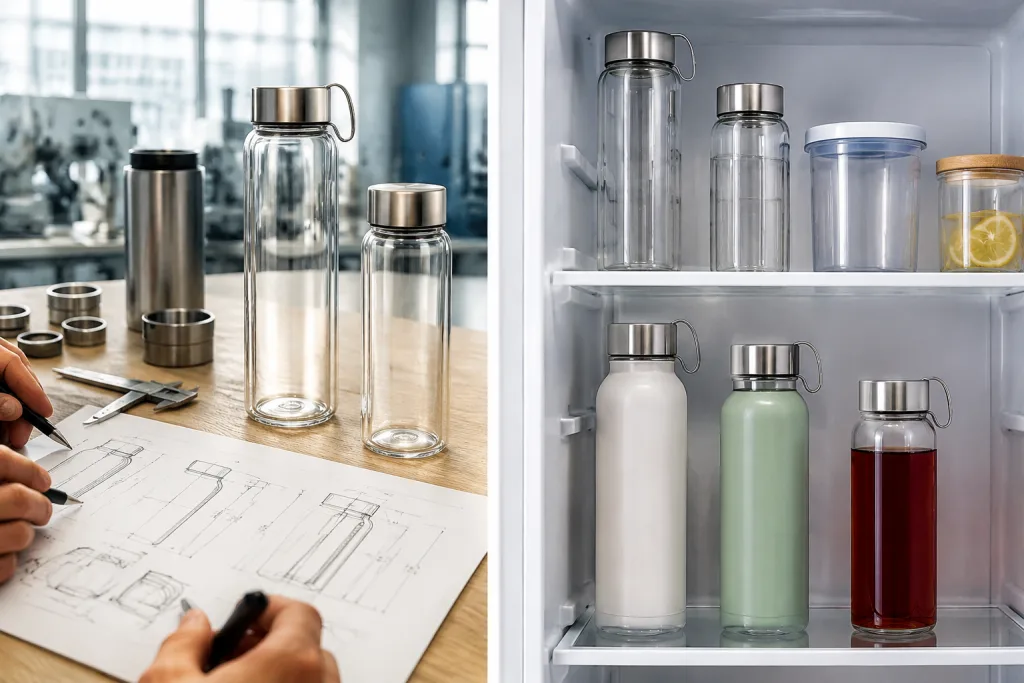
Shape changes the customer feel fast. A slim body looks premium and drops into cup holders, but stability takes a hit. A straight wall is easier on the pad printer and the packing line. A tapered shoulder gives a better one-hand grip, and we see outdoor buyers ask for that after the first sample round. For borosilicate glass insulated water bottle factory sourcing, shape also changes sleeve coverage and impact protection. QC pulled one sample with a 1.2 mm scuff on the glass wall, and the buyer flagged it on the spot.
For Amazon or DTC packaging, the bottle footprint should fit the case pack and FNSKU labels with no dead space. If you are sourcing thermos bulk for a distributor thermos program, ask for master carton size early. A 12-piece carton that stacks well can cut freight waste on pallet loads from China, especially on a Zhejiang to North America lane. The wrong question is whether the carton is “good enough”; the math on cube and pallet count tells the truth.
Packaging, Compliance, and MOQ
Packaging is where margin slips away. A printed color box, molded pulp insert, and shrink wrap can add USD 0.20-0.65 per unit, depending on how many inserts and print passes the line needs. If the order is a promo thermos with a 45-day campaign, this is the wrong place to spend money; put it into decoration or cut lead time by 3 to 5 days. If you are building a retail custom thermos line, the box has one job: hold the bottle, survive transit, and sell the brand in the first 3 seconds.
Compliance needs to be locked before deposit. We ship a lot of orders where the buyer flagged coating docs after the PO was signed, and that turns into a week of back-and-forth. For Europe, ask for REACH declarations on coatings, inks, and silicone. For North America, request food-contact documentation and, where relevant, ASTM or FDA-aligned test reports. A serious thermos supplier should also show BSCI or a similar social audit status if your buyer asks for it. On a borosilicate glass insulated water bottle factory order, ask for separate files for the glass tube and the gasket; QC pulled the sample twice on one job because those were mixed up.
MOQ decides whether the idea becomes a program. At our Hangzhou site in Zhejiang, standard MOQ is 3,000 pieces per SKU for standard decoration, while more complex thermos customizable packaging can require 5,000 pieces. That math works for distributor thermos accounts. For a smaller thermos supplier or a first-time buyer, we often split decoration and packaging so the entry point stays realistic and the unit price does not get crushed by setup waste. We once caught a PO typo that said 300 instead of 3,000; the buyer wanted the lower number, but the line had already been planned for a full run.
Send your spec, get a real factory quote
Share your volume, decoration, and target market. We will quote the right thermos factory spec from Zhejiang, not a guess.
Frequently asked questions
What is a realistic MOQ for a custom thermos order?
For standard stainless thermos production, 3,000 pieces per SKU is realistic at a Zhejiang factory. If you need laser engraving or a simple single-color print, some programs can start at 1,000 to 2,000 units, but unit price rises by about 8% to 18%. Full-color packaging or multiple lid variants usually pushes MOQ to 5,000 pieces. For a thermos bulk launch, ask for one MOQ by decoration method, not one generic number. That keeps your custom thermos quote honest.
How do I judge thermal performance before I place an order?
Ask for test conditions, not just hours. A proper thermos manufacturer should report start temperature, ambient temperature, fill volume, and measurement points. For a 500 ml stainless bottle, a common benchmark is above 70°C at 6 hours and above 55°C at 12 hours. For a borosilicate glass insulated water bottle factory, ask for both hot and cold retention and whether the lid was tested separately. Real data beats a glossy brochure every time.
Is borosilicate glass better than stainless for outdoor retail?
Not universally. Borosilicate glass gives clearer product presentation and clean taste, which works well for premium gifts and desk use. Stainless thermos bodies handle impact much better for outdoor retail, travel, and distributor thermos channels. If your customer will toss the bottle into a pack, stainless wins. If the bottle will sit on a desk or in a controlled environment, borosilicate can be the better story. The right choice depends on how the end user handles it, not on which one sounds more premium.
What inspection standard should I request?
AQL 2.5 for major defects and 4.0 for minor defects is a common baseline for thermos manufacturers, but you should define leak testing separately. I recommend 100% leak test on production units, plus sample-based dimensional and print checks. If the order is for promotional thermos distribution, add carton drop testing to protect the campaign. For factory thermos imports into Europe, also ask for REACH-related documents and make sure the coating and gasket files are current.
Can I get different finishes on one thermos order?
Yes, but it affects cost and lead time. A thermos custom project with matte powder coat, brushed steel, and printed logo in one PO usually needs separate line setup and can add 3 to 7 days to production. If you want a customized thermos program with multiple finishes, keep the body shape the same and vary only the surface treatment or artwork. That gives your thermos supplier a cleaner schedule and keeps freight consolidation simpler.