Key Takeaways
- Borosilicate glass usually adds 15% to 35% over soda-lime glass on ex-factory cost, depending on wall thickness and lid
- Typical MOQ for a custom shaker bottle or custom sports water bottle starts at 3,000 to 5,000 pcs per SKU
- Standard lead time is 25 to 40 days after sample approval; new molds or special lids can add 15 to 25 days
- Expect test and compliance budgets of USD 150 to 500 per model for REACH, food-contact, and carton drop checks
If you are sourcing a borosilicate glass fitness water bottle supplier, the first mistake is treating “glass” as premium and simple. It is neither. Borosilicate improves thermal shock resistance, but it also pushes up forming loss, annealing time, and breakage control costs. On one gym-chain order, a 0.8 mm wall spec looked neat on paper; once we ran the line, the landed price moved more than the logo fee ever did.
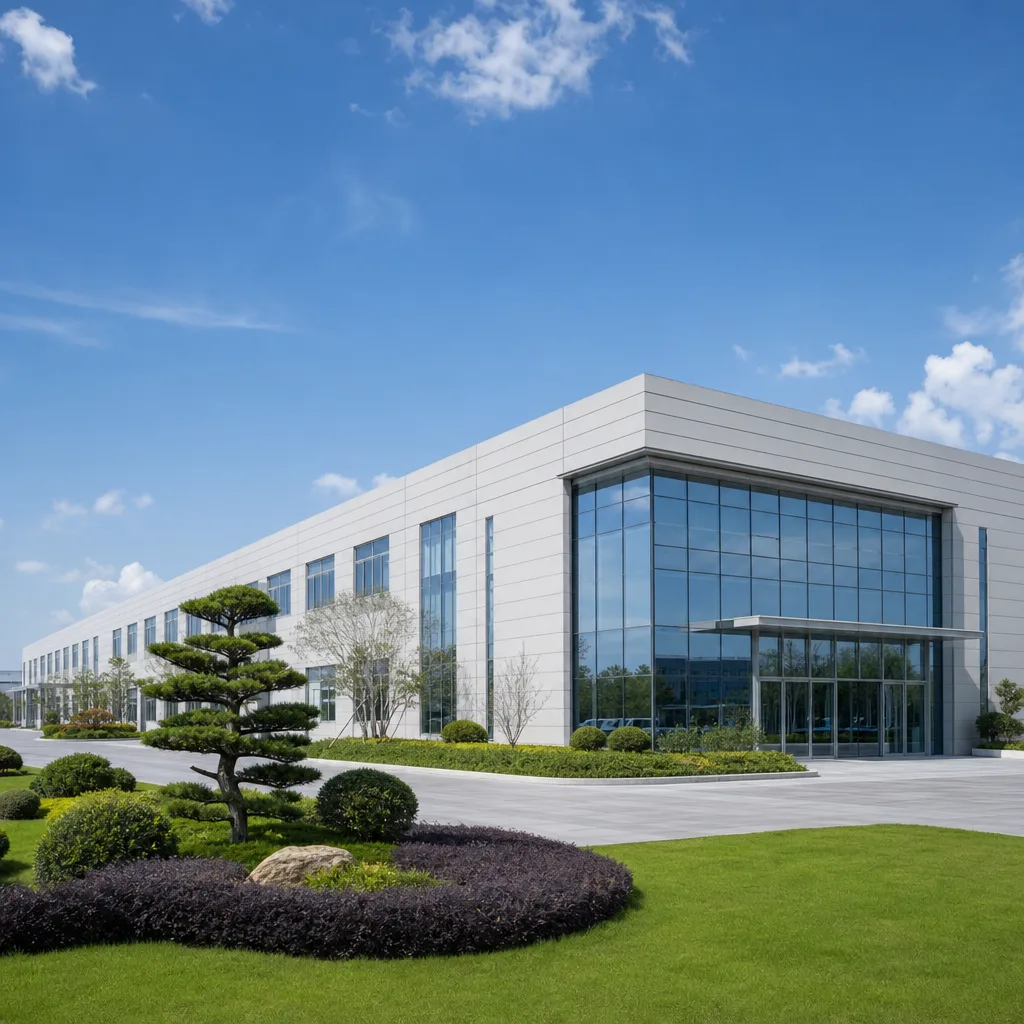
In Zhejiang and across China, the better factories talk in batches, not buzzwords. They quote by wall thickness, lid type, deco method, drop-test target, and packing spec. That is the right question to ask. A real factory with 200,000 units/month capacity can still miss the mark if its MOQ is 3,000 pieces, its print shop only runs silk screen, or its QC pulled the sample from the wrong carton route.
What drives your unit cost
When we price a borosilicate glass fitness water bottle supplier order, glass is only the first line. We pay for tube or press-form material, forming yield, annealing hours, cap sourcing, decoration, and packing. Borosilicate costs more because the kiln needs tighter control and the line runs cleaner. That shows up on the floor, not just on the quotation.
For a 500 ml bottle, a plain borosilicate body can sit around USD 0.65 to 1.20 per piece at 3,000 pcs, before lid and print. Add a PP or Tritan lid and the factory price usually moves to USD 0.95 to 1.75. A stainless lid, silicone sleeve, or infuser basket can push it to USD 1.60 to 2.80. If you want a custom fitness water bottle with a 1-color logo, budget another USD 0.05 to 0.18 per unit. We have seen buyers push back on laser engraving versus screen print, but the channel decides it; a gym chain wants a clean cap, while an e-commerce pack often needs bolder branding.
- Glass wall thickness: 1.8 mm runs cheaper; 2.2 to 2.5 mm improves drop resistance and raises cost
- Lid type: flip-top, screw cap, bamboo-look cap, or shaker cap each pulls different tooling, inserts, and sourcing work
- Decoration: one-color silk screen is usually the lowest cost; multi-color or gradient print adds setup time and more rejects
- Packing: individual box, egg-crate insert, or master carton spec changes freight efficiency and breakage rate
In Zhejiang, a good supplier will split the cost instead of hiding it inside one FOB number. QC pulled the sample on a Friday, checked the 58 mm mouth, and the math still had to work. If a quote looks too neat, the factory is probably leaving out packaging, testing, or replacement allowance.
MOQ tiers that make sense
MOQ is where a lot of gym brands lose two weeks, sometimes three. A distributor fitness water bottle program needs enough volume to cover decoration and packing setup, but not so much that cartons sit in the warehouse for 90 days. For borosilicate glass, we run the line by body style, lid style, and print count. That is the real math.
For a standard custom gym water bottle, 3,000 pcs per color is a workable start. If the buyer wants a custom logo shaker bottle with a special lid or insert, we usually see the floor move to 5,000 pcs. A simple one-color logo on a stock mold can sometimes go at 1,000 to 2,000 pcs, but the unit price climbs by 12% to 25%. QC pulled the sample on one of these runs and the buyer flagged the bagging change, so yes, the trade-off is real.
Practical tiering:
- 1,000 to 2,000 pcs: pilot run, distributor sampler, or first retail test
- 3,000 to 5,000 pcs: normal MOQ for a branded launch
- 10,000 pcs+: lower unit cost, cleaner packing flow, more room for custom tooling
If you are a gym chain ordering a customizable sports water bottle for retail and member gifts, split the order by SKU, not by wish list. One body, one lid, one logo color. The buyer always wants three cap colors and two print positions; the math does not work that way. We saw a PO typo once—“5,000” became “500”—and the line had to stop while the carton labels were fixed. Complexity gets paid for somewhere, and usually it shows up in MOQ.
Lead time from sample to ship
Lead time is not a single number if the supplier is being straight with you. For a bulk sports water bottle program, the clock starts at sample approval, not the first email. If the mold is ready and the lid is stock, we can move fast. If you need a shaker insert, a new carton, or a special finish, the schedule opens up. We’ve seen a buyer flag a PO typo on the carton code and lose three days before the line could pack the first box.
A normal run looks like this: 3 to 7 days for sample prep, 5 to 10 days for freight sample delivery, 2 to 5 days for approval, and 25 to 40 days for production after deposit and final sign-off. Add 10 to 20 days if you need new tooling for a lid, silicone part, or sleeve. For a custom made shaker bottle with multiple parts, I would not promise less than 45 to 60 days door-to-port unless every part is already in stock. QC pulled the sample at 1.5 mm cap gap once, and that one check pushed the ship date by a full week.
What slows shipments is rarely the bottle body. It is usually the cap, the logo approval, or the outer carton spec.
Ask the supplier for a production calendar with gate points: artwork approval, pre-production sample, inline inspection, and final inspection. A real export team in China will map that against your season launch. If they cannot give you a timeline in days, they are not managing lead time; they are guessing. That is the wrong question to dodge. We run the line with dates, not hope.
Decoration changes the math
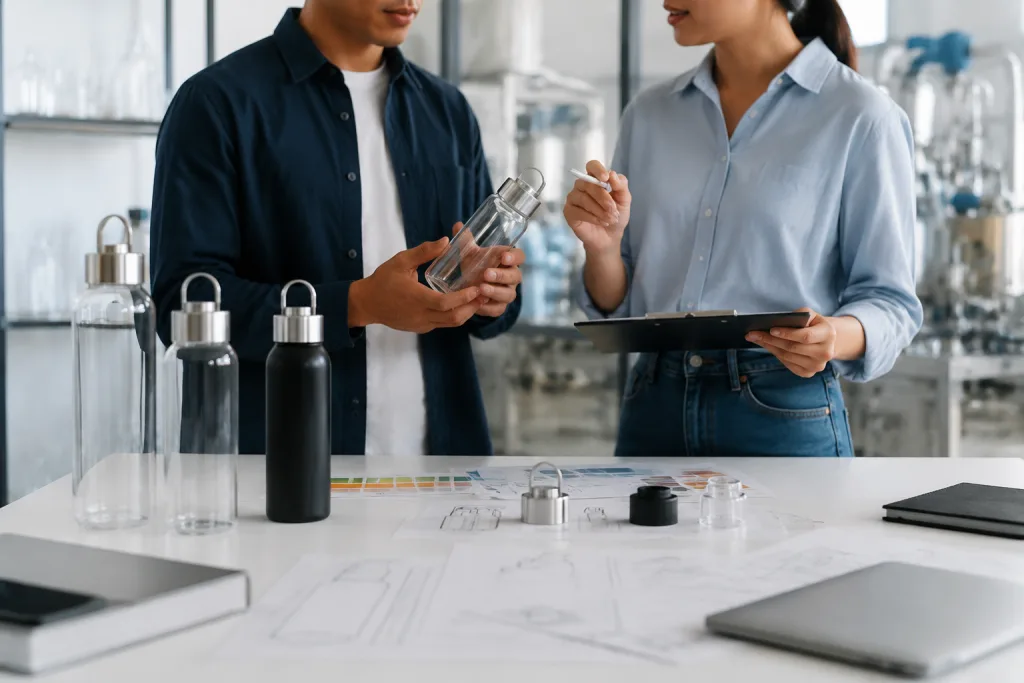
Decoration is where a customizable fitness water bottle starts making money or giving you headaches. We run one-color silk screen on glass every week, and the line still cares about surface energy, curing temperature, and wash resistance. Glass is less forgiving than PET or stainless. If you want a logo that survives hand washing and gym use, ask for abrasion testing, not a pretty proof.
For a custom shaker bottle or custom sports water bottle, the main decoration options are silk screen, UV print, decal, and laser on metal parts. Silk screen is usually the cleanest choice for 1-color branding, with a unit uplift around USD 0.05 to 0.12. Full-color UV print can add USD 0.15 to 0.40, depending on coverage and curing setup. We had one buyer flag a PO typo on the print position and the whole carton label had to be rechecked. Decals look flexible, but fine gradients and wrap-around placement create QC trouble fast.
If you sell through retail or gym counters, the logo has to hold up under shelf handling. If the bottles go into employee packs or member gifts, you can ease the print spec and put more budget into the box. For a distributor gym water bottle program, the right question is not how many decoration options you can quote. It is which one stays clean from one meter away and does not blow up the math. That sounds plain. It sells.
- Best low-risk option: 1-color silk screen
- Best premium option: laser on cap plus clean body print
- Best for fast sourcing: stock mold with existing lid and carton
Testing you should not skip
If your supplier cannot speak plainly about testing, walk away. A borosilicate glass fitness water bottle supplier should show food-contact support for Europe and North America, plus shipping checks that match real carton loads. At minimum, ask for REACH-related material declarations, LFGB or FDA-aligned food-contact support, carton drop tests, and glass stress control. We run this kind of check on the line because breakage is not a theory. It turns into returns, and returns kill margin fast.
Good factories in Zhejiang usually run incoming inspection on glass bodies, lid torque checks with a torque meter, and visual defect sorting under light boxes. For export, the QC plan should cite AQL. A practical standard is AQL 2.5 for critical defects and AQL 4.0 for major defects, depending on your risk tolerance. If you are selling a bulk gym water bottle program into chains, ask for an inspection report with sample size, defect count, and photo evidence. “OK” is not QC. We’ve seen that go sideways after one typo on the PO and a buyer flagged the whole lot.
Testing cost is modest next to a failed launch. Budget USD 150 to 300 for simple lab support and USD 300 to 500 if you need a broader document pack or multiple SKU checks. That is cheap insurance when you are shipping into Europe or North America, especially when a distributor asks for a compliance file and wants it before the first 5,000 pieces move.
How to price for landed margin
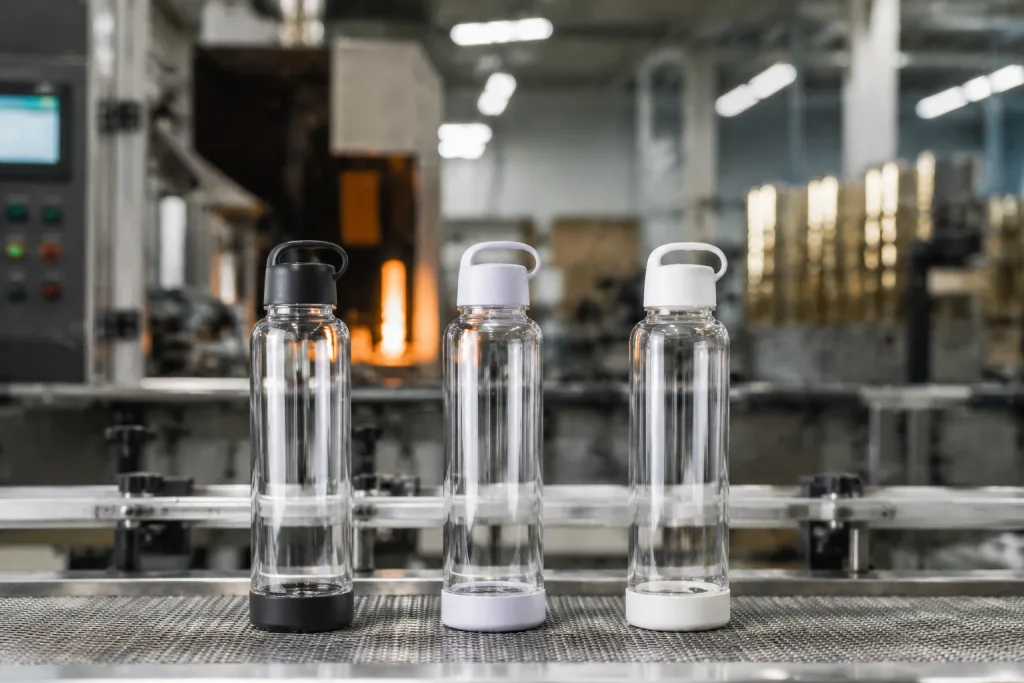
FOB is only the starting point. It is not your real cost. When you buy a bulk fitness water bottle, price it on landed terms: bottle cost, carton cost, inland trucking, export docs, freight, duty, and breakage. We have seen a borosilicate bottle look cheap on paper, then fail in a 1.2 m drop test because the inner tray was loose. That is how the “best” quote turns into the worst result.
For planning, we usually model a customized gym water bottle with 10% to 18% freight on ocean shipments when the container is full enough to ship efficiently; airfreight for samples can blow past that fast. Duty changes by destination and HS code, so your broker should confirm it before you commit the margin. If you are a distributor shaker bottle buyer, leave 1% to 3% for damage on the first run unless the line has already proven the pack in transit.
Here is the rule we use with buyers: if the FOB is 15% below market, check whether the carton, insert, and spare parts are included. A PO typo on “with straw” versus “without straw” can move the whole math, and we have had that exact fight. In China, the savings usually shift from one line item to another. The number that counts is what your warehouse books after receipt.
- FOB target: compare the same logo, lid, carton, and accessory spec
- Freight target: tighten pack-out before you push on ocean rates
- Damage allowance: reserve 1% to 3% for first shipments
What to ask before you order
Before you place a PO, force the supplier to answer the dull questions. That is where a real factory shows up. Ask for monthly output, current capacity, and whether they mold the glass body in-house or buy it from another shop. A factory in China with 200,000 units/month capacity is not automatically the better pick; we run into lines that sound big on paper and choke at one lid station.
For a customizable shaker bottle or customized sports water bottle, ask four things: sample turnaround in days, MOQ by lid type, lead time after deposit, and what happens if 2% of cartons fail the drop test. Then ask for photos of the packing line and an export carton spec. If you are a distributor fitness water bottle buyer, ask whether they can repeat the same color and logo across reorder lots. That is the real question. We’ve seen buyers chase a pretty sample and then get burned when the second run comes back off-shade by 1.5 mm on the print ring.
The better suppliers in Zhejiang answer straight. No drama. They will tell you if a custom logo shaker bottle needs a longer cure time, or if a bamboo lid looks good but turns into a headache in humid markets. QC pulled the sample, checked the cap torque, and that was the end of the story. That kind of blunt answer saves money.
Request a factory quote with real cost breakdown
Send your target MOQ, lid style, logo file, and launch date. We will quote by unit cost, lead time, and packing spec—not guesses.
Frequently asked questions
What is the typical MOQ for a borosilicate fitness bottle order?
For most factory programs, a standard MOQ is 3,000 pcs per SKU for a custom fitness water bottle and 5,000 pcs if you add a special shaker lid or insert. A simple stock-mold pilot can sometimes start at 1,000 to 2,000 pcs, but unit cost usually rises 12% to 25%. If you need multiple colors, treat each color as a separate SKU. For gym chains, I usually recommend one body, one lid, one print spec to keep the MOQ manageable.
How long does production usually take in China?
If the mold exists and the lid is stock, expect 25 to 40 days after sample approval and deposit. Add 3 to 7 days for sample prep, plus freight time for samples. If you need new tooling, a special cap, or custom carton inserts, plan on 45 to 60 days. In Zhejiang, a well-run factory will give you a gate-by-gate schedule so you know when artwork, pre-production sample, and final inspection are due.
What should I budget for a custom logo shaker bottle?
A plain borosilicate bottle body can start around USD 0.65 to 1.20 at 3,000 pcs, before lid and decoration. With a standard lid, the range is usually USD 0.95 to 1.75. Add USD 0.05 to 0.18 for one-color logo print, and more for UV or multi-color decoration. If you want a premium cap, sleeve, or infuser, the total can move to USD 1.60 to 2.80. Ask for FOB at the exact same spec, not a generic quote.
Can borosilicate glass work for gym retail and distributor programs?
Yes, if you control packing and QC. Borosilicate is a better fit than ordinary glass when you want a premium feel for retail shelves, member gifts, or distributor fitness water bottle programs. It handles thermal shock better, but it still needs proper wall thickness, usually around 1.8 to 2.5 mm depending on the design. For North America and Europe, ask for food-contact documentation, REACH support, and carton drop-test evidence before you launch.
What inspections should I request before shipment?
Ask for pre-shipment inspection using AQL, ideally AQL 2.5 for critical defects and AQL 4.0 for major defects, depending on your risk profile. Request checks for print alignment, lid torque, glass scratches, and carton drop performance. For a bulk sports water bottle order, also ask for photos of the packaging line and a count of spare parts if your product has a shaker insert or silicone sleeve. That is the easiest way to reduce return rates after import.