Key Takeaways
- Borosilicate glass usually performs best at 1.8-2.5 mm wall thickness for a retail fitness bottle.
- A practical MOQ for private label runs in China is often 3,000-5,000 units per SKU.
- Typical lead time is 25-35 days after sample approval, plus 5-8 days for packing.
- Ask for REACH, food-contact, and drop-test data before approving a custom sports water bottle.
If you are sourcing a borosilicate glass fitness water bottle private label program for a gym chain or fitness brand, the bottle is only half the decision. The real job sits in the spec sheet: glass grade, 3.0 mm wall thickness, cap torque, leak rate, carton crush test, and whether the logo still holds after 200 dishwasher cycles. We run this kind of program in Zhejiang every week, and the factory photos always look fine. The buyer flagged it, then QC pulled the sample, and the issue was a 1.5 mm gasket mismatch.
This matters more with glass than with PET or steel. Borosilicate stays stable, tastes clean, and takes hot-fill better, but the cap system, sleeve, and shipper box have to be right. If the torque spec slips by 0.3 N·m, you get leaks. For a bulk fitness water bottle order, that is not a small problem. You need exact controls for custom gym water bottle branding, transit damage, and retailer rules, because this is a commercial product, not a giveaway.
Start with the glass spec
The first line on the sheet should be the glass itself. For a borosilicate glass fitness water bottle private label program, the supplier needs to state the glass grade, wall thickness, mouth finish, and thermal resistance in numbers. Borosilicate handles temperature swings better than soda-lime glass and keeps taste out of the bottle. That matters on the gym floor. Buyers notice fast.
Do not accept “high borosilicate” as a sales phrase. We have seen this go sideways on the line when the buyer flagged a crack after a cold-fill test. Ask for the composition standard, then lock the wall thickness by size: 1.8 mm works for lighter SKUs, 2.2 mm is safer for daily gym carry, and 2.5 mm gives a more solid hand feel. The math does not work if you treat all sizes the same.
- Wall thickness: 1.8-2.5 mm depending on size and target price.
- Temperature tolerance: ask for the exact hot/cold range, not “boiling safe.”
- Finish: confirm the neck thread standard and gasket fit.
- Use case: custom fitness water bottle, not lab glassware.
In Zhejiang, better factories show thickness tolerance on the sample report with a caliper reading, usually within 0.2 mm. We run that check before packing. The weaker ones send a clean photo and call it done, then QC pulled the sample and found the neck off by 1 mm.
Cap system decides leakage
Most complaints on a custom shaker bottle or custom sports water bottle start at the cap, not the bottle body. If the lid leaks in a gym bag, your private label program turns into a service ticket pile fast. Lock down closure type, gasket material, torque range, and cycle testing. We ship enough of these to know the cap is the whole game. A flip lid works on the training floor, but a screw cap with a silicone seal usually gives cleaner leak results for ecommerce and distributor channels.
For a bulk gym water bottle, ask the factory to test the closure inverted for 24 hours, then run vibration and drop testing. On the line, we also check whether the cap is PP, Tritan, or stainless steel, and whether the gasket is food-grade silicone. QC pulled the sample twice last month because one buyer flagged a 0.5 mm thread mismatch. A custom logo shaker bottle needs thread consistency first; laser decoration on the lid means nothing if the closure fails.
What buyers should lock down
- Leak test: 24-hour inverted hold, then freight simulation with vibration and drop checks.
- Gasket: food-grade silicone with replacement tolerance.
- Torque: enough for sealing, not so high that users over-tighten and crack the neck.
- Cycle life: target 3,000-5,000 open/close cycles for retail programs.
For distributors fitness water bottle programs, this is where margin gets protected. A lid that costs USD 0.20 more can save far more in claims, returns, and store credit. We've seen the math work out that way on 10,000-piece runs, and we've seen it go sideways when a PO typo called for the wrong gasket hardness.
Branding that survives use
Private label branding has to hold up through washing, rubbing, and daily hand contact. A custom logo shaker bottle or customized fitness water bottle usually has three decoration routes: silk screen, laser, or decal. On glass, silk screen still makes the most sense for single- or two-color logos. Laser on a coated cap can look clean, but the bottle body is what buyers see on shelf and on the gym floor. If the logo starts peeling after 2 weeks, that print failed before the product did.
Ask for decoration specs line by line: ink type, curing temperature, logo size limit, and whether the print is dishwasher safe. For a custom made shaker bottle or customizable sports water bottle, we ask for at least 50 home wash cycles, or the buyer should agree to hand-wash only. Full-wrap graphics need alignment tolerance in writing. A 1.5-2 mm shift sounds small; on clear glass, the line notices it fast. QC pulled a sample, and that offset showed up immediately.
Buyers in Europe and North America usually care less about “more decoration” and more about whether the branding stays intact after normal use.
When you source from China, the decoration sample is not optional. Zhejiang factories can run clean branding, but only when the spec is clear and signed off before mass production. We had a PO last season with a typo on the logo width, and the buyer flagged it before the line started. That saved a reprint.
Dimensions affect shelf and freight
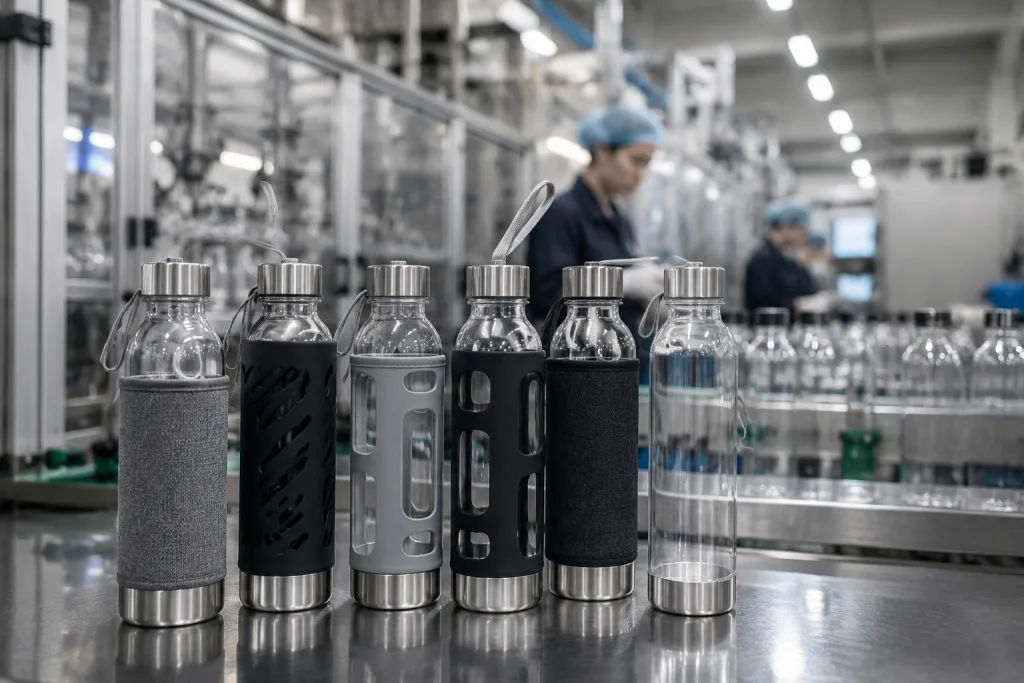
The same bottle can move fast or sit on the shelf, and size is usually why. For a bulk fitness water bottle program, match the dimensions to shelf width, hand feel, and carton loading. We run 500 ml, 750 ml, and 1,000 ml a lot. A 500 ml bottle works for studio classes and small gym bags. A 750 ml bottle is the safe middle. A 1,000 ml version gives a premium look, but freight weight goes up and the line sees more breakage during packing.
Ask the supplier for outer diameter, height, and packed carton count. Those three numbers decide whether a distributor gym water bottle program ships with margin. We had a buyer flag a 78 mm body because it killed cup-holder fit and carton density in the same shot. If the bottle is 68 mm in diameter, it usually sits better in standard holders. For Amazon or store replenishment, carton size also changes FBA fees, pallet layers, and the damage rate. QC pulled the sample and found a loose divider at 12 mm, which is the kind of detail that turns into claims later.
- 500 ml: lighter, lower freight, and easier to place at entry price points.
- 750 ml: the most balanced custom sports water bottle size for gym buyers.
- 1,000 ml: stronger premium signal, but it needs tighter breakage control.
- Packout: ask for master carton count and gross weight, not just bottle size.
If you are a distributor sports water bottle buyer, check how many units fit on a Euro pallet and whether the carton burst strength can handle long-haul trucking. We have seen this go sideways when a PO typo changed carton length by 10 mm, and the math stopped working.
Testing is where value shows
A clean spec sheet is not enough. You need test evidence. For a borosilicate glass fitness water bottle private label order, ask for drop testing, thermal shock results, leak testing, and food-contact compliance. The stronger factories in China will show in-house data plus third-party reports for REACH or LFGB where applicable. If you sell into North America, ask how the product lines up with FDA food-contact expectations. Do not treat the glass body as the only compliance point; cap material, inks, and silicone matter too. We have seen a buyer miss a silicone smell issue and lose a whole first shipment.
For retail buyers, AQL inspection should be written into the order. A common starting point is AQL 2.5 for critical defects and 4.0 for major defects, but your tolerance depends on channel risk. If the program is for a gym chain with live users, push harder on leakage and decoration defects than on a one-off promo order. A distributor fitness water bottle line should also include carton-drop testing at the outer-box level, not just a bottle drop test by itself. QC pulled one sample at 1.2 meters and the lid popped open; that is the kind of miss you catch before the truck leaves.
Minimum checks worth paying for
- Leak test: inverted, shaken, and transported.
- Drop test: packed and unpacked, with defined height.
- Thermal shock: especially if you position the bottle for hot and cold use.
- Compliance: REACH, LFGB where needed, and material declarations.
In Zhejiang, factories that export regularly will understand these requests. In China, many still need the buyer to define the method clearly, so put the standard in writing. We run this every week on the line with a simple checklist, because the math does not work if the PO says “test pass” and nothing else. One typo on a PO can turn 2.5 into 25, and that is a headache nobody needs.

MOQ and pricing reality
Price only means something against the full spec. A basic bulk gym water bottle in borosilicate glass with a standard screw cap and one-color logo usually sits at USD 2.10-3.40 at 3,000 units. That range moves with size, cap type, and pack style. We ran a 450ml sample last week; once the buyer added a matte black lid and a printed sleeve, the unit cost jumped fast. A custom fitness water bottle with a metal lid, printed gift box, and thicker glass can land at USD 4.50-6.80 before freight.
For private label, MOQ usually starts at 3,000 units per design. Some Zhejiang factories will quote 1,000-2,000 if they already have a base mold and stock cap. That lower MOQ cuts room on logo placement, cap color, and packaging format. QC pulled the sample and caught a 2 mm logo shift on the second run; the buyer flagged it, and that is the sort of issue that shows up when you push the floor too hard. If you are a brand owner testing a new line, a smaller run works. If you are a distributor or gym chain ordering across multiple regions, lock the spec and push for repeatability instead of chasing the lowest unit price.
Ask for FOB China pricing, not a fuzzy landed guess. On glass, a quote without carton spec, pallet plan, and inspection cost is incomplete. We see this go sideways when the PO says “gift box” but leaves out board grade and drop test requirement. If you sell as a customizable gym water bottle, the lowest ex-factory price can still become the most expensive option after breakage and rework.
Private label packaging and supply
Packaging is not decoration. It protects the bottle, keeps freight under control, and decides how the SKU looks on shelf. For a customized shaker bottle or customized sports water bottle program, we run the carton around the actual bottle size so void space stays low and breakage stays down; 3 mm of extra clearance can turn into damaged corners on the line. Individual boxes fit retail. Egg-crate or divider cartons fit bulk replenishment. If you ship into North America, ask for the pallet height limit in writing and check whether the outer carton still passes a standard drop test after vibration.
Ask the factory how they handle spare parts, especially if you are building a custom shaker bottle with an extra lid, filter, or sleeve. We’ve seen this go sideways when the buyer assumed every carton would include a backup cap, then the PO typo left the spare count at zero. For a distributor shaker bottle program, 2%-3% spare allowance for caps and seals is the normal call. Confirm logo color control too. A Pantone match that drifts one or two shades is enough for the buyer to flag it on reorder six months later.
- Retail box: best for premium presentation and ecommerce.
- Bulk pack: lower freight cost, faster warehouse handling.
- Spare parts: useful for distributor and chain-account service.
- Repeat order control: keep the same approved sample and artwork file.
If you want a dependable custom gym water bottle line, packaging belongs in the product spec from day one, not as a last-minute add-on from the China factory. The math doesn’t work any other way.
Send us your spec sheet today
We can quote your custom sports water bottle program, confirm MOQ, and align samples, branding, and inspection before production starts.
Frequently asked questions
What MOQ should I expect for a borosilicate glass fitness water bottle private label order?
For most factories in Zhejiang or broader China, expect 3,000-5,000 units per SKU as a realistic MOQ for a custom sports water bottle. If the factory has an existing mold, cap, and carton structure, some will quote 1,000-2,000 units, but branding and color choices may be limited. For a true private label run with custom printing, custom packaging, and repeatable export quality, 3,000 units is the cleaner benchmark. At that level, you can usually negotiate better FOB pricing, better QC alignment, and a more stable production slot.
What lead time is normal after sample approval?
A normal lead time is 25-35 days after sample approval and deposit, with another 5-8 days for packing if you need printed retail cartons. If the order uses a new lid, new color, or additional sleeve, add time for tooling or decoration trials. For a bulk fitness water bottle shipment, always budget an extra week for pre-shipment inspection, carton compression checks, and freight booking. In peak season, some Zhejiang factories need longer, especially if you want a distributor fitness water bottle program with multiple SKUs in one shipment.
Is borosilicate better than regular glass for gym bottles?
Yes, in most commercial uses it is the safer choice. Borosilicate glass handles thermal shock better, typically tolerates wider temperature swings, and gives a premium clean-taste feel that suits a custom gym water bottle. It does not mean unbreakable. You still need the right wall thickness, usually 1.8-2.5 mm, plus a protective sleeve or carton design that survives freight. If your product will be carried daily by gym members, borosilicate is usually worth the extra cost versus standard glass.
What compliance documents should I ask for?
Ask for food-contact declarations, material specifications for the glass, silicone, and lid, plus REACH or LFGB documentation where relevant. For North America, confirm how the product aligns with FDA food-contact expectations. You should also request AQL inspection terms, leak test results, and carton-drop data if the bottles ship in retail packaging. If the bottle includes a printed logo, ask about ink safety and curing method. For a customized fitness water bottle, the cap and seal matter just as much as the glass body.
How do I compare quotes from two China suppliers?
Compare them line by line: glass grade, wall thickness, cap material, logo method, carton spec, test standards, and FOB port. A quote for a customized shaker bottle that looks USD 0.30 cheaper can easily become more expensive if the lid leaks, the logo fades, or the carton breaks in transit. Ask both suppliers for the same sample approval sheet, then compare defect tolerance, spare-part policy, and repeat-order consistency. That is how distributors fitness water bottle buyers avoid hidden cost, especially when sourcing from Zhejiang factories.