Key Takeaways
- Borosilicate wall thickness of 1.8 to 2.2 mm reduces crack risk better than thin soda-lime builds.
- For a custom shaker bottle, cap torque and liner fit matter more than logo size; leaks usually start there.
- Expect MOQ around 3,000 to 5,000 units and 25 to 35 days lead time from a Zhejiang factory.
- Use AQL 2.5 for major defects and require REACH-compliant materials for EU shipments.
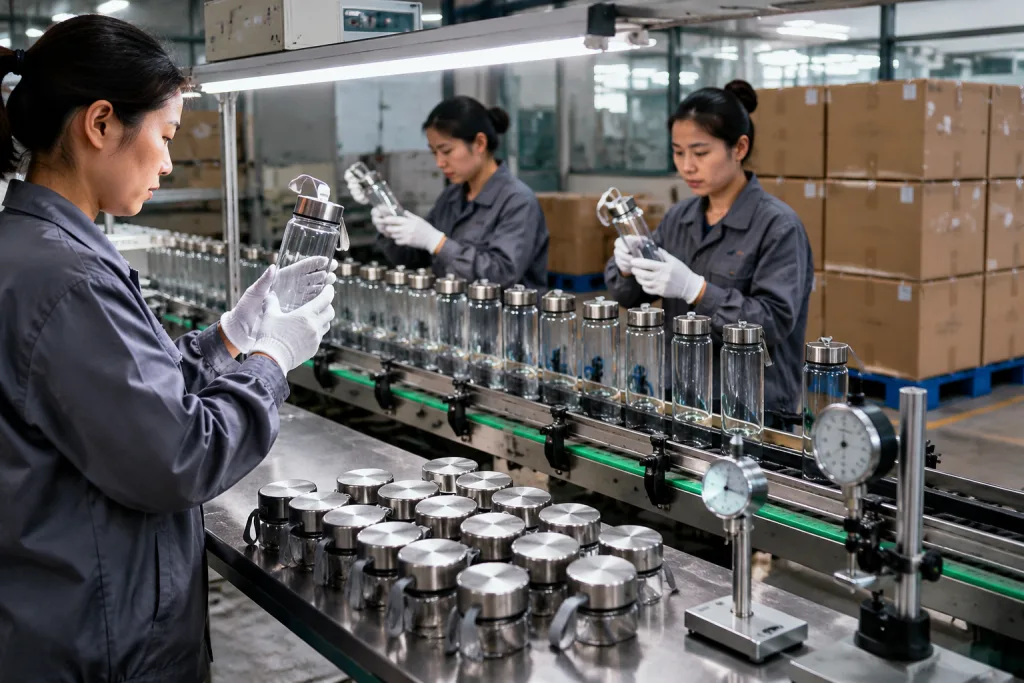
If you are sourcing a borosilicate glass fitness water bottle custom for a gym chain or fitness brand, the hard part is not the design brief. The hard part is the failure stack: micro-cracks after thermal shock, cap leaks in transit, print rub-off, and packaging that looks fine until the first drop test. We see this on the line. In China, especially across Zhejiang suppliers, the factories that win repeat orders are usually not the ones quoting the lowest price. They are the ones that control tube thickness, annealing, closure torque, and carton compression without guessing.
That matters because a custom sports water bottle for retail or club use has to survive staff handling, distributor sorting, and end users who over-tighten lids, throw bottles into bags, and wash them in hot water. This is the wrong question to ask: “Can you make it look good?” The real question is whether the spec blocks predictable defects before they show up in the AQL report. We ship programs like this with 80,000 to 150,000 units per month, MOQ at 3,000 to 5,000 pieces, and lead time around 25 to 35 days after sample approval.
Where Glass Bottles Usually Fail
The first failure mode is hidden stress. Borosilicate glass handles heat better than ordinary soda-lime glass, but it still cracks when wall thickness drifts or the neck finish is off by a fraction. On a 20,000-piece fitness water bottle run, that turns up as carton-drop breakage, not in the sample room. If one side measures 1.6 mm and the other 2.4 mm, the line is already set up for complaints.
The second failure is closure mismatch. A custom gym water bottle with a bamboo cap, stainless cap, or PP flip lid can all look fine and still leak under vibration. We have seen buyers approve the bottle, then the cap liner fails at 1.2 N·m torque because the thread pitch was never locked down. Record thread tolerance, test closure torque, and run a 24-hour inverted leak test at room temperature, then again after a 60°C cycle. Cheap check. Expensive mistake if you skip it.
- Body wall thickness: target 1.8 to 2.2 mm
- Neck finish tolerance: keep thread variation within ±0.2 mm
- Leak test: 24 hours inverted, then 50 to 60°C thermal cycle
- Drop test: 1 meter on carton corner and flat face
When a factory in Zhejiang says the bottle is “strong,” ask for the glass spec and the QC record, not the adjective.
Spec The Glass, Not The Sample
Sampling fools buyers all the time. We’ve seen a hand-picked custom fitness water bottle sample come off the best line worker, polished edges and a clean print pass, then the real run opens up a wider tolerance band. The PO has to define the bottle, not the sample table. For borosilicate glass fitness water bottle custom programs, we lock down composition, annealing, wall thickness, rim finish, and capacity tolerance.
Ask for borosilicate 3.3 glass when the bottle will see hot-fill or dishwasher cycles. Set capacity tolerance at ±5%, not “about 500 ml.” If the bottle carries a silicone sleeve, call out Shore A hardness and sleeve coverage. If it is a customizable fitness water bottle for retail, we also want a pull-off test on the sleeve so it does not creep after repeated washing. For shaker use, the whisk ball or mixing insert must clear the inner wall; loose inserts cause rattling complaints and returns. QC pulled one sample last month with a 0.4 mm wall spot near the base, and that tiny miss turned into a buyer flag.
What to put on the spec sheet
- Material: borosilicate 3.3 glass
- Capacity: 450 ml, 500 ml, or 650 ml with ±5% tolerance
- Wall thickness: 1.8 to 2.2 mm
- Annealing requirement: no visible stress marks under polarized inspection
- Finish: smooth rim, no sharp edge, no chips larger than 0.5 mm
For distributors fitness water bottle orders, this level of detail is the right question to ask. You are buying repeatability across reorders in China and Europe, and the math does not work if the spec lives only on the sample card. We run the line against the PO, not against a showroom piece.
Print That Survives Handling
Decoration fails quietly until it turns into a claim. A custom logo shaker bottle with weak screen print or cheap UV print can pass outgoing inspection, then start flaking after a few dishwasher runs, especially on glossy glass. Laser engraving on coated caps or sleeves is more forgiving, but only when the coating is stable and the artwork depth is set right. For a custom sports water bottle sold through gym retail, the print has to hold up against bottle cages, lunch bags, and constant hand contact. We ship plenty of these, and the line always shows the same problem first.
Ask the factory how they check ink adhesion. A fingernail scratch is not a test. You want cross-hatch adhesion, tape pull, and, if the bottle is meant for dishwasher use, at least 20 wash cycles in a 60°C machine test. For a custom shaker bottle or customizable shaker bottle, place the logo away from the grip zone and base edge, where hands and tabletops beat it up. If the order includes a distributor shaker bottle in multiple colors, lock Pantone codes early and allow a ±5 Delta E window, because glass and coating do not stay identical from lot to lot. QC pulled the sample on one job and the buyer flagged a logo shift of 6 Delta E; the math did not work.
Good print stays quiet. Bad print is the first thing a buyer sees when the pallet is opened.
For bulk sports water bottle orders, approve a solid 1-color mark before you gamble on a fragile 3-color layout that cracks after the first club cleaning cycle. That is the wrong question to ask if someone wants the cheapest decoration; the real question is how many returns the artwork will create.
Caps, Lids, And Leak Risk
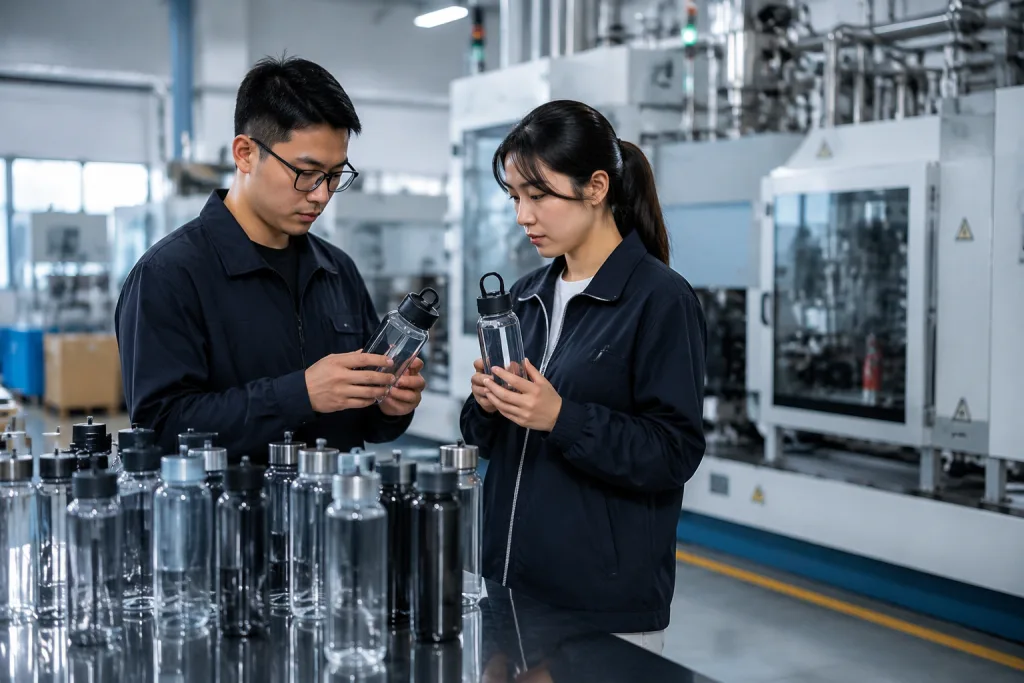
Most leak complaints start at the lid, not the bottle body. On a bulk gym water bottle program, closure choice should follow use case, not looks. A screw cap with a silicone gasket is usually the lowest-risk pick for borosilicate glass. Flip lids, straw lids, and shaker-style closures can work, but each one adds a failure point. If your buyer is a distributor fitness water bottle account that checks shelf appeal and field performance, lock the gasket and thread fit before the first pilot run.
Define the gasket material, compression set, and contact width. A thin silicone ring can deform during hot filling and turn into a slow leak. For a custom gym water bottle built for club merch, we run an inverted leak test after 70°C water, cooling to room temperature, then 30 seconds of shaking. For a custom shaker bottle, the mixing insert and lid hinge need cycle testing. If the hinge fails at 500 opens, it is not a shaker bottle; it is a return ticket.
- Gasket: food-grade silicone, no odor, no visible flash
- Torque: specify a closing torque window, not just “tight fit”
- Leak test: room temp, hot-fill, vibration, and inversion
- Cycle test: at least 1,000 open-close cycles for moving parts
Factories in Zhejiang usually know these tests if you ask on day one. We ship lids with a simple 2-point check: thread gauge on the line, then a water inversion test before carton pack-out. The buyer flagged one PO typo where “silicone” was written as “silicon”; that kind of mistake sounds small until QC pulls the sample and the lid spec no longer matches export cartons. The math doesn't work when the wrong closure goes into a 20,000-piece order.
Packaging Prevents Most Damage
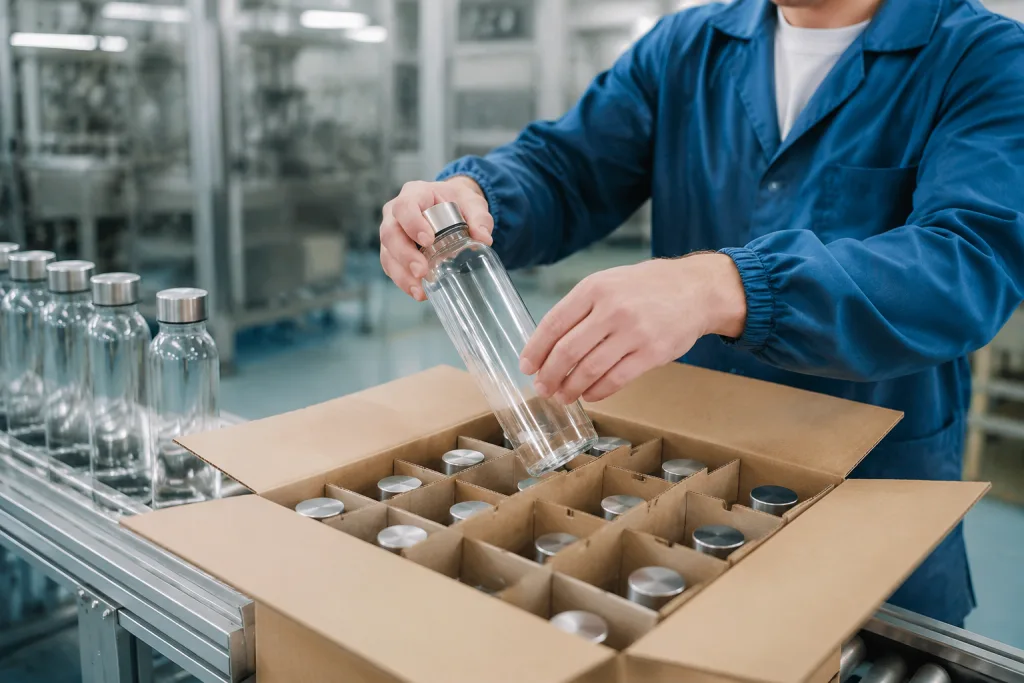
Glass bottle damage in export is usually a packaging issue wearing a product label. We’ve seen a 24-piece master carton pass local truck delivery, then fail on the ocean leg because the inner tray was thin and the outer carton had no real crush margin. For a borosilicate glass fitness water bottle custom order bound for North America or Europe, build the pack around drop height, carton stacking, and moisture exposure from day one.
For direct-to-distributor shipping, we run molded pulp, EVA, or corrugated partitions so bottle-to-bottle contact stays at zero. Ask for an outer carton burst strength of at least 160 kPa for normal export loads, and run carton compression testing, not just a sample shake test. If the product is a customized sports water bottle with sleeve and cap, the sleeve can take some impact, but only when it is locked in place. QC pulled the sample once and found the sleeve drifting 8 mm inside the carton; the print rubbed through. For FBA or club warehouses, build FNSKU or SKU labeling into the carton plan before palletizing. That avoids relabeling labor later.
For distributors on gym water bottle programs, ask for a full carton drop test, not only a bottle drop test. That’s the wrong question to ask if the pack is weak. Glass does fine on its own. Bad packaging does not.
Buying Terms That Keep You Safe
The contract terms matter. Small claims turn into expensive claims once a chain rolls across regions. For a custom fitness water bottle order, we run FOB Zhejiang or FOB Ningbo when the buyer wants freight control and clean factory pricing. If you want landed cost planning, use DDP only after the bottle, cap, and carton artwork are frozen. Ask for pre-production samples, inline inspection, and final random inspection to AQL 2.5 for major defects and 4.0 for minor defects. QC pulled the sample, and that was the first place a 0.8 mm chip showed up. That is the level that keeps a drinkware PO from drifting.
For Europe, confirm REACH-relevant materials, food-contact declarations, and ink safety. For North America, ask for ASTM or equivalent impact and safety references where they apply, plus food-contact documents. A BSCI audit helps when a retail buyer asks about factory compliance, but it does not replace product QC. On a borosilicate glass fitness water bottle custom order, the buyer flagged chips, bubbles over 1.5 mm, crooked print, cap leakage, scratch depth, and odor, so those points go into the spec sheet, not a vague “good quality” note. If the supplier is in Zhejiang, ask for monthly output, usually 80,000 units or more on a mature line, and the exact sampling plan at packing. One typo on the PO can still trigger a week of back-and-forth.
That is how you buy from China without turning the PO into a dispute file.
Spec your glass bottle before production starts
Send your target capacity, cap style, and artwork. We will map the failure points, tighten the spec, and quote the exact build.
Frequently asked questions
What MOQ should I expect for borosilicate glass fitness water bottle custom orders?
For most factories in Zhejiang or broader China, MOQ is usually 3,000 to 5,000 units per design for a borosilicate glass fitness water bottle custom run. If you want a custom logo shaker bottle with multiple colors, the MOQ can rise because of print setup and cap sourcing. For a simple custom sports water bottle with one logo position and standard cap, some suppliers can start at 2,000 pieces, but pricing usually improves at 5,000 to 10,000 pieces. Always confirm whether the MOQ is per color, per size, or per artwork version.
How do I reduce leak complaints on a custom shaker bottle?
Specify the lid as a tested assembly, not just a component list. For a custom shaker bottle, require silicone gasket material, thread tolerance, torque window, and a 24-hour inverted leak test. If the product is a custom made shaker bottle with a flip top, ask for 1,000-cycle hinge testing and a hot-fill leak test at around 60 to 70°C. Many leak claims come from over-tightening, so the closure should be designed to seal within a controlled torque range rather than relying on force.
Can a borosilicate bottle handle dishwasher use?
Yes, if the glass is properly annealed and the decoration is designed for it. Borosilicate glass fitness water bottle custom projects can handle dishwasher cycles better than ordinary glass, but the print, sleeve adhesive, and cap insert often fail before the bottle does. If you want a customizable fitness water bottle for repeated washing, require at least 20 dishwasher cycles in validation and avoid weak pad print near the grip area. Also confirm cap materials and gasket hardness, since heat can deform cheap seals.
What compliance documents should I ask for when sourcing from China?
For Europe, ask for food-contact declarations and REACH-related material confirmation. For the United States, request food-contact compliance and any ASTM references relevant to packaging or impact testing. If you are buying a distributor fitness water bottle program, also ask for factory audit evidence such as BSCI and a QC report based on AQL inspection. The paperwork should match the exact SKU, decoration method, and cap material, because a document for one configuration does not automatically cover another.
What lead time is normal for a custom gym water bottle order?
After sample approval, a typical custom gym water bottle or bulk sports water bottle order takes about 25 to 35 days at a capable factory in Zhejiang, China. If the order includes new molds, special sleeves, or imported components, add 10 to 15 days. For repeat orders of a distributor sports water bottle line, lead time can drop if cartons, caps, and glass bodies are already in stock. The real bottleneck is often artwork approval and packaging sign-off, not glass forming.