Key Takeaways
- A 500-750 ml borosilicate bottle usually needs 1.8-2.2 mm wall thickness for wholesale shipment
- Practical MOQ is 1,000-3,000 pcs per SKU, depending on lid, sleeve, and packaging complexity
- AQL 2.5/4.0 with thermal shock and leakage checks should be written into the PO
- FOB China pricing changes sharply when you add bamboo lids, silicone sleeves, color boxes, or inserts
Borosilicate glass looks simple on a product page. On the line, it is not. A 550 ml bottle with a bamboo lid, silicone sleeve, and gift box can miss the mark because the glass wall is 0.2 mm too thin, the lid insert rusts, or the carton fails a 1.2 m drop test. QC pulled a sample last week and the caliper read 1.0 mm where the PO asked for 1.2 mm. If you buy borosilicate glass drinkware wholesale, the spec sheet decides whether your margin survives.
From our Zhejiang factory network, we see the same buyer mistake every month: they chase FOB first and lock structure later. That is the wrong question to ask. Wholesale drinkware is not just capacity and logo. It is glass formula, tube diameter, annealing curve, lid material, sleeve fit, packing method, AQL 2.5, and the replacement rule. We shipped a batch where the buyer flagged a PO typo on lid color, and that small miss cost a week. Those details matter more than a USD 0.08 quotation gap.
Glass grade is the first risk
The first line on your borosilicate glass drinkware wholesale spec should not be the logo. Put the glass type first. For export drinkware, buyers normally ask for high borosilicate glass with about 12-13% boron trioxide content and a low coefficient of thermal expansion, often around 3.3 x 10⁻⁶/K. That number is the reason the bottle survives hot tea, cold brew, and normal temperature swings better than soda-lime glass. On our line, QC checks wall thickness with a digital caliper; a 0.4 mm thin spot near the shoulder is where trouble starts.
Do not write only “glass bottle” on an RFQ. That invites substitutions, and we have seen this go sideways. In China, lower-cost soda-lime glass looks fine in photos, but it is heavier, weaker against thermal shock, and more likely to crack when the user pours 90°C water into a cold bottle. One EU buyer once flagged a sample because the carton weight jumped by 1.8 kg per master carton after a trader switched glass grade. For wholesale drinkware sold through retail, office gifting, or wellness channels, the complaint cost beats the material saving every time. The math does not work.
Ask the supplier to state the glass category, annealing process, and intended temperature range. A reasonable claim for 600 ml to 1,000 ml borosilicate bottles is -20°C to 120°C, but test your exact structure if there is a tight stainless infuser, plastic lid, or silicone sleeve. We run thermal shock testing at 80°C delta as an internal benchmark, with samples moving from hot water to room-temperature water under a timer. It is not a magic guarantee. It does catch weak annealing and uneven wall distribution before the buyer’s warehouse finds it.
If you source drinkware bulk from Zhejiang or other China production clusters, you will see handmade and machine-formed options. Handmade glass gives flexibility for small production and odd shapes, especially when the MOQ is 1,000-3,000 pcs and the buyer wants a custom sleeve mold. Machine-formed glass gives tighter consistency at volume; the line holds mouth diameter and height better when the order moves past 30,000 pcs. For a 3,000 pc trial order, handmade can pass if the tolerance sheet is clear. For a 30,000 pc reorder, watch the tolerance range, reject rate, and annealing record, because QC pulled samples with a 2 mm height spread before and the buyer rejected the shelf display fit.
Capacity and wall thickness decide durability
Capacity sounds like a marketing line, but it changes the whole product. A 350 ml glass tumbler, a 550 ml canteen wholesale item, and a 1.9 L bulk growler behave differently on the lampworking bench, in the inner box, and in a courier drop test. Bigger volume puts more bending force on the neck and more impact load on the base. The same 1.6 mm wall that passes on a small tea cup can crack on a tall 750 ml bottle; QC pulled 12 samples last month and found hairline checks near the shoulder after a 76 cm carton drop.
For most wholesale canteen programs, we run 1.8-2.2 mm wall thickness on 500-750 ml borosilicate bottles, with a stable base closer to 3.0 mm where the shape allows. A beer growler wholesale program is a different job. A 1 L or 1.9 L growler bulk order needs a stronger shoulder, thicker base, and a closure that survives repeated opening on the line and at the bar. If it is sold as a beer growler in bulk for craft beverage use, be careful with pressure claims. We have seen this go sideways: 80 pieces looked fine visually, then the buyer flagged carbonation wording after their distributor asked for a pressure rating. Most decorative glass growlers are not rated for carbonation pressure.
Specify capacity as both nominal and brimful. For example, “600 ml nominal, 650 ml brimful” avoids arguments when the sample holds less than the sales page promised. Also state size tolerance. A practical tolerance for handmade borosilicate might be ±3-5 mm in height and ±5% in capacity, measured with a height gauge and water fill, not by eyeballing a counter sample. If you need strict retail shelf alignment, say so before sampling.
Buyers looking for the best wholesale drink bottle often chase the lightest unit to cut freight. This is the wrong question to ask if the carton then fails. Saving 25 g of glass may reduce carton weight, yet push breakage from 1% to 4% after mixed-pallet handling; we ship enough LCL orders to know where the weak bottles show up. On a USD 2.80 FOB bottle, the math does not work. It becomes a delayed debit note from your distributor.
Lids, sleeves, and contact materials
The lid is where 6 out of 10 borosilicate projects start losing margin. Bamboo gives a natural shelf look, stainless reads premium, PP keeps the BOM down, and clear Tritan-style lids suit tea and infused-water sets. Each option changes the test plan: leakage, odor, migration, dishwasher claims, and lead time. For wholesale drinkware shipping to Europe or North America, ask for food-contact declarations on the full assembly, not just the glass body. We have seen buyers approve the cup, then QC pulled the sample because the silicone gasket had no declaration.
A bamboo lid usually includes a stainless insert or plastic insert, plus a silicone gasket. Bamboo varies in color and grain, and it cracks when the drying step is rushed. Put the limit in writing. If you buy canteen bulk with bamboo lids, write an acceptable color range, moisture requirement such as 8-12%, and gasket fit into the approval sample. For plastic lids, specify PP, ABS, or other resin clearly on the PO; one buyer once sent “plastic lid” and then rejected ABS after production. For metal lids, 304 stainless is common for food contact, while 201 stainless costs less but is the wrong choice for wet contact zones.
Silicone sleeves improve grip and cut breakage, but the tolerance can bite you. Too loose, it rotates. Too tight, the line has to stretch it by hand and micro-cracks show up at the glass rim during inspection. For drinkware wholesale, sleeve thickness of about 1.5-2.0 mm is common. Ask for sleeve weight, Pantone color, and whether the sleeve is molded or cut from tube stock. We run a simple check with calipers on sleeve ID and glass OD before mass assembly; a 0.8 mm mismatch already causes complaints.
For alcohol flask wholesale or alcohol flask in bulk requests, be precise. A flat pocket flask, a glass spirit bottle, and a small borosilicate tasting flask are not the same compliance case. If you are selling an alcohol flask wholesale bulk program, confirm local labeling, capacity, and closure rules in your market before tooling. The factory can make the container, but you own the market claim. We ship the glass; we do not decide whether your 100 ml label passes retail audit in Germany or California.
Decoration specs affect yield fast
Logo method is not a cosmetic afterthought. It changes reject rate and unit cost fast. On borosilicate glass, we usually run silk screen printing, decal, laser marking on metal or bamboo parts, pad printing on lids, or frosting and color coating. For a one-color logo on a straight 70 mm diameter bottle, silk screen is stable and keeps the scrap rate around 2%-4% when the fixture is set well. For curved or tapered shapes, artwork distortion is the trap; QC pulled a sample last month where a 50 mm round logo looked oval by 3 mm after printing.
If you are quoting drinkware bulk with a brand logo, send vector artwork in AI, EPS, or PDF. State logo size in millimeters, Pantone code, and position from the base or top edge. “Logo on front” is not a production instruction. It causes arguments. A better line is: “1C white silk screen, 45 mm wide, centered, lower edge 80 mm from base, tolerance ±2 mm.” This is the language factories in Zhejiang can inspect with a steel ruler and a print-position jig.
For beer tumbler wholesale and beer tumbler in bulk programs, decoration must survive condensation, repeated washing, and bar handling. Standard silk screen may pass a basic 3M tape test but fail after dishwasher cycles. If you want dishwasher-resistant printing, ask for the ink system and curing temperature, then test 20-50 wash cycles. Do not rely on the word “durable.” The buyer flagged it before, and the math doesn't work when 1,200 tumblers come back because the logo ghosts after two weeks in a restaurant.
Color coating on glass looks good for retail, but it adds scratch risk and REACH-related chemical questions. If you sell into the EU, request REACH documentation for coating, ink, and silicone. If you sell into the United States, ask about FDA food-contact suitability for components that touch beverage or mouth. The decoration is part of compliance, not just branding; on our line, one rubbed coating sample failed after 30 strokes with a 1 kg abrasion weight, and that finding stopped the shipment until the coating supplier changed the batch.
Packing is part of the product
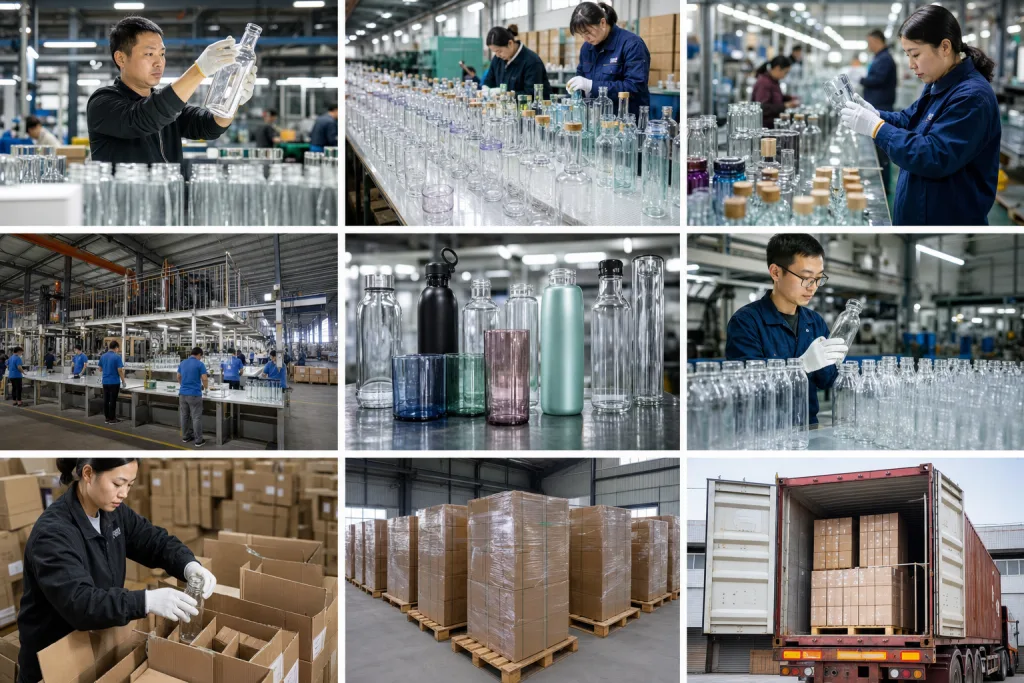
Glass drinkware wholesale lives or dies in the carton. We see this on the line every month: the sample sits in thick foam and passes the showroom test, then bulk breaks because production changed to 1.5 mm dividers, soft E-flute color boxes, or left only 3 mm top clearance. For borosilicate glass, lock the inner packing, master carton board grade, drop-test standard, and pallet method before deposit. Carton spec is product spec.
For a 550 ml bottle, common export packing might be 1 pc/color box, 24 pcs/master carton, with 5-layer K=K or B=C corrugated board depending on carton weight. A gift box could use 350 gsm white card with an E-flute insert, but heavier glass needs molded pulp or stronger paperboard; we usually check the fit with a 0.5 mm feeler gap around the shoulder and base. If you ship to Amazon FBA, you may also need FNSKU labeling, carton weight below 22.7 kg, and packaging that survives parcel handling without retail box collapse. The buyer always flags crushed corners first.
For wholesale growler or beer growler wholesale bulk orders, do not overpack by instinct. This is the wrong question to ask. Excess foam may protect the unit, but if CBM jumps from 68 cartons to 92 cartons per pallet position, the freight math stops working. Ask for a carton drop test: one corner, three edges, and six faces from 76 cm or 100 cm, depending on carton weight and your channel. QC pulled the sample after one test last quarter; the box looked ugly, but only 0/24 pcs broke, so we approved the structure and changed only the outer liner.
At BottleForge Industrial, a normal borosilicate line in China can pack 40,000-80,000 units/month depending on SKU mix, while trial MOQ is often 1,000 pcs for clear glass with standard lids and 3,000 pcs for custom sleeve colors or printed retail boxes. Those numbers matter when you plan seasonal promotions. A late box approval can cost more time than glass forming; we have seen a lid PO typo delay cartons by 12 days while the furnace schedule stayed fixed. Approve packing early.
Inspection lines you should not skip
A purchase order for borosilicate glass drinkware wholesale should spell out inspection points, not just say “good quality.” We usually write AQL 2.5 for major defects and 4.0 for minor defects on the PO, with zero acceptance for critical defects. Critical means broken glass, sharp edges, contamination, serious leakage, unsafe odor, or wrong material in food-contact components. Simple words. No guessing. On one 18,000 pcs tumbler order, QC pulled 200 pcs from packed cartons and found 3 cups with sharp lip grinding; that became a stop-ship issue, not a discount discussion.
Inspection should cover dimensions, capacity, wall appearance, annealing issues, lid fit, gasket placement, leakage, logo position, color, packing, and carton marks. For a leak test, fill the bottle, close it, invert for 10 minutes, then check standing and shaking conditions if it is sold as a travel bottle. We run this over a stainless sink, not on a desk. For a canteen wholesale order, add a strap pull test if the lid or sleeve carries a loop. A pretty strap that fails at 3 kg will generate returns; the math does not work when Amazon or a supermarket buyer charges back 6 cartons for one weak loop.
Glass defects need clear names. Bubbles are not always rejects; small trapped bubbles are common in borosilicate after furnace forming. But stones, cracks, sharp seams, serious deformation, dirty inclusions, and unstable bases should be major or critical defects. Define acceptable bubble size, such as no more than 2 bubbles over 1.5 mm on the visible front surface. Use a 0.02 mm caliper and a printed defect board beside the line. Without this, your inspector and supplier will argue by opinion, and we have seen this go sideways over one word: “visible.”
If your buyer asks for BSCI, ISO 9001, or Sedex-related factory information, confirm early. Not every glass workshop in Zhejiang has the same audit profile. China can produce excellent bulk drinkware, but audit readiness, document control, and English test reports vary by factory. Match the factory to your channel, not just to the lowest FOB line. We once received a PO with “Sedex 4P” typed instead of “Sedex 4P audit available,” and the buyer flagged it two days before booking space; that is the wrong time to discover the workshop only has ISO 9001.
FOB pricing and order planning
FOB pricing for borosilicate glass comes from the glass body, lid, sleeve, decoration, packaging, labor, inspection loss, inland trucking, and factory margin. A plain 500-600 ml borosilicate bottle may quote around USD 1.60-2.40 FOB China at 3,000 pcs; add a bamboo lid, silicone sleeve, one-color logo, and printed gift box, and it often lands near USD 2.60-4.20. We check this on the packing bench with carton size, gross weight, and drop-test history, because large wholesale growler formats or premium beer tumbler bulk packs eat space fast and breakage allowance is not free.
Ask suppliers to split optional cost lines. Stainless lid versus bamboo is one line. Kraft box versus color box is another. Sleeve versus no sleeve should show the sleeve weight, usually in grams, not just a vague “accessory charge.” 1C print versus decal also needs a separate price, because a decal firing issue can pull 2-3% extra loss from the line. This protects margin without stripping the product. When buyers ask for beer tumbler wholesale bulk or alcohol flask bulk pricing as one blended number, we have seen this go sideways: the buyer flagged the retail box cost too late, after the PO was already signed.
Lead time is usually 7-12 days for sampling after artwork confirmation and 30-45 days for mass production after deposit and final sample approval. Add another 7-10 days if you need third-party testing, and plan 18-25 extra days before Chinese New Year, not “a little longer.” If your launch date is fixed, approve the technical sample first, then packaging, then production. Short sentence. Lock the glass. A hangtag debate should not hold the furnace schedule, especially when the mold room has already set the 500 ml tooling and QC pulled the sample for capacity measurement.
For repeat wholesale drinkware programs, keep a golden sample, signed color standard, and carton layout file with barcode position, inner box size, and master carton marks. Reorders move faster when the supplier does not have to guess what your first PO meant; we once lost half a day because “matte black” was typed as “mate black” on a buyer’s PO. The best sourcing result is boring: the second order matches the first, the distributor has no surprise claims, and your landed cost stays inside the spreadsheet your sales team already sold internally.
Send your borosilicate glass spec for a factory review
Share capacity, lid, logo, packing, target MOQ, and market. We will return practical FOB options and risk notes before sampling.
Frequently asked questions
What MOQ should I expect for borosilicate glass drinkware wholesale?
For standard clear borosilicate bottles, a realistic MOQ is usually 1,000 pcs per SKU if you use an existing mold, standard lid, and simple logo. If you need a custom silicone sleeve color, printed gift box, special bamboo lid, or private mold, expect 3,000-5,000 pcs. For bulk growler and beer growler bulk orders, MOQ depends heavily on capacity because carton space and production setup are larger. A trial order below 1,000 pcs is sometimes possible, but the FOB price may rise 15-35% and packaging customization becomes limited.
Is borosilicate glass safe for hot drinks?
Yes, properly annealed high borosilicate glass is suitable for hot drinks, but you should avoid careless claims. Many bottles can handle a temperature range around -20°C to 120°C, and some pass an 80°C thermal shock test. The exact result depends on wall thickness, base design, lid structure, and whether there are metal or plastic inserts. For wholesale drinkware, request a thermal shock test on the approved production sample, not only on a similar factory sample. Also check the lid and gasket materials, because the glass may pass while the plastic lid deforms or develops odor.
Can I use the same supplier for canteen bulk and growler wholesale orders?
Sometimes, but do not assume it. A 600 ml wholesale canteen and a 1.9 L wholesale growler require different forming control, packing, and inspection focus. Growlers have larger bodies, heavier bases, and more neck stress during shipping. If the growler is marketed for beer, confirm whether it is decorative or designed for pressure use. Many glass growlers are suitable for filling and serving non-pressurized beverages, but not for secondary fermentation or high carbonation. Ask for samples, carton drop testing, and clear capacity tolerance before combining programs.
What quality documents should a European or North American buyer request?
For Europe, request food-contact documentation, LFGB or relevant EU food-contact test reports where applicable, and REACH information for coatings, inks, and silicone parts. For North America, ask for FDA food-contact suitability for contact materials and Prop 65 evaluation if selling into California. Factory-level documents may include ISO 9001, BSCI, or Sedex depending on your customer requirement. Also include an AQL inspection plan in the PO. Documents are useful, but they do not replace checking actual production for leakage, cracks, logo position, and carton strength.
How should I compare FOB quotes for alcohol flask wholesale bulk or beer tumbler bulk?
Compare line by line, not only the final FOB number. Ask each supplier to state glass type, capacity, wall thickness, lid material, gasket material, logo method, packing, carton quantity, and estimated CBM. A USD 0.20 cheaper alcohol flask wholesale quote may use thinner glass, a 201 stainless insert, or weaker packaging. For beer tumbler wholesale, check whether printing is standard ink or dishwasher-resistant ink. For alcohol flask in bulk programs, confirm market labeling and closure expectations. The quote that is clearest is often safer than the quote that is lowest.