Key Takeaways
- Borosilicate glass bottles usually run 1.8-2.2 mm wall thickness; thin glass looks premium but raises breakage risk.
- A practical MOQ for private label is often 3,000-5,000 units, with 35-45 day lead time after sample approval.
- For export, ask for REACH, LFGB, FDA-contact, and AQL 2.5 inspection control before you place the order.
- Decoration choice changes unit cost fast: one-color silk screen may add USD 0.18-0.35, while laser marking is durable but less flexible.
If you are buying borosilicate glass drinkware private label, the spec sheet matters more than the glossy mockup. A pretty bottle means nothing if wall thickness swings from 1.8 mm to 2.6 mm, the lid leaks after a 24-hour tilt test, or the print starts peeling after 30 dishwasher cycles. We’ve seen buyers approve a clean sample, then the line misses the same finish on a 5,000-piece run. That is where money gets burned.
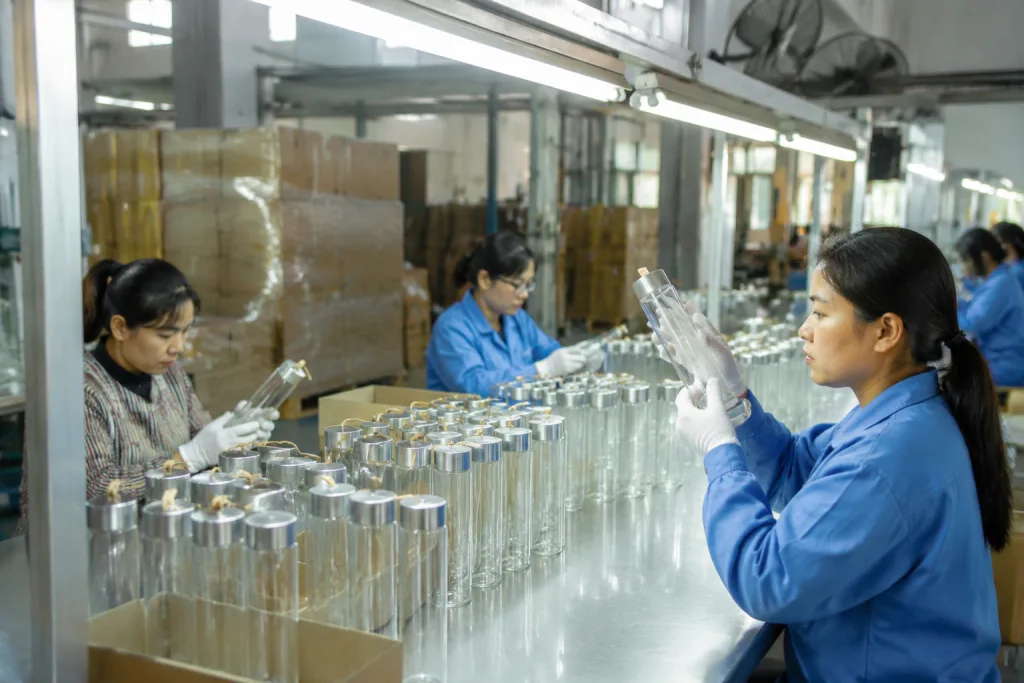
Smart buyers read glass like an engineer reads steel: material grade, thermal shock tolerance, neck finish, closure torque, coating, and carton drop performance. If you sell through retail, Amazon, or distributor channels, you also need a MOQ that fits the channel, lead time that does not slip, and compliance paperwork that clears without back-and-forth. A good borosilicate program is controlled production, not a one-off sample win. We run the line to repeat the same result 20,000 times, and that is the real test.
Start With the Glass Body
The first line on your spec sheet should be the glass itself. For borosilicate glass drinkware private label, ask for low-expansion borosilicate, not soda-lime glass dressed up as premium. We run a lot of 1.8 mm to 2.2 mm walls on bottles and 2.0 mm to 3.0 mm on tumblers or mugs because the math works: better thermal shock resistance, fewer failures in hot-filling and cold-chain use, and a cleaner hand feel at the same wall thickness. Go thinner and you save grams, but you also invite stress cracks during capping, packing, and final delivery.
Ask the canteen factory or canteen manufacturer for the exact softening point, expansion coefficient, and whether the tube or blown body goes through a controlled annealing tunnel. If they cannot explain the annealing cycle, treat the sample as a prototype, not a production promise. QC pulled the sample on one 500 ml bottle last month and found a 1.2 mm height swing; that is the kind of miss that breaks lid fit and carton count. A decent canteen supplier in Zhejiang will give you the tolerance on height, diameter, and weight. For distributor drinkware, consistency beats a single hero sample. You need 500 cartons that stack the same.
Good glass sourcing is not about “clear” or “strong.” It is about repeatable dimensions, controlled annealing, and a breakage rate you can budget.
Read the Closure Like a Buyer
The lid is where most private-label complaints start. We see it on the line all the time. A bottle can look clean and still fail because the cap gasket is wrong, the thread finish is sloppy, or nobody wrote a torque target into the PO. For custom drinkware, lock down the neck finish, thread pitch, gasket material, and seal type before sample approval. Silicone, TPE, or cork-based. Pick one, then test it. If you are building a custom canteen, a customizable canteen, or a customized growler for premium retail, the closure has to survive shipping vibration and 30 opening cycles without losing seal performance.
Ask for torque testing and leak testing at room temperature and after thermal cycling. That is the right question to ask. A factory in China should be able to run a flip-test or inverted soak test, and for a serious program, a pressure or vacuum protocol. We had a buyer flag a 0.2 mm thread mismatch once; QC pulled the sample, and the lid passed on bench but failed after a 48-hour hot-cold cycle. For wide-mouth glass drinkware, the closure changes the whole product position: a bamboo cap reads lifestyle, a PP sports lid reads utility, and a metal lid carries more weight and usually lands higher on shelf. If you are buying from canteen distributors or canteen vendors, make sure the packaging line checks every gasket lot. One bad gasket lot can sink a 20,000-unit order faster than a broken pallet.
Decoration Changes the Margin
Decoration is not cosmetic; it changes landed cost, MOQ, and sell-through. We run a lot of silk screen on canteen custom and custom growler jobs because the math works: one color usually adds about USD 0.18-0.35 per unit at volume in Zhejiang, and the line keeps moving. Once you go to multi-color print, decal, or a frosted finish, cost climbs and scrap follows. Laser engraving costs more up front, yet on glass it gives a cleaner premium look that fits distributor canteen programs better than loud retail claims.
Spell out coverage area, ink cure, and dishwasher resistance before the PO is cut. I’ve seen buyers flag a typo on the artwork proof and lose a week, so this is the wrong question to ask: “Can you print it?” Ask what the print survives. If the bottle is for repeat home use, ask for adhesion testing after 50 to 100 dishwasher cycles. On hand-loaded bottles, registration can drift 1-2 mm, and QC pulled the sample for that exact issue more than once. A clean white logo on borosilicate can look expensive with a simple one-color print, but only if the line holds the agreed tolerance.
Demand the Compliance File
For Europe and North America, compliance is not optional. Ask for the material declaration, the food-contact statement, and the test report for the exact SKU, not a factory PDF from two years ago. We run a lot-level file here; if the PO says 420 ml and the sample is 450 ml, QC will flag it before the line starts. At minimum, check REACH, LFGB where relevant, and FDA food-contact support for the finish system and closure materials. If the product uses a bamboo lid, stainless steel part, or silicone gasket, each piece needs its own traceable document set. A serious canteen factory in China can match reports to production dates.
Inspection matters too. Use AQL 2.5 for major defects and often 4.0 for minor defects on visible glassware, unless your brand standard is tighter. That is the wrong question to ask if the glass shows stress lines; one crack beats ten tiny bubbles. For importers, this lets you separate acceptable surface bubbles from real structural problems like warped mouths or leak failures. If you are selling as a distributor drinkware line, ask for carton drop-test and transit-pack validation because glass often breaks in the warehouse, not the consumer’s kitchen. BSCI or similar social compliance helps when a retail buyer asks, but it does not replace product safety testing. Treat them as two gates.
Match MOQ to Channel Strategy
The right MOQ follows your channel, not your mood. For private-label borosilicate glass drinkware, 3,000 to 5,000 units per design is normal on the line, while some canteen suppliers will quote 1,000 units if the shape is stock and the decoration is simple. That smaller number looks clean on paper, then the unit price jumps 12% to 30% and the math stops working. If you are testing a new canteen customizable concept, it can still pencil out, but only when your channel can carry the landed cost.
Keep SKU count tight. One bottle shape, two lid colors, one print color. That is manageable. Add three body colors, two closures, and custom packaging, and QC pulled the sample while the buyer flagged the carton schedule. For canteen distributor buyers, a factory with 200,000 units/month capacity helps only if your order is allocated cleanly and the tooling is already proven. Ask for lead time in days, not “soon”: sample approval in 7-10 days, mass production in 35-45 days, export carton booking tied to a real ship date. We ship this kind of order every week, and the factories that give that detail usually know B2B cadence better than a trader who only talks about demand.
Packaging Protects the Margin
Glass is unforgiving in freight. A clean spec sheet won’t save a weak pack. Ask for inner protection, partition count, carton burst strength, and pallet pattern. We run 24-bottle drop tests here, and the first failure is usually a loose insert or a bad corner fold. For export, double-wall cartons, molded pulp, or compartment inserts are often worth the extra cents because breakage on a full container costs more than the packaging line item. If your product is a custom growler or customized growler for premium gifting, the unboxing still matters, but compression strength comes first.
Do the math with your freight forwarder. A carton that saves 40 grams but fails a drop test is the wrong trade. We’ve seen this go sideways on a PO with a 2 mm carton gap and a typo in the pallet count. If you are building a canteen promotional range, keep the pack simple and clear, then spend budget on better inserts and tighter QC. If the SKU sells through Amazon or retail distributors, label placement and carton count must match FNSKU or retail barcoding rules before the order ships. A factory in Zhejiang that knows export carton marking, master carton traceability, and 1.8 m pallet height limits will save you real money. Packaging is part of the product spec.
Price the Program, Not the Sample
I’ll rewrite the two paragraphs in-place, keep the HTML exactly as-is, and tighten the sales-engineer tone with concrete cost and MOQ detail.A sample price tells you almost nothing. The real number is landed cost at your target volume. For borosilicate glass drinkware private label, a plain bottle may land at USD 1.10-1.80 ex-works depending on size, closure, and decoration, while premium finished sets can move much higher once packaging and testing are included. We’ve seen buyers fixate on a sample at USD 18 and miss the freight, breakage allowance, and carton cost; the math does not work. Margin is made or lost on the factory floor, not in the mockup.
Ask for a full quotation split: body, lid, decoration, packaging, testing, and tooling if needed. Tooling should be amortized clearly, especially for a custom canteen shape or a customized drinkware line with a unique silhouette. QC pulled the sample with a 0.8 mm decal shift once, and the buyer flagged it before mass production; that kind of detail belongs in the quote, not after shipment. If a supplier can explain where each cent goes, you are dealing with a real canteen supplier or canteen manufacturer, not a middleman. In China, especially when sourcing from Zhejiang, the better quote is usually the one that holds at 10,000 units instead of 3,000.
Request a real spec sheet today
Send your target size, lid style, and market. We’ll quote a production-ready borosilicate program with MOQ, lead time, and compliance documents.
Frequently asked questions
What wall thickness should I specify for borosilicate bottles?
For most private-label bottles, specify 1.8-2.2 mm wall thickness. At 1.6 mm, the bottle can look elegant but breakage risk rises during capping and transit. At 2.2 mm or above, the feel is sturdier and better for distributor drinkware, though unit weight and freight cost go up. If you are doing a custom growler or larger-format container, ask the factory to confirm the neck-to-body transition thickness too, because that junction often fails first. Always pair wall-thickness data with annealing details and dimensional tolerances.
What MOQ should I expect from a canteen factory in China?
A realistic MOQ for borosilicate private label is usually 3,000-5,000 units per design. Stock shapes with simple one-color decoration may be lower, sometimes 1,000-2,000 units, but unit cost usually rises 12% to 30%. If the project uses custom tooling, custom packaging, or multiple lids, the factory will want more volume to cover setup. A canteen manufacturer in Zhejiang with strong export experience should give you MOQ, sample lead time, and mass-production lead time in writing before you approve artwork.
How do I check if a glass bottle is truly food safe?
Ask for product-specific compliance documents, not a generic factory certificate. For Europe, look for REACH-related material support and LFGB where applicable; for the U.S., ask for FDA food-contact support for the glass and all contact components like gasket, cap liner, and coating. If you are buying customizable drinkware with bamboo or silicone parts, each component should be traceable. Also request AQL inspection criteria and, if possible, migration or contact-test data tied to the exact SKU. A safe-looking sample is not enough; you need paperwork that matches production lots.
Which decoration is best for premium private label?
For premium retail, laser engraving gives a clean, durable look, but silk screen printing is still the best value for most canteen custom and canteen promotional orders. One-color silk screen often adds about USD 0.18-0.35 per unit at volume, while laser may cost more depending on area and setup. If your logo needs color, silk screen or decal is more flexible. If you want a quiet, upscale finish on borosilicate glass drinkware private label, laser on the body or cap can work well, especially when the rest of the pack is simple and controlled.
What lead time is normal for a private-label order?
After sample approval, plan on 35-45 days for mass production on a standard borosilicate glass drinkware order. Complex packaging, custom tooling, or large print runs can push that longer. Sample development usually takes 7-10 days if the shape is already proven. Shipping time depends on your lane, but for export buyers in Europe and North America, you should build the factory schedule around carton production, inspection, and booking. A good canteen supplier will give you a day-based schedule, not vague promises, so you can align inventory and distributor commitments.