Key Takeaways
- For borosilicate glass, 1.8-2.2 mm wall thickness is common for daily bottles; heavier growlers may need thicker glass and stronger cartons
- MOQ is usually 1,000-3,000 pcs per SKU, but color sleeves, bamboo lids, and private molds can raise it
- Screen printing suits 1-3 color logos; decals or heat transfer work better for wraparound artwork
- Use AQL inspection, drop-tested packaging, and REACH/LFGB/FDA food-contact checks before shipment
Buying from a borosilicate glass drinkware manufacturer is not the same as buying stainless steel bottles. Glass is less forgiving. A 0.3 mm wall-thickness change, a lid gasket that sits 0.5 mm proud, or a silicone sleeve with the wrong shore hardness can turn a clean-looking item into a claims problem. If you only compare FOB prices, the math doesn't work; the real cost often shows up later as cracked samples, loose caps, soft cartons, or replacement claims that sit on someone’s desk for 12 days instead of being closed in 3.
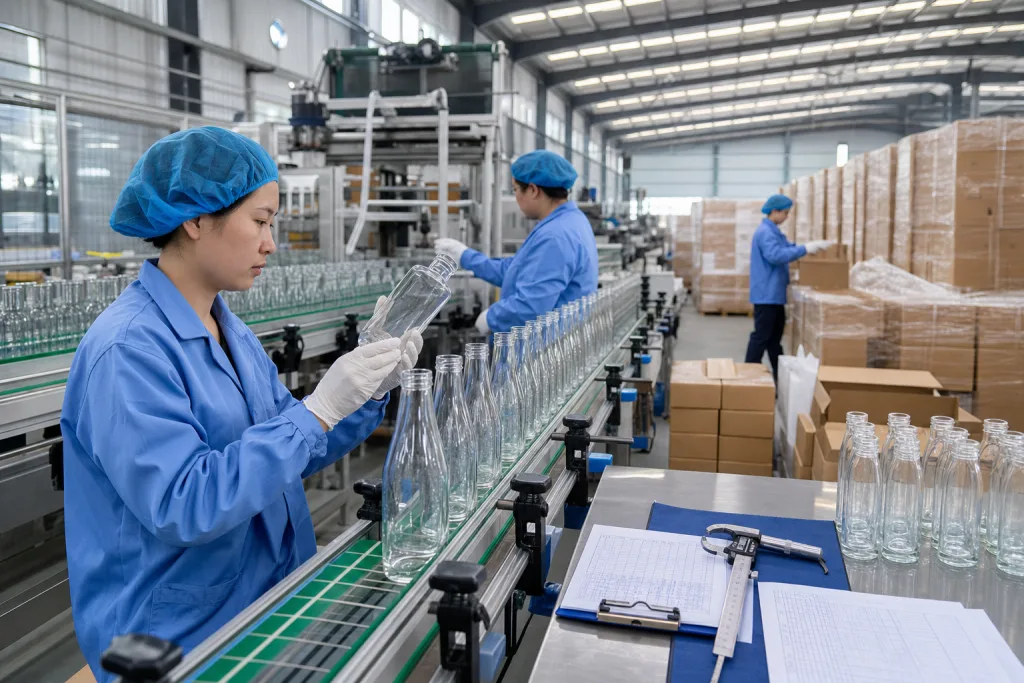
From our factory network in Zhejiang, China, the cleanest orders start with four decisions made before tooling: product structure, customization method, compliance scope, and logistics tolerance. We run B2B custom drinkware programs with typical MOQs from 1,000 to 3,000 pcs per SKU and production lead times around 30-45 days after sample approval. On one recent borosilicate cup order, QC pulled the sample after the buyer flagged a lid wobble; the fix was not a new mold, just changing the silicone ring spec from 52.0 mm to 52.6 mm before mass production.
Start With Use Case, Not Shape
The first decision is not whether the bottle looks modern. Ask where the end user will put it at 8:30 on Monday morning. Borosilicate glass handles thermal shock better than ordinary soda-lime glass, but it is still glass; our QC team still uses a 0.02 mm feeler gauge on lid fit because one loose thread can turn into a leaking desk bottle. A desk bottle, yoga bottle, tea infuser bottle, retail gift set, and customized growler each need different risk controls, and shape is the wrong question to ask first.
For a corporate custom canteen, we usually start with a clean cylindrical body, 500-750 ml capacity, silicone sleeve, and laser-engraved stainless or bamboo lid. The buyer often asks for a slim shape; then the line checks whether it stands stable after sleeve assembly. For a distributor drinkware line sold through retail, carton drop performance and barcode labeling may matter more than saving USD 0.08 on the cap. For a distributor growler, filling method and sealing pressure come first, then handle design and whether the product is for cold beverage service only.
A serious borosilicate glass drinkware manufacturer should ask about the channel before quoting. Amazon FBA needs FNSKU labels, carton limits, and individual packaging; last month a buyer flagged a PO typo where “master carton” was written as “inner carton,” and that single line changed the packing cost. Promotional orders need fast logo sampling and stable color matching, usually checked against a Pantone card before mass production. A canteen distributor selling to schools or hospitality groups often needs repeatable SKUs and lower breakage rates more than a fancy custom lid.
Here is the practical trade-off: the more protection you add around glass, the less cheap the unit looks on paper. A 550 ml bottle with a silicone sleeve, bamboo cap, gift box, and inner EPE protection will not price like a plain clear bottle in a white box. Simple math. If your landed cost increases by USD 0.25 and your breakage claim drops from 4% to under 1%, we would call that a good B2B decision; we have seen this go sideways when buyers cut EPE thickness from 20 mm to 10 mm just to win a tender.
Glass Specs Buyers Should Control
Borosilicate earns its place because it takes temperature shock better than standard soda-lime glass. Do not approve “high borosilicate” as the full spec. Ask for the material grade, wall thickness, capacity tolerance, body weight tolerance, annealing control, and whether the body is machine-blown or hand-finished. For most daily drink bottles, 1.8-2.2 mm wall thickness is a workable range. Thin glass sells well on a showroom shelf; we have seen it go sideways after 3 carton drops in courier distribution. On our line, QC checks wall thickness with a digital caliper at the mouth, shoulder, and lower body, not just one clean spot.
Capacity needs control too. A 500 ml bottle may have actual brim capacity above 520 ml, while safe fill volume may sit closer to 480-500 ml depending on lid structure. This is where the buyer often asks the wrong question: “Can we print 500 ml?” is less useful than “What volume will the consumer safely fill without leaking?” If you sell into Europe or North America, your label claim should match daily use, not only the theoretical rim measurement. Last April, QC pulled a 500 ml sample that measured 527 ml to the brim and 492 ml under the gasket line; the buyer flagged the mismatch before artwork release.
For a customizable growler or larger glass canteen, check base thickness and shoulder consistency. Uneven glass distribution creates stress points. It breaks later. On samples, look for wavy walls, heavy seam marks, small bubbles, and oval mouths. A few tiny bubbles may pass for mid-market retail, depending on your agreed defect chart, but mouth deformation should be rejected because it affects sealing. We run a simple go/no-go mouth gauge on canteen samples; one 65 mm mouth out by 0.8 mm was enough to make the silicone gasket leak during an inverted 30-minute test.
In Zhejiang, China, we usually push buyers to sign off on a physical golden sample before mass production. The sample should include the actual lid gasket, sleeve hardness, printing method, and packaging insert. Digital drawings help, but glass behavior is physical. If you are comparing canteen manufacturers or canteen vendors, ask each one to state the glass thickness, body weight tolerance, and inspection method in writing. Vague answers are a warning sign. We once received a PO with “same as sample” but no sample code; production stopped for 2 days until the buyer confirmed the 680 g body weight target and the approved kraft insert.
Choose Decoration By Failure Mode
Logo method is a branding choice, and it also changes production yield, dishwasher resistance, sample timing, and complaint risk. We see this on the line. A 0.3 mm logo stroke that looks fine in PDF can break during screen printing on curved borosilicate glass, then QC pulled the sample and the buyer asks why the “same file” failed. For customized drinkware in borosilicate glass, we normally quote screen printing or decal printing on the glass body; heat transfer for sharper color blocks; laser engraving for metal lids; pad printing for plastic parts; debossing for silicone sleeves.
Screen printing is usually the lowest-cost choice for one to three solid colors. It fits canteen promotional programs with a simple logo and a short ship window, especially when we run stock glass and a standard jig. Decal printing suits detailed artwork or wraparound graphics, but kiln curing adds time and cost, and small pinholes show up fast under a 500 lux inspection lamp. Heat transfer can look sharp. Test it. We ask buyers to approve adhesion after washing and 3M tape rubbing, because we have seen bright gold artwork go sideways after the third dishwasher cycle. Laser engraving on stainless caps or bamboo lids is clean and durable, but bamboo color variation is part of the material, not a defect.
If you want a canteen customized with a sleeve, the sleeve becomes a second brand surface. Silicone sleeves can be Pantone-matched with a MOQ that often starts around 1,000-3,000 pcs per color, depending on the supplier’s material plan. Debossed logos look premium and do not scratch off, but mold charges may apply. A small sleeve mold can be USD 120-300; a special shape or full private mold costs more. The buyer flagged this once after seeing the PI: the sleeve mold fee was hidden under “accessory cost,” and that is the wrong way to quote it.
The real trade-off is speed versus brand impact. A stock bottle with one-color screen print can often move from artwork approval to mass production in 25-35 days. A canteen customizable program with custom sleeve color, bamboo lid engraving, gift box, and insert card can need 40-55 days. Fixed launch date? Keep the first PO simple. The math does not work if artwork is approved on Friday, the PO has a typo in the Pantone code, and the buyer still expects cartons ready before the vessel cut-off.
Lids, Sleeves, And Leak Claims
Most complaints on glass drinkware are not about the glass chemistry. They are about leaking lids, broken caps, cracked sleeves, and crushed cartons. We see it on the claim sheet. A serious canteen manufacturer treats the lid system as part of the product, not as trim added after the bottle mold is approved. For glass bottles, we run stainless steel lids with PP inner plugs, bamboo-look caps with plastic liners, full PP flip lids, screw caps, and infuser cap assemblies; each one needs its own torque check, gasket fit check, and drop-carton review before bulk packing.
Ask what part touches the beverage. Food-contact parts should be tested, not guessed from a supplier’s old file. For Europe, buyers often request LFGB and REACH-related checks. For the United States, FDA food-contact compliance is common. If your product is for children, additional ASTM or CPSIA considerations may apply depending on design and age grading. Glass drinkware for adults is simpler, but silicone gaskets, coatings, paints, and inks still need control; last month QC pulled a lid sample where the black ink on the top logo failed a 3M tape rub after 20 passes.
Leak testing should be written into the QC plan. A basic factory test may include filling with water, inverting for 30 minutes, and checking 100% of units or a defined sampling plan. For higher-risk lids, we add a shake test, hot water test within safe use range, and gasket compression review with a simple caliper reading before and after assembly. If a canteen supplier says “no leak” but cannot describe the test, the math doesn't work. You do not have a specification; you have a sales promise.
Sleeves are functional. A silicone sleeve at 55-65 Shore A hardness usually gives good grip without feeling too soft. Neoprene sleeves protect against scratches and improve handling, but they can hold moisture in the seam after washing. Cork sleeves look natural but are less forgiving in repeated wet use. For canteen suppliers serving retail chains, sleeve color consistency and odor control need checking on pre-production samples; we had a buyer flag a 1.5 mm sleeve height difference because the logo window sat off-center on shelf photos.
Quality Control Before Shipment
For glass, inspection should happen before the container door closes. Once a shipment lands at your warehouse with cracked inner cartons or swapped lids, the argument gets slow and expensive. We run AQL before loading, with clear defect calls: critical, major, and minor. General Inspection Level II with AQL 0 for critical defects, 2.5 for major defects, and 4.0 for minor defects is a solid base, and we tighten it for gift sets. On the line, QC pulled 20 pcs from a 500-carton lot and caught a 0.8 mm rim chip before stuffing the container. If a buyer says, “we’ll sort it at destination,” that is the wrong question to ask.
Critical defects include sharp edges, cracked glass, contaminated interiors, failed leak tests, wrong food-contact material, or broken pieces inside packaging. Major defects include heavy bubbles, poor logo adhesion, incorrect capacity marking, lid thread problems, and cartons that fail drop testing. Minor defects cover small cosmetic marks within agreed limits. We use a torque gauge on lid checks, and a cap that misses 0.6 N·m usually comes back as a complaint. The math doesn’t work if that slips past QC.
Packaging is part of quality, not a shipping afterthought. For export from China, glass drinkware should normally use individual boxes or wrapped units, inner partitions where needed, and a 5-ply export carton for heavier SKUs. A 1.2 m drop test is a useful reference for e-commerce packaging, though your exact test should match carton weight and channel. If you ship to Amazon, carton size, weight, scannable FNSKU, suffocation warnings for polybags, and master carton labels must be handled before production finishes. We check carton seam strength with a tape pull at the packing table, and a PO typo like “FNSKU” missing one letter will stall a pallet fast.
BottleForge Industrial’s partner lines in Zhejiang can support approximately 300,000-500,000 drinkware units per month across stainless, glass, and plastic programs, but capacity does not replace QC. For your first order with any canteen factory, pay for third-party inspection or require photo/video inspection records. The USD 180-300 inspection fee is cheaper than sorting 2,000 cracked gift boxes at your own warehouse. We’ve seen buyers skip inspection on a 1,000-carton order and regret it later. QC released the lot only after random cartons passed a 10-drop test on the floor.
Pricing, MOQ, And Order Structure
Most borosilicate glass drinkware quotes look clean on paper: unit price, carton size, MOQ, lead time. The real number sits in the build sheet. A plain 500-600 ml borosilicate bottle with a standard lid usually lands around USD 1.20-2.20 at factory level, depending on wall thickness, order volume, and how the carton is packed. Add a silicone sleeve, bamboo lid, two-color print, and gift box, and FOB China often moves to USD 2.00-4.20. We run these jobs every week on the line, and a custom growler or heavy glass gift set can go higher fast.
MOQ is set by components as much as by the glass body. The bottle itself may be open at 1,000 pcs, but once the buyer flags a Pantone sleeve, custom lid color, retail box, or special gasket, the practical MOQ often shifts to 3,000 pcs. QC pulled the sample once and found a lid insert mismatch at 2 mm tolerance, which killed a small run. For a canteen promotional campaign, stock parts with a custom logo are the safer play if you want cost and lead time under control.
If you are a distributor canteen buyer, do not split the first order across too many colors. Three colors at 1,000 pcs each tie up more work than one color at 3,000 pcs. You get more mold swaps, more artwork sign-off, more carton label checks, and more mixed stock on the warehouse shelf. We’ve seen this go sideways when a PO showed “blue, blu, and navy” on three lines; the typo alone cost two days. The same rule applies to distributor drinkware and distributor growler programs: start with the strongest SKU and scale after sell-through data.
Payment terms matter too. Most China factories ask for 30% deposit and 70% balance before shipment on first orders. Repeat buyers with a clean history can usually push for better terms after a few stable shipments. Be careful if a canteen vendor offers a low number with no deposit discipline, no sample process, and no inspection plan. That is not flexibility. It is a problem waiting on the packing table, and the math does not work.
How To Shortlist The Factory
Your shortlist should separate trading convenience from manufacturing control. A trading company is fine for a repeat stock item, but a technical glass program needs access to production facts. Ask the borosilicate glass drinkware manufacturer for 6 things: recent product photos taken on the line; audit documents; food-contact test reports; decoration samples with Pantone or laser settings; packaging specifications with carton size and drop-test grade; a written timeline from artwork approval to shipment. We also ask for one caliper reading on glass thickness, because “2 mm glass” on a quotation sometimes measures 1.6 mm when QC pulls the sample.
Factory audits such as BSCI, Sedex, or ISO 9001 do not guarantee a perfect order, but they show whether the operation understands documentation. For food-contact drinkware, test reports should match the actual materials used in your SKU. A lid report from a different model or last year’s coating batch is not enough for a retail buyer with FDA or LFGB files to close. We have seen this go sideways: the buyer flagged a silicone gasket report dated 2022 while the factory had changed gasket suppliers in March 2024.
Compare canteen manufacturers with the same RFQ sheet. No shortcuts. Include capacity in ml and usable fill line; glass thickness in mm; lid material with grade; gasket material with hardness if available; decoration method with print area; packaging with inner box, master carton, barcode placement, compliance market, Incoterm, target ship date, and inspection standard such as AQL 2.5. If one canteen vendor sends a price in 20 minutes without asking about lid fit or carton drop requirements, the math probably does not include the order you need.
The best sourcing relationship is practical. You give clear specifications and launch dates that the line can actually run. The factory gives direct limits on MOQ, tooling, yield, and lead time, such as 3,000 pcs MOQ, 12 days for sample molds, and 18 days for mass production after artwork approval. Zhejiang, China has a mature drinkware supply chain, but not every supplier fits every project. For custom canteen, customizable drinkware, or canteen promotional orders, choose the partner who explains trade-offs before the PO, including ugly details like a PO typo on PMS 186C or a 9.5 kg master carton that needs stronger tape, not the one who only says yes.
Send your glass drinkware RFQ for review
Share capacity, lid type, logo artwork, market, and target quantity. We will respond with practical MOQ, lead time, and specification risks.
Frequently asked questions
What MOQ should I expect from a borosilicate glass drinkware manufacturer?
For standard borosilicate glass bottles, expect 1,000-3,000 pcs per SKU as a realistic MOQ. If you use a stock bottle, standard lid, and one-color logo, 1,000 pcs is often possible. If you need Pantone silicone sleeves, custom bamboo lids, printed retail boxes, or a special infuser assembly, the practical MOQ may rise to 3,000 pcs or more because each component has its own production minimum. Private molds are a different discussion and may require 5,000-10,000 pcs to make the tooling cost sensible. For a first PO, we usually suggest one strong size and one or two colors rather than spreading 3,000 pcs across five weak variants.
Is borosilicate glass suitable for hot drinks?
Yes, borosilicate glass is commonly used for tea bottles and hot beverage containers because it has better thermal shock resistance than ordinary soda-lime glass. But the final product must still be designed correctly. The lid, gasket, sleeve, and decoration ink also need to tolerate the intended temperature. If your bottle will be marketed for hot tea, ask the canteen supplier to confirm safe use temperature, run hot water leak checks, and test logo adhesion after washing. Do not claim boiling-water performance unless the actual SKU has been tested. For double-wall glass, pressure and venting risks must be reviewed carefully, especially if the cap seals tightly.
Which logo method is best for customized glass drinkware?
For simple logos, one-color or two-color screen printing is usually the best balance of cost, speed, and appearance. It works well for corporate customized drinkware and canteen promotional orders. For detailed artwork, gradients, or wraparound graphics, decal printing gives better coverage but adds cost and curing time. Laser engraving is excellent for stainless steel or bamboo lids, not the glass body itself in most bottle programs. Debossing on silicone sleeves is durable and premium, but sleeve mold charges may apply. Always approve a decorated pre-production sample and request a basic adhesion test, such as tape testing or rub testing, before mass production.
How do I reduce breakage during international shipping?
Control packaging early. For export from China, do not rely on a thin color box and loose master carton for glass. Use individual boxes or wrapped units, partitions or molded inserts where needed, and a 5-ply export carton for heavier products. Ask for carton drop testing based on your sales channel. E-commerce and Amazon FBA orders need stronger packaging than palletized wholesale shipments. Also confirm carton weight; keeping master cartons under about 15 kg makes handling safer. AQL inspection should include carton condition, inner protection, and a sample drop or vibration review if the order is high risk. Spending USD 0.15-0.35 more on packaging is often cheaper than replacement claims.
What documents should a canteen distributor request before ordering?
A canteen distributor should request a formal quotation, product specification sheet, material breakdown, artwork proof, packaging layout, carton marks, compliance test reports, and the factory’s QC plan. For Europe, ask about LFGB, REACH, and relevant food-contact documentation. For North America, FDA food-contact suitability is common, and children’s products may need additional ASTM or CPSIA review. If the order is for retail, also request barcode placement, warning labels, and master carton information. Before deposit, confirm Incoterm, lead time, sample approval process, and AQL inspection level. A serious canteen manufacturer or canteen factory should be able to put these details in writing.