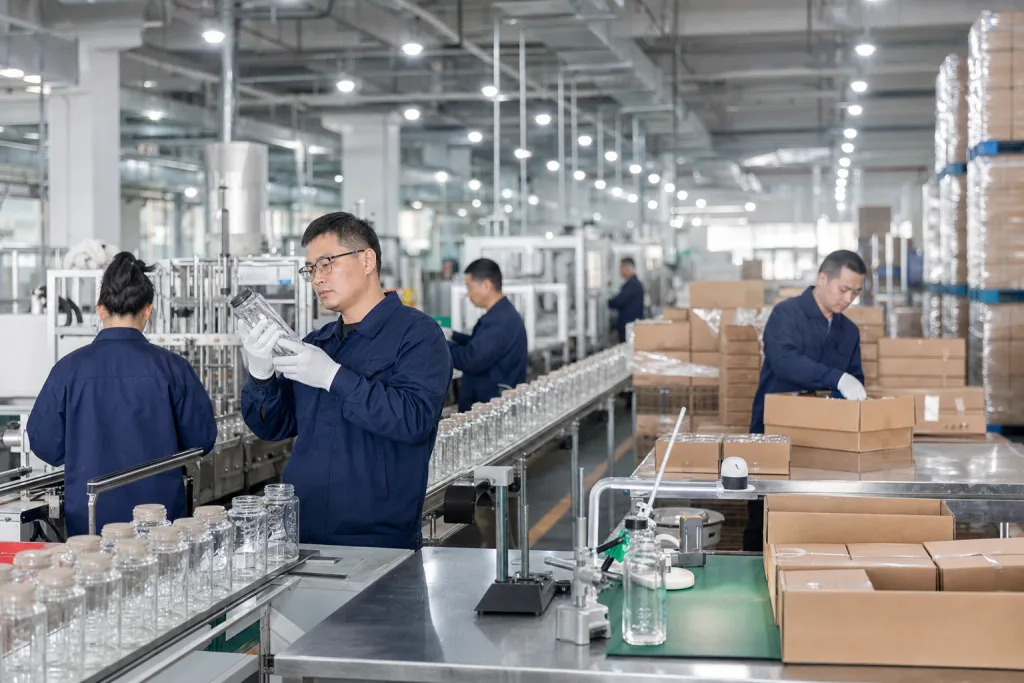
Key Takeaways
- For borosilicate glass, specify tube thickness tolerance at ±0.15 mm and rim roundness before sampling
- A realistic MOQ for custom color box and logo glass drinkware is usually 1,000-3,000 units per SKU
- Packaging should pass a 76 cm carton drop test if you ship distributor canteen or retail e-commerce orders
- Use AQL 2.5 major / 4.0 minor inspection, with extra checks for thermal shock, lid leakage, and logo adhesion
A borosilicate glass drinkware factory can look tidy on a video call and still ship cartons with chipped rims, loose lids, tilted logos, or breakage claims. Glass tells on you. If you buy custom drinkware for retail, promotional campaigns, or distributor programs, unit price is the wrong first question. One missed rim tolerance, a 0.3 mm thin spot at the mouth, or an untested insert tray can turn 8,000 bottles into stock nobody wants to touch.
We manufacture and source drinkware in Zhejiang, China, and we see the same problem every month. A buyer asks for a good-looking canteen with a logo, then the PO says only “500 ml glass bottle, bamboo lid, packed in color box.” That is not a spec. It is a wish. Last April, QC pulled the pre-production sample on the line because the silicone ring sat proud by 1.5 mm and the lid leaked after three shake tests. A useful RFQ tells the canteen factory where failures will happen before we run mass production.
When glass thickness is guessed
The first failure mode is simple: the sample feels right, then the container shipment lands and the bottle wall is thinner. Borosilicate glass comes from tubing or formed glass, and a small wall change shows up fast on the line. A 550 ml bottle with 1.8 mm average wall thickness behaves differently from one at 1.5 mm, especially at the shoulder, base push-up, and drinking rim. We have seen QC pull 20 samples from a pilot carton and find the shoulder running 0.25 mm under the approved sample.
If you are buying from a borosilicate glass drinkware factory in China, do not approve only capacity and outer shape. Put the measurable dimensions into the purchase order: height ±1.5 mm, diameter ±1.0 mm, wall thickness target 1.8 mm with minimum 1.6 mm, rim thickness 2.5-3.2 mm, and base thickness minimum 3.0 mm for table impact resistance. Use the PO, not WeChat chat history. For a custom canteen with a sleeve, specify the sleeve fit after glass tolerance, not just the glass CAD drawing; the buyer usually flags this only after the sleeve twists or gaps by 1 mm.
Bad thickness control creates commercial trouble. Breakage rises during filling and packing, especially when cartons are drop-tested at 76 cm and the base is thin. Cartons start to feel mixed. A distributor canteen program looks cheap when one bottle feels solid and the next feels light in the same master carton. Lids and silicone seals also miss their seat if the mouth tolerance drifts; we have had a 63 mm cap pass on the sample and fail on 8 cartons from bulk.
For larger customized drinkware orders, ask for first article inspection before mass production. At our Zhejiang partner lines, a normal run may be 80,000-120,000 glass units per month depending on shape complexity, but speed is the wrong question to ask. Ask how often operators measure wall thickness during production. Every 2 hours is a reasonable checkpoint for long runs, and the record should show actual readings from a digital caliper, not a clean table typed after lunch. If the canteen supplier cannot show a caliper record or QC sheet, you are buying luck.
Rims chip before customers complain
Rim defects are where glass drinkware projects slip first. A 0.2 mm chip on a drinking edge can sail through a warehouse check and still fail the first customer sip. We saw that on a 600 pcs sample run last month: QC pulled 12 pieces with edge nicks after a carton drop test. This is not a cosmetic issue.
There are three rim risks to control: the cut, the flame polish, and the handoff after finishing. Borosilicate tubes are cut, opened, and finished on the line. If the cut is rough, the flame angle is off, or the rim cools too fast, micro-cracks start at the lip. You will not see them under normal light. Put the cup in hot water, then hit it with a cold rinse, and the defect shows up fast.
Your spec should say: no sharp edges, no visible chips above 0.3 mm, no radial crack at rim, drinking surface fully fire polished, and 100% visual check before packing. For premium customizable drinkware, ask for a cotton swab test on the rim; if fibers snag, the finish is not ready. A buyer once pushed back and called it overkill. The math did not work in his favor. One return claim costs more than a swab and 10 extra seconds at inspection.
Do not let the factory pack glass straight after hot processing without controlled cooling. Annealing is not a brochure word. It cuts internal stress. Ask whether the plant runs an annealing oven and whether they do polarized light stress checks on samples. We ship 3,000-unit orders this way all the time, and for that MOQ it is a fair ask. On one PO, the buyer even typoed the carton count, but the stress check caught a rim issue before the load left the dock.
For inspection, use AQL 2.5 for major defects and treat rim chips, cracks, and sharp edges as critical or major, not minor. If you are a canteen distributor or retail importer, put that line into the QC sheet before the inspector walks in. Inspectors follow the document, not your memory. I would also add a carton-drop note at 76 cm for the first batch; we have seen a clean-looking rim fail only after packing vibration.
Lids leak after the sample
Buyers call a glass bottle “simple” right up to the first leak test. Then the lid owns the claim. The glass body can pass, but a weak closure turns 10,000 pcs into a debit note. Bamboo lids, PP lids, stainless caps, silicone plugs, and straw caps do not fail the same way, so we do not treat them as one item on the BOM. A customized canteen with a natural bamboo top photographs well, but bamboo moves by batch; last month QC pulled 12 bamboo lids from incoming inspection and found 0.6 mm variation after moisture conditioning. Seal it properly, or the math does not work.
For each lid, write the contact materials and compliance target on the spec sheet, not only in the email thread. For Europe, request LFGB or EU food contact declarations where applicable, and REACH for coatings, inks, and accessory materials. For North America, ask for FDA food contact material statements. If the product is for kids, ASTM and CPSIA-related checks apply by design and market. We also ask the lid vendor to mark gasket material clearly; “silicone ring” on a PO is not enough when the buyer later asks whether it is food-grade silicone or TPE.
Leak testing needs plain numbers. We run checks like this: fill to 95% capacity with room-temperature water, close to the defined torque, place horizontally for 30 minutes, then shake 20 cycles. Simple test. For a travel-style custom canteen, add inverted testing for 2 hours. For hot-fill claims, push back early: 7 out of 10 glass canteens we review are not pressure-safe when filled with boiling water and sealed immediately. On the line, we use a torque meter instead of “hand tight,” because one operator’s hand tight is another buyer’s complaint.
Thread fit deserves attention. If the glass mouth is 58 mm, define the mouth OD and thread pitch tolerance. A canteen supplier can change lid subcontractors to save USD 0.08 per unit, and we have seen this go sideways. That small change can cause leakage across 20% of production. For a distributor growler or customized growler, the closure system carries more risk because the product holds larger volume and users expect a stronger seal. Do not approve a lid from one sample batch and accept a different gasket in mass production without written approval; our QC table has caught this with a caliper at pre-shipment more than once.
Decoration fails in real handling
Logo decoration on glass looks easy in a PDF. On the line, it is where small mistakes show up fast. Screen printing, decal, heat transfer, frosting, color coating, and laser marking all fail in different ways, so the cheapest option is not always the lowest-cost option. We had a 3,000 pcs canteen promo order where QC pulled the sample after carton rubbing and found white ink transfer on the divider paper. The buyer had approved the artwork, but the logo could not survive normal packing friction.
For borosilicate glass, screen printing works well for one- or two-color logos. At 1,000 units, it is usually around USD 0.08-0.18 per print position depending on size and ink coverage. Decals are better for multi-color artwork, but they cost more and need firing control; a 15°C oven drift can change the final tone. Frosted coating feels premium in hand, but weak coating peels first near the base ring or under a silicone sleeve. Laser marking is stable on some coated surfaces. For clear glass, it is not a magic fix.
Your artwork spec should state the Pantone code, print size in mm, position tolerance of ±1.5 mm, required opacity after curing, and the exact adhesion test method. A simple 3M tape test after curing catches plenty of trouble before mass production. For retail programs, we run 50 cycles of hand-rub abrasion with a wet cloth and 20 cycles with a dry cloth; this takes 12 minutes per sample, not 2 minutes. If you plan to claim dishwasher-safe, ask the borosilicate glass drinkware factory for a defined dishwasher test report. An email line saying “dishwasher safe” is not proof.
For canteen customizable ranges, keep decoration zones away from high-contact curves and sleeve edges. A logo printed across a shoulder radius will distort, especially when the radius drops below 18 mm. A logo placed under a silicone band will abrade; we have seen this go sideways after only one buyer sample review. A reliable canteen manufacturer should push back when artwork cannot survive daily handling. That pushback is a good sign, not bad service.
Cartons are under-specified
Glass damage gets blamed on the courier, but we see 7 out of 10 breakage claims start with packaging specs, not handling. If the master carton is oversized, weak, or packed with 1 mm thin dividers, it can fail before it reaches your warehouse. For China export orders, cartons move from our packing line to a truck, consolidation warehouse, container, port, destination warehouse, then the parcel network. That is too many impacts for a soft carton.
Specify packaging like you specify the bottle. For individual retail boxes, use 300-350 gsm white card or E-flute corrugated for heavier items. For master cartons, 5-ply export carton is a normal baseline, with edge crush strength matched to carton weight. Keep master cartons under 15 kg when possible; our QC scale sits beside the sealing machine for this exact check. For a 500 ml glass canteen, 24 pcs per carton can pass. For a heavier custom growler, 12 pcs per carton is safer, even when the buyer pushes back on freight cost.
Ask for a 76 cm drop test on one corner, three edges, and six faces if the product will ship through distributor channels or e-commerce. We run this with a marked test carton before mass packing, not after 300 cartons are already taped. For Amazon-style FBA preparation, confirm carton size, weight, FNSKU labeling, suffocation warning for polybags if used, and barcode scannability before production packing. A distributor drinkware order does not need individual FNSKU labels, but it still needs carton marks that match the packing list exactly; one PO typo in the SKU code can hold a pallet at receiving.
One common mistake is approving beautiful gift boxes with no internal restraint. The bottle moves inside, the lid rubs the print, and the glass base hits the box wall. We have seen this go sideways on a 2,000 pcs canteen order where QC pulled the sample after a shake test and found ring scratches on the lid coating. Add molded pulp, paper wrap, a corrugated insert, or a tight sleeve. This can add USD 0.12-0.35 per unit, but the math does not work if you accept 6% breakage. Good canteen vendors discuss packaging cost early because claims usually start with cartons.
Compliance paperwork arrives too late
About 6 out of 10 buyers ask for test reports after production is finished. That is backwards. If your product needs REACH, LFGB, FDA food contact, Prop 65 review, BSCI factory audit, or ISO 9001 documentation, confirm it before deposit. A borosilicate glass body is usually the easy part; lids, paints, silicone seals, sleeves, adhesives, and coatings are where QC pulled the sample and the buyer flagged the gap. We have seen a PO say “FDA cup,” while the actual issue was the PP lid and the 1.8 mm silicone gasket.
For Europe, REACH screening applies to external coatings, soft-touch finishes, silicone, and some colorants. LFGB is often requested for food-contact parts, especially lids and seals. For North America, FDA food contact documentation and California Prop 65 assessment may matter by sales channel. If you sell to children, the rules get tighter. “Export quality” is not a document. Ask for the actual report number, issuing lab, product description, test date, and matching material; we run this check before tooling, because a $280 color-matching fee is cheaper than holding 12,000 finished lids in the warehouse.
A practical approach is to build a compliance matrix: glass body, lid material, gasket material, coating, ink, sleeve, packaging, and destination market. Mark which report covers each part. If one material changes, the report may no longer apply. This matters for canteen distributors who reorder quarterly; the second batch must match the approved bill of materials. We have seen this go sideways when a buyer approved a silicone seal in June, then asked for a cheaper TPE seal in September with the same report file. The math does not work.
Factory audits are similar. BSCI or Sedex may be requested by larger retailers. ISO 9001 tells you something about process control, but it does not guarantee good glass. A Zhejiang drinkware exporter can help coordinate documents, but you still need to state the required standard in the RFQ. Put it in writing. If a canteen supplier only starts looking for paperwork after your goods are packed, your shipment date is already in danger; a lab retest can turn a planned 12-day buffer into 18 days, and the line cannot fix missing paperwork with a caliper or annealing oven.
Price cuts change the product
The last failure mode is commercial: the buyer pushes the price down, then the product changes without a red stamp saying “downgraded.” The wall drops from 2.0 mm to 1.7 mm, the 5-layer carton becomes a softer B-flute, the silicone gasket is swapped, or final inspection is cut from full checks to spot checks. Nobody writes that on the PI. We see it later as leakage, sleeve scratches, or breakage after a 1.2 m drop test.
For a normal borosilicate glass drinkware factory order in China, expect MOQ around 1,000 pcs for simple logo printing, 2,000-3,000 pcs for custom color coating or retail packaging, and higher if you need a new mold, exclusive lid, or a fully customized growler shape. Lead time is typically 25-35 days after sample approval for standard items, and 45-60 days for new tooling or complex decoration. As a rough FOB Ningbo or Shanghai range, simple borosilicate bottles may run USD 1.20-2.80, while premium glass canteens with sleeves, bamboo lids, and color boxes may land at USD 2.60-5.50 depending on volume and packaging. The math gets tight fast; if the buyer asks us to cut USD 0.18 on a 1,000 pcs run, the line still has the same annealing oven time, same silk-screen setup, and same carton CBM.
When comparing canteen manufacturers, ask each to quote the same spec sheet, not the same product photo. Include AQL level, packaging test, compliance documents, decoration method, carton strength, and replacement policy for confirmed factory defects. A quote that is USD 0.25 lower can be clean business, or it can be missing the inner tray, annealing check, and real gasket material. We had one buyer flag a cheaper quote last year; QC pulled the sample, weighed it on the bench scale, and the bottle was 38 g lighter than our approved sample.
For repeat distributor growler or canteen customized programs, lock a golden sample and signed bill of materials. Keep one sample at your office and one at the factory. On reorders, compare weight, glass thickness, lid torque, print color, and carton structure. Do it every time. That small discipline protects your margin better than another week of price negotiation, because once 2,400 pcs have shipped and the PO typo says “standard lid” instead of “leakproof bamboo lid,” the argument gets expensive.
Send your glass drinkware spec for factory review
We will check wall thickness, lid risk, packaging, MOQ, compliance, and FOB pricing before you commit to sampling.
Frequently asked questions
What MOQ should I expect from a borosilicate glass drinkware factory?
For existing glass shapes, 1,000 pcs per SKU is a realistic starting point for one-color logo printing. If you need custom coating, special Pantone lids, retail color boxes, or a canteen customized for a campaign, expect 2,000-3,000 pcs. New tooling for a custom growler or exclusive bottle shape may require 5,000 pcs or a mold fee from USD 800-3,500 depending on complexity. MOQ also changes with decoration suppliers. A canteen vendor may accept 500 pcs for plain stock, but that rarely works for controlled color matching, packaging print, and inspection cost.
Is borosilicate glass safe for hot drinks?
Borosilicate glass has better thermal shock resistance than ordinary soda-lime glass, but the full product must be designed for the use claim. The glass body may handle a temperature change of around 120°C in controlled testing, while the lid, gasket, coating, or sleeve may not. Also, sealing a bottle immediately after adding boiling water can create pressure and leakage risk. If you want to market the item for hot tea or coffee, request thermal shock testing, lid heat-resistance data, and warning text. Do not let a canteen supplier make a broad “hot safe” claim without test conditions.
Which logo method is best for customizable drinkware in glass?
For simple one- or two-color logos, screen printing is usually the best balance of cost and durability, often USD 0.08-0.18 per position at normal MOQ. Decal printing is better for multi-color or detailed artwork but costs more and requires firing quality control. Frosting and color coating look premium but need adhesion and abrasion testing. For canteen promotional orders, always define Pantone color, logo size, position tolerance, and tape test requirements. If the product will be washed often, ask for a dishwasher or abrasion test before approving mass production.
How do I inspect a glass canteen order before shipment?
Use a written QC checklist with AQL 2.5 major and 4.0 minor as a baseline. Treat cracks, sharp rims, leakage, broken cartons, wrong material, and serious logo defects as major or critical. The inspector should check capacity, height, diameter, wall thickness, rim finish, lid fit, leak test, logo adhesion, packaging, barcode, and carton marks. For a 3,000 pcs order, inspection usually samples 125-200 units depending on the inspection level. Add a 76 cm drop test if goods will ship through distributor canteen or e-commerce channels.
Can one factory handle both glass bottles and stainless drinkware?
Sometimes the exporter can coordinate both, but the production lines are usually different. Borosilicate glass forming, annealing, and fire polishing are not the same as stainless steel vacuum bottle welding and vacuum testing. If you buy customized drinkware across glass, stainless, and plastic, work with a supplier that is honest about which items are made in-house and which are partner-produced. Ask for factory photos, audit documents, production capacity, and QC responsibility. A good China supplier can manage mixed drinkware programs, but your PO must define standards for each material.