Key Takeaways
- Most borosilicate glass drinkware custom orders start at 1,000-3,000 pcs per shape, depending on lid and print complexity
- FOB China unit cost often ranges from USD 2.20-6.80 for retail-ready glass bottles and tumblers
- Printing, sleeve, lid, and gift box choices can add USD 0.25-1.80 per unit before freight
- A practical timeline is 7-12 days for samples, 30-50 days for mass production, and 3-7 days for final inspection and loading
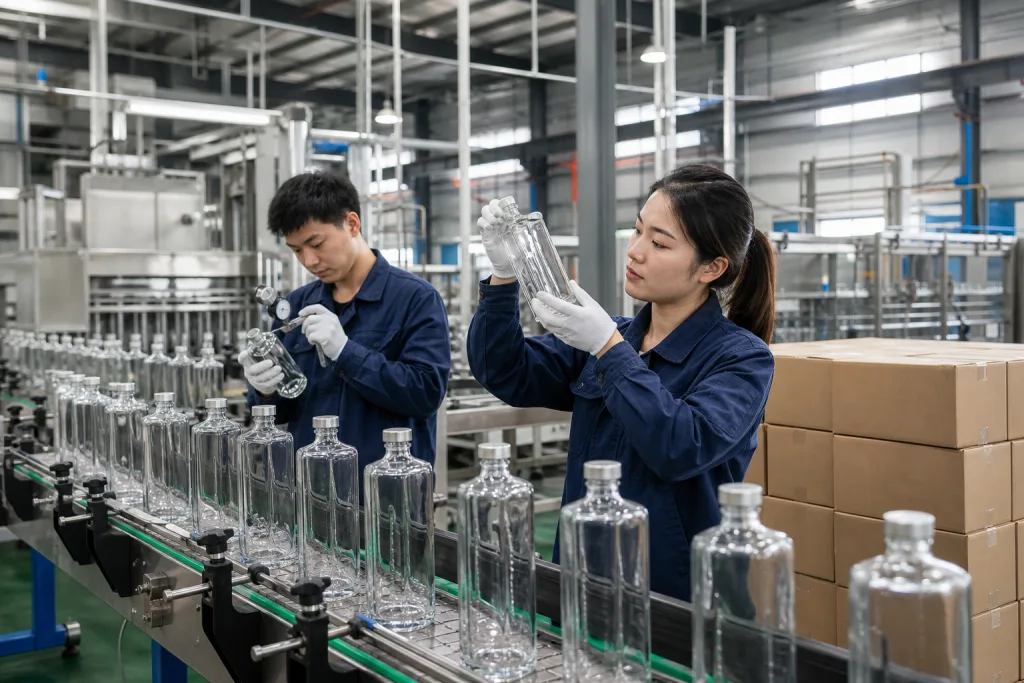
Borosilicate glass looks simple on a product page. Buying it well is harder. You are paying for glass tube grade, forming yield, lid fit, sleeve tolerance, printing scrap, export packing, and inspection discipline. On the line, QC checks rim roundness with a 0.02 mm caliper, and that small gap decides whether a bamboo lid sits flat or leaks in a buyer’s carton test. A low quote gets expensive fast when 4% of bottles arrive cracked or the logo turns gray after the first dishwasher cycle.
For borosilicate glass drinkware custom projects, “what is the unit price?” is the wrong question to ask. You need the MOQ tier, decoration method, carton strength, sample timing, and which side is carrying the risk when printing scrap runs past 3%. From Zhejiang, China, we typically see 15,000 to 30,000 glass units per month across mixed bottle and tumbler orders, with realistic custom lead times of 30 to 50 days after artwork approval. We ship faster only when the buyer locks the Pantone code, lid material, and packing mark before the first sample; one missed “matte black” note on a PO can add 6 days.
Where The Unit Price Starts
The base price for borosilicate glass drinkware custom work starts with the glass body. Standard 300 ml to 750 ml bottles made from high borosilicate glass usually land around USD 1.10-2.40 FOB China for the naked bottle at 3,000 pcs, before upgraded lids, sleeves, inserts, or retail packaging. Double-wall cups and tea infuser styles cost more because forming time is slower and scrap risk is higher; expect USD 2.60-5.20 before branding. On our line, a single-wall bottle might clear the flame-forming station in 38-45 seconds, while a double-wall cup needs extra alignment and annealing time, so the math does not work if a buyer expects the same price.
Wall thickness matters. Buyers often write “strong glass” on the RFQ, but the factory needs a number. For common single-wall bottles, 1.8-2.2 mm is a practical range. Below that, you get a lighter product but breakage rises during filling and carton drop tests. Above 2.5 mm, the bottle feels premium but cost and shipping weight rise fast. For double-wall tumblers, thickness and inner-wall alignment affect both appearance and yield; QC pulled one 500 ml sample last month with a 1.6 mm side wall and visible inner cup lean, and we rejected it before packing.
Lids are the second large cost driver. Bamboo lids with silicone rings often add USD 0.45-0.95. Stainless steel lids can add USD 0.55-1.20 depending on 304 grade, plastic insert, and leak-proof structure. Flip lids or straw lids move the product closer to a customizable drinkware program and need mold checking, torque testing, plus extra assembly labor. We run a simple leak test by filling to 80%, inverting for 30 minutes, then checking the carton liner; one buyer flagged a 2 mm silicone-ring gap that looked harmless but failed after warm water contact.
If you are a canteen distributor or distributor drinkware buyer comparing glass against stainless steel, glass saves on the vacuum insulation process but gives back margin through breakage control and packing. A fair quote should separate the glass body and lid first, then show decoration, packaging, and testing as separate lines. If a canteen supplier gives only one all-in price with no breakdown, you cannot see what will change when your retailer asks for a sleeve upgrade or a different carton drop-test standard. We have seen this go sideways after a PO typo changed “white sleeve” to “white box,” adding 12 days to the schedule and forcing a carton rework at the packing table.
MOQ Tiers That Actually Work
MOQ is not a penalty. It is the quantity where setup time, decoration loss, purchasing, and QC stop eating the margin. For a standard borosilicate bottle from an existing mold, we run 1,000 pcs as a workable MOQ for one logo and one carton mark. Below that, the silk-screen frame, ink mixing, line changeover, and AQL 2.5 inspection time still cost the same. At 3,000 pcs, pricing often drops by 5-10% because printing setup, carton production, and lid purchasing spread out better. At 5,000-10,000 pcs, we can push the lid supplier harder and hold a steadier production slot instead of squeezing the order between two larger runs.
For new shapes, the MOQ changes. A fully new glass mold may need 5,000-10,000 pcs for the first production run, plus tooling cost. Tooling for a basic glass body can range from USD 800-2,500. Complex lids are a different cost center. A new plastic flip lid or custom canteen cap may require USD 2,000-8,000 in tooling depending on cavities, texture, and leak-proof parts. The buyer sometimes asks for 1,000 pcs with a brand-new cap, but the math does not work when one mold trial already burns through material, CNC adjustment, and leak-test samples.
Decoration also changes MOQ. One-color silk screen on an existing bottle can start at 1,000 pcs. Multi-color screen printing is safer at 2,000-3,000 pcs because color registration and reject sorting take time. QC pulled the sample last month on a 2-color logo because the second screen shifted about 0.8 mm near the bottle curve. Decal printing, gradient spraying, or full-wrap artwork may require 3,000 pcs or more. If you want a canteen customizable program with four colors, two lid types, and six logo versions, the practical MOQ is not one number. It is split by SKU, and this is the wrong question to ask if the purchase order has 48 tiny variants.
- 1,000 pcs: existing bottle, simple logo, standard lid, export carton with one carton mark.
- 3,000 pcs: better price, retail box option, tighter decoration control after pre-production sample approval.
- 5,000 pcs: stronger component buying, suitable for canteen promotional campaigns where we ship one main SKU with limited color splits.
- 10,000 pcs: best for distributor canteen or distributor growler programs with repeated reorders, stable lid stock, and cleaner carton planning.
Decoration Costs And Failure Points
Branding borosilicate glass is where custom drinkware budgets drift first. Silk screen printing is still the standard for logos and measurement marks; we run mesh screens on curved glass, and a 0.5 mm registration miss is already visible on a scale mark. One-color printing often adds USD 0.08-0.18 per unit at 3,000 pcs. Two-color printing may add USD 0.16-0.35. Metallic inks, large coverage, or tight registration push the cost up fast. Laser engraving works on metal lids and some coated parts, but it is the wrong question to ask for clear glass branding if you expect a bold logo. On glass, you usually get a light frosted mark.
Decal printing fits detailed artwork better, but it costs more and needs firing. You may see USD 0.35-0.90 per unit depending on size and coverage. Price is only half the problem. Decals can shift, bubble, or show edge lines if the supplier cuts drying time; QC pulled one 500 ml sample last month with a 1.2 mm decal lift near the bottom curve. For premium customized drinkware, we usually ask the buyer to approve a physical pre-production sample, not a digital mockup. Screens lie. Kilns do not.
Color spraying gives a strong retail look, especially matte black, frosted white, gradient blue, or soft-touch coatings. But coatings need testing before you lock the PO. Ask for adhesion testing, dishwasher guidance, and a cross-hatch test result; our line checks with 3M tape after the coating cures for 24 hours. For European buyers, REACH requirements matter for coatings, inks, and silicone parts. For North American buyers, check food-contact requirements and applicable ASTM or FDA-related documentation based on your channel. We have seen this go sideways when the buyer approved the color chip but forgot the coating compliance file.
Private label buyers sometimes combine glass bottles with sleeves. A neoprene sleeve may add USD 0.35-0.75, while a silicone sleeve can add USD 0.60-1.40 and may require its own mold if the shape is not standard. For a customized canteen or customizable growler look, sleeves improve grip and hide scuff marks from carton rubbing. They also create another size tolerance problem. If the sleeve is too tight, assembly slows from 900 pcs per hour to around 520 pcs per hour; if too loose, the product feels cheap and the buyer flags it on the first unpacking video.
Artwork cost is not only the print charge. Budget for setup, reject rate, extra inspection time, and one round of sample correction.
Packaging And Breakage Math
Glass drinkware lives or dies in packaging. We can blow a clean borosilicate bottle on the line, pass the annealing check, and still lose the reorder if the export cartons crush on the water. For borosilicate glass drinkware custom orders, we cost packaging as its own line item: PE inner bag or tissue wrap, paper sleeve or gift box, E-flute divider, 5-layer K=A master carton, corner board if the bottle is tall, plus a pallet option when the buyer does not want floor-loaded cartons.
A plain white box may add USD 0.18-0.35. A printed retail box with 350 gsm paperboard may add USD 0.35-0.80 depending on size and finish. If you need a rigid gift box, expect USD 1.20-2.80. For e-commerce or Amazon FBA style packing, we usually check the 1.0-1.2 meter drop-test risk, FNSKU label placement, suffocation warning polybags if used, and carton marks that match the booking. Not free. Label and packing labor can add USD 0.05-0.18 per unit, and we have seen 6-SKU assortments run higher because one wrong FNSKU sticker gets the whole carton rejected.
Breakage allowance should be agreed before deposit, not after the first claim email. A well-packed glass bottle shipment from China should target below 1% transport breakage under normal handling. Poor packing can reach 3-6%, and the math does not work when the quote saved USD 0.12 but claims cost USD 0.60 per unit landed. QC pulled one 500 ml sample last month after a corner-drop test; the bottle survived, but the lid dented through a thin divider, so we changed the insert thickness from 1.5 mm to 2.0 mm. If you are a canteen vendor supplying retailers in Europe or North America, your customer will not care that the factory saved USD 0.12 on the carton. They will charge back the damaged units.
Carton weight also affects freight. Glass is heavier than plastic and many stainless styles. A 500 ml glass bottle with lid and retail box may weigh 450-700 g per unit. Master cartons above 15 kg are rough on warehouse handling, and buyers have flagged this during inbound checks at German and US 3PL warehouses. For distributor drinkware programs, we prefer cartons in the 10-14 kg range, with shipping marks that show the PO number, SKU code, and country of origin exactly as written on the purchase order. Small typo, big headache. Zhejiang export factories know this paperwork, but you still need to put it on the PO before we run carton printing.
Timeline From Sample To Loading
A realistic lead time starts after artwork, lid choice, packaging, and payment are all confirmed. If the logo file is still being changed from Pantone 186C to 200C, the clock has not started. For existing borosilicate glass items, sample preparation is usually 7-12 days. If you need custom coating, decal, or a new sleeve, sample time moves to 12-20 days. International courier adds 3-5 days to Europe or North America. We run the first logo check with a 0.2 mm tolerance on decal position; QC pulled samples last month because the logo sat 3 mm too low on a 500 ml glass bottle.
After sample approval and deposit, mass production normally takes 30-50 days. The range depends on season, quantity, decoration process, and whether the canteen manufacturer has glass tubes, lids, silicone rings, and color boxes in stock. Around major China holidays, especially Chinese New Year, you should add 15-25 days of buffer. In Zhejiang, around 70% of small component suppliers close before the final assembly factory closes, so lids, silicone rings, and boxes must be booked early. This is where we’ve seen orders go sideways: the glass is ready, but one 55 mm PP lid is still waiting for color approval.
A clean schedule for a 3,000 pc custom drinkware order looks like this: 2 days for final artwork checking, 8 days for sample, 3 days for courier review, 5 days for box proof and print file confirmation, 30-35 days for production, 2 days for internal QC, 1 day for third-party inspection, and 2-4 days for loading arrangement. That is roughly 53-60 calendar days from serious kickoff to vessel handover, not counting sea freight. The line needs a signed pre-production sample, not a WhatsApp “looks ok” message; one PO typo we caught changed 3,000 pc to 30,000 pc, and the carton booking would have been a mess.
If you need the goods for a fixed launch date, ask for a production calendar, not a promise. A promise is cheap. The calendar should show glass forming, decoration, lid arrival, packaging arrival, assembly, inspection, and shipment booking. A serious canteen factory or canteen supplier will show these steps because delays usually happen between steps, not during the main production day itself. The buyer often flags the same thing: “Can you ship 12 days earlier?” Sometimes yes, but if the bottle has a sprayed coating plus decal firing, the math doesn’t work without cutting inspection or paying for air freight.
Quality Checks Worth Paying For
Glass QC should be boring, documented, and a little strict. We run AQL on finished goods, but borosilicate needs process checks before the last carton is taped. Bubbles, black spots, rim unevenness, lid fit, silicone smell, print scratches, coating dust, and weak cartons show up fast if the line is sloppy. For most B2B buyers, AQL 2.5 for major defects and 4.0 for minor defects is a solid start. Critical defects stay at zero. On our bench, QC pulls a caliper and a rim gauge before packing. That is the real check.
Leak testing is mandatory for bottles with lids, especially if you sell them as travel items. We do an inverted hold for 2-4 hours after filling, then check the seal line and the cap threads. For tighter orders, add shake testing and torque checks. If the buyer wants a custom growler or customized growler with a larger lid, the sealing area is wider and gasket hardness matters more than people think. Silicone rings should be food-grade and fit by design, not by stretching them by hand. We have seen that go sideways on a 3,000-piece PO. The buyer flagged it.
Thermal shock is why buyers choose borosilicate glass, but do not oversell it. Good borosilicate handles temperature change better than soda-lime glass, and it still breaks if the spec is careless. If your claim says hot tea, cold brew, dishwasher-safe, or microwave-safe, the test has to match that claim. For coated or printed items, the decoration may fail before the glass body does. We run a 1,000-cycle dishwasher test on some projects, and the print is often the first thing to flake. That is the wrong place to save money.
Factory audits matter too. BSCI, ISO 9001, and food-contact material records do not promise perfection, but they cut a lot of guesswork. If you are choosing between canteen manufacturers or canteen vendors, ask for recent inspection photos, not just certificates. A Zhejiang, China supplier with stable export QC should show incoming material checks, line inspection records, and final packed carton photos for your PO. We once caught a PO typo on box count before shipment, and that saved a week. Ask for proof from the line, not a clean PDF.
How To Compare Supplier Quotes
Compare quotes line by line, or the price means nothing. We see this mistake at least 6 times a month: one quote includes a color retail box, REACH testing, and AQL inspection, while the cheaper quote is bulk-packed borosilicate bottles with no testing at all. Put your RFQ into a table: capacity, glass thickness in mm, lid material, seal structure, decoration size, packaging, MOQ, Incoterm, sample cost, tooling cost, production lead time, and validity period. QC pulled one 550 ml sample last week and found the glass wall was 1.8 mm, not the 2.2 mm shown on the buyer’s spec sheet. Small gap. Big claim later.
FOB Ningbo or FOB Shanghai is common for Zhejiang factories. EXW looks cheaper on the first line, but then you are handling local trucking, export clearance, and sometimes a missing HS code on the packing list. For new buyers, FOB is cleaner. If you are a canteen distributor building a repeat program, ask the canteen manufacturer to quote 1,000, 3,000, 5,000, and 10,000 pcs. On our line, the real break often appears at 3,000 pcs because carton printing and lid assembly setup get spread across more units.
Watch the words “free sample.” A plain stock sample might be free, but a customized canteen sample with logo, silicone sleeve, and printed box needs film, setup labor, and one operator standing at the pad-printing machine for a short run. Paying USD 80-250 for a proper pre-production sample is reasonable if it prevents a USD 15,000 mistake. The same goes for third-party inspection. USD 250-350 before shipment is cheap compared with sorting 42 cartons of cracked glass or off-center logos in your warehouse.
The best supplier is not always the lowest number. That is the wrong question to ask if the quote is incomplete. You want the canteen vendor who states what is included, where the risk sits, and what they will do if the batch fails inspection. For borosilicate glass, ask for clear costing, stable lead time, and packaging that survives the route from China to your customer. We ship test cartons with a 60 cm drop check because thin glass and weak dividers have gone sideways before. That is the difference between a one-time promotional order and a distributor canteen program you can reorder without holding your breath.
Price your glass drinkware order with fewer surprises
Send capacity, logo, lid, packaging, MOQ, and market. We will return a practical FOB China quote and production timeline.
Frequently asked questions
What is the normal MOQ for borosilicate glass drinkware custom orders?
For existing molds, the workable MOQ is usually 1,000 pcs per shape with one simple logo. At 3,000 pcs, the price normally improves by 5-10% and retail packaging becomes easier to arrange. If you need a new glass shape, custom silicone sleeve, or private lid, expect 5,000-10,000 pcs plus tooling. A multi-SKU customized drinkware program should be planned by SKU, not only by total order quantity.
How much should I budget per unit FOB China?
For a standard borosilicate bottle with lid and simple logo, many B2B projects fall around USD 2.20-4.20 FOB China at 3,000 pcs. Double-wall cups, infuser bottles, silicone sleeves, and printed gift boxes can move the price to USD 4.50-6.80 or higher. Testing, FNSKU labels, and stronger cartons are usually extra. Always ask for a line-by-line quote so you can see the cost of glass, lid, decoration, and packing.
Is borosilicate glass better than stainless steel for promotional drinkware?
It depends on the user and channel. Borosilicate glass gives a clean taste, premium transparency, and good heat resistance, making it strong for tea, wellness, office, and retail gift programs. Stainless steel is better for impact resistance and insulation. For canteen promotional orders, glass works well when the packaging is strong and the buyer accepts careful handling. If your campaign involves outdoor sports or rough transport, stainless may be safer.
How long does a custom glass drinkware order take?
For an existing borosilicate shape, allow 7-12 days for samples and 30-50 days for production after approval and deposit. Add 3-7 days for inspection, booking, and loading. If you need a new mold, custom coating, or complex retail box, add 10-25 days. Around Chinese New Year, add at least 15-25 days of buffer because component suppliers in China may close earlier than assembly factories.
What quality standards should I request before placing an order?
Ask for food-contact documentation for glass, silicone, plastic, and coatings, plus REACH support if selling into Europe. Use AQL inspection, commonly 2.5 for major defects and 4.0 for minor defects, with zero tolerance for critical safety defects. Require leak testing for bottles, visual checks for bubbles and rim defects, print adhesion checks, and packed carton inspection. For e-commerce, add drop-test expectations and correct FNSKU or SKU labeling.