Key Takeaways
- Borosilicate glass usually starts at 2.5 mm to 3.5 mm wall thickness for consumer drinkware; thinner than that, you are taking on more breakage risk.
- A serious China supplier should quote sample time in 7 to 10 days, mass lead time in 25 to 40 days, and MOQ around 3,000 to 5,000 pieces for custom work.
- For export, ask for REACH, LFGB, and food-contact documents, plus drop-test and thermal-shock data; don’t rely on photos.
- Customization decisions should follow the margin: logo only, color box, sleeve, or full canteen custom branding with a higher MOQ.
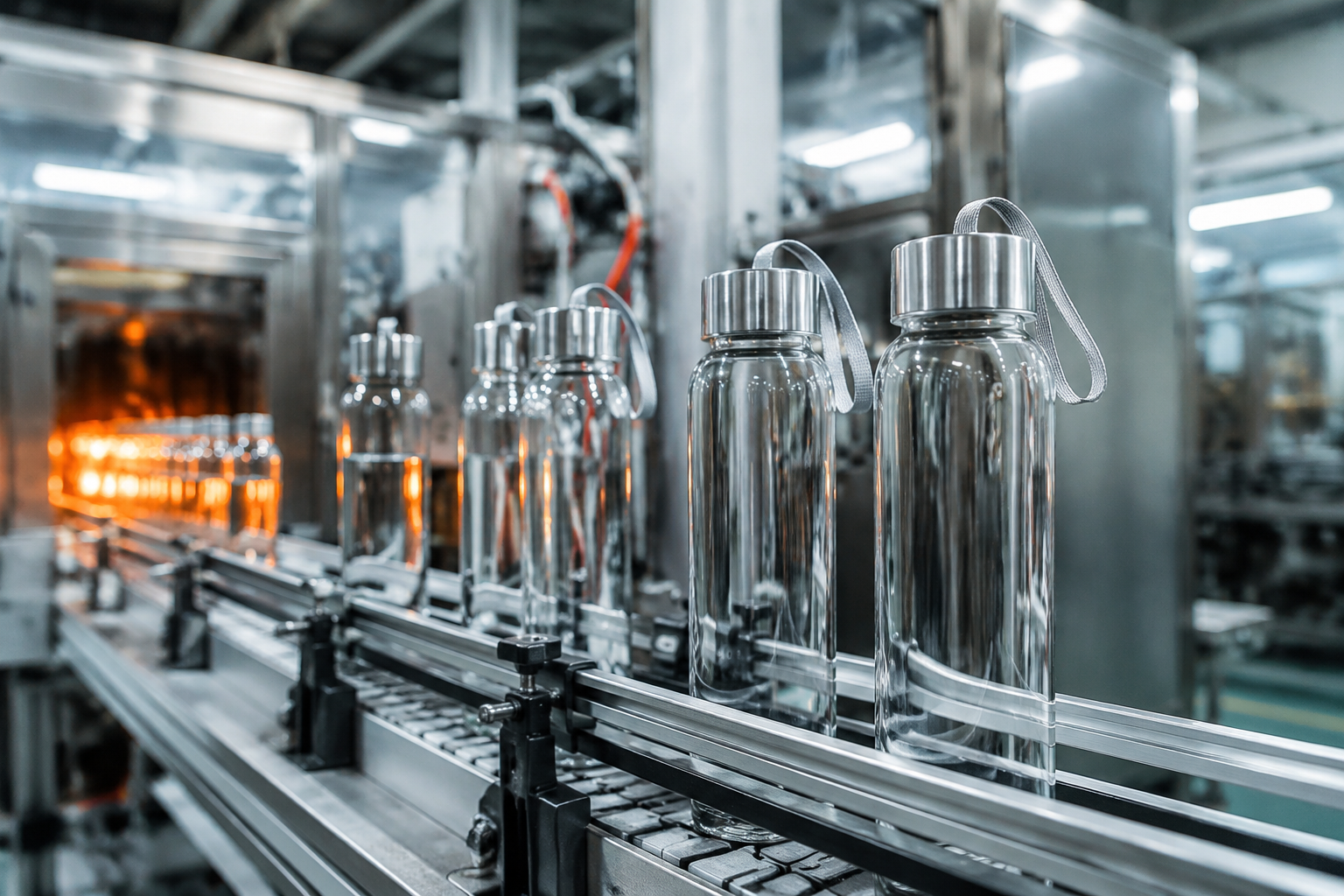
If you are sourcing a borosilicate glass drink bottle supplier, the first mistake is treating it like a simple bottle order. It is not. You are buying a product that has to survive thermal shock, shipping damage, print wear, and the buyer who drops a filled bottle on a concrete floor. We run into this every season. In Zhejiang, the factories that do this well talk in wall thickness, annealing control, carton drop tests, and repeatability, not just nice photos.
The right decision framework is simple: lock the glass spec, set the customization budget, define the compliance bar, then push on capacity and QC. A real borosilicate glass drink bottle supplier should quote MOQ, lead time, and decoration options in the same call. On a normal line, we see 80,000 to 150,000 units per month and 25 to 40 days for standard orders. If a buyer wants everything at once, the math usually does not work.
Start With the Use Case
Before you compare factories, define the use case first. A borosilicate bottle for cold brew, a desk bottle for office use, and a promotional canteen custom order for a trade show are three different buying problems. Miss that step and you pay for features you do not need, or you under-spec the bottle and eat returns later. The buyer selling through retail needs shelf appeal and packaging control; the distributor serving corporate gifting cares about margin and decoration flexibility; the brand owner needs a product story that holds up on Amazon, in B2B catalogs, and on repeat orders.
Start with volume, channel, and failure tolerance. If you are ordering 5,000 pieces of customized drinkware for Europe, ask whether the bottle must pass REACH and LFGB, whether a silicone sleeve is required, and whether the cap needs stainless steel, bamboo, or PP. A custom growler is a different call: heavier glass, larger capacity, and tighter shipping protection. On the line, we ask these basics first because they drive mold choice, carton design, and line speed; QC pulled the sample, saw a 1.2 mm cap gap, and the buyer flagged it before we ran the whole batch. If the supplier cannot frame the order this way, they are not thinking like an export partner.
Use case questions that matter
- Will the bottle be used for hot-fill, cold-fill, or both?
- Is the buyer a retailer, canteen distributor, or corporate gifting channel?
- Do you need a plain bottle, a customizable canteen, or a fully customized growler program?
- Is the product meant to be replenished quarterly or bought once as canteen promotional stock?
The more precise your use case, the faster the supplier can quote correctly. A vague brief turns into a slow quote and a messy PO typo, and the math does not work. We have seen it go sideways on 12-day rush orders and on 18-day normal orders alike.
Choose the Glass Spec Carefully
Borosilicate glass earns its keep because it handles thermal shock better than ordinary soda-lime glass. That is the first filter. But “borosilicate” is not a free pass, and we still ask for composition, wall thickness, neck finish, and annealing record. For standard drinkware, 2.5 mm to 3.0 mm wall thickness is common. For a premium bottle or a custom drinkware line that needs better impact tolerance, 3.2 mm to 3.5 mm is safer. If the quote looks too cheap, the line probably shaved thickness or changed the cap spec. We have seen that go sideways on a 28 mm neck bottle.
A practical borosilicate glass drink bottle supplier should explain why a 500 ml bottle with a 28 mm neck seals easier than a slim decorative shape. That is not sales talk; it shows up on the filling line. Ask for thermal-shock test data in writing, with the temperature differential and the test method. A lot of export buyers want 120°C differential or better for borosilicate products, but the target depends on use case and market. QC pulled a sample with a poor annealing finish once, and it failed before the bottle body did. Do not mix lab-grade claims with retail drinkware specs; a lab bottle and a canteen are built for different loads.
For a custom canteen or customized canteen line, shape changes breakage more than most buyers expect. Tall, narrow bottles look clean on renderings, but they ship less efficiently and chip more easily at the shoulder. A slightly shorter body can cut carton damage by 8% to 15%. We run that comparison with the drop test jig, not a mood board. If a factory only pushes the pretty silhouette, that is the wrong question to ask.
Ask for the glass spec in writing: thickness, capacity tolerance, annealing process, and thermal-shock test method. “High quality glass” means nothing when the PO typo says 3.0 mm and the sample arrives at 2.6 mm.
Customization Should Follow Margin
Customization is where a lot of buyers burn margin. The order is simple: logo first, then packaging, then accessories, then structure. If you are testing a new market, keep the bottle standard and add a one-color logo by silkscreen or laser. We run that way on the line for a reason. If sell-through is proven, move into a canteen customizable program with colored caps, sleeves, gift boxes, or molded shapes. Full structural changes belong with mature accounts, because they push MOQ, tooling cost, and scrap risk.
A canteen supplier in China may offer screen print, decal, laser engraving, UV print, or frosting. Each method has its own cost and wear profile. Laser engraving is usually cleaner on stainless components, while silkscreen often wins on cost for large flat areas. For glass, a printed logo on the body can look sharp, but the buyer should confirm dishwasher resistance if that matters. QC pulled the sample at AQL 2.5 when the print rubbed after 20 cycles. If you are buying for a distributor drinkware catalog, packaging often makes more money than the product change itself. That is the wrong question to ask if you start with decoration spend alone.
This is also where the language gets messy. Some buyers search for canteen custom, custom canteen, canteen customized, or customizable canteen, but what they really want is a product that can be re-ordered without re-learning the supply chain every season. The best canteen manufacturers in Zhejiang build a repeatable program, not a one-off sample. We ship a PO with a wrong carton typo at least once a quarter, and the fix is always the same: lock the spec before you chase variants. If you are handling a canteen vendor relationship for retail or gifting, ask for a packaging spec sheet, logo placement drawing, and artwork proof approval process. That saves rework later.
- Low risk: standard bottle + logo + kraft box
- Medium risk: custom color cap + sleeve + printed carton
- Higher risk: new shape, new mold, and customized drinkware packaging
If you are also sourcing a custom growler or customized growler line, keep decoration simple at first. The more curved the surface and the heavier the bottle, the higher the artwork setup cost becomes. We’ve seen this go sideways on a 68 mm neck and a 1,000-piece trial, so start with the print, then move to structure only after the math works.
Check Supplier Capacity and QA
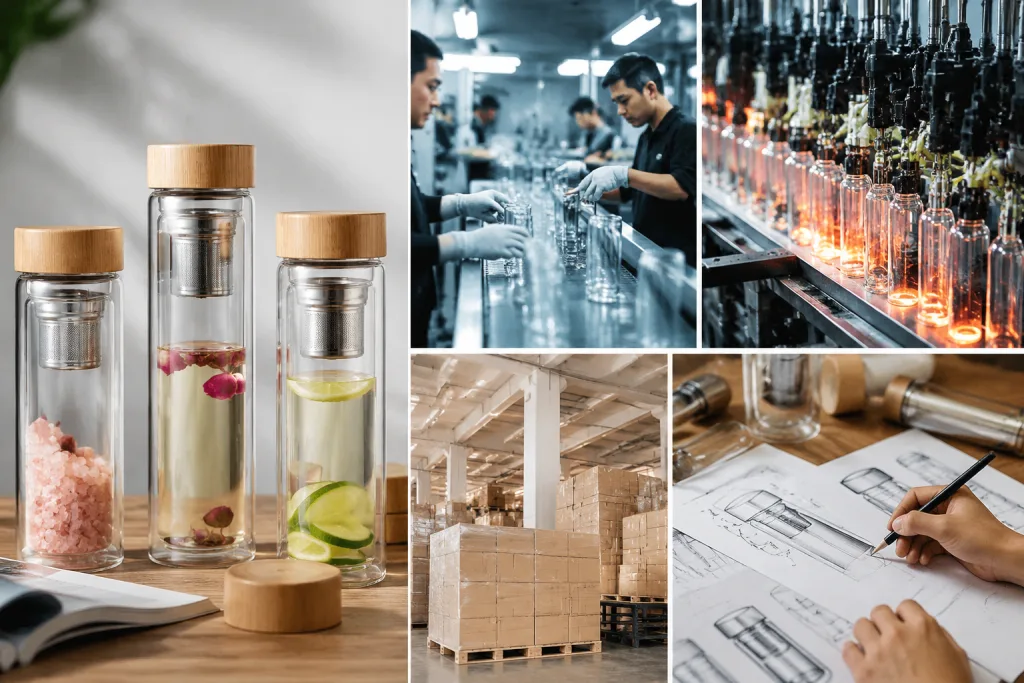
Capacity is the first gate. A factory making 20,000 units a month is not the same shop as one shipping 100,000 units, and this is the wrong question to ask if you skip the line setup. Ask for monthly output, number of production lines, and whether bottle forming, cap assembly, printing, and packing stay in-house. We run into buyers who get a nice sales deck, then discover the “factory” outsources caps. If the answer is vague, delivery and complaint handling usually go the same way.
For export orders, QC is not optional. Ask what AQL level they use at final inspection; AQL 2.5 for critical defects and 4.0 for major defects is common, but some channels tighten that. We check rim chips, body bubbles, print misalignment, and cap torque with a torque meter, not by eye alone. For borosilicate, that last part matters. Internal stress and post-annealing consistency can sink an order even when the bottle looks clean.
Request a pre-production sample, a golden sample, and a packing sample. The golden sample has to match mass production, or you will fight every PO. We’ve seen a buyer flag a typo on the carton artwork and the whole shipment got held at the port. A solid canteen manufacturer will also show defect logs, carton drop test records, and complaint closure timing. If they claim BSCI or ISO certification, ask for the certificate number and scope, not a logo on a PDF.
Buyers in Europe and North America should ask for REACH documents and food-contact declarations up front. If the bottle uses stainless steel or silicone parts, each part needs its own compliance file. Good suppliers in China already have this ready at MOQ stage; weak ones stall until the PO is signed. The math does not work any other way.
Price, MOQ, and Lead Time
Price only makes sense when you line it up with MOQ and lead time. A standard borosilicate bottle usually lands at USD 1.20 to USD 2.80 FOB China, depending on capacity, cap type, print method, and packing. Add a sleeve, gift box, or special lid, and the number moves fast. We run this on the same line every week, and a custom order can lift unit price by 15% to 30% without changing how the bottle performs. That is normal. What is not normal is a supplier who will not split out tooling, sample, and packaging costs.
For a custom canteen order, MOQ is often 3,000 to 5,000 pieces, sometimes higher if you want a new mold or special decoration. Sample lead time is usually 7 to 10 days. Mass production is often 25 to 40 days after sample approval and deposit, though peak season in Zhejiang can push that out. QC pulled the sample at 600 mm height and checked the cap seal twice. If you have a promo launch date, tell the supplier on day one and ask for a backward schedule with artwork freeze, sample approval, and carton confirmation dates. The math does not work any other way.
Here is the part buyers often miss: a lower unit price with a slower lead time can cost more in lost sales than a higher quote from a better-organized canteen supplier. If you are a canteen distributor or drinkware buyer, consistency beats bargain hunting. Reorders are where margin lives. We have seen this go sideways when the buyer flagged a one-week slip and the whole campaign missed the shelf window. The supplier who ships on time and keeps color and print stable is usually cheaper over a year than the one who wins the first PO by 8 cents.
FOB is still the cleanest comparison point for most export buyers. Just make sure you also ask whether the quote includes carton marks, master carton packing, and export labeling. One PO typo on carton count can turn into a rework call at the loading dock. Those small details change landed cost more than most first-time buyers expect.
Build the Compliance File Early
Compliance is a first-order job. For the EU, ask for REACH support and food-contact declarations on day one. If the bottle uses stainless steel caps or lids, confirm the grade, the migration test, and the exact finish on the cap ring. For North America, ask what food-contact files they can send and whether any state packaging rules apply. A borosilicate glass drink bottle supplier that ships into export markets answers these questions without blinking.
Some buyers still treat a bottle vendor like a carton supplier. That is the wrong question to ask. You get burned later when Amazon or a wholesale buyer asks for files you never collected. If you sell through FNSKU programs, the supplier needs to handle FNSKU labels, carton barcodes, and insert control. For private label drinkware, packaging and label compliance sit inside the product spec, not outside it. We have seen PO typos on label copy turn into a 3,000-unit reprint.
For a canteen promotional program tied to retailers or events, ask for test reports from the actual production lot, not an old report from last year. Small difference. Big mess if QC pulled the sample from the wrong batch. Check whether the factory stores raw glass, caps, and printed cartons in separate zones; a 5S line with marked racks and pallet tags cuts mix-ups fast. Good Zhejiang factories do this because they have been audited. Weak ones call it extra work until the buyer flags a claim.
Use one simple rule: if the supplier cannot name the document you need within 30 seconds, they do not ship much to your market.
Sourcing in China Without Guesswork
I’m rewriting the section in-place, keeping the HTML structure intact and tightening the sales language so it reads like a factory-side sourcing note.Send your spec, get a real factory quote
Share your capacity, logo, and compliance needs. We’ll price the bottle, confirm MOQ, and map a workable China production plan.
Frequently asked questions
What MOQ should I expect from a borosilicate glass drink bottle supplier?
For standard export orders, expect MOQ around 3,000 to 5,000 pieces for a custom bottle, and sometimes 1,000 to 2,000 pieces for stock shapes with simple logo work. If you request a new mold, custom cap, or special packaging, MOQ can move higher. A serious China supplier will explain where the break point comes from: glass forming setup, printing waste, and carton minimums. If the answer is just “depends,” push for a written breakdown so you can compare quotes cleanly.
How much does a custom borosilicate bottle usually cost FOB China?
Most buyers see roughly USD 1.20 to USD 2.80 FOB China for a borosilicate bottle, depending on capacity, wall thickness, lid style, decoration, and packing. A sleeve, gift box, or premium cap can raise that by 15% to 30%. If you want canteen custom branding or a more complex customized drinkware package, assume the unit price will rise. Always ask for the quote split: bottle, lid, print, insert, and carton. That is the only way to judge true margin.
What testing should I request before placing an order?
At minimum, ask for thermal-shock data, food-contact declarations, REACH support for Europe, and a final inspection method tied to AQL. For borosilicate glass, you also want clarity on wall thickness, annealing, and drop-test results for packed cartons. If the bottle includes stainless steel or silicone parts, request material specs for those components too. A supplier that works regularly with Europe and North America should provide these without drama. If they cannot, the risk is on your side.
How long does production usually take in Zhejiang or China?
For standard custom drinkware, sample lead time is often 7 to 10 days and mass production is usually 25 to 40 days after sample approval and deposit. Peak season in Zhejiang can add a week or more, especially if you want custom packaging or a new mold. If you are launching a canteen promotional campaign or retailer program, build in time for artwork, proofs, and carton confirmation. Buyers who leave only 2 weeks for approval usually end up paying for air freight.
Can one supplier handle both bottles and other drinkware programs?
Yes, if the factory is set up for it. Many buyers want a borosilicate bottle line plus custom canteen, custom growler, or broader customized drinkware programs under one vendor relationship. The key is whether the supplier actually controls forming, decoration, packaging, and inspection in-house. A capable canteen manufacturer can usually handle related SKUs with consistent branding and packing rules. That said, do not force every product into one source if it weakens quality or delays delivery. Source for capability, not convenience.