Key Takeaways
- Borosilicate glass usually runs at 1.2-2.0 mm wall thickness and handles thermal shock better than soda-lime glass.
- A workable MOQ for custom drinkware is often 3,000-5,000 units, with 30-45 day lead times after approval.
- Ask for REACH, LFGB, and food-contact test reports before you confirm any customized drinkware order.
- For export from China or Zhejiang, packaging and carton drop tests matter as much as the bottle itself.
If you are lining up borosilicate glass drink bottle manufacturer partners, the real question is not whether glass looks premium. The real question is whether the factory can hold 1.2 mm to 2.0 mm wall thickness, keep the logo sharp after firing, and pack cartons so they survive ocean freight from China to your warehouse. We ship into Europe and North America every week, and the buyer usually flags the same three things first: safety, lead time, and repeat-order consistency.
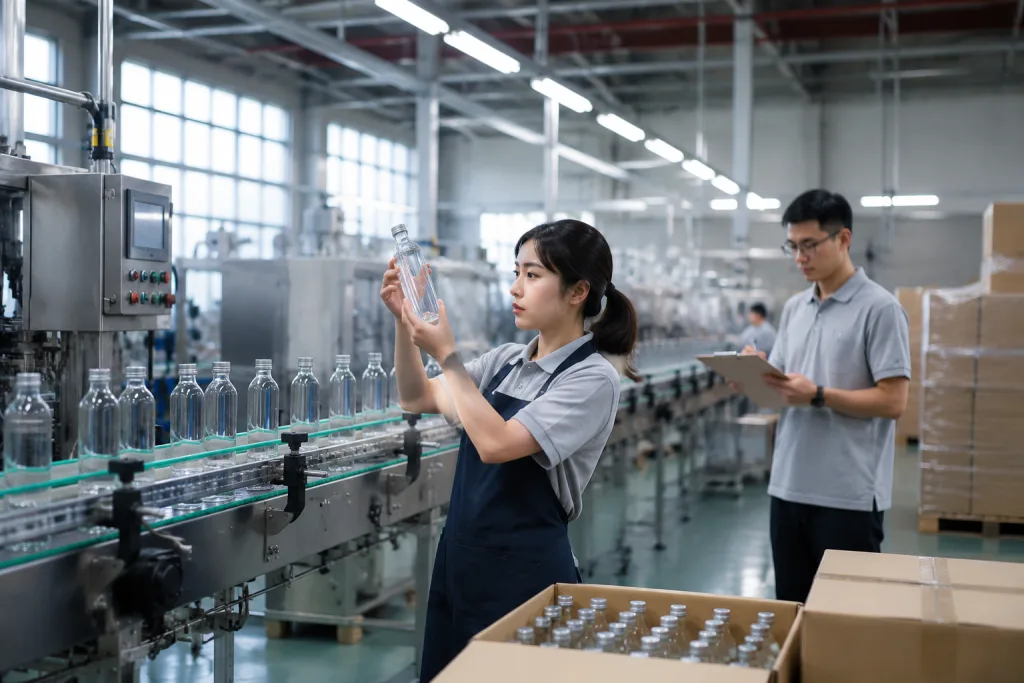
A buyer’s checklist saves time here. On a solid borosilicate line in Zhejiang, we run MOQ at 3,000 to 5,000 units, sample approval before mass production, and a 30 to 45 day lead time if the PO is clean. QC pulled the sample on the line, checked wall variance, and if the supplier cannot speak clearly about REACH, food-contact testing, and AQL, the math does not work — you are buying risk, not drinkware.
What you are really buying
When buyers ask for a borosilicate glass drink bottle manufacturer, they usually mean three things: stable material, clean decoration, and export discipline. The bottle looks simple. The order is not. A 500 ml customized drinkware bottle with a loose cap, a chipped rim, or a weak logo will create complaints faster than a cheaper plastic item.
Start with the basics. Borosilicate glass has lower thermal expansion than ordinary glass, so it handles hot-fill and temperature swings better. For a canteen custom program, the factories in Zhejiang that know their job will quote bottle weight, wall thickness, and cap material separately. That tells you they run the line with real controls. If a canteen supplier only sends a catalog photo and a vague FOB number, the math does not work.
Buyers should also separate custom drinkware from stock-decorated pieces. A true canteen customized program means the mold, surface finish, print method, and packaging all follow your spec. Ask for the actual route: forming, annealing, inspection, printing, assembly, and carton packing. We had one buyer flag a PO typo on carton count, and QC pulled the sample before shipment because the print sat 2 mm off center. A proper canteen manufacturer should show where defects are checked and how many operators are on the line per shift.
Good procurement is not chasing the lowest quote. It is cutting the hidden costs that show up after the vessel lands at your DC.
Checklist before you request quotes
Do not send price requests to five factories before you lock the order details. You will get five quotes that look correct on paper and fail in the margin check. We run RFQs best when they fit on one page: exact capacity, print method, cap style, test items, and pack spec. That is how you sort a real canteen factory from a trading desk in 10 minutes.
- Capacity: 350 ml, 500 ml, 750 ml, or 1,000 ml.
- Material: borosilicate glass with wall thickness target of 1.5 mm or 2.0 mm.
- Closure: bamboo lid, stainless lid, PP lid, or leakproof sports cap.
- Decoration: silkscreen, laser engraving, or decal with bake-on process.
- Packaging: individual box, egg-crate insert, or master carton with drop-test target.
- Compliance: REACH, LFGB, FDA food contact, or ASTM-style internal test references.
For promotional canteen jobs, ask for the printable area in millimeters and the max ink coverage. A logo that passes on a flat mockup can fail on curved glass if the zone is too tight; we saw this go sideways on a 38 mm panel. If you need a custom canteen for retail, ask whether the factory can supply FNSKU labels, polybags, and carton marks. If you need drinkware for distributor resale, request a neutral carton and a second-label pack.
One practical point: ask the supplier to quote both EXW and FOB Ningbo or Shanghai. The buyer flagged a PO typo once—FOB was written as CFR—and the gap exposed a padded freight assumption. Even if your final booking goes out of another port, this tells you whether the math works. A solid borosilicate glass drink bottle manufacturer in Zhejiang will answer straight, because we ship against landed cost, not brochure price.
How to judge factory capability
Capability is not a brochure. We judge it by output, defect control, and repeatability on the line. A canteen manufacturer pushing 200,000 units per month across mixed drinkware usually matters more than a small workshop talking up handmade quality. The math works that way. Scale affects annealing stability, cap sourcing, and whether packing labor is still available when the peak orders hit.
Check these points in the audit or video call:
- Monthly or annual output for each item, not only the factory total.
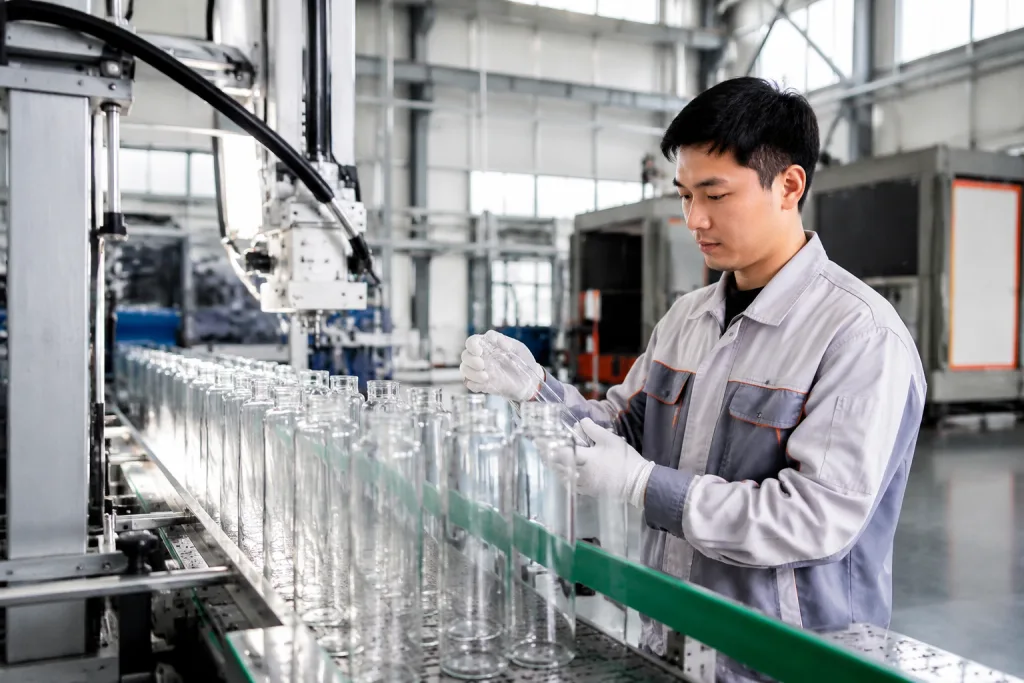
- Annealing process, and whether bottles run through a controlled tunnel.
- Inspection points for bubbles, inclusions, rim chips, and print adhesion.
- Cap torque testing and leak testing on filled bottles.
- Carton compression and drop test method for export cartons.
If you sell as a canteen distributor or distributor drinkware importer, ask how the factory handles spare parts and replacement caps. We’ve seen one missed cap turn into a 30-day complaint cycle. A canteen supplier that holds 60 to 90 days of cap stock saves money and keeps your brand out of trouble. Also ask whether the factory uses AQL 2.5 for major defects and AQL 4.0 for minor defects, or just says “100% inspection” without a written standard. QC pulled the sample, and the difference shows up fast. Real factories in Zhejiang and other parts of China can explain the sampling logic. Vague factories cannot.
For customized growler or customizable growler projects, the same discipline applies even when the bottle gets larger. A 750 ml body and a wider mouth create different stress points, so the mold and annealing curve need proof before mass production starts. The same goes for customized canteen lines with infusers, strainers, or dual-wall sleeves. The design looks simple. The failure points are not.
What customization is worth paying for
Not every customization pays for itself. Some options sell harder on shelf; some just add cost and slow the line. For a retail canteen line, start with what the customer can see and touch: logo placement, lid feel, cap color, and packaging. We’ve seen a buyer add three extras, then the PO typo on the artwork file turned into a 12-day delay because QC had to pull the sample set again.
The options worth paying for are usually these:
- Logo methods: silkscreen for simple branding, laser engraving for a premium look, or decal for multi-color graphics.
- Bottle shape: straight wall for easier printing, or a contoured body for a better grip in hand.
- Cap system: bamboo, stainless, or a leakproof sport lid, depending on the sales channel.
- Pack format: retail box, gift box, or bulk shipper for distributor canteen orders.
For Amazon-style resale or wholesale retail, the carton often matters as much as the bottle. A good custom canteen supplier can label cartons for marketplace use and keep master carton size tight for pallet loading; we run 32 pcs per carton on some sets, and that small change cuts freight waste fast. The math does not work if the box is oversized.
If you need a drinkware program, not one hero SKU, ask the factory to standardize hard. Use one bottle body and change the lid, print, and packaging. That keeps reorders cleaner and MOQ easier to hold. The factories that ship export every week will tell you which parts are standard, which are semi-custom, and which ones trigger a new tool or a 15-day lead-time hit.
Pricing without guesswork
Pricing only makes sense once you know what is inside the number. A bottle quoted at USD 1.80 EXW can land at USD 3.20 after decoration, inner boxes, freight, duty, and breakage allowance. Normal. What is not normal is a quote that skips the cap, packing insert, or test fee.
For most custom drinkware programs, ask for a line-by-line quote: bottle body, cap, decoration, inner packing, master carton, and sample fee. Ask for the mold cost if there is one, and ask if it is refundable after volume. On a 500 ml borosilicate line, a simple custom mold often runs USD 300 to USD 1,500, and we run setup cost separately when the shape needs a new blow mold.
Use your quote sheet to compare only identical terms: FOB port, sampling lead time, production lead time, carton spec, and defect policy. One buyer flagged a 2 mm carton wall on a cheaper offer, and that was the right pushback. If one canteen distributor is 8% cheaper but ships weak packs and no carton test, the math does not work after claims.
For seasonal orders, ask for a split shipment plan. That helps cash flow and cuts warehouse pressure. Borosilicate glass drink bottle manufacturer pricing also reflects factory discipline: proper annealing, stable lids, trained inspectors. QC pulled the sample on one lot, found a lid torque issue, and we stopped the line before packing. That supplier will not be the lowest quote in China, but the landed cost is usually lower than replacing broken goods after arrival.

Quality checks that protect your margin
If you sell into Europe or North America, quality is not a factory issue. It is a margin issue. One shipment with chipped rims, leaking caps, or logo wear can wipe out the profit on the whole order. We have seen 2,000 units turn into a claim over a 0.3 mm rim chip. So the QC plan needs numbers, not a polite promise.
Use a simple control path:
- Approve pre-production samples with signed photos and reference measurements.
- Verify first article samples against the approved drawing.
- Inspect during mass production if the order exceeds 10,000 units.
- Use AQL sampling on finished goods before balance payment.
- Check outer cartons for drop resistance and moisture damage.
Ask the canteen factory to document rim tolerance, neck finish, cap thread fit, and leak test results. If the product is a custom growler or customized growler, ask whether the handle, closure torque, and carton insert were tested under vibration. We once caught a PO typo that changed the cap color code, and the buyer flagged it before the line ran. If you are buying a canteen customized for hot and cold use, request thermal shock results and a statement on safe filling temperature. This is the wrong question to ask: "Can you assure quality?" Ask for the test sheet.
In Zhejiang, the strongest export factories know QC language travels across markets. They can explain what they do in terms your warehouse team, compliance team, and sales team all understand. QC pulled the sample, checked the neck gauge at 28 mm, and moved on. That matters more than a glossy sample room.
Picking the right supplier model
There is a difference between a canteen vendor, a canteen supplier, and a real canteen manufacturer. A vendor may pull from three plants. A supplier may own one step and outsource the rest. A manufacturer runs the core production, and that is the model you want when the same SKU comes back every quarter.
Pick the model that matches the job:
- Manufacturer: best for repeat SKUs, custom specs, and tighter QC on the line.
- Supplier: works when you need mixed categories or faster sourcing across items.
- Distributor: good for local stock, with less control over the spec sheet.
If you are building a distributor canteen program, ask whether the factory can support staggered replenishment and hold raw material inventory. We have seen that cut repeat lead time by 5 to 10 days. If you need a canteen distributor relationship for private label, ask for exclusivity by territory or by channel, and put it in writing. A buyer once left that off the PO, and the account got messy fast.
For long-term programs, look for a factory in Zhejiang or broader China that can handle the paperwork cleanly: commercial invoice, packing list, test reports, and carton labels without last-minute drama. QC pulled the sample and found a 2 mm label shift on one run; that is the kind of miss that turns into a claim later. A borosilicate glass drink bottle manufacturer that ships 150,000 to 300,000 units per month across a few drinkware lines is usually large enough to support your reorder cycle without pushing you into emergency air freight.
Request a factory quote with your spec sheet
Send your capacity, logo method, target MOQ, and market requirements. We will quote the bottle, cap, packing, and compliance pieces clearly.
Frequently asked questions
What MOQ should I expect for borosilicate glass drink bottles?
For a custom order, a realistic MOQ is often 3,000 to 5,000 units per SKU. Some canteen manufacturers can go lower for a stock body with simple logo work, but you pay more per unit. If you need a true custom mold, expect a higher starting point or a mold fee. For Europe and North America, it is smarter to pay for a stable MOQ than to chase 1,000 units and lose control of packaging and quality. Ask the factory whether the MOQ is per color, per lid, or per print method, because those details change the number fast.
How long does production usually take in China?
A normal borosilicate glass drink bottle order takes about 30 to 45 days after sample approval, assuming packaging is standard and the cap is in stock. If you need a canteen customized with a new lid or complex decoration, add 7 to 15 days. Shipping from China is separate. A good Zhejiang factory will tell you the true production window, not the calendar time including port congestion. For peak season, build a buffer of at least 2 weeks so you do not end up paying for air freight.
What compliance documents should I request?
At minimum, ask for food-contact test reports, REACH documentation for Europe, and LFGB if your market requires it. For North America, many buyers also ask for FDA food-contact references and internal migration data. If the bottle uses paint, decals, or printing, request the test scope on inks and coatings too. A serious canteen supplier should also share AQL inspection records, carton drop-test results, and material declarations. If the supplier hesitates on documentation, that is a warning sign, not a paperwork delay.
How do I compare borosilicate glass with other drinkware materials?
Borosilicate is a better fit when you want premium positioning, higher heat resistance, and a cleaner glass look. It is not the cheapest option. Compared with basic glass, it handles thermal shock better; compared with steel, it looks more transparent but is more fragile in transit. For custom drinkware sold through retail or gifting, it usually supports a higher perceived value. If you are buying a custom growler or canteen promotional item, choose borosilicate when presentation and heat resistance matter more than impact resistance.
Can I order mixed styles from one factory?
Yes, but keep the platform simple. One bottle body with different lids, logos, and packaging is usually the best way to build a canteen customizable program without blowing up MOQ. If you try to mix too many bottle shapes, the factory may split the order by tool, which raises cost and lengthens lead time. A capable canteen factory in China can often support 2 to 4 related SKUs in one program if the body diameter, cap system, and packing insert stay close. That is how many distributors keep assortment broad without making the order unmanageable.