Key Takeaways
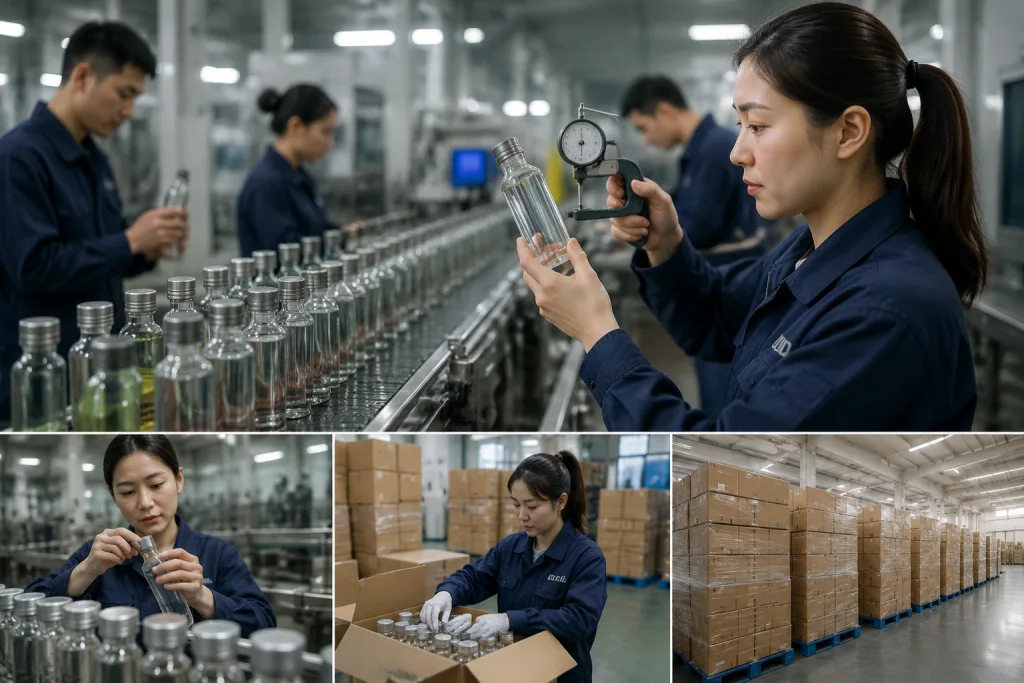
- Borosilicate bottles usually specify 1.2 mm to 2.0 mm glass wall thickness; thinner saves weight, thicker improves durability.
- A serious China factory should quote MOQ at 3,000 to 5,000 pcs and standard lead time at 25 to 35 days.
- Ask for thermal shock, dishwasher, and drop-test data, plus REACH or FDA-related documentation for your market.
- Decoration, cap torque, and carton specs matter as much as the glass itself for distributor drinkware and retail programs.
When you source a borosilicate glass drink bottle factory, the job is not to find a pretty bottle. You are buying a spec stack: glass formula, wall thickness, closure fit, decoration limits, test reports, and a supplier that can repeat the same result 20,000 times without drifting. We run into buyers who ask for “better quality” and then send no thickness target; that is the wrong question to ask. A 500 ml bottle that passes thermal shock at 120°C is a usable product. One that cracks at 80°C becomes warehouse trouble, and QC pulled the sample fast when that number showed up on the bench.
If you are building a custom drinkware line, you also need to separate the factory that can make a sample from the one that can ship a compliant order. In China, especially Zhejiang, the line talks in MOQ, lead time, AQL, REACH, and carton count, not vague promises. We have seen a buyer flag a PO typo on “5000 PCS” versus “500 PCS,” and that one missing zero changed the whole shipment plan. That is the standard you should expect from a canteen manufacturer, a canteen supplier, or a custom canteen project that has to survive retail, Amazon, or distributor channels.
Read the glass spec first
The first line on a borosilicate glass drink bottle factory spec sheet should state the glass composition and the intended use. That is where margin gets made or returns start. True borosilicate glass uses more silica and boron, which gives better thermal resistance and chemical stability. In buyer terms, it cuts cracking on hot-fill, lowers failures in cold-chain transit, and holds up after repeated washing. For Europe and North America, ask which standard the factory uses for raw material control and whether the bottle is for beverage contact only, not decorative glass. We’ve seen buyers miss this and end up with a PO typo that turns into a claim.
Watch the numbers. A common 500 ml bottle can weigh 220 g to 320 g, depending on wall thickness and base profile. A 1.2 mm wall ships lighter and costs less; a 2.0 mm wall gives a better hand feel and fewer breaks in distributor canteen programs. That gap matters when you price landed cost. If your canteen distributor wants a premium line, the extra 30 to 60 grams can pay for itself if it cuts breakage. We run the line this way every week: one build is a promo canteen, the other is a retail canteen customizable SKU, and the math is not the same.
- Ask for: glass type, wall thickness, finished weight, and neck finish.
- Check: whether the bottle is annealed properly after forming.
- Reject vague specs: “high quality glass” is not a spec.
Closure and neck fit matter
I’ll rewrite the section in place, keeping the HTML exactly intact and making the prose sound like a factory sales engineer wrote it.Decoration changes the budget
Decoration is where a lot of canteen suppliers quietly blow up your target cost. Silkscreen, decal, laser engraving, frosted etching, and sleeve wrapping all behave differently on glass. If your artwork is simple and you need 5,000 pcs or more, silkscreen usually gives the best cost per impression. If you want a premium retail look or variable codes, laser engraving works, but it adds cost per unit and wants a flatter print area. A customizable growler or canteen customized line for craft beverage or outdoor retail often uses two decoration methods, and we price each one separately. We run that on the line every week.
The wrong question is “Can you print my logo?” The real question is “What fails after abrasion, dishwasher cycles, and handling?” Ask the factory for adhesion results and, if needed, cross-hatch testing. For export programs, you also need to know whether the inks or coatings meet REACH expectations for Europe. A canteen vendor serving North American chain stores should hold print registration within 1.0 mm on repeat runs. We had a buyer flag a 2 mm shift on a PO once; that was a claim, not a style issue.
In Zhejiang and across China, strong factories treat decoration as process control, not art. That is the gap between a custom canteen that looks good in one photo and a customized canteen that holds its branding through the full season. If your buyer wants a custom growler style bottle with branding, get print proofs, curing method, and packed-sample approval before mass production. QC pulled the sample on a 48-hour cure check before we ship. If the ink is still soft, the math does not work.
Packaging protects margin
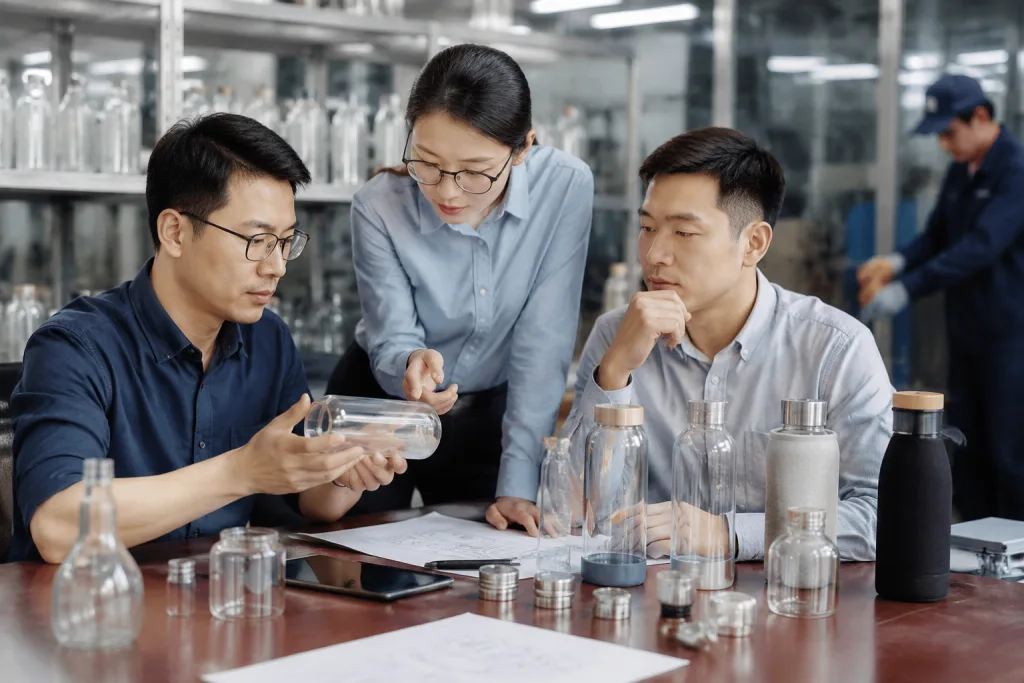
A glass bottle does not fail only when it cracks. It fails when the carton crushes, the inner tray rubs the print off, or the pallet shifts in transit. Packaging is a spec line, not an afterthought. For export drinkware, I want the factory to quote master carton size, inner box count, carton strength, and whether drop testing was done on a full shipping unit. On our line, we check a 6 kg carton with a tape measure before the first bulk run. If the bottle goes through a distributor canteen channel, the pack has to survive warehouse handling and store replenishment, not just air freight.
Standard details matter. A 500 ml bottle in a single box may need a 3-ply or 5-ply inner system depending on weight and decoration. Double-wall corrugated cartons make sense if you are shipping from China to Europe or North America over 30 to 45 days at sea. If you want Amazon-style prep, ask whether the factory can apply FNSKU labels, carton marks, and polybag warnings without manual relabeling at your warehouse. We once saw a PO typo on the carton count turn into a 1,200-piece rework. That is the wrong place to save money, because buyers lose 2% to 4% of landed cost in damage when they treat packing as a side note.
For a canteen distributor or distributor drinkware buyer, pack configuration also affects pick efficiency. A 12-pack or 24-pack that stacks cleanly will move faster than a mixed set with loose accessories. In Zhejiang, the better canteen manufacturers will give you packed dimensions within 5 mm and show photo proof of the finished shipper before loadout. QC pulled the sample and checked the top flap gap with a caliper; that kind of detail tells you whether the line is tight or just looks good in a sales deck.
Testing beats promises
I’ll rewrite the three paragraphs in place, keep every tag as-is, and make the language sound like a factory-side sales engineer with concrete QC details.If a borosilicate glass drink bottle factory cannot show test records, keep walking. Ask for the material confirmation sheet, thermal shock report, leak test method, dishwasher resistance proof if it is claimed, and the IQC/OQC plan. For export jobs, ask for the compliance file tied to your market, such as REACH-style declarations for the EU or buyer-specified paperwork for the US. We run this every week in Zhejiang; if a plant cannot pull it up fast, the line is probably not under control.
Use AQL, not feelings. For surface defects, a lot of buyers start at AQL 2.5; for leakage or sharp-edge issues, they go tighter, often AQL 0.65 or lower, depending on risk. If you are sourcing customized drinkware for retail, ask for a pre-production sample, a golden sample, and a signed inspection sheet. That beats a salesperson saying “our QC is strict.” On a real order, QC pulled the sample, checked the rim at 0.3 mm, and logged the carton drop test; that is the level that matters. If they cannot list the inspection points, the math does not work.
This is where a canteen supplier and a real canteen factory split apart. A supplier can buy bottles. A factory controls the molding, tests repeatability, and keeps defect rates stable from one reorder to the next. That matters for a customized canteen or canteen promotional program that comes back six months later with the same PO and a typo on the artwork file fixed too late.
Price only works with volume
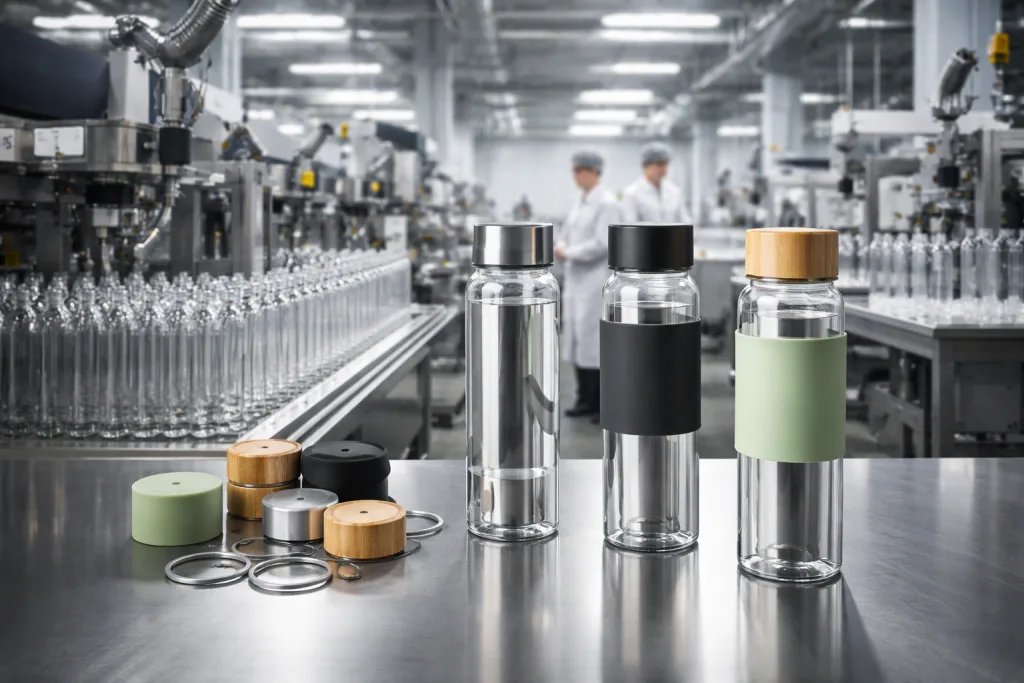
Most buyers ask for a unit price too early. Wrong question. The useful number is the landed structure. A borosilicate bottle from a China factory can look cheap at FOB, then blow up once you add a 304 stainless cap, silk-screen decoration, export carton reinforcement, palletizing, and inland trucking from Hangzhou to Ningbo. In a real quote, you should see FOB terms, MOQ, production lead time, sample charge, tooling if any, and packing details. For a mainstream custom drinkware order, MOQ often starts at 3,000 pcs; for a more complex customized growler or custom canteen build, 5,000 pcs is common. We ship these numbers every week. Some Zhejiang factories can go lower, but the line usually gives up options or the per-unit cost jumps.
Lead time matters more than buyers admit. A typical order needs 7 to 10 days for sample signoff, 20 to 30 days for production, and another 5 to 10 days for booking and export paperwork. QC pulled the sample on a 2 mm neck finish once, and the buyer flagged it before mass production, which saved a messy rework. If you sell through canteen distributors, missing a season hurts more than paying 4% extra. Ask for the monthly capacity number; a credible export factory should state output, such as 100,000 to 300,000 units per month depending on model mix. That tells you if you are dealing with a real canteen factory or a trading layer with a decent website.
Price should also change with your channel. A distributor canteen order needs consistency and replacement parts. A canteen promotional order needs cost control and tight packed efficiency. A retail canteen customized line needs better finish and lower defect tolerance. The factory should price each use case differently, not throw one generic quote at every buyer. We’ve seen that go sideways fast when the PO says one thing and the carton spec says another.
Send your bottle spec sheet today
We’ll review your glass, cap, print, and pack specs line by line so you can quote a clean custom drinkware program from China.
Frequently asked questions
What MOQ should I expect from a borosilicate bottle factory?
For a standard borosilicate glass drink bottle factory in China, a realistic MOQ is usually 3,000 to 5,000 pcs per design and color. If you add special caps, sleeves, or heavy decoration, the MOQ can move to 5,000 to 10,000 pcs. A Zhejiang factory with strong export systems may accept lower trial quantities, but you often pay a higher unit price and fewer customization options. For distributor drinkware programs, I would rather lock one stable SKU at 5,000 pcs than split a weak order across too many variants.
How do I judge bottle durability before ordering?
Ask for wall thickness, annealing details, and thermal shock data. A practical borosilicate bottle for daily use is often 1.5 mm to 2.0 mm wall thickness, depending on size and target price. You should also request a leak test, a drop test from 0.8 m to 1.0 m, and, if claimed, dishwasher-cycle confirmation. For canteen customized or custom canteen orders, durability is not a feeling; it is a test sheet and a signed golden sample.
What compliance documents do Europe and North America expect?
At minimum, ask for food-contact declarations, REACH-oriented statements for Europe, and any buyer-specific US documentation the factory can support. If your distributor canteen or custom drinkware program includes prints or coatings, request ink or coating compliance confirmation too. Many buyers also ask for factory audit evidence such as BSCI or similar social compliance documentation. The key point is that the supplier should issue documents aligned to your channel and market, not a generic PDF with no batch reference.
Can I customize a borosilicate bottle like a canteen promotional item?
Yes, but customization should match the channel. A canteen promotional order usually focuses on logo print, one cap color, and tight cost control. A canteen customizable retail SKU may include sleeve, closure choice, and premium packaging. If you want a custom growler look, the factory needs to confirm neck finish, lid compatibility, and decoration area before quoting. On glass, every added option changes process time and defect risk, so quote each element separately.
How long does production usually take in China?
For a normal order from a borosilicate glass drink bottle factory in China, expect 7 to 10 days for sample approval and 20 to 30 days for mass production after deposit and final artwork signoff. If you need special tooling, embossed details, or complex packaging, total lead time can stretch to 35 to 45 days. Zhejiang factories with steady export schedules are often faster on repeat orders because the canteen manufacturer already has the mold, carton spec, and QC template in place.