Key Takeaways
- Typical MOQ for borosilicate double wall glass bottles starts at 3,000-5,000 pcs per SKU
- FOB Zhejiang pricing often lands around USD 1.20-3.80 depending on size, lid, and decoration
- Standard lead time is 30-45 days after sample approval; custom tooling adds 15-25 days
- Expect thermal shock resistance around 120-150°C for quality borosilicate, not ordinary soda-lime glass
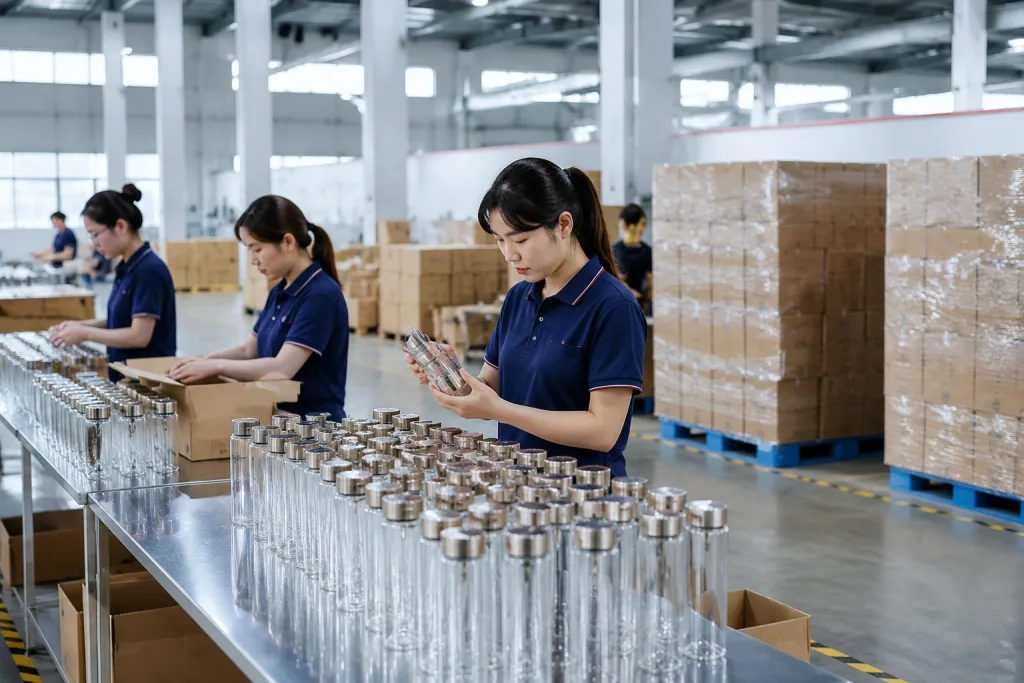
If you are buying borosilicate glass double walled bottle wholesale, the first question is not whether it looks premium. The real check is whether the bottle survives carton drop tests, fills without splash-back, passes REACH, and still leaves margin after print, inner boxes, and freight. In Hangzhou and the wider Zhejiang belt, we see buyers lose time by judging samples on shine instead of wall thickness, glass grade, and thermal hold. That is the wrong question to ask.
The cleaner way is to compare each option by use case. A 350 ml café bottle, a 500 ml gift bottle, and a 750 ml retail bottle carry different breakage risk and packing cost. For Europe or North America, we run the numbers first: MOQ, a 30-45 day production window, AQL 2.5 inspection, and a neck finish and lid fit that stay steady across 20,000 units or more. QC pulled one sample last week at 1.8 mm wall thickness, and the buyer flagged it before the line moved on.
Spec table before you compare
I’ll keep the HTML exactly intact and rewrite only the prose to sound like a factory-side sales engineer. I’m checking for any repo instructions first, then I’ll patch the section and return the cleaned HTML only.Buyers waste hours debating “premium feel” when the spec sheet already gives the answer. For borosilicate glass double walled bottle wholesale, start with size, heat retention, net weight, and cap type. A 350 ml bottle for specialty coffee is a different build from a 500 ml retail bottle for wellness brands, and a 750 ml bottle for gifting or hospitality needs a stronger carton, not just a prettier sample. On our line, we check neck finish with a caliper before QC signs off.
| Spec | 350 ml bottle | 500 ml bottle | 750 ml bottle |
|---|---|---|---|
| Wall thickness | 1.2-1.5 mm per layer | 1.5-1.8 mm per layer | 1.6-2.0 mm per layer |
| Net weight | 220-280 g | 280-360 g | 380-480 g |
| FOB Zhejiang | USD 1.20-1.85 | USD 1.55-2.60 | USD 2.20-3.80 |
| MOQ | 3,000 pcs | 3,000-5,000 pcs | 5,000 pcs |
| Lead time | 30-40 days | 35-45 days | 35-45 days |
That table beats a glossy sample. If you are sourcing drinkware wholesale, ask for carton drop-test data too, because a clean bottle still breaks if the packing spec is weak. We’ve seen that go sideways more than once when the buyer flagged one typo on the PO and the insert size was wrong by 5 mm. A normal export carton here uses 5-layer corrugated board with 180-250 lb burst strength, plus molded pulp or EVA inserts, and that is the math that keeps claims down.
Glass type is not the whole story
I’ll rewrite the section in-place, keep the HTML tags intact, and tune the prose to sound like a factory-side sales engineer.Borosilicate helps with temperature swings better than soda-lime glass, but the line decides whether that benefit reaches the buyer. In Zhejiang, we still see customers ask for “borosilicate” while skipping incoming raw-material records, furnace logs, and finished-product test sheets. That is how a bad PO turns into a claim.
The real check is thermal shock testing, usually by cycling the bottle between hot and cold conditions in a controlled setup. For a good body, we look for 120-150°C performance, depending on wall thickness, shoulder shape, and the lid stack. The lid usually fails first. If the cap uses silicone seals, QC should check hardness and food-contact status against REACH and FDA-style requirements for the target market.
“The bottle body may be borosilicate, but the commercial failure usually comes from the lid, the carton, or the decoration.”
If you buy from China, ask for the full bill of materials. We run glass grade, gasket material, coating, and use case as separate items on the spec sheet, because a bottle for hot fill is not the same as one for cold brew or ambient storage. The math does not work any other way.
Use case decides the winner
Match the bottle to the channel, or the math breaks fast. We run a 350 ml line for premium single-serve coffee, herbal tea, and hotel minibars; the compact size sits better in hand and turns faster on the shelf. A 500 ml bottle fits e-commerce, corporate gifts, and lifestyle brands that want one everyday SKU. A 750 ml bottle only makes sense when the buyer wants shelf presence and has already approved the carton cost.
- Café and specialty beverage: choose 350 ml for better hand feel and quicker sell-through.
- Retail and DTC: choose 500 ml if you need a balanced landed cost and a wider buyer base.
- Gift and premium bundle: choose 750 ml only when the packing budget is already locked.
- Sampling and promo programs: keep decoration simple; a 12%-18% cost jump shows up fast on the PO.
One SKU cannot do every job. We’ve seen buyers ask for “the best wholesale drink bottle for all channels,” and that usually means they get an average bottle for every channel. QC pulled the sample on a recent order because the client mixed retail and minibar requirements in one spec sheet; the use case was wrong, not the bottle. If you also source bulk canteen or wholesale canteen items, split the logic. A stainless steel canteen bulk order has a different damage profile and freight risk than a borosilicate glass bottle order.

Pricing breaks and MOQ reality
Glass looks cheap on a quotation sheet. The line tells a different story. For borosilicate glass double walled bottle wholesale orders from Zhejiang, a plain clear bottle with a standard silicone ring is usually the lowest-cost build. Add a bamboo cap, silk screen printing, laser marking, or color spray, and the unit price climbs fast. QC pulled one sample last week with a 0.8 mm lid gap, and that small miss turned into a rework discussion.
Here is the pricing reality. At 3,000 pcs, you are paying for setup discipline. At 10,000 pcs, the math starts to move in your favor. A solid factory in China can run about 200,000-300,000 units per month across similar glass bottle lines, but your slot still depends on decoration time and raw material stock. If a supplier cannot hold a 30-45 day lead time after sample approval, they do not control the line tightly enough. We have seen that go sideways when a buyer flagged a PO typo on the cap spec and the schedule slipped by 12 days.
Ask for a quotation split by bottle body, lid, packaging, and freight. That is the only clean way to compare drinkware wholesale offers. A low bottle price with a weak insert and an overpriced carton is not a low price. The wrong question is “What is your best price?” The right one is “What is the landed cost at 5,000 pcs, with AQL 2.5, in export cartons?”
Testing and compliance buyers skip
Most import headaches are preventable. For Europe, ask for food-contact compliance, REACH paperwork, and labeling proof for every coated or printed surface. For North America, request migration or safety statements tied to the finished bottle, not a generic supplier letter. If the factory says “it is just glass,” push back. The lid, ink, and silicone count too.
- AQL inspection: use AQL 2.5 for critical and major defects on outbound inspection.
- Drop test: test the outer carton with the real packed weight, not an empty box.
- Thermal shock: confirm the method and temperature delta, not just the pass/fail result.
- Seal check: verify leak-free closure after 24-hour inversion.
If you also buy bulk drinkware, beer tumbler bulk, or beer growler wholesale items, keep the compliance file split by material and SKU family. We’ve seen buyers mix canteen wholesale paperwork with glass bottle files, then nobody knows which SKU passed which test. That is the wrong question to ask after the PO lands. In Zhejiang, the better factories keep each structure separate from day one, because a 304 stainless lid and a borosilicate glass body do not fail the same way.

When glass beats other formats
Use borosilicate glass when the brand story depends on clarity, purity, or thermal performance. It fits wellness, tea, cold brew, specialty coffee, and premium promo runs. We ran a 500 ml sample set last month, and the buyer kept the clear-wall look because the hand feel sold the product. It is the wrong choice for rough handling, sports use, or price-sensitive retail where breakage is acceptable.
If you are comparing growler bulk or beer growler bulk, a glass double wall bottle is not a growler substitute. Growler wholesale orders usually put volume, sealing, and transport utility first. A beer growler wholesale bulk program may use stainless steel or heavy glass, while a borosilicate bottle is about presentation and moderate-capacity beverage use. Same for alcohol flask bulk or alcohol flask wholesale bulk programs: different carton pack, different channel, different spec. QC pulled one carton with a 2 mm neck tolerance issue, and that is the kind of mismatch that turns into a PO headache fast.
For brand owners, define the channel first, then pick the format. A supplier in China can run both canteen bulk and glass bottle lines, but the process controls are not the same. We ship these on separate routes because the buyer flagged a scratch issue on the first run, and the math does not work if you mix the specs. Keep the spec sheet tight, keep the use case narrow, and ask for inspection points by mm, not vague promises.
Send your spec sheet for a quote
We’ll match your volume, decoration, and packaging targets with clear FOB pricing from Zhejiang, not vague catalog numbers.
Frequently asked questions
What MOQ should I expect for borosilicate glass double walled bottle wholesale?
Most factories in Zhejiang quote 3,000-5,000 pcs per SKU for standard sizes. If you want custom color lids, logo printing, or gift packaging, expect 5,000 pcs or more. Very simple stock items can sometimes start at 1,000 pcs, but that usually comes with limited options and less room on price. For real wholesale drinkware planning, 3,000 pcs is the practical starting point.
What is a realistic FOB price for these bottles?
For China FOB, a plain 350 ml bottle often lands around USD 1.20-1.85, a 500 ml bottle around USD 1.55-2.60, and a 750 ml bottle around USD 2.20-3.80. Bamboo caps, printed logos, and premium cartons push it higher. If a quote is far below that range, check whether the glass thickness, lid, or packaging has been downgraded.
How long does production usually take?
After sample approval, standard lead time is 30-45 days. If the order needs custom tooling, special spray coating, or complex packaging, add 15-25 days. A factory in Zhejiang with stable furnace and assembly capacity can often hold a monthly output of 200,000-300,000 units across related drinkware lines, but your exact slot still depends on season and decoration load.
What tests should I request before shipment?
Ask for leak testing, thermal shock testing, carton drop testing, and AQL 2.5 inspection. For Europe, request REACH-related documentation and food-contact declarations for the full finished product, including lids and seals. If you are importing into Amazon FBA, also make sure carton labeling and unit barcodes are correct before the goods leave China.
Is borosilicate better than soda-lime glass for wholesale bottles?
Yes, if your use case involves temperature changes, premium positioning, or hot-and-cold beverage handling. Borosilicate typically offers better thermal shock resistance, often in the 120-150°C range depending on structure. If your product is purely decorative or low-cost, soda-lime may be cheaper, but for a premium bottle line the performance gap matters. That is why many procurement managers choose borosilicate for high-value wholesale drinkware programs.