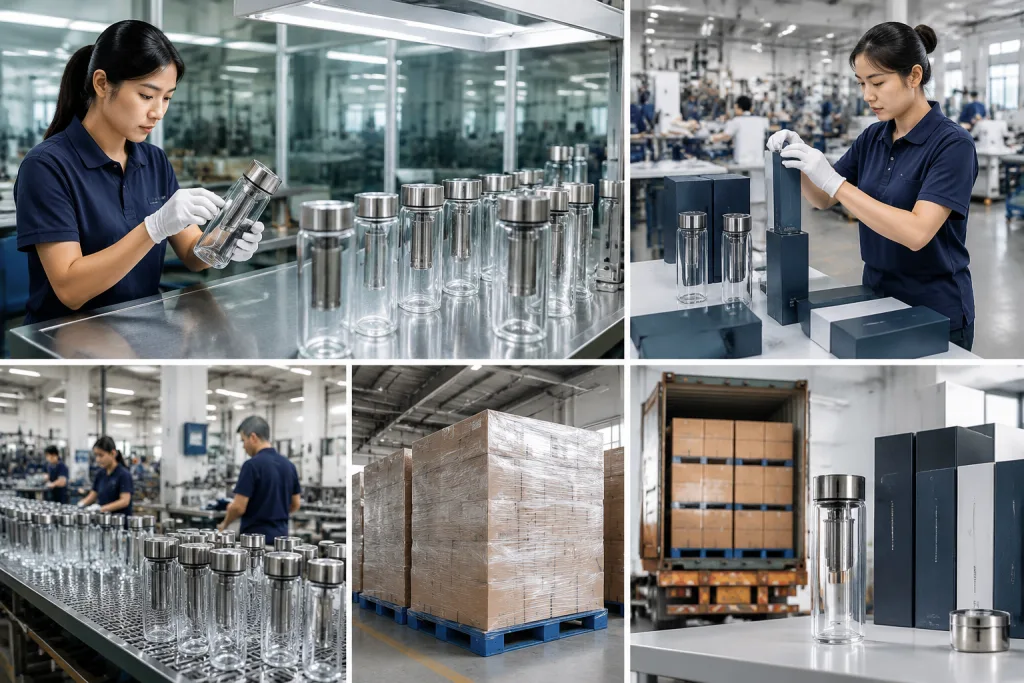
Key Takeaways
- A borosilicate glass double walled bottle private label program usually starts at 1,000 units MOQ and 30-45 days lead time from artwork approval.
- For export, ask for borosilicate glass test reports, carton drop testing, and REACH or FDA documentation before you place an order.
- A 250 ml to 350 ml bottle often lands at USD 2.10-3.60 FOB China, before custom logo, gift box, or special lids.
- You should specify wall thickness, lid seal, decoration method, and packaging spec up front, or your customized drinkware margin will disappear.
If you are sourcing a borosilicate glass double walled bottle private label, you are solving three jobs at once: the bottle has to look premium, it has to survive export handling, and it has to leave room for margin after decoration, packaging, and freight. This is where projects slip. The sample looks clean, but the production bottle comes in 40 g heavier, the logo starts flaking after a dishwasher test, or the outer carton crushes in a 1.2 m drop. We have seen that go sideways more than once.
At BottleForge in Zhejiang, we run this kind of job for buyers in Europe and North America. They want customizable drinkware, but they also need lead times they can plan around, clean compliance papers, and a supplier who knows what a distributor program needs on the line. For this bottle, ask for 1.8 mm borosilicate walls, 250 ml or 350 ml capacity, MOQ around 1,000 units, and 30-45 days after artwork approval. QC pulled a sample last week and measured wall variance at 0.2 mm; that is the kind of number that matters. If a supplier cannot hold that, the math does not work.
What you are really buying
I’ll rewrite the section in a more field-tested sales tone, keep the HTML intact, and preserve the heading and tag structure exactly.When buyers ask for a borosilicate glass double walled bottle private label, they are not just buying a bottle. They are buying a sellable package: the glass body, lid, seal, decoration, inner carton, master carton, and the paper trail behind it. If one piece slips, costs jump. We’ve seen a buyer flag a 2 mm carton gap and the whole shipper line had to be reworked. A supplier quoting only the bottle price is missing the point. You need a canteen manufacturer mindset, even for glass.
Borosilicate glass earns its place because it takes thermal shock better than soda lime glass. In plain terms, it holds up when hot tea, cold water, or a fast temperature swing hits it. The double wall also sells itself on shelf; that floating look is why the line works for premium retail, hospitality, and branded gifts. Common sizes are 250 ml, 350 ml, and 500 ml. For private label, 350 ml is usually the easiest sell because the unit cost stays sane and the box fits standard shelf sets. If you buy as a canteen distributor or distributor drinkware buyer, this range gives you room to move on resale. The math works.
The mistake is treating this like a generic customized drinkware item. It is not. Glass needs tighter pack-out, stricter QC, and a lower breakage allowance than a metal custom growler or stainless tumbler. QC pulled the sample at 6.8 kg carton weight and the drop test still showed corner crush, so we changed the dividers. Ask the canteen factory for their export carton breakage rate. If they cannot give you a number, keep looking.
Specs that matter most
I’ll rewrite this section in-place, keeping the HTML intact and tightening the sales-engineer tone. I’m going to make the specs more concrete, add a few factory-floor details, and strip the AI-style phrasing.Start with the spec sheet, not the render. If you want a private label launch that ships cleanly, lock the build before sampling. The line only tells you the truth after the first 20 pcs, and the numbers below move cost and breakage.
- Material: borosilicate glass body, 3.3 coefficient grade for export custom drinkware
- Wall thickness: 1.6 mm to 2.0 mm is common; 1.8 mm gives a safer balance on weight and price
- Capacity: 250 ml, 350 ml, or 500 ml; we often see 350 ml win on retail shelf tests
- Lid: PP, bamboo, stainless, or a hybrid cap with a silicone gasket; QC pulled the sample apart at 10 N and found the gasket fit was the real issue
- Decoration: one-color silk screen, laser engraving on metal parts, or fired decal if the budget can take the extra kiln step
- Package: individual box plus 6 or 12 pcs master carton with corner protection; 76 cm carton drop on 6 faces is the baseline we ask for
For a canteen custom project, lid sealing matters more than the artwork. A good-looking customized canteen that leaks comes back fast. On glass bottles, ask for the silicone ring spec, usually food-grade silicone, and ask for torque and leak-test results before you approve mass production. The buyer flagged a PO once because the cap thread callout was off by 0.5 mm. That typo cost a week.
If you are comparing a custom canteen program with a glass bottle program, glass gives you less room on finish, mouth diameter, and lid fit. A canteen promotional item can hide more variation. A borosilicate bottle cannot. This is the wrong question to ask: “Can the same canteen manufacturer handle it?” Unless they run a glass line, or have a sourcing office that checks the mouth finish against the cap drawing, the math does not work.
How pricing really works
I’ll rewrite the section in place, keeping the HTML tags and structure intact while making the pricing copy sound like a real factory sales note.Buyers ask for a unit price too early. That is the wrong question. Borosilicate glass double walled bottle private label pricing comes down to size, lid, decoration, packaging, testing, and order quantity. On our line, a 250 ml bottle with a basic PP lid and one-color logo usually lands at FOB China USD 2.10-2.80 for 1,000 to 3,000 units. A 350 ml version with a bamboo lid or heavier packaging moves to USD 2.80-3.60. Add a gift box, insert tray, or custom printed sleeve, and you are looking at another USD 0.20-0.60 per set.
Freight can wipe out a good factory price fast. Glass is bulky and breaks if the carton is lazy, so the box structure changes the cubic meter cost. We’ve seen a 350 ml bottle fit 36 pcs per carton with a tight inner tray, then drop to 24 pcs when the buyer pushed for a nicer but looser pack-out; freight per unit jumped 8% to 15%. QC pulled the sample and checked the outer carton at 5-ply, 3-layer insert, because that is where the math either works or it doesn’t. A serious canteen supplier should quote the bottle, the packed master carton size, and the weight. If you are buying for a distributor canteen or distributor growler program, ask for landed-cost modeling before sign-off.
In Zhejiang, where export drinkware programs usually pass through factories and traders, the gap between a cheap quote and a workable quote is packaging discipline. China can run almost any custom drinkware design, but the deal only holds when the factory handles the full chain, from labelling to palletization. We had a PO once with the carton typo “35PCS/CTN” instead of “36PCS/CTN”; the buyer flagged it before booking, and that one digit would have wrecked the loading plan.
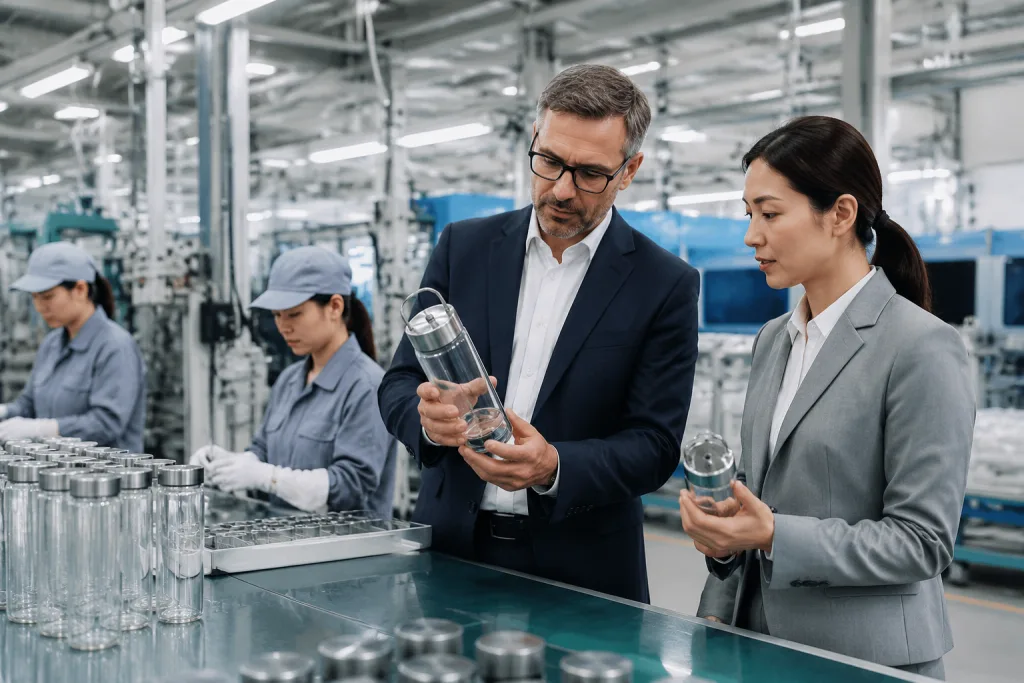
Private label checklist
I’ll keep the tag structure and rewrite the prose to sound like a factory-side sales engineer, with tighter wording and a few concrete production details.Private label is not just a logo on glass. It is a choice about brand control, decoration risk, and where the budget goes. For a borosilicate bottle, we keep the checklist tight and specific.
- Logo placement: body, lid, or carton
- Decoration method: silk screen, laser, decal, or emboss on lid component
- Color control: Pantone reference, not a vague shade name
- Retail readiness: barcode, hangtag, care card, and FNSKU if you sell into Amazon
- Compliance marks: country of origin, capacity, food-contact wording if required
- Packaging language: English, French, German, or bilingual copy if you are a canteen distributor in Europe
A custom growler project gets attention because of the shape, but the branding rules stay the same. Keep artwork vector-based and give us a minimum line thickness, usually 0.2 mm or above for silk screen. If the logo has gradients, the line on the screen print frame gets messy fast, and the buyer flagged it on one PO because the file was a JPG. A canteen customizable product can look clean in the sample room and still miss on the line if you ignore print limits.
For a long-term program, ask for a branding sample before mass production. A real canteen vendor should send a pre-production sample with actual logo placement, actual carton print, and actual lid color. QC pulled one sample at 12 mm misalignment on the carton window last month; that kind of miss becomes a launch delay. This is the right gate to set, and we have seen the math go bad when distributor teams skip it.
Quality checks you should demand
I’ll rewrite the prose only, keep the HTML exactly as-is, and make the copy sound like a factory-side sales engineer wrote it.Quality control on glass is not theory. We run it with numbers. Ask for AQL 2.5 on major defects and 4.0 on minor defects if you are shipping retail-ready units, unless your own QA book is tighter. The factory should spell out what counts as major: cracks, bubbles in the wall, sharp rim edges, leaking lids, broken print, or a neck that sits off-center by even 1.5 mm. If they cannot define that on paper, your returns team will eat the cost later.
Before shipment, demand three checkpoints: incoming material inspection, in-process inspection, and final inspection. For borosilicate glass, we also keep a thermal shock record, a leak test report, and drop-test data for the cartons. Last month QC pulled a sample that failed at the lid torque station, 0.8 N·m against spec, and that batch stayed on the line until we fixed it. A real factory in Zhejiang can show production photos, QC sheets, and batch traceability without stalling. If the supplier cannot produce those, they are not ready for export volume.
“A cheap glass bottle that fails once in transit is not cheap. It is just delayed cost.”
For Europe and North America, ask straight about REACH, food-contact compliance, and the inks or silicone parts in your spec. We ship enough private label work to know this: if the buyer flagged a missing silicone test on the PO, the math does not work after the shipment lands. The better private label bottle suppliers answer compliance questions fast, with documents in hand. That is the difference between a vendor and a partner.

How to choose the right factory
Choose the factory on export discipline, not product photos. A borosilicate glass program needs packaging engineering, stable cap and seal sourcing, and the same finish across repeat runs. Ask how many units they ship per month, not how many they can promise on paper. A Zhejiang factory that knows the line should handle 80,000 to 150,000 units per month across drinkware, with 30-45 days lead time for normal custom orders after sample approval. We have seen the math go sideways when a buyer only asks for capacity and skips carton drop tests.
Ask how they handle repeat orders. Can they hold tooling? Can they archive artwork? Can they match the same Pantone six months later on a reorder? That is the real test. We once had a PO with one wrong cap color code, and QC pulled the sample before it hit packing. If you are sourcing custom canteen, customizable canteen, or customized canteen lines alongside glass bottles, the factory has to keep materials straight at the packing table and the label station.
For distributors, the stronger partner covers more than one category. If you need custom drinkware, a promotional bottle, a custom growler program, and a private label glass bottle program, one source cuts coordination time. But breadth does not cover weak export habits. Ask for export references, carton photos, and a sample schedule. Zhejiang has a lot of factories. China has more. Your job is to find the one that runs like an export supplier, not a trading office guessing at production.
Request your private label bottle quote
Send your target size, logo, lid choice, and carton spec. We’ll quote MOQ, lead time, and FOB China pricing from our Zhejiang team.
Frequently asked questions
What is the usual MOQ for a private label borosilicate glass bottle?
Most export factories set MOQ at 1,000 pieces per design and colorway, sometimes 3,000 if you want a special lid or custom carton. For a more complex customized drinkware setup, the factory may split MOQ by body, lid, and packaging. If you are a canteen distributor testing the market, ask whether the supplier can support a mixed-color carton or a repeat-order reserve. In Zhejiang, many factories can do lower trial quantities, but price usually rises by 10% to 25%.
How much should I budget per unit FOB China?
For a 250 ml to 350 ml borosilicate glass double walled bottle private label order, budget roughly USD 2.10 to 3.60 FOB China depending on lid type, print method, and packaging. A plain logo on a PP lid is usually cheaper than a bamboo lid or full gift box set. If you need a canteen custom program with premium retail packaging, add USD 0.20 to 0.60 per unit. Freight, duties, and warehousing are separate, so do not treat FOB as landed cost.
What compliance documents should I request?
Ask for REACH-related declarations for EU shipments, food-contact documentation for the glass, lid, and silicone parts, and any relevant test reports for inks and coatings. If you sell in the US, confirm FDA food-contact suitability where applicable. You should also request carton drop test evidence, leak test records, and a QC sheet with AQL levels. A serious canteen manufacturer or canteen supplier in China should provide these without making it a special favor.
Can I mix this with other drinkware items in one order?
Yes, but keep the production logic clean. Many buyers combine a borosilicate bottle with a custom canteen, customizable drinkware, or a custom growler line to hit freight or marketing goals. The problem is packaging and QC get more complex. If you mix glass with metal, ask the factory to separate packing specs, carton labels, and inspection standards. A canteen factory that handles mixed programs well can reduce your total sourcing workload, especially if you run distributor drinkware programs.
How do I know if a supplier is export-ready?
Check for three things: stable monthly capacity, repeatable lead time, and documented QC. A good export supplier should tell you their monthly output, such as 80,000 to 150,000 units, give you a real 30-45 day lead time, and show you AQL inspection records. They should also know how to pack for carton drop resistance and how to label for customs and retail. If a canteen vendor cannot answer those basics, they are not ready for North America or Europe.