Key Takeaways
- Borosilicate glass double walled bottles usually start at MOQ 1,000-3,000 pcs per SKU, with sample lead time of 7-10 days
- A reliable factory in Zhejiang or China should quote wall thickness, tolerance, and test standards, not just capacity and colors
- For custom drinkware, lid sealing and drop testing often matter more than the glass itself because most claims start at the closure
- FOB pricing can move 12-25% based on print method, lid material, and whether the pack-out includes retail cartons and FNSKU labels
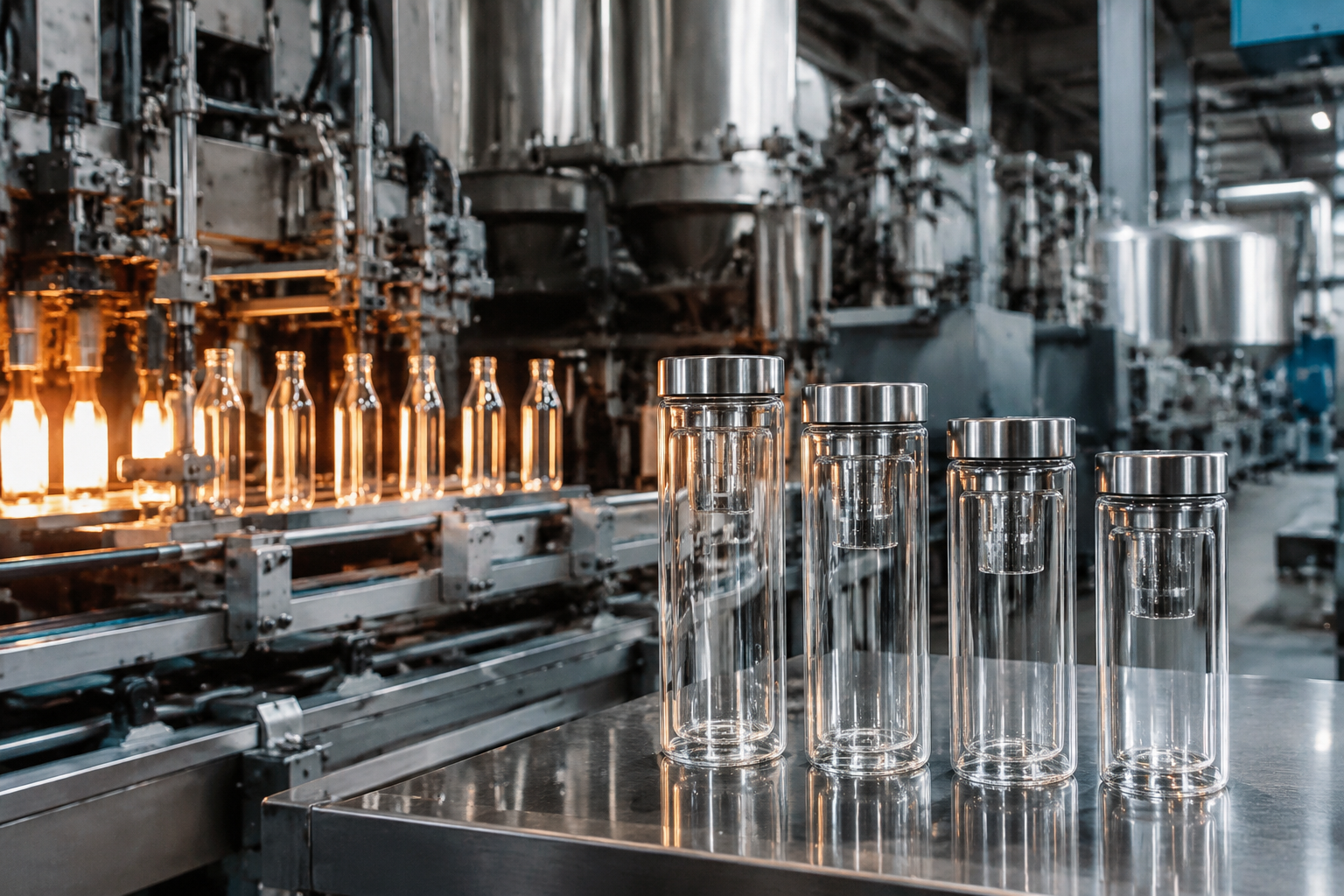
If you are sourcing a borosilicate glass double walled bottle factory, do not treat it like a commodity bottle job. It is a thermal container with fragile material behavior, tighter QC, and packaging that can swing landed cost by 8% to 15% on a real PO. On our line in Zhejiang, the factories that handle this well usually keep forming stable, watch inspection closely, and size MOQ with actual carton math.
The spec sheet matters more than the sales pitch. Wall thickness, glass grade, lid seal, outer diameter tolerance, and the test method decide breakage, complaint rate, and whether the program survives the first 90 days. We once saw a buyer flag a 1.5 mm thickness note on a draft PO, and that typo would have turned into a mess; this is the wrong question to ask if you start from marketing copy. If you are a brand owner, canteen distributor, or canteen supplier, you need factory numbers, not smooth talk.
Read the spec sheet first
When you evaluate a borosilicate glass double walled bottle factory, start with the line items that drive failure rate, not the polished sales copy. Borosilicate glass should be listed by material grade, wall structure, and target temperature range. If the supplier only writes “high borosilicate,” push back. Ask for the coefficient, the wall thickness, and whether the body is hand-blown or machine-formed. On export jobs, we usually see 1.2-1.8 mm per wall, depending on capacity and shape.
That looks technical on paper. It hits the invoice and the claim rate. Thinner walls cut shipping weight and can shave a few cents off FOB, but they also raise breakage risk in cold-chain use, shelf handling, and distributor storage. For distributor drinkware programs, ask for dimensional tolerance on height and diameter; ±1.5 mm is a solid target on a well-run line. Ask for the thermal shock test method too. QC pulled the sample in our shop, and the buyer flagged the same point on a PO with a typo on the temperature spec. A factory in China that knows the line will answer directly.
- Material: borosilicate glass, not generic soda-lime glass
- Wall spec: 1.2-1.8 mm per wall for most retail models
- Tolerance: ±1.5 mm is a practical export target
- Test request: thermal shock, leak test, and drop test data
Double-wall performance is practical
The double wall is not a marketing gimmick. It slows heat transfer, keeps condensation off the outside, and gives the bottle a cleaner hand feel. Ask for a measured temperature-retention test with a fixed fill temperature, room temperature, and sample count. If the supplier cannot show a repeatable result, the number is just decoration. We ran a 500 ml sample on the line last month; QC pulled the sample at 20°C ambient, and the buyer flagged a fake “8-hour hot” claim that fell apart after the second read.
For buyer planning, a double wall adds cost and fragility at the same time. Outer wall cracking, trapped air defects, and uneven base thickness are the reject points we see most. The factory should state whether the base is reinforced and whether the air gap stays uniform at 2.0 mm or 2.5 mm across the body. A common export range is 300 ml to 750 ml, with 450 ml and 500 ml moving fastest for custom orders. This is the wrong question to ask if you only compare unit price; a PO typo on carton count or inner pack size can wipe out the margin on one container. If you sell customized drinkware to Europe or North America, packaging discipline matters as much as thermal performance because one bad carton can erase the margin from twenty good units.
Ask for a batch report, not a promise. If the supplier cannot show 24-hour condensation results, leak-rate data, and drop-test behavior, you are still in the sampling stage.
Lids decide the complaint rate
Most buyer complaints do not start in the glass body. They start at the lid, gasket, or threading. A borosilicate glass double walled bottle factory should tell you the cap build in plain terms: PP, AS, stainless steel, bamboo veneer, or a mixed stack. Then check the gasket spec. Food-grade silicone is the normal pick, but we still ask for hardness, thickness, and the fit tolerance. A 0.5 mm mismatch on the seal is enough to seep. Too stiff, and the customer says the cap feels cheap.
This is where canteen customized projects get messy. A custom canteen or customizable canteen looks simple on the render, but the cap adds tooling cost and lead time. We have seen a buyer flag a lid drawing because the thread pitch was copied from another model and the sample would not close flush on the line. Expect 20-35 days for a new lid mold sample cycle and 35-50 days for production mold readiness if the design is truly new. For a canteen promotional order, existing lids are the safer bet. If you are a canteen distributor or canteen vendor, choose one lid platform that works across sizes. That is the right question to ask.
- Seal material: food-grade silicone, usually 2.0-3.0 mm
- New mold timing: 35-50 days for production readiness
- Lower-risk path: existing lid with custom logo or color
- Distributor advantage: one lid platform across multiple SKUs
Decoration changes your margin
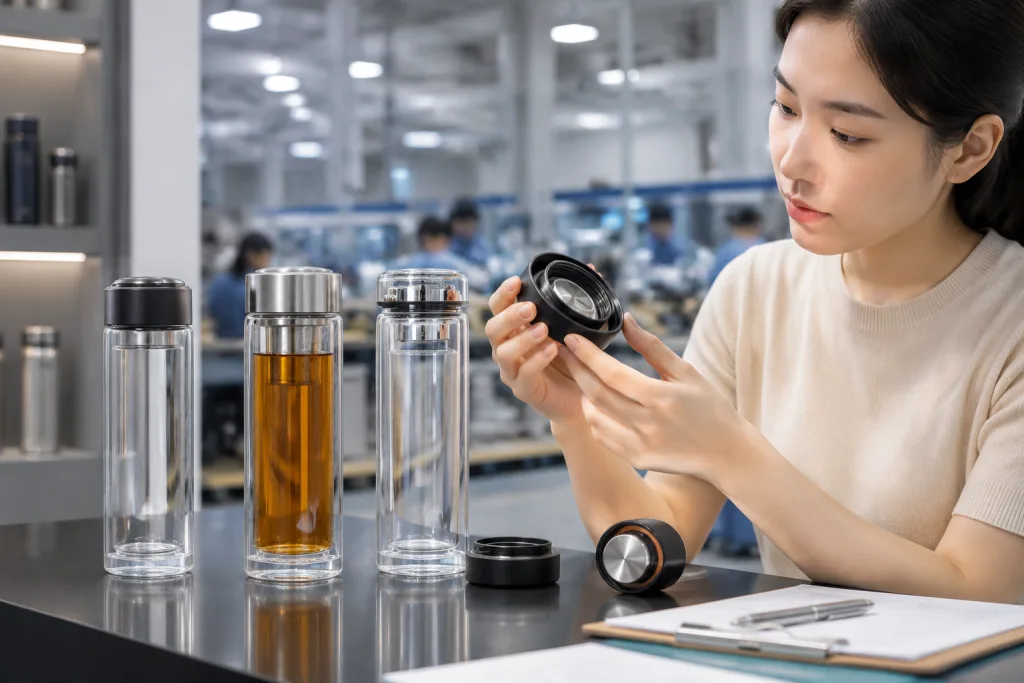
Custom drinkware buyers often stare at logo placement and skip the cost stack. Bad move. On glass, silkscreen, decal, laser marking, and pad print do not price the same. We run 3 decoration lines in Hangzhou, and a 1-color logo on a clear bottle may add only a small amount to FOB, while a full-wrap decal, metallic ink, or 3-position branding can push cost up 10-20%. If you are comparing canteen custom or custom growler programs, decoration choice is often the gap between a quote that lands and a SKU that dies on arrival.
The factory should tell you the print durability test method, especially if your customers will wash the bottle in dishwashers. QC pulled the sample after 50 cycles, and the ink held because the cure was right; if the cure is off by 10-15°C, the result changes fast. For Europe and North America, ask about REACH alignment for inks and any food-contact statement for components that touch the beverage. If the product is positioned as customized canteen merchandise or customized drinkware for retail, the brand story has to survive repeated washing, handling, and transit. A cheap print that fades in 2 weeks is the wrong saving to chase.
For bigger programs, ask whether the supplier can support canteen promotional sets with mixed decorations in one container load. We ship mixed cartons this way when the buyer wants 2 languages or 3 regional logos, and it saves them from splitting every order into tiny lots. A canteen factory in Zhejiang that runs multiple decorating lines usually gives more room than a pure trading setup in China. The math works only if the MOQ, carton mix, and lead time all line up.
Packaging protects your landed cost
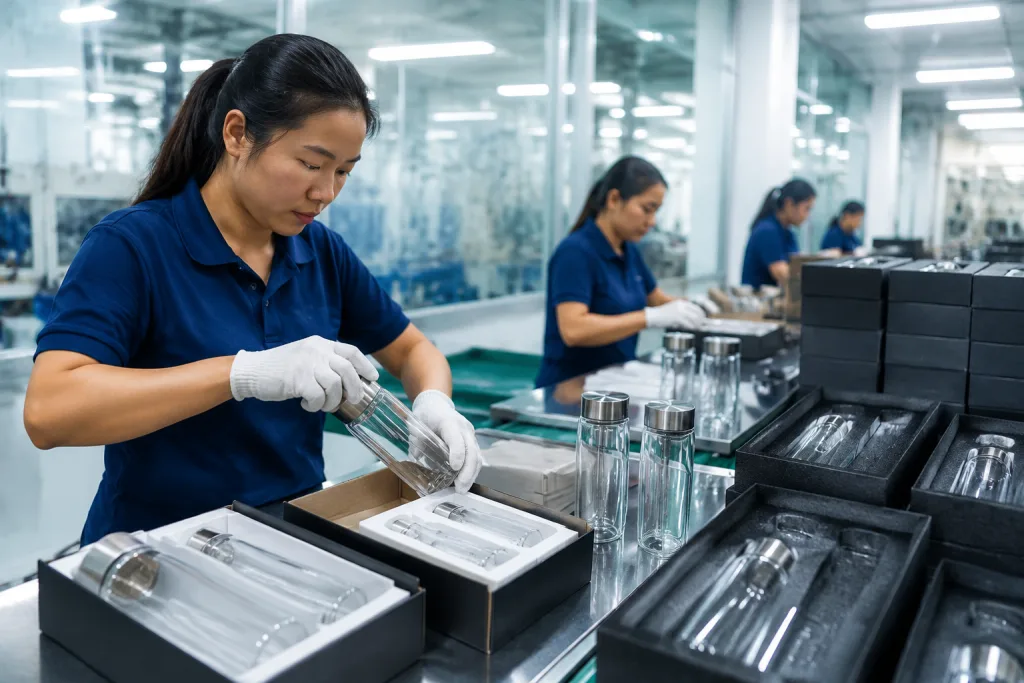
Glass packaging is part of the product. A borosilicate glass double walled bottle factory should quote the bottle, inner box, master carton, partition count, and the packed drop-test result in one line. We run a 1-meter drop test on packed samples for export jobs, and QC pulled the sample again after the first carton corner split. Standard export pack uses one inner box with molded pulp or EVA support, then a 5-ply outer carton. For e-commerce and Amazon-style fulfillment, that pack-out decides whether your landed cost stays sane or gets eaten by breakage.
If you import for distributor drinkware or distributor growler programs, ask for carton compression data and a 1-meter drop test in packed condition. The cheapest carton is usually the wrong question to ask. A retail-ready pack-out may add 0.20-0.60 USD per unit, and that number looks small until the buyer flags 3% breakage at the warehouse. If you need FNSKU labeling, barcode placement, or master-carton marks, lock it before production starts. We’ve seen a PO typo on the label spec hold a full shipment for 12 days.
- Common pack: individual box plus 5-ply master carton
- Damage control: molded pulp or EVA support insert
- E-commerce prep: FNSKU, barcode, and carton mark alignment
- Cost impact: packaging can add 0.20-0.60 USD per unit
MOQ and lead time tell the truth
The factory’s MOQ tells you if they have real export experience. For a standard borosilicate glass double walled bottle, 1,000-3,000 pcs per color or per design is the normal range. We run 2,000 pcs as a common starting point on the line. If a supplier offers 300 pcs for a fully custom canteen project, treat it as a sample-style quote, not a production promise. Small MOQ sounds friendly, but the math usually gives you a higher unit price, fewer decoration choices, and a schedule that slips when QC pulls the sample.
Lead time should be written like a work order, not a sales slogan. For a ready mold, 25-35 days after sample approval and deposit is a realistic target. New mold work, new lids, or major decoration changes can push that to 45-60 days, and we have seen a buyer flag a PO typo on the color code turn into a 4-day delay at packing. A solid canteen manufacturer in Zhejiang should break the schedule into raw material purchase, forming, annealing, inspection, and pack-out. If they only give you one number, that is a guess.
Use lead time to protect the launch window. If your sell-in date is fixed, leave 10-15 days for inspection, sea freight booking, and documents. We once shipped a Europe order with AQL 2.5 passed, then still missed the target because the buyer left no buffer for the booking cut-off. This is the wrong question to ask: not “can you make it fast,” but “where does it slow down.” A canteen vendor that understands export timing keeps you out of air freight panic later.
Quality control should be measurable
If you are serious about procurement, ask how the factory runs inspection, not whether they “have QC.” A proper export line usually has incoming material checks, first-article approval, in-process checks, and final AQL inspection. We run AQL 2.5 for major defects and 4.0 for minor defects as the base case; for retail programs with a lower tolerance on leaks or chips, buyers often push for tighter limits. That is the right bar for customized growler or customizable drinkware work, where one cracked bottle can turn into a lost account.
Ask for ISO 9001 if they have it, and ask for BSCI if your retailer requires social compliance papers. If the bottle will touch beverages in regulated markets, request material declarations and REACH confirmations for the exact components, not a generic folder dump. A factory in China can ship good borosilicate glass bottle sets without big certification language, but the paperwork still has to match your channel. We’ve seen a PO typo on the carton mark hold up inbound at Amazon-style warehouses for 12 days, while the unit price barely mattered.
The fastest way to judge a factory is to ask for one full batch report from a previous order: defect counts, breakage rate, and carton drop results. If QC pulled the sample and they still cannot show the numbers, the process is not controlled. We’ve seen that go sideways on line 3: the buyer flagged a 0.8% chip rate, the factory said “within tolerance,” and the math did not work.
Send your spec sheet for a real quote
We can review your bottle, lid, print, and packaging requirements, then turn them into a factory-ready quote with MOQ and lead time.
Frequently asked questions
What MOQ should I expect from a borosilicate glass double walled bottle factory?
For standard export production, expect 1,000-3,000 pcs per SKU, color, or decoration set. A simple logo on an existing bottle platform may stay near the low end, while a new lid, custom shape, or mixed decoration can push MOQ to 3,000-5,000 pcs. If a supplier offers 200-300 pcs, check whether they mean sample stock or a nonstandard short run. For canteen custom work, the real issue is not just MOQ but whether they can repeat the same lot with stable breakage and print consistency.
How do I compare borosilicate glass with ordinary glass?
Look at the thermal and structural behavior, not the marketing label. Borosilicate generally handles thermal shock better than soda-lime glass because of its lower expansion rate, which matters if your customers move between cold fill and hot wash cycles. For a buyer, that means fewer cracked bodies in real use. Ask the factory for material declaration, wall thickness, and test method. If the product is intended for customized drinkware or canteen promotional programs, this difference directly affects complaint rates and replacement cost.
What should I ask about leakage and lid performance?
Ask for a closed-lid leak test, gasket material, and thread design, then request photos or a batch report. For a practical export standard, many buyers want zero leakage in 24 hours under normal orientation and no seepage after repeated opening cycles. Silicone gasket thickness, usually around 2.0-3.0 mm, matters more than people expect. If you are buying from a canteen factory or canteen supplier, the lid is often the part that turns a good-looking bottle into a return problem.
Can I get custom logos on glass bottles without raising cost too much?
Yes, if you keep the decoration simple. A one-color logo on a standard clear body is usually the lowest-cost route, while wrap decals, metallic effects, or multi-position branding can raise FOB by 10-20%. Laser marking may work better on metal lids than on the glass body, depending on the design. For custom drinkware and canteen customized programs, the cheapest option is usually a stable one-color print on an existing bottle mold with a standard cap.
What compliance documents do European and North American buyers usually need?
At minimum, ask for material declarations, food-contact confirmation for relevant components, and proof of inspection process. Depending on your channel, you may also need REACH-related statements, ISO 9001, BSCI, and carton labeling information. If you sell through Amazon or retail distribution, barcode and FNSKU labeling can matter as much as the product test. A good canteen manufacturer in Zhejiang or elsewhere in China should be able to align documents with your import route without improvising at the last minute.