Key Takeaways
- Borosilicate walls usually start at 1.2-1.8 mm; below that, breakage risk rises fast.
- A practical MOQ for customized drinkware is often 1,000-3,000 units, with 30-45 day lead time.
- Ask for AQL 2.5/4.0 inspection, thermal shock data, and drop-test results before FOB pricing.
- A good factory in Zhejiang should show monthly output of 300,000+ units and documented QC gates.
If you buy custom drinkware for retail, promotions, or distribution, the bottle usually does not fail on the showroom floor. It fails on the line, in transit, or six weeks after launch when buyers start sending back cracked lids, sweating walls, or print that peels off. That is why choosing a borosilicate glass double wall bottle supplier is less about pretty samples and more about how the factory controls weak points. We run this check every week, and the buyer flagged it first: a 0.3 mm wall variance can turn into a 2% reject rate fast.
In Zhejiang and across China, the better factories talk in wall thickness, thermal shock, and drop-test data, not marketing copy. That is the right question to ask. Whether you are buying canteen custom programs, a custom growler line, or distributor drinkware, the job is to spec around failure modes before you place a 3,000-unit order and eat the cost of a bad decision. QC pulled the sample on our bench last month, and the test note said the same thing: fit the spec to the weak point, then order.
Where these bottles usually fail
The first mistake is treating a double-wall glass bottle as “simple” because the shape looks clean. It isn’t. You have two glass walls, a vacuum or air gap, a closure system, decoration, and packaging, and all of them have to survive the same 12-day ocean move. One weak point, and the order turns into a claim file.
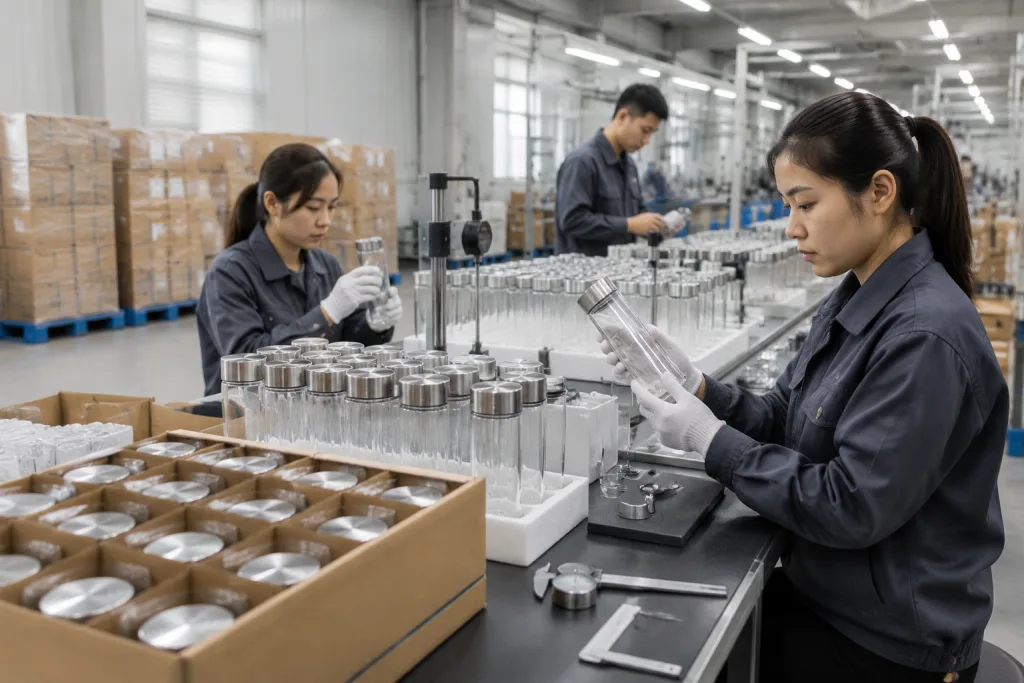
The failure modes show up the same way on our line. Wall thickness drifts, then one side goes brittle. The neck finish lands off by 0.3-0.5 mm, so caps wobble or leak. The vacuum seal is uneven, and you get fogging or condensation. Print fails after dishwashing because the ink was not cured right. Outer cartons are too thin, and damage only shows up after arrival in Rotterdam, Hamburg, or Los Angeles.
Ask a borosilicate glass double wall bottle supplier to break defects down by process stage: forming, annealing, sealing, decoration, packing. QC pulled the sample and found the real problem fast when the neck gauge missed spec. A serious canteen manufacturer or canteen factory in Zhejiang will name the step that creates the defect. A weak vendor goes straight to price. That is the wrong question to ask.
- Glass defect: chips, bubbles, stress lines, uneven wall thickness
- Functional defect: leak, fogging, loose cap, poor heat retention
- Commercial defect: print wear, carton crush, cosmetic rejection
Spec the glass, not the story
“Borosilicate” by itself means nothing on a PO. We spec the mix, the wall, and the annealing control. For consumer drinkware, 1.2-1.8 mm is the working range, and the line tech will tell you the difference fast: under 1.2 mm, the bottle feels clean in hand but chips easier; over 1.8 mm, you pay for weight and glass loss without a clear gain.
Ask for the exact glass standard the factory runs, not a sales note that says “high borosilicate.” A real supplier can state the thermal shock test range, whether QC pulls ASTM-style checks or an internal method, and the carton-level breakage rate they accept at inspection. We’ve seen buyers accept a nice sample and skip this step; that usually turns into a claim later.
For a custom drinkware program, the spec sheet needs capacity tolerance, neck finish tolerance, lid torque target, and logo placement tolerance. Same for a canteen custom line. The shape can be elegant, but if the neck runs 0.8 mm off or the seal line shifts, the buyer flags it and the distributor starts chasing leaks instead of reorders.
Good glass specs reduce returns. Good stories do not.
Lid and seal problems cost more
Most buyers spend time on the bottle and under-spec the closure. That is the wrong place to save money. On a double-wall bottle, the lid is where leaks, odor retention, and complaint emails start. We’ve seen a cap pass the first sample and fail after 500 open-close cycles because the gasket was too soft or the thread pitch was off by 0.3 mm.
For hot-fill or daily-use programs, lock down the gasket material, torque range, and leak test method before the line runs. Silicone gaskets are common, but silicone grades vary. Ask for compression-set data, because a gasket that flattens after a few weeks turns into seepage and the buyer flags the whole lot. If the bottle uses a flip lid or integrated straw, test hinge wear and seal memory on their own.
This is where a lot of canteen suppliers talk big. They say the lid is “100% leakproof,” then soften that claim when you ask about inverted shake tests. We don’t buy that. Put the test in writing: 30 seconds inverted, 10 shakes, no visible leakage, pass/fail by sample size. For promotional canteen or custom canteen work, the closure has to be boringly reliable, because end users toss gifts in bags and drop them on desks.
- Ask for: gasket material, torque target, cycle-life data
- Test for: inversion, vibration, temperature cycling
- Watch for: thread flash, cap skew, loose sealing ring
Decoration fails in the real world
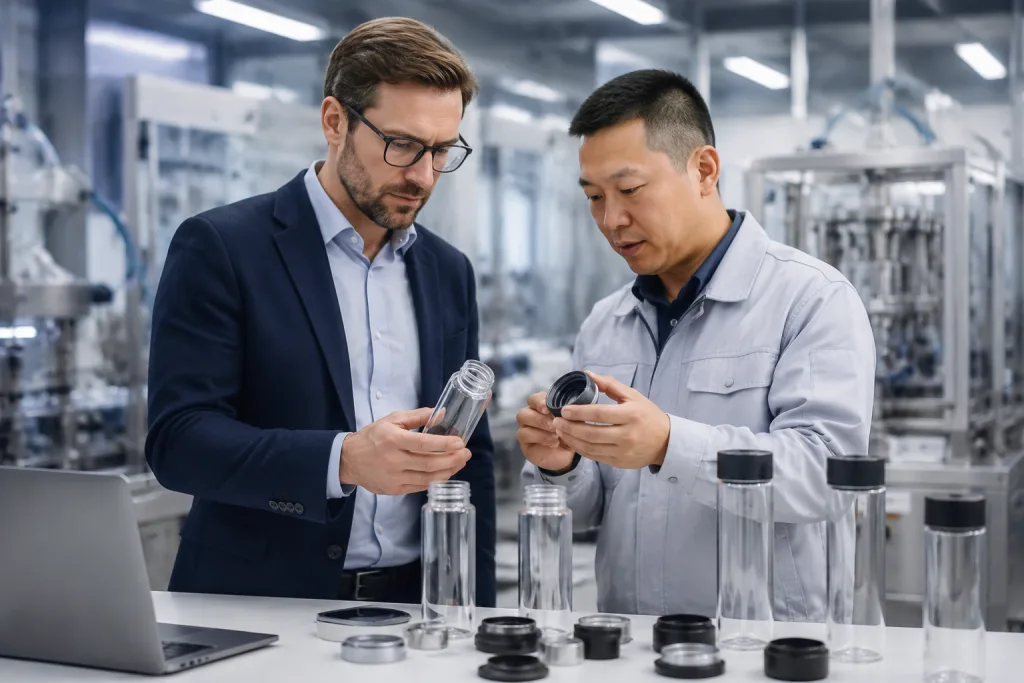
Custom drinkware lives or dies on decoration durability. We run this test a lot: glass prints react differently from stainless steel, and the wrong ink system will chip, fade, or scratch after a tight pack-out. If your program needs a logo, do not leave decoration for the last round of sampling. Put it in the technical spec on day one.
For screen print, ask for cure temperature and adhesion testing. For decals, ask how the factory handles dishwasher resistance and whether the ink system is food-contact compliant where relevant. Laser engraving on borosilicate is narrow territory, so don’t force a metal-style method onto glass. QC pulled the sample, and the edge flake told the story. A supplier who ships both glass and other drinkware usually handles this better than a trader who only knows one lane.
If you are building a canteen promotional program or a distributor drinkware lineup, request a decoration proof on actual production glass, not a paper mockup. We’ve seen a logo look sharp on a sample and drift on the live run when the print jig moved 1.5 mm. If you want premium positioning, specify Pantone tolerance, logo height in millimeters, and max misregistration. The buyer flagged it on a PO typo once, and that one line saved a full carton rework.
For retailers asking about customizable canteen or customized canteen projects, the real issue is not whether the logo can be applied. It is whether 95% of the shipment matches the approved art without rework. That is the wrong question to ask if the spec is vague. On a 5,000 pcs order, the math does not work unless the art file, clamp pressure, and inspection limit are clear from the start.
Packaging is part of the product
Glass breaks in packaging more often than in forming. A bottle can pass factory inspection and still arrive shattered if the inner tray lets it bounce. We are not buying one bottle. We are buying a shipping system.
For export, ask the factory to show carton drop-test data, corner crush strength, and how the bottles sit inside the master carton. We run 3-layer or 5-layer cartons, and the inner divider choice changes the result fast. Inner partitions, molded pulp, and EPE inserts each solve a different problem. If the unit price looks too low, packaging is usually where the supplier cut cost. That math does not work.
For Europe and North America, pick the packing spec around the final channel. Amazon FBA, retail shelves, and distributor fulfillment all care about carton size and barcode placement. If you need FNSKU labels, tell the factory early. If the load is mixed SKU, state pallet height and carton stacking limit up front. We’ve seen a PO typo on pallet height turn into a rework bill. A Zhejiang supplier that ships export orders every week should know this without guessing.
- Check: carton ECT rating, divider fit, and drop-test results
- Clarify: retail box, master carton, and pallet pattern
- Confirm: label placement, barcode type, and FNSKU readiness
What to demand before PO
Before you issue a purchase order, ask for the papers that separate a real factory from a polished trading desk. You want sample approval records, inspection criteria, and traceability. We had a buyer flag a PO typo on the carton count once, and the factory caught it because the spec pack matched the golden sample. In China, the better suppliers hand over material certificates, pre-production sample photos, in-process inspection logs, and final AQL reports without drama. In Zhejiang, that is standard on export lines that run every week.
Use a tight control stack: approved golden sample, written spec sheet, packaging spec, and QC checklist. For B2B canteen suppliers and canteen manufacturers, AQL 2.5 for major defects and 4.0 for minor defects is a common starting point, but the number should fit your channel. A mass-market chain can live with a different bar than a premium custom line. We run 0.5 mm and 1.0 mm checks on the line, and if the buyer wants a looser finish, we still write the defect limit down first. That is the real question, not how cheap the unit price looks.
Price matters, but only after the factory proves repeatability. Ask for FOB terms in writing, tooling charges if any, sample lead time, mass production lead time, and whether the line can handle 1,000, 3,000, or 10,000 units without changing process. A reliable borosilicate glass double wall bottle supplier should know monthly output and where the bottleneck sits, whether it is the annealing oven or the packing table. If they cannot tell you whether they can ship 300,000 units per month across drinkware lines, they are not ready for serious procurement.
When you also source a custom growler or customizable growler program, use the same checklist. Different shape, same discipline. QC pulled the sample, checked the rim at 0.3 mm, and the issue was a weak print file, not the glass. The factories that last in Zhejiang and across China respect process before price.
Send your spec, get a factory-grade quote
Share your capacity, lid, print, and packaging targets. We’ll quote the realistic version, not the sample-room fantasy.
Frequently asked questions
What MOQ should I expect from a borosilicate glass double wall bottle supplier?
For a custom run, 1,000-3,000 units is a realistic MOQ range, depending on shape, decoration, and packaging. If you need a new mold, tooling can add USD 800-3,000 or more. For stock shapes with custom print, some factories in Zhejiang will start lower, but unit price usually improves sharply at 5,000+ units. Ask whether MOQ changes for canteen custom, canteen customizable, or customized drinkware orders, because decoration and packaging often drive the real minimum.
How do I test if the bottle will leak or fog?
Ask the factory to run inversion leak tests, shake tests, and temperature cycling. A practical test is 30 seconds inverted with no visible leakage, then a hot/cold cycle to check condensation or fogging in the wall gap. Also request sample photos after 24 hours at room temperature. A serious canteen supplier should give you a written pass/fail standard, not just say it is leakproof. For export, keep records tied to each batch number.
What QC checks matter most for export orders?
Start with wall thickness, neck finish, cap torque, print adhesion, and carton drop resistance. Then request final inspection by AQL 2.5 major and 4.0 minor, or tighter if your channel demands it. If you are shipping to Amazon FBA or retail DCs, add barcode verification and pallet stacking limits. A good canteen factory will provide an in-process QC sheet, not just a final inspection photo set.
Can I combine custom logo work with dishwasher-safe performance?
Yes, but you must specify the decoration method and cure process. Screen print and decals can work if the ink system is designed for the target wash cycle and cured correctly. Ask for adhesion and abrasion results after 50-100 wash cycles if that matters to your channel. This is especially important for promotional canteen programs, where buyers expect the logo to survive ordinary use. Do not assume a pretty sample equals durable production.
How do I compare factories in China without getting lost in price?
Compare on repeatability, not only on FOB. Ask each canteen manufacturer for monthly output, lead time, defect rate, packaging spec, and test data. A factory in Zhejiang that can show 300,000 units per month across drinkware lines, 30-45 day lead time, and documented QC steps is usually a safer partner than a cheaper seller with no traceability. If they also support custom growler or distributor drinkware programs, you can judge how they handle mixed requirements.