Key Takeaways
- Typical MOQ starts at 1,000 pcs for a private label glass bottle, with sample lead time around 7-10 days
- A workable export price for borosilicate double wall glass is often USD 2.10-4.80 per unit FOB China, depending on lid, size, and decoration
- Double wall borosilicate glass is usually specified at 1.8-2.2 mm per wall, with a total wall system that protects hand feel and insulation
- For Europe and North America, ask for REACH, food contact declaration, and carton drop test results before bulk approval
If you are buying a borosilicate glass double wall bottle private label, the main risk is not finding a factory. It is signing off a clean sample and then watching bulk fail on 1.8 mm wall thickness, lid torque, logo rub test, or carton drop damage. We see that every season. A sample that looks sharp on a desk can still add 0.18 USD per unit in breakage and rework once we run 5,000 pieces.
For a B2B buyer, treat this as a sourcing job, not a product hunt. Start with the RFQ, freeze the sample spec, then turn the approved sample into a PO with every line written out. The buyer flagged a one-word typo on the carton spec last month, and that saved a 12-day delay. If you buy custom drinkware often, you already know canteen custom programs, custom growler runs, and branded glass bottles all live or die on that discipline.
Start with the RFQ, not the sample
Most projects go sideways on the first message: “Please quote my glass bottle.” That line gives a factory almost nothing. A proper RFQ should pin down capacity, shape, lid type, logo method, target market, and pack-out. If you want a borosilicate glass double wall bottle private label program that can move through retail or distributor channels, treat the RFQ like a spec sheet, not a chat.
Send these line items in the first email:
- Capacity: 350 ml, 500 ml, or 750 ml
- Glass spec: borosilicate, double wall, target wall thickness 1.8-2.2 mm
- Lid: PP, stainless steel, bamboo, or silicone-sealed
- Decoration: one-color silk print, laser mark, decal, or no decoration
- Packing: white box, color box, mailer, or PDQ display
- Target quantity: 1,000 / 3,000 / 5,000 pcs
That level of detail lets a canteen supplier quote cleanly. It also puts canteen manufacturers on the same basis. We ship from Zhejiang every week, and the factories that get full specs usually reply faster because they can split tooling, decoration, and packing instead of guessing at one unit price. If the buyer asks for “just a quick quote,” the math does not work. The same RFQ format fits a custom canteen, a customizable canteen, or a custom growler; the material changes, the quoting logic does not.
PO line item to prepare now: product spec sheet, artwork file, target incoterm, required certifications, and packaging artwork approval date.
Vet the factory before price
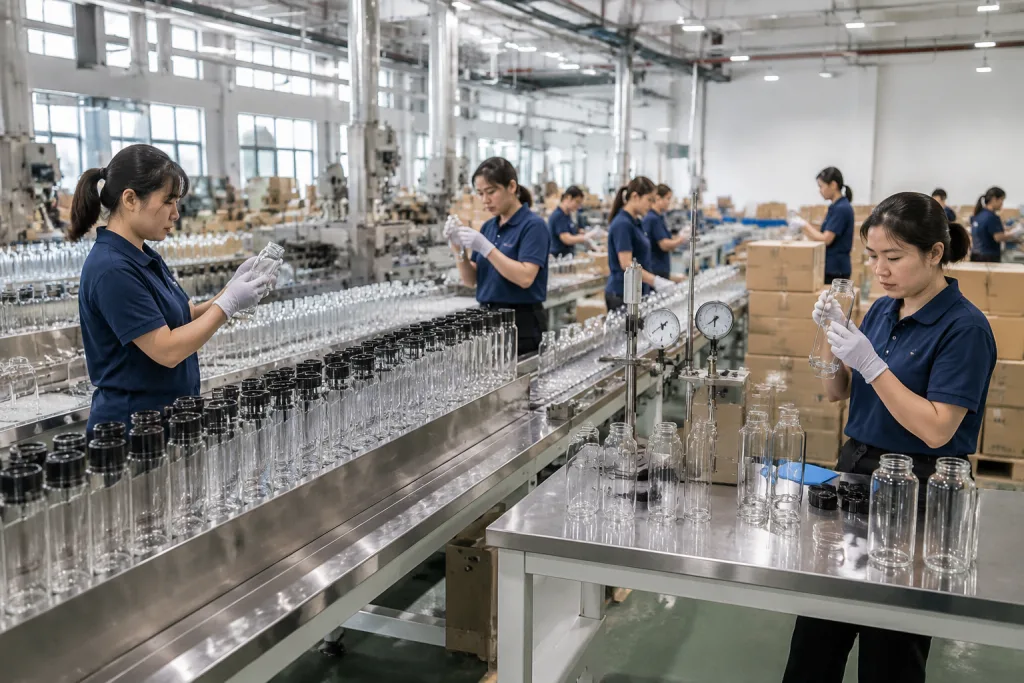
Price means little if the factory cannot hold a steady batch. We run into this on the line all the time. A real canteen manufacturer should show monthly output, glass forming capacity, and decoration control with numbers on the table. For a medium-size export factory in Zhejiang, 300,000-500,000 units per month across mixed drinkware lines is a workable range, with private label runs booked into weekly production slots. If the supplier cannot state capacity clearly, you are likely talking to a trader, not a canteen factory.
Ask for business proof, not marketing language:
- BSCI or Sedex audit if you need social compliance
- REACH declaration for Europe
- Food contact statement for glass, lid, and coatings
- ISO 9001 if they claim system control
- Recent AQL inspection record, ideally AQL 2.5 for critical defects
For a canteen distributor or distributor drinkware buyer, factory transparency matters because your customer will blame you, not the supplier, when lids leak or the logo rubs off. QC pulled the sample, and we have seen a 1.2 mm lid gap sink an order. If you are comparing canteen suppliers, canteen vendors, or a canteen distributor model with direct factory sourcing, measure them on the same points: who owns the mold, who controls glass annealing, who packs, who inspects, and who replaces breakage. This is the wrong question to ask if you start with unit price. A good vendor answers in numbers, not adjectives.
Practical rule: if a factory cannot state MOQ, lead time, and monthly output in one message, do not move to sample stage yet.
PO line item to prepare now: factory qualification checklist, compliance documents, agreed defect thresholds, and production calendar.
Turn sample approval into a contract
Sampling is where buyers lose control fast. The sample is a reference standard, not the final shipment. For borosilicate glass, QC pulled the sample against the gauge block and checked clarity, thermal response, wall thickness, and lid threading. If you buy for Europe or North America, the sample must show the real decoration method, not a hand-finished version that looks cleaner than the line can run.
What should be in the sample PO?
- Sample quantity: 2-5 pcs per variant
- Sample fee: USD 30-120 depending on mold and logo method
- Sample lead time: 7-10 days for stock shape, 15-25 days for new mold or new lid
- Approval criteria: color, height tolerance, lid torque, logo position, and leak test
If you are checking a customizable drinkware portfolio or a customized canteen line, lock the sample to written acceptance criteria. For glass bottles, ask for a hot-water thermal test, a 24-hour leak check, and a carton drop test on the outer box. We’ve seen buyers skip the carton test, then the first shipment lands with crushed corners and the buyer flags it on day one. Get a signed golden sample with a date stamp. Keep one on your side and one in the factory file. That saves arguments later.
PO line item to prepare now: sample SKU codes, approved artwork, test method, and signed golden sample reference.

Price the bulk order correctly
Bulk pricing for a borosilicate glass double wall bottle private label order moves by tier, not by one neat number. At 1,000 pcs, a plain export quote often sits around USD 3.60-4.80 FOB China. At 3,000 pcs, it can drop to USD 2.80-3.90. At 5,000+ pcs, a basic logo and standard lid may land in the USD 2.10-3.20 range. We run these numbers on the line with a 0.3 mm print tolerance and a lid sample in hand; once the buyer adds a bamboo top, full-color print, or gift box, the math moves fast. I’d challenge any quote that hides those adders.
Do not compare unit price unless the commercial terms match. Ask the factory to split out:
- Glass body cost
- Lid cost
- Decoration cost
- Packing cost
- Carton and master carton cost
- Inspection and export handling
This matters if you also source canteen promotional products, custom growler items, or distributor canteen programs. A canteen customized for retail usually needs retail-ready packaging; a canteen customizable run for corporate gifting puts more weight on print area and unit margin. Same product family. Different cost structure. QC pulled the sample once and found the inner box spec was missing on the PO, which turned a clean quote into a mess. If the supplier is a canteen vendor with weak costing discipline, they bury packaging and compliance inside the unit price. Ask for the split. If they push back, the margin is the reason.
PO line item to prepare now: confirmed unit price by SKU, packing cost, carton spec, and applicable freight basis such as FOB Ningbo or FOB Shanghai.
Write the PO like a factory will read it
Your purchase order should read like a production instruction, not a commercial wish list. We run lines that will follow the PO word for word, and if you leave a gap, someone will fill it with the cheapest option. A buyer once sent us a PO that said “standard lid”; QC pulled the sample, and the lid changed from PP to thin PS on the first trial pack. That is how claims start.
Use this PO structure:
- Product name: borosilicate glass double wall bottle private label
- SKU: one code per 400 ml, 500 ml, and lid type
- Material: borosilicate glass, PP lid, silicone ring
- Size: capacity, height, diameter, weight, wall thickness
- Decoration: artwork file name, print position, Pantone code
- Packing: inner box, master carton count, carton drop standard
- Inspection: AQL level, defect definition, third-party inspection date
- Delivery: lead time in 18 days, port, incoterm, partial shipment rule
For a canteen manufacturer or canteen manufacturers group in China, this is normal paperwork. In Zhejiang, the better factories expect that level of control because they run several export accounts on the same line. If you are buying as a canteen distributor, distributor growler buyer, or distributor drinkware importer, the PO is your legal shield. The math does not work any other way: if the PO says 2.8 mm glass and the line ships 2.4 mm, you have a clean claim.
PO line item to prepare now: SKU matrix, quality tolerance, shipment schedule, and penalty terms for spec deviation. We also ask buyers to add one typo-check round before release; a PO that says “carton 24 pcs” instead of “24 sets” has already caused a repack charge on our side.
Inspect before you ship
Do not wait until the cartons are on the water to check quality. On glass, the cheapest defects are the ones you catch before packing. We run pre-shipment inspection on 100% appearance sampling plus AQL sampling for critical issues. A workable setup is AQL 2.5 for major defects and AQL 4.0 for minor defects, with a leak test, logo rub test, and carton compression check. QC pulled one sample where the lid torque missed spec by 0.3 N·m; that is the kind of miss that turns into a claim later.
What matters in inspection?
- Glass bubbles, scratches, and molding marks
- Wall concentricity and thickness variation
- Lid seal fit and torque
- Print alignment and color match
- Carton drop resistance and inner protection
If you sell in North America, check whether the shipping carton can survive Amazon FBA handling if that sits in your channel plan. If you need FNSKU labeling, say it before production ends. For Europe, confirm language labels, barcode format, and local recycling mark rules. A canteen promotional order can live with a small cosmetic spread; premium custom drinkware cannot. That is the wrong question to ask if someone says “the glass looks fine from one meter.” We see it go sideways when the buyer flags a PO typo on carton marks after the line has already packed 2,000 pcs. When you work with a canteen supplier in China, especially one in Zhejiang, inspect the first batch, then lock the approved process for repeat orders.
PO line item to prepare now: inspection agency name, defect thresholds, sample quantity, and release authorization procedure.
Send your RFQ with exact specs today
We can quote your borosilicate bottle, confirm MOQ, and map sample-to-bulk timing from our Zhejiang factory with clear export terms.
Frequently asked questions
What MOQ should I expect for a borosilicate glass double wall bottle private label order?
For most export-ready factories in Zhejiang, a realistic MOQ is 1,000 pcs per SKU for a standard shape and 3,000 pcs if you need new mold work or multiple print colors. If you choose a stock bottle with private label only, some canteen manufacturers can quote lower, but the unit price usually rises by 10-20%. For a new customized drinkware program, confirm whether MOQ is per color, per lid type, or per carton spec, because those details change the economics fast.
How long does sampling and bulk production usually take?
A stock-shape sample usually takes 7-10 days. If you need a new lid, new print setup, or packaging mock-up, plan for 15-25 days. Bulk lead time for a normal private label run is often 30-45 days after sample approval and deposit. In peak season, a canteen factory in China may need 50-60 days. If you are buying through a canteen distributor or canteen supplier with limited factory control, add another week for coordination.
What certifications should I request for Europe and North America?
At minimum, ask for REACH for Europe and a food contact declaration for the glass body, lid, and silicone gasket. If the factory has BSCI or Sedex, that helps on retailer audits, though it is not a substitute for product compliance. For a canteen manufacturer supplying branded custom drinkware, I also recommend ISO 9001 and an AQL inspection report. If you need California Prop 65 review or Amazon FBA labeling, state that before production starts.
How do I compare quotes from canteen suppliers fairly?
Compare them on the same spec sheet. Match capacity, wall thickness, lid material, decoration method, inner packaging, and incoterm. A quote at USD 2.30 FOB Ningbo may be more expensive than USD 2.10 if the cheaper one excludes inner boxes, quality testing, or export cartons. Ask each canteen vendor to break out glass, lid, printing, packing, and freight handling. That is the only way to compare a custom canteen, a customizable canteen, or a customized growler program without guessing.
Can I combine glass bottles with other custom drinkware in one order?
Yes, but only if the factory truly handles mixed categories. Many canteen manufacturers can do glass bottles, stainless tumblers, and a custom growler run, but not all run the same production schedule. If you combine items, keep separate SKUs, separate packing specs, and separate lead times. A distributor canteen order for 5,000 units may ship in one container, but the production logic still needs clean separation to avoid mix-ups. This is common when a distributor drinkware buyer wants a broader line from one China factory.