Key Takeaways
- A workable borosilicate glass double wall bottle quote usually starts at MOQ 1,000-3,000 pcs and 25-40 day lead time after sample approval.
- Ask for wall thickness, borosilicate grade, carton test, and decoration method in the RFQ or you will get apples-to-oranges pricing.
- A real bulk PO should separate bottle, lid, packaging, and testing charges so you can control landed cost.
- For North America and the EU, request REACH, LFGB, and drop-test evidence before you release production.
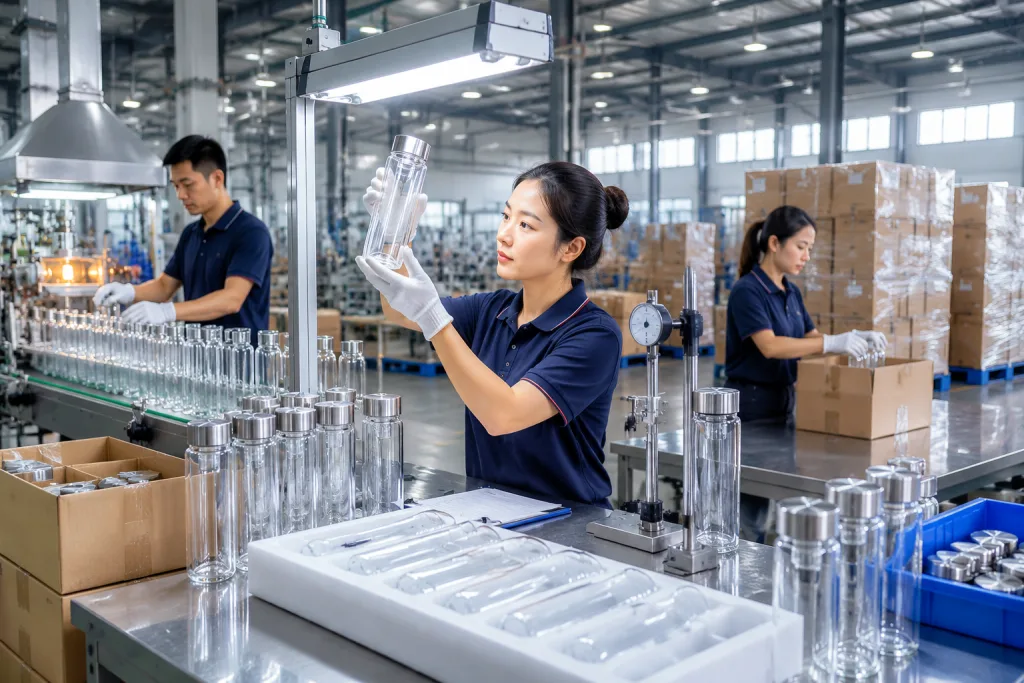
If you are sourcing a borosilicate glass double wall bottle manufacturer, you are not buying a nice-looking bottle. You are buying a fragile item with thermal, packaging, and compliance risk that can wipe out margin fast. We have seen one cracked carton in transit erase a whole batch’s savings on unit price.
The better move is simple: treat this as an engineering buy, not a catalog buy. On our line in Zhejiang, we ask for the same basics every time: target capacity, glass wall thickness in mm, lid structure, decoration method, compliance market, and packaging spec. Give clean inputs, and you get cleaner quotes, tighter samples, and fewer surprises at bulk. That is how serious canteen manufacturer and canteen supplier relationships are built for Europe and North America.
Start with the right RFQ data
Most sourcing problems start with a lazy RFQ. Send only a photo and ask for a price, and the factory will give you a number, but it will not be a useful one. A borosilicate glass double wall bottle manufacturer needs enough detail to lock the process: capacity in ml or oz, overall height, maximum diameter, wall thickness, lid material, gasket material, color finish, logo method, and carton count. If your target is a custom drinkware program, say whether it is canteen custom, custom canteen, or a canteen promotional item for a distributor canteen program. The commercial answer changes with volume and decoration. We see this on the line all the time.
Use one RFQ sheet and keep it strict. Include the market: EU, UK, US, or Canada. Include compliance needs such as REACH, LFGB, FDA contact safety, and any retailer test standard like ASTM drop or shipping simulation. Also note whether you want a canteen customizable blank, a customized canteen with one-color print, or a customized drinkware program with a full wrap. If you are acting as a canteen distributor or canteen vendor, tell the factory whether you need mixed SKUs in one carton or one SKU per carton. That detail matters in Zhejiang factories that run high-volume export lines. A clean RFQ saves days, not minutes. QC pulled the sample, and the carton count was off by 12.
- Capacity: 350 ml, 500 ml, 750 ml, or 1 L
- Glass spec: borosilicate 3.3, 1.8-2.2 mm wall
- Decoration: silk screen, laser, decal, or etched mark
- Packaging: color box, brown box, mailer, master carton
Read the quote beyond price
A cheap quote can still cost more. Check the line items, not just the EXW or FOB number. A borosilicate glass double wall bottle factory worth using will split out the bottle body, lid, silicone seal, print, packaging, and testing. If the seller will not itemize those parts, the margin usually comes back later. We have seen it on the line: one quote looked 12% lower, then the buyer flagged a carton upgrade and the total landed higher than the “expensive” offer.
Put the trade terms in writing. FOB Ningbo or FOB Shanghai is normal for Zhejiang exports, and both are manageable if your forwarder is steady. If you need a drinkware supplier for a distributor program, ask for tiered pricing at 1,000, 3,000, and 5,000 pcs. That shows the real break point. For a promotional order, simpler packaging and a 20-25 day lead time can work. Retail needs another setup, often 30-45 days, and the buyer should hear that upfront. This is the wrong question to ask: “What is your lowest price?” Ask what changes at each volume step.
Do not compare quotes by unit price alone. Compare them by landed cost, carton risk, and the defect rate you can actually tolerate.
Useful PO line items at this stage include sample charge, mold or tooling if any, print setup, inner carton, master carton, and pallet fee. QC pulled the sample, checked the 1.5 mm seal groove, and that is where hidden cost shows up fast. If a factory says tooling is free, confirm whether they have built it into the unit price. The math does not work any other way. That is normal. Just keep it visible.
Sample for fit and failure
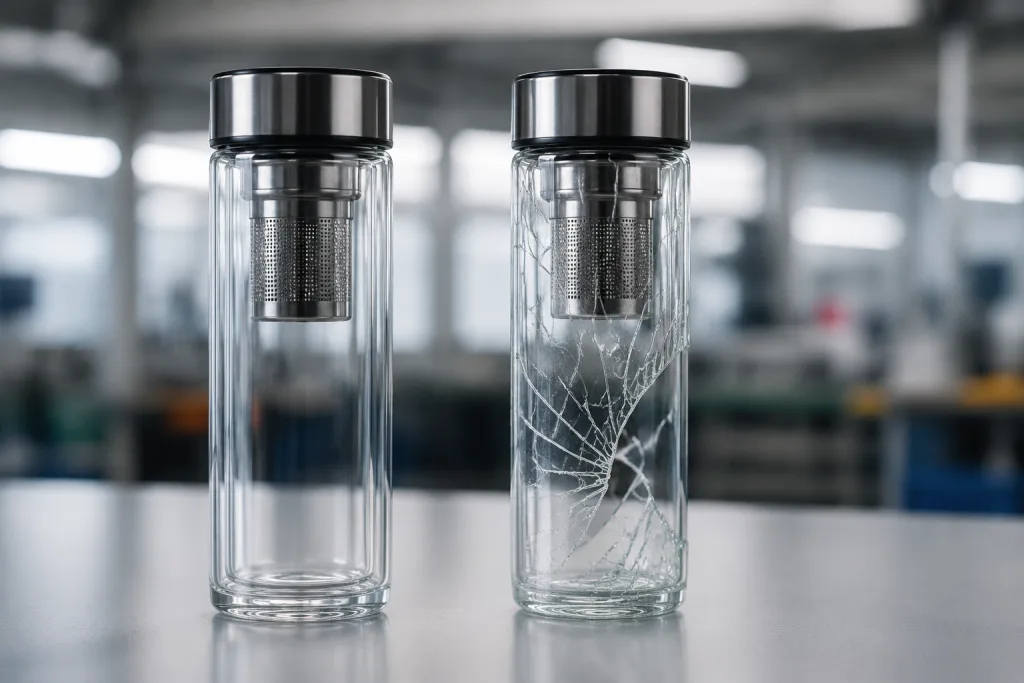
The sample is where most buyers find out if the factory can build, or just reply fast. Ask for two rounds at minimum: one blank structural sample and one decorated sample. The blank shows glass clarity, seam quality, lid fit, gasket compression, and thermal movement. The decorated sample shows whether the canteen artwork lands in the right place, holds up, and justifies the cost. On a borosilicate glass double wall bottle, the glass can pass while the lid starts weeping after two heat cycles. So the sample has to work, not just look clean.
For a serious custom growler or customizable growler program, ask for hot-fill testing at 90°C if the design allows it, then run a cool-down cycle to check whether condensation forms inside the wall. Have the factory point to the exact control for dew point risk. If they cannot explain that in plain terms, stop there. We run this kind of check on the line with a caliper and a torque tester, because the buyer flagged a 1.2 mm lid gap once and the whole job turned into a rework mess. Add a simple QC sheet to the sample PO: dimensions within ±1.5 mm, lid torque check, no visible bubbles larger than 1.0 mm in the viewing area, and leak-free upside-down hold for 5 minutes. That is the right question to ask.
Sample PO line items should list courier charge, sample unit cost, decoration cost, packaging prototype, and the re-sample fee if you revise the artwork. If you work with canteen manufacturers across China, pay the sample bill cleanly. A cheap sample usually means weak follow-through, and we have seen that go sideways on a 500-piece pilot more than once.
Lock the bulk PO line by line
Once the sample is signed off, the bulk PO needs to read like a control sheet, not a wish list. Put the approved sample code on it. State the exact bottle capacity, glass wall thickness, lid style, gasket material, logo position, print Pantone number, and carton spec. For a customized canteen or customized drinkware program, that kind of detail keeps the line steady on repeat orders. If you are a distributor canteen buyer, say whether future orders must keep the same print plate or whether artwork can change by SKU.
A practical PO in this category usually breaks out these lines: bottle body, lid assembly, gasket, print, individual box, master carton, palletization, carton test, and pre-shipment inspection. If the seller is a canteen vendor with export experience, they know why we separate them. Do not merge everything into one vague item called “drinkware.” That hides cost, and when the buyer flags a claim later, the math does not work.
Use acceptance terms. We see buyers run AQL 2.5 for major defects and 4.0 for minor defects on appearance and leakage, with 100% leak test before packing. On one 500 ml run, QC pulled the sample and found two lid gaskets out of spec at 0.8 mm; that is the kind of miss you want caught before loading. If the order is retail-bound, ask for drop testing on packed cartons from 76 cm or 1 m, based on your freight profile. For Amazon or e-commerce, add FNSKU labeling, barcode verification, and carton mark placement. That is the difference between a factory that ships and a factory that supports the channel.
- Approved sample reference number
- FOB port and incoterm
- Inspection standard and AQL
- Packaging artwork and carton quantity
Check compliance before tooling
For Europe and North America, lock compliance before you pay for tooling or mass production. A borosilicate glass double wall bottle manufacturer in China should support REACH material declarations, food-contact files, and migration test paperwork where the product needs it. If the bottle is sold as a canteen custom item for food and beverage use, the cap, gasket, print, and coating all count. We have seen the glass pass and the ink fail. That is the hole in the plan.
If you need a canteen distributor program, ask the factory to build a compliance file by SKU. Put the material list, test reports, supplier declarations, and production photos in one pack. If the product uses stainless or aluminum parts, confirm the grade. If it is all-glass, confirm the borosilicate formula and whether the line is running 3.3 or another variant. One Zhejiang buyer once sent a PO with the wrong cap code, and QC pulled the sample before the cartons moved. That is the kind of boring work customs and retailer audits reward.
For promotional orders, some buyers cut the test set, but that only works when the channel and claim stay tight. A canteen promotional item going to a trade show carries a different risk than a retail bottle for a national chain. State the end use clearly. If you want the product sold as customizable canteen or customizable drinkware, the documents need to match that claim. Do not write marketing copy into the PO and expect the factory to guess the standard; the math does not work.
Manage production and inspection in China
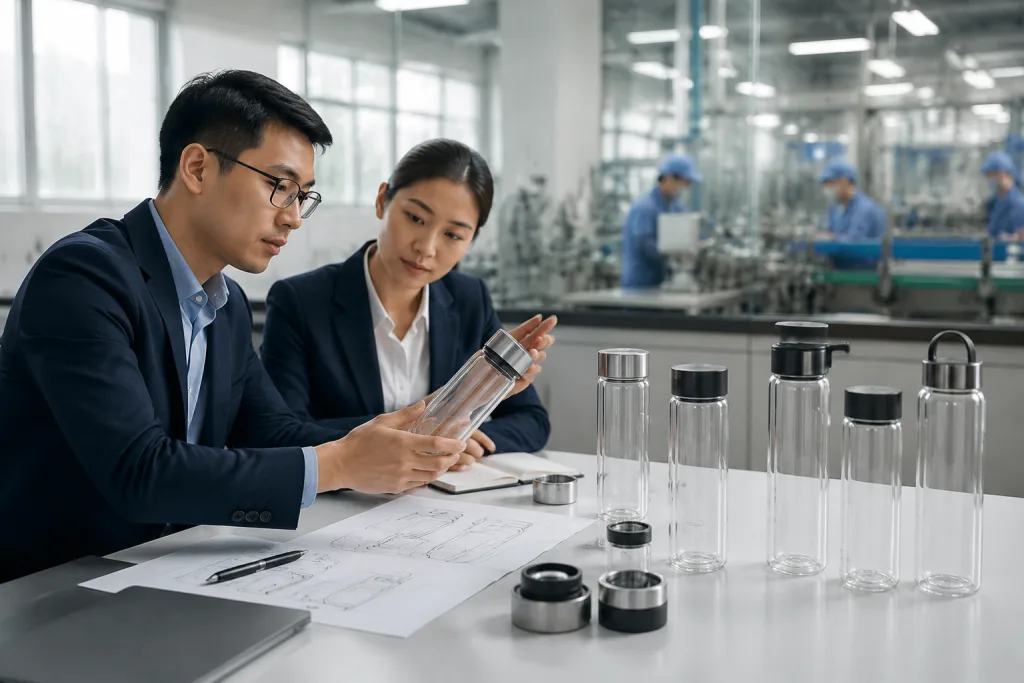
Once production starts, keep the factory on dates and checkpoints. For this category, 25-40 days after sample approval is normal, and the clock changes with decoration, packaging, and season. Q4 is the squeeze point. Glass furnaces, carton plants, and print shops all back up fast in China, so if the order is time-sensitive, book it early. A real export canteen manufacturer should show monthly output, line count, and where QC pulls the sample. In a solid Zhejiang plant, monthly capacity may run from 120,000 to 300,000 units, depending on SKU mix and packaging complexity.
Ask for in-process photos at three stages: glass forming, assembly, and packing. Basic? Yes. Useful? Also yes. It catches the ugly stuff early. If the shoulder line drifts by 1.5 mm, you want to see it before print, not after palletizing. We’ve seen buyers flag a PO typo on the carton count only after the goods were packed; that turns a small fix into a mess. If you are buying from a canteen factory for a distributor drinkware rollout, book a pre-shipment inspection 3-5 days before ETD. Check quantity, print alignment, leakage, carton compression, and shipping marks. Keep one sealed golden sample in your archive and one in the factory. That is how you avoid the next argument on the next PO.
Buyers who source across China often chase unit price and ignore escalation speed. That is the wrong question to ask. Agree up front on what happens if glass breakage goes over 1.5%, or if print mismatch misses the approved tolerance. Put the remedy in writing: rework, replacement, or credit. We run enough orders to know this goes sideways when people leave it vague. You do not need drama. You need a process.
Plan reorders like a program
If the first order lands clean, the second one should cost less and move faster. That only happens when you keep the paperwork in one place. Save the approved drawing, sample photos, test reports, carton spec, and PO history together. When you reorder a borosilicate glass double wall bottle, keep the same factory code and keep the artwork file in vector format. We run into trouble when the buyer flags a typo on the PO and the file name does not match the sample tag.
A good supplier will tell you when the SKU count is too high. A custom growler with three lid colors, two print locations, and four packaging options sounds flexible, but it can stop the line and push defects up. Simple makes money. The same goes for a customized growler or custom canteen line: lock the base bottle, then change the decoration or box only when the margin supports it. QC pulled the sample, found one cap mismatch on a 24 mm neck, and the math did not work.
For distributors, the strongest programs use one stable bottle body, one or two lid SKUs, one packaging spec, and seasonal artwork updates. That setup ships better than chasing novelty, and Zhejiang factories know how to repeat it. Give us the same inputs, and we repeat the same result. A factory can run 5,000 pcs on Tuesday and 5,000 pcs again next month without a fresh meeting if the spec stays fixed.
Send your RFQ with exact specs
We will quote the bottle, lid, packaging, and testing line by line so you can compare China offers without guessing.
Frequently asked questions
What MOQ should I expect for a borosilicate glass double wall bottle?
For a standard export SKU, expect MOQ around 1,000-3,000 pcs per design and color set. If you want custom print, retail packaging, or special lids, 3,000 pcs is more realistic. A Zhejiang factory may support lower pilot quantities, but unit price will jump 15-30%.
How much does a custom borosilicate glass bottle cost FOB China?
For a basic 350-500 ml bottle, FOB China can land around USD 2.20-4.80 depending on lid type, decoration, and carton spec. If you add full-color print, premium lid hardware, and gift packaging, the price can move above USD 5.00. Ask for separate line items before comparing offers.
What documents should I ask for before bulk order release?
Ask for material declarations, product photos, approved sample reference, test reports, carton spec, and a production PO with exact quantities. For EU and US shipments, request REACH-related declarations, food-contact support, and if needed LFGB or FDA-related paperwork. Put the approved sample code on the PO.
How do I reduce breakage in transit?
Use a thicker master carton, molded pulp or EPE inserts, and a drop-tested outer carton. For glass bottles, keep the inner box snug so the bottle cannot move more than 5 mm. Ask the factory for packed-carton drop tests from 76 cm or 1 m, depending on your shipping profile.
Can I treat this as a canteen promotional item for my distributor program?
Yes, but define the channel. For a canteen promotional order, you can simplify packaging and decoration to cut cost and shorten lead time to around 20-25 days. If the product is going into retail or e-commerce, tighten QC, label control, and compliance paperwork. The same bottle can serve both, but the PO should not.