Key Takeaways
- Choose the factory by spec control first: borosilicate glass, wall thickness, and seal integrity matter more than a $0.20 price gap.
- For most private-label programs, expect MOQ around 3,000 pieces and FOB China pricing from about USD 2.10-4.80 depending on capacity, lid, print, and packaging.
- Ask for compliance proof up front: REACH, LFGB or FDA food-contact support, and factory audits such as BSCI if you sell into retail.
- Double wall glass is not a commodity if you need consistent branding, carton drops, and repeatable bulk supply from Zhejiang or wider China.
If you are buying borosilicate glass double wall bottles for retail, gifting, or promotion, the wrong factory choice shows up fast: cloudy glass, loose seals, slow samples, and cartons that fail the drop test before they reach your warehouse. You do not need a glossy pitch. You need a supplier that holds tolerances, quotes cleanly, and ships on time.
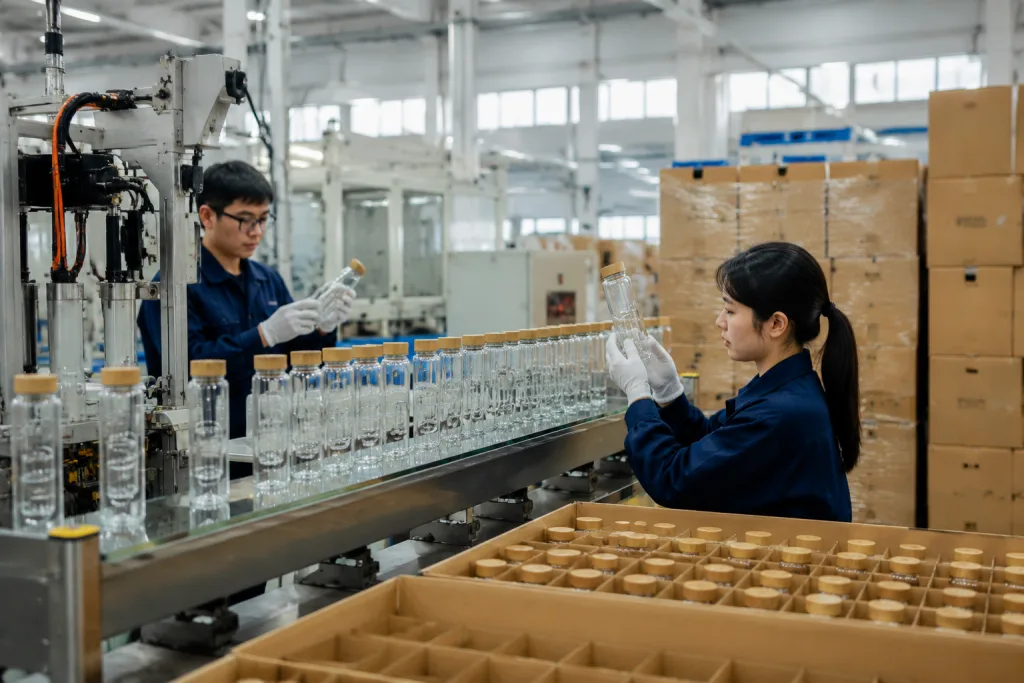
At BottleForge Industrial in Zhejiang, we see the same pattern from Europe and North America: buyers start with price, then find out the real issue is spec control. A borosilicate glass double wall bottle factory should give you the right wall thickness, food-contact materials, stable OEM branding, and a lead time you can plan around. China has plenty of factories; the real question is which one runs like a manufacturing partner, not a brochure. We run 180,000 units per month in our Hangzhou facility, with a typical MOQ of 3,000 pieces and a standard lead time of 25-35 days after sample approval.
Start with the bottle spec
I’ll rewrite the section in-place, keeping the HTML tags and the heading structure intact while tightening the sales-engineer tone and adding concrete factory-floor detail.Before you compare factories, lock the product spec. A borosilicate glass double wall bottle factory should give you the glass grade, capacity, wall build, closure material, and decoration method without hiding behind “customizable” language. For a 350 ml bottle, we run outer wall thickness at 1.5 mm to 2.0 mm and inner wall at 1.2 mm to 1.8 mm, depending on the mold. If the supplier cannot state that on day one, you are buying risk, not drinkware.
The real trade-off is heat retention versus breakage tolerance. Double wall borosilicate handles heat better than soda-lime glass, but thin walls and a sharp base push reject rates up; QC pulled 8 cracked samples from a 200-piece lot when the base radius was too tight. Ask for the glass formulation, annealing process, and whether the factory runs manual or semi-automatic forming. A custom canteen project that needs shelf appeal can live with slower output; a canteen promotional order needs a stronger carton spec and simpler print. If you also sell a custom growler or customizable growler line, use the same rule: set capacity, neck finish, and lid torque before you ask for price. The math does not work the other way around.
Good buyers ask for a sample with measured dimensions, not just photos. We have seen PO typos on neck finish codes turn into a 12-day delay, so check the drawing before the line starts. Weak suppliers talk about style; good canteen suppliers talk about tolerances, breakage rates, and test records. That is the difference between a bottle that looks premium and one that actually ships.
Price is not the decision
FOB price matters, but it should not be your first filter. We run borosilicate glass double wall bottle lines in Zhejiang, and the spread between factories usually comes from process control, decoration complexity, and packing strength. A plain bottle with a basic PP lid may sit around USD 2.10-2.80 FOB at 3,000 pieces. Add a bamboo or stainless part, laser logo, and custom carton, and the quote moves into USD 3.20-4.80. If someone is far under that, ask what changed. We’ve seen a 0.8 mm wall spec quietly turn into a thinner tube, and QC pulled the sample before it left the line.
Look at total landed cost. A canteen distributor buying for retail should price cartons, master cartons, freight damage, and rework, not just the unit number. Saving USD 0.15 per unit while losing 4% in transit is bad math. The same applies to canteen distributor and distributor canteen orders where mixed SKUs clog the warehouse. Ask for packing details: single box or color box, drop-test standard, pallet pattern, and carton compression strength. One PO typo can sink the whole plan; we had a buyer flag “12 pcs” versus “120 pcs” on a sample order, and that is the wrong question to ignore. For export programs, a factory that can quote DDP estimates alongside FOB is easier to work with, but the assumptions need to be on paper.
Cheap glass gets expensive when it cracks in customs, in the warehouse, or on the retailer shelf.
That is why a canteen vendor with stable pricing, not just low pricing, is worth more than a flashy sample. Good canteen vendors in China know where the margin sits, and they will show it in the spec sheet. If a supplier dodges on lid weight, carton strength, or AQL 2.5, we would walk. The line tells the truth.
Check compliance before sampling
If you sell into Europe or North America, compliance is not optional. A borosilicate glass double wall bottle factory should have REACH files, food-contact declarations, and, where needed, LFGB or FDA-aligned statements for the parts that touch liquid. If the build uses silicone, stainless steel, bamboo, or printed coatings, each part needs its own check. Buyers often blame the glass first; in practice, the lid, gasket, and ink cause most of the trouble. We have seen a PO typo on the ink code turn into a hold at QC.
Ask whether the factory has BSCI, ISO 9001, or similar audit coverage, and do not mix up an audit with product compliance. One shows the management system exists; the other shows the bottle meets your market rules. For canteen customized and customized drinkware programs, ask for the test list before approval: migration, odor, dishwasher tolerance, thermal shock, and lid leakage under inversion. If you need a customized growler or custom canteen for beer or cold brew, confirm whether the closure has been tested for carbonation or pressure build-up. The line can pass a water leak test and still fail under pressure. Same bottle, different use.
Real factories in Zhejiang do not get offended by compliance questions. They expect them. If a canteen factory cannot produce test reports within 3 days, you will likely wait 12 days or more when a claim lands. We run into this all the time, and the math does not work in the buyer’s favor. For canteen supplier selection, that is where you separate sales talk from manufacturing discipline.
Match tooling to your market
Tooling decides whether your bottle reads as a branded item or a stock import. We run this every week on the line. A factory may already have a borosilicate body mold you can sample, but once the buyer wants a fixed shoulder, a narrower neck, or a cleaner wall line, new tooling is the only clean answer. For a double wall glass body, mold cost often lands around USD 3,500-8,000, and the first tooling lead time is usually 20-35 days before the first sample comes off the bench. That is standard.
For a custom project, trim the spec where the market allows it. One European retail buyer was happy with a small logo etch and a plain carton; the PO still had one typo on the carton size, and QC pulled the sample before packing. A North America promo order may ask for a louder print, lower MOQ, and a faster ship date. If you are comparing customizable versus fully customized programs, the real split is tooling commitment and decoration freedom. A customizable line shares one base mold and changes lids or sleeves; a fully customized bottle changes the body itself.
The same logic holds for a custom growler program. If you need SKU depth without tying cash to one shape, an existing mold plus decoration options is the safer play. If your buyer flags silhouette as the selling point, a true custom bottle usually wins at retail because the shape is yours, not a catalog copy. This is the wrong question to ask: “Can the factory do it?” The better question is whether the new mold cost will pay back in margin, repeat orders, and fewer price fights. A good factory will tell you when the math works and when it does not.
Demand production proof
Sample approval is the easy part. Stable production is the real test. Ask the borosilicate glass double wall bottle factory for monthly output, inspection steps, and yield data for the exact style you want. At our Zhejiang plant, the bottleneck is not glass forming; it is keeping decoration, lid assembly, and packaging in sync at scale. A supplier claiming 500,000 units per month should be able to show where the line sits, how many workers are on it, and the in-process defect rate. One typo on a PO can expose the whole chain.
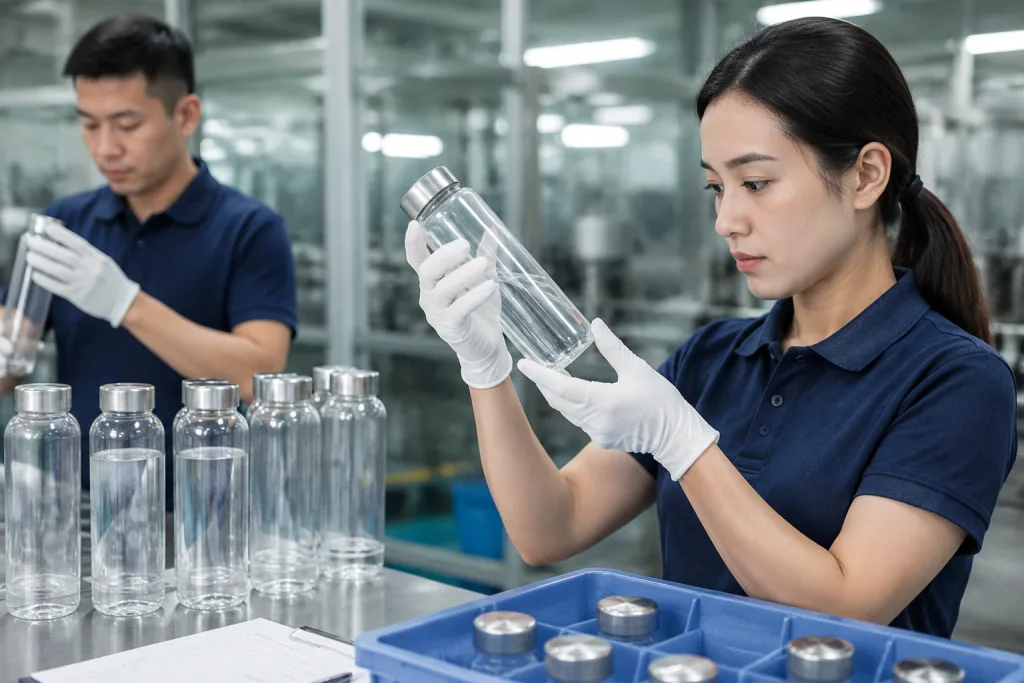
For buyer qualification, request the AQL standard in writing. Many export programs use AQL 2.5 for major defects and 4.0 for minor defects, but your retailer may want tighter control on decoration, especially for private label. If you buy for a canteen distributor or a growler program, ask for pre-production confirmation, inline inspection, and final random inspection photos. We run this check with calipers and a light box. Better yet, ask for a retained sample from the approved batch.
Pay attention to lead time language. “30 days” sounds neat until you learn it excludes raw material booking, artwork approval, and carton proofing. A practical supplier will break the schedule into sample days, tooling days, mass production days, and shipping buffer. That is the right question to ask. In China, especially in Zhejiang, you will find plenty of capable factories; the ones that earn repeat orders quote production like engineers, not like traders.
Build your supplier shortlist
When you build a supplier shortlist, look past the bottle. The right factory can repeat orders, revise packaging, and handle channel rules without restarting the job. An Amazon program needs carton control down to the 5-ply box spec. A Europe distributor will ask for test files and multilingual labels before they talk price. Your factory should know that difference.
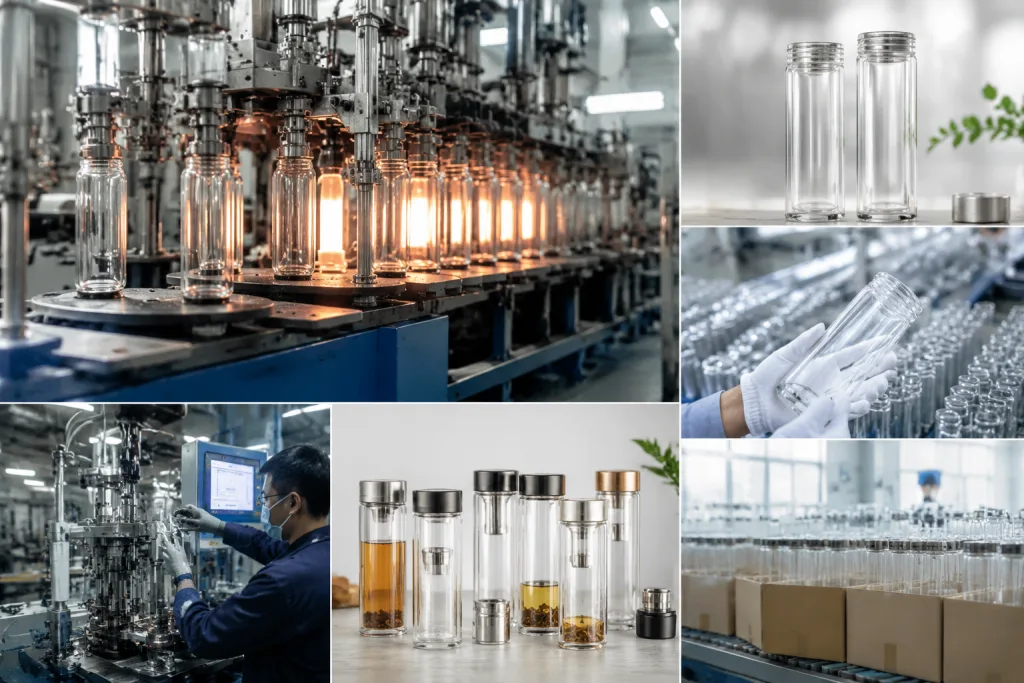
Use a hard filter: sample lead time at 7-12 days, quotation in 24-48 hours, and reorder quantities close to the original MOQ. If they miss those three, your account turns into special handling. We’ve seen that go sideways on a 3,000-piece borosilicate run. For custom drinkware, ask what they can actually hold on glass: laser engraving, screen print, water transfer, matte coating. QC pulled a sample with the wrong logo position once, and the buyer flagged it. On glass, print adhesion and dishwasher resistance matter more than a pretty render.
- Shortlist factories with export records in Europe and North America.
- Confirm the plant can run canteen customized, customized drinkware, and custom logo orders on one line.
- Ask for packaging drawings before deposit, not after production starts.
- Verify whether the supplier is a real canteen factory or just a trading office.
If you want a workable vendor relationship, choose the factory that answers the plain questions straight. PO typo, carton spec, label file — that is where projects win or die. That is how you get a stable custom canteen, not a one-off shipment.
Send your spec sheet for a factory quote
We’ll check your bottle design, MOQ, decoration, and packaging, then return a practical FOB price and lead time from Zhejiang, China.
Frequently asked questions
What MOQ should I expect from a borosilicate glass double wall bottle factory?
For a standard private-label order, a realistic MOQ is 3,000 pieces per design and color. Some canteen manufacturers will quote 1,000-2,000 pieces, but that often comes with higher packaging cost or limited decoration. If you need custom tooling, expect a separate mold charge and a larger first order. For a canteen promotional run, you may negotiate split shipments, but the production run still usually sits near 3,000 units. A factory in Zhejiang with stable export volume can often keep repeat MOQs lower once the mold is active.
How do I compare borosilicate glass with soda-lime glass for this product?
Borosilicate handles thermal shock much better, which is why it is preferred for premium double wall bottles and many customized drinkware programs. It is also lighter for the same perceived quality if the design is optimized. Soda-lime is cheaper, but it is more vulnerable to cracking under hot-fill or rapid temperature change. If your market expects a premium canteen customized product, borosilicate is usually the safer choice. For cost-sensitive canteen promotional orders, soda-lime can work if the use case is strictly cold beverage and the branding brief accepts the lower spec.
What compliance documents should I ask for first?
Start with food-contact declarations, REACH support, and any lab reports for glass, silicone, and coatings. If you sell in the US, ask for FDA-aligned material statements for the relevant components. For Europe, LFGB evidence is often requested by retailers even when it is not legally mandatory. A good borosilicate glass double wall bottle factory in China should also provide BSCI or ISO-related audit information if available. Do not wait until after sampling; request these files before you approve artwork or pay tooling.
Can I get custom branding on the bottle and box?
Yes. Most factories can support screen print, laser engraving, decal, or embossed logo on the bottle, plus custom cartons and inserts. The better question is durability. Screen print can be economical at scale, but you should test dishwashing and abrasion; laser engraving on metal lids is often more durable. For a canteen custom launch, ask for 2-3 logo placements and a printed carton proof. Expect an extra USD 0.15-0.80 per unit depending on the method and the number of colors.
How long does production usually take?
For a standard design with approved artwork, typical lead time is 25-35 days after sample approval and deposit. New tooling adds 20-35 days before the first sample, so a new custom growler or customized growler program can stretch beyond 45 days before mass production even starts. If packaging is complex or the factory is busy before peak season, add another week. A serious canteen supplier will show you a schedule that separates sampling, tooling, production, inspection, and booking the vessel.