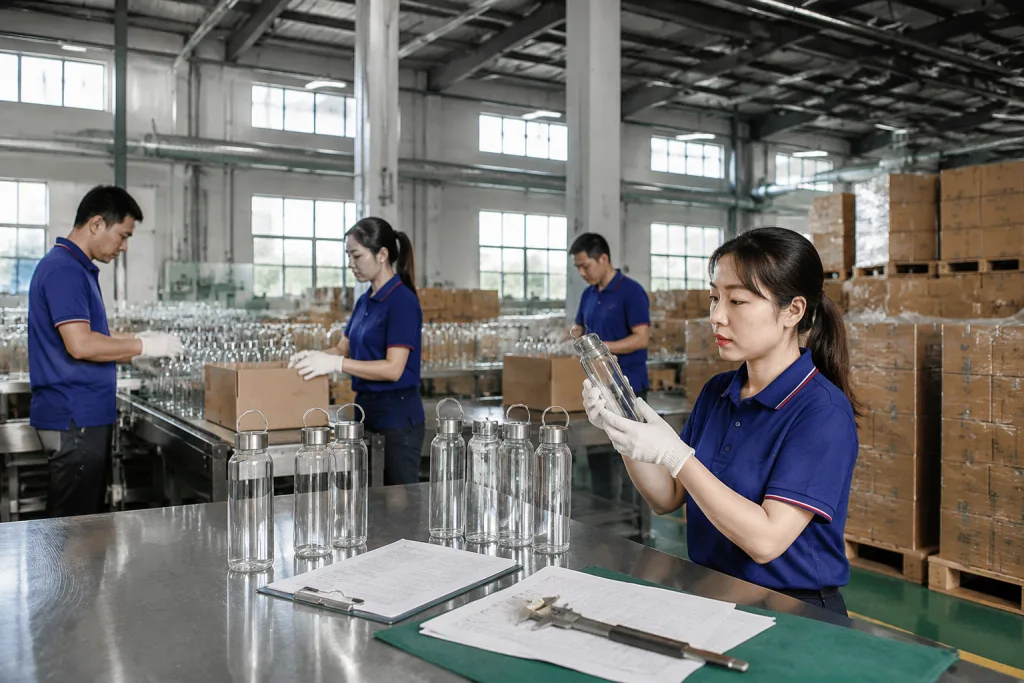
Key Takeaways
- A serious borosilicate glass BPA free water bottle supplier should quote FOB China, MOQ, and lead time in one page; typical MOQ is 3,000 to 5,000 pcs and lead time is 25-40 days.
- Borosilicate 3.3 glass with 1.2-1.8 mm wall thickness is the practical range for reusable bottles; thinner walls cut weight but raise breakage risk.
- Ask for LFGB, REACH, FDA food-contact declarations, and drop-test data before you approve a canteen custom program.
- Decoration and cap choice can add 15%-35% to unit cost, especially for customized drinkware with silicone sleeves, bamboo lids, or laser logos.
If you are buying a borosilicate glass BPA free water bottle supplier for retail, promotion, or private label, the real risk is not finding a factory. It is picking the wrong one. Glass looks simple until you price the cap system, confirm thermal shock limits, ask for REACH and LFGB files, and find the MOQ sits at 5,000 pieces because the decoration method is tied to one line. We saw a buyer flag a cap typo on the PO last month, and that tiny mistake cost two days. In Zhejiang and across China, the gap between a workable supplier and a time sink usually shows up in the details you confirm before you pay a deposit.
You should think like a procurement manager, not a product fan. Decide first whether you need a borosilicate glass bottle for cold-fill only, hot-and-cold use, or a gift-grade canteen customizable program with packaging and decoration included. A good canteen factory in Hangzhou or Ningbo can run 80,000 to 150,000 units per month, but only if your spec is clean and the neck finish matches the cap within 0.3 mm. This is the wrong question to ask after sampling starts. The wrong spec turns a simple custom drinkware order into broken bottles, repeated tests, and margin loss.
Start With the Use Case
Before you compare canteen suppliers, lock the use case first. A borosilicate glass bottle for office desks is not the same job as a promo bottle for outdoor retail, and it is not the same build as a custom growler for beverage brands. We run three different pack-outs for those paths. For gifting or ecommerce, you can go lighter on wall thickness and keep the carton simple. For distributors, the bottle has to survive warehouse handling, carton stacking, and a 1-meter drop without a cracked neck.
Use case drives the spec sheet, and this is the part buyers skip. For cold-fill water, tea, or infused drinks, borosilicate 3.3 glass with a 1.2 mm wall can work. If the buyer flagged rough transit or repeat use, move to 1.5 mm or 1.8 mm. Ask for the cap material too: PP, Tritan, stainless steel, or bamboo-clad. Check the silicone seal rating, and do not accept a vague answer. We’ve seen a PO typo swap in a 90°C seal when the customer needed 100°C, and QC pulled the sample right away. A supplier who knows the line will tell you the cost impact; a weak vendor just says “good quality” and sends a nice photo.
For B2B buyers, use case also changes the commercial math. A custom canteen for a chain retailer may need 10,000 pcs plus barcode-ready packaging, while a distributor order may need mixed SKUs and a faster reorder cycle. If you are building a promotional program, decoration durability matters more than premium packaging because the bottle carries the logo, not the other way around. This is the wrong question to ask if you start with appearance alone. We ship plenty of orders where the print held up and the carton looked plain, and those accounts reorder faster because the product survives the channel.
Judge the Glass, Not the Photo
Glass quality is where first-time buyers get burned. Borosilicate handles thermal shock better than soda-lime glass, but you still need the actual numbers. Ask the supplier to confirm the glass composition and whether it is borosilicate 3.3 or another grade. “Heat-resistant glass” is too loose. We see that phrase on too many quotes. A credible Zhejiang factory will send a spec sheet with wall thickness, tolerance, and the test method, and QC pulled the sample before the line packed the first carton.
Typical wall thickness for a reusable bottle sits between 1.2 mm and 1.8 mm. Below 1.2 mm, breakage risk jumps and the bottle feels flimsy in hand. Above 1.8 mm, weight goes up and freight cost follows. The math is simple. If your target landed cost is under USD 1.20, you usually need a simpler shape and a standard cap. At USD 1.80 to 3.20 FOB, you can support cleaner finishing, a sleeve, or a better closure. We had a buyer flag a PO typo once because the wall spec said 1.0 mm by mistake; that order would have gone sideways.
Do not skip testing. Ask for thermal shock data, drop test results, and batch consistency records. I’d rather see one clean test report than three glossy photos. For export orders, the supplier should know the difference between production sampling and validation testing. A real canteen manufacturer can tell you which tests stay in-house and which ones come from a third-party lab. That matters when a Europe buyer asks for REACH documents or when a U.S. distributor wants food-contact confirmation, and it matters even more when the carton mark says 24 pcs but the packing list shows 20.
Pick the Right Closure System
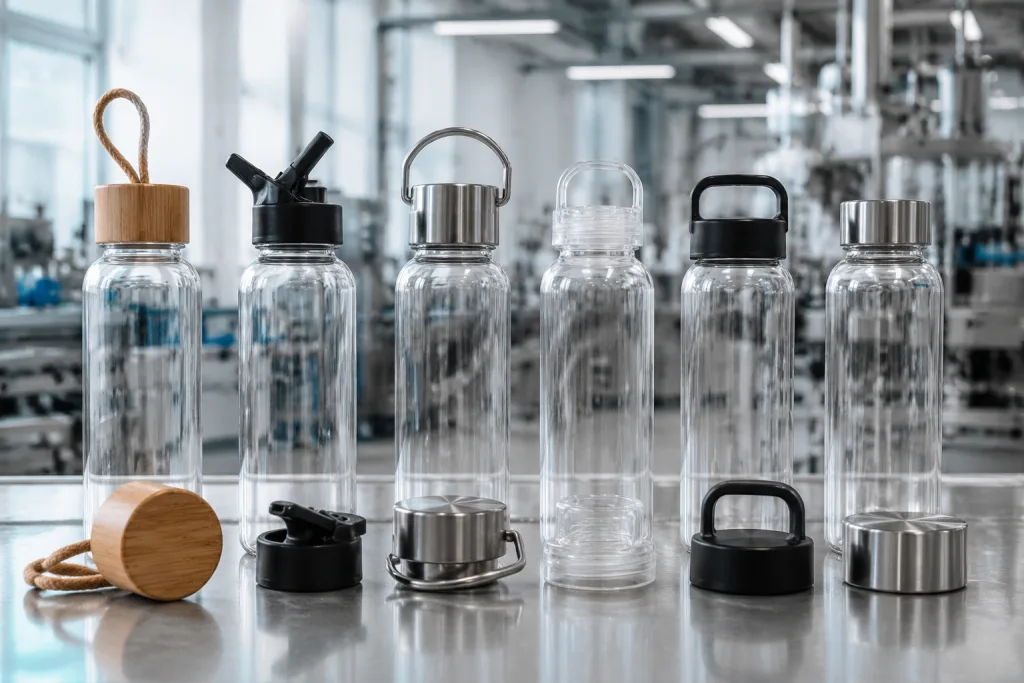
The cap is where a cheap bottle turns into a complaint. A glass bottle with a weak lid leaks, picks up odors, or quits after a few dishwasher runs. If you are sourcing canteen customizable programs, the closure belongs in the commercial quote, not as a last-minute add-on. The usual picks are PP lids with silicone seals, stainless steel lids, bamboo accents, and sport-style flip tops. Each one changes unit price, assembly time, and the return rate.
A plain PP cap with a silicone gasket is the safest route for large-volume canteen suppliers because it holds cost down and the line stays repeatable. We run torque checks on the bench, and a stainless cap usually adds about USD 0.08 to 0.25 per piece depending on finish and tooling. Bamboo sells better on premium retail shelves, but it needs dry storage and tighter packing; QC pulled the sample after a humid 48-hour hold once the buyer flagged a warped ring. If you are building a canteen custom line for retail, ask for torque testing and leak testing after 24 hours at room temperature and again after thermal cycling.
For high-volume distributor canteen orders, standardization wins. One bottle body, one or two cap choices, and one decoration method usually gives the best margin. The math does not work any other way. For a canteen promotional campaign, do not overbuild the lid; your logo sells, not a hinge that comes back as a claim. If you are developing a customized canteen for multiple channels, keep one closure platform and vary only the graphics or sleeve color.
Check Compliance Before Price
Price without compliance is a trap. I’ve seen buyers chase a clean FOB number, then get stuck when the supplier cannot produce the file set. For Europe, ask for LFGB and REACH documents for the glass body, silicone seal, plastic cap parts, and any inks or coatings. For North America, ask for food-contact declarations and material disclosures. If the bottle is going into Amazon, check FNSKU packaging and carton labels at the same time as the compliance file; we run that review before sample approval, not after.
Do not assume “BPA free” covers everything. BPA is a resin issue, usually tied to polycarbonate or certain plastics. A borosilicate glass bottle can be BPA free on the body and still fail on the cap, seal, or printed coating. A supplier that knows the job will separate “BPA free” from “food-safe” and name each component. If they only send a certificate scan, the math does not work. Ask for the test report number and the exact tested part.
For custom drinkware sold in Europe, ask for heavy metal limits in decoration inks and a dishwasher test at 50 cycles or the standard you need. If the artwork uses metallic foil or a gradient, confirm the print method before the PO goes to the line. We’ve seen a buyer flag a tiny typo in the artwork file and the whole carton label had to be reworked. Chinese factories in Zhejiang can do clean work, but the file has to be right from day one.
Price the Full Custom Program
Most buyers underprice the non-product costs. We see it every week. A canteen distributor watches the bottle FOB and misses printing, inner boxes, master cartons, inserts, freight cube, and breakage allowance. On glass, packaging carries more weight than on steel or plastic. If the line ships loose cartons with thin dividers, the defect rate can move from under 1% to 3% or more in transit. That is not a factory quality issue; it is a packing issue.
For a custom drinkware program, price the full stack: base bottle, cap, logo application, sleeve or accessory if used, inner packaging, and outer carton. A simple customized growler or custom growler style glass bottle can add 20% to 40% once decoration and packaging are included. The buyer usually says, “Why is the print carton this high?” Fair question, wrong target. On a canteen promotional order, the carton can cost more than the bottle decoration itself if the artwork, insert, and drop test spec are tight.
The best suppliers quote in a way you can buy from. That means MOQ, unit price at 3,000 pcs and 5,000 pcs, sample cost, sampling lead time, and production lead time. In Zhejiang, a practical factory might quote samples in 5 to 8 days and mass production in 25 to 40 days after sample approval. QC pulled the sample, checked the 0.8 mm print edge, and sent it back when the logo shifted 2 mm. If a factory promises 7-day production on a complex customized canteen with glass, lid, and print, the math does not work.
Ask for the landed-cost version of the quote, not only the factory price. If the supplier cannot tell you the carton size, the breakage allowance, and the packing ratio, they do not really understand export drinkware.
Separate Factory Strength From Trading
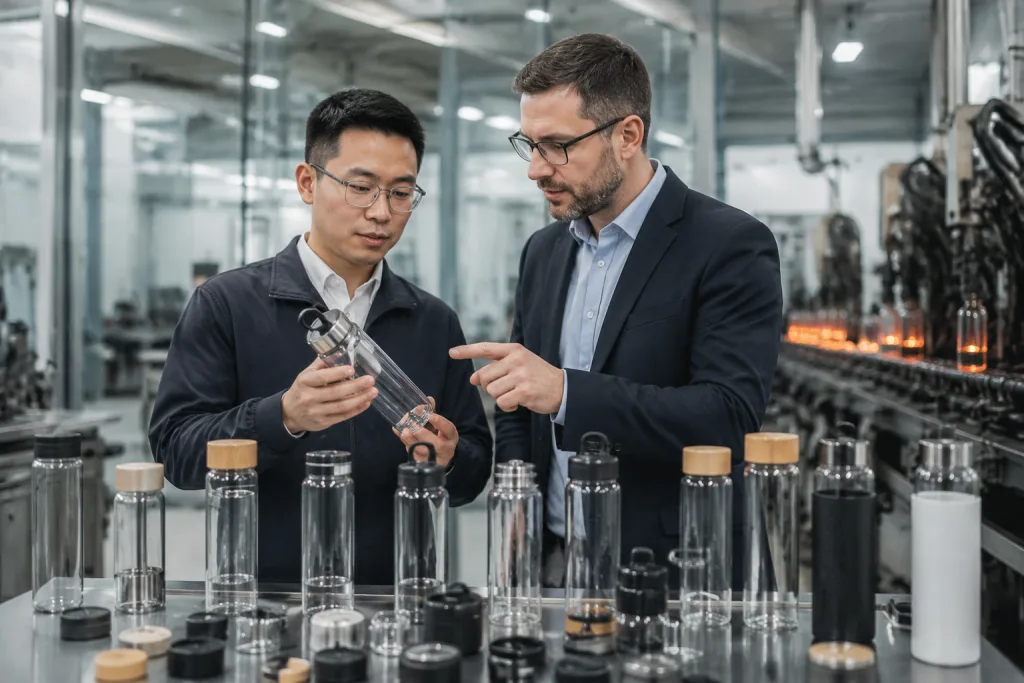
Not every canteen vendor is a factory, and not every factory is set up for your channel. A real canteen factory should show line capacity, QC checkpoints, and monthly output from the actual line, not a brochure number. A medium-size Zhejiang plant may run 80,000 units per month on standard glass bottle lines and smaller runs on customized items. That works for a regional distributor. It falls short if you are opening national stock in 3 warehouses.
Ask straight out whether they are a canteen manufacturer or only a sourcing intermediary. A manufacturer can change moulds, packing structures, and cap assemblies faster; we’ve seen a cap thread change go through in 7 days when the tool room had the insert on hand. A trading company can still help when you need mixed categories or factory consolidation, but then you need to lock the spec line by line. The buyer flags a PO typo on the bottle finish, and suddenly the whole order is off. One builds. The other moves product.
When you check canteen suppliers, ask for photos of the production line, QC station, and packing area. Ask for AQL levels on final inspection, ideally AQL 2.5 for major defects and 4.0 for minor defects unless your program needs tighter control. We run a simple rule here: if they cannot name the inspection table, the math does not work. A factory in China that handles export properly will answer those points without hesitation, and QC pulled the sample on the spot can show whether they are a real plant or just a sales desk.
Build for Reorders, Not One-Offs
The best buyers do not chase one shipment. They build a SKU they can reorder five times without reworking the line. That is where customizable drinkware makes money. We run this every week: same bottle body, same cap tooling, same carton structure, then change print, insert, or sleeve color. Reorders move faster, and margin stays where it should. If you buy for a canteen distributor or handle distributor drinkware, the math is simple. A $0.18 saving on the first PO gets wiped out if the second PO needs new tooling.
For a canteen customizable line, keep the setup tight enough to survive a second order and a third. One bottle body in 550 ml and 750 ml, one closure, and one or two logo positions is enough for most programs. We saw a buyer try to add three lid colors and a gift box insert on the same SKU. The line got messy fast. If you need a premium retail angle, add one accessory, not three. The same rule applies to a customized canteen or customized growler: fewer parts, fewer defects, fewer headaches when QC pulled the sample at 2.5 mm neck tolerance and the buyer flagged it.
Ask the supplier how they hold color consistency, glass tolerance, and print registration on repeat orders. Ask what sits in stock and what gets remade for each PO. A solid borosilicate glass BPA free water bottle supplier can tell you which parts stay fixed, which parts change with season, and which parts need fresh approval every time. We have seen PO typos on sleeve color codes turn into a week of delay. That is the wrong question to ask if you only care about the first carton; it is the right question if you want a program that ships again without drama.
Send your spec sheet, get a factory quote
We can review your bottle size, cap, logo, and packaging, then quote MOQ, lead time, and FOB terms from Zhejiang.
Frequently asked questions
What MOQ should I expect from a borosilicate glass bottle factory?
For a standard borosilicate glass bottle, many factories in Zhejiang and other parts of China start at 3,000 to 5,000 pcs per design. If you need custom print, a special lid, or retail packaging, 5,000 pcs is more realistic. Very simple stock shapes can be lower, sometimes 1,000 to 2,000 pcs, but the unit cost is usually much higher. For a canteen factory that truly handles export, ask for MOQ by color, by logo method, and by packaging format, because those three numbers are not always the same.
How much does a customized glass water bottle usually cost?
For export FOB China, a basic borosilicate glass BPA free water bottle often sits around USD 0.90 to 1.60 depending on size and cap. Once you add silk-screen print, sleeve, bamboo lid, or premium packaging, the price can move to USD 1.80 to 3.20 or more. A custom growler style bottle with heavier glass and premium closure can go higher. The real answer depends on wall thickness, lid material, decoration method, and carton spec. Always ask for pricing at 3,000 pcs and 5,000 pcs so you can see the break point.
What compliance documents should I request?
For Europe, request LFGB and REACH documents for the materials used in the glass bottle, cap, and seal. For North America, ask for food-contact declarations and any relevant test reports. If the product is sold on Amazon, you should also confirm packaging details for FNSKU labeling and carton barcodes. Do not stop at a single “BPA free” claim. A good canteen supplier should show which parts are BPA free, what the test method was, and which components are in contact with food or beverage.
Is borosilicate glass safe for hot drinks?
Yes, borosilicate glass is widely used for hot and cold beverages because it handles heat better than ordinary soda-lime glass. That said, safety still depends on the design. A bottle with 1.2 mm walls and a poor cap system may be technically heat resistant but still uncomfortable or risky in daily use. If you plan to fill with hot tea or water near 90°C, ask the supplier for thermal shock data and sealing tests. Also confirm that the cap and gasket materials are rated for the same temperature range.
How do I compare a factory, supplier, and distributor?
A canteen manufacturer or canteen factory makes the product and controls tooling and production. A canteen supplier may be a factory or a trading company. A canteen distributor usually buys finished stock and resells it, sometimes with lighter customization. If you need repeatable custom drinkware, direct factory sourcing usually gives better control over quality, lead time, and pricing. If you need mixed SKUs or smaller test orders, a distributor can be faster. The right choice depends on whether your priority is speed, flexibility, or long-term margin.