Key Takeaways
- Borosilicate glass usually runs at 1.2-1.8 mm wall thickness and handles thermal shock better than ordinary glass.
- A practical MOQ for a custom bottle program is often 3,000-5,000 units, with 30-45 days lead time after sample approval.
- For EU and North America, ask for REACH, LFGB, and food-contact documentation, plus AQL 2.5 inspection on critical defects.
- The right factory should quote FOB China clearly, separate bottle, cap, and decoration costs, and show packaging drop-test results.
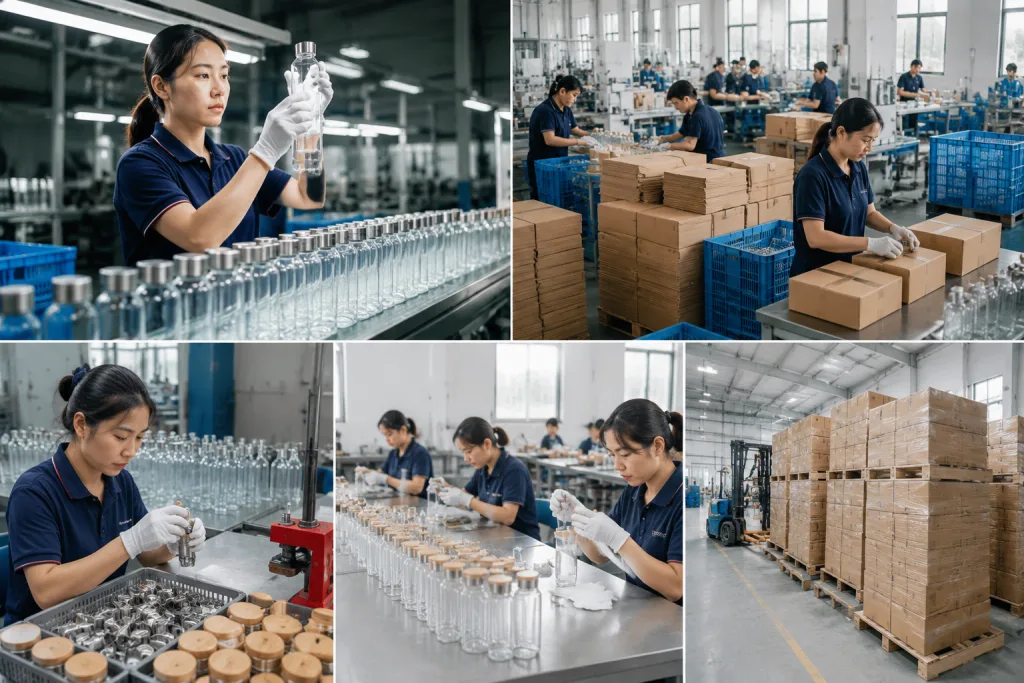
If you buy drinkware for retail, gifting, or distribution, the spec sheet decides whether the product sells or gets returned. A borosilicate glass bpa free water bottle manufacturer is not just selling a bottle; you are buying wall thickness, thermal shock resistance, cap sealing, decoration limits, and packaging that survives freight from Zhejiang to your warehouse. We run this check at the line with calipers, and 1.2 mm versus 1.5 mm changes the result fast.
The common mistake is treating glass like a commodity. It is not. Borosilicate behaves differently from soda-lime glass, and the right factory in China will tell you where it helps and where it is the wrong choice. If you need custom drinkware that looks premium, passes REACH expectations, and holds up in real use, compare options by use case, not brochure language. QC pulled the sample, and the buyer flagged a loose cap after a 1.2-meter drop test, so the math does not work if you skip the details.
What the spec sheet really says
When buyers compare a borosilicate glass bpa free water bottle manufacturer, start with the spec sheet, not the hero photo. We run glass programs on three checks: composition, wall thickness, and closure performance. Borosilicate glass earns its place because low thermal expansion cuts cracking when the bottle sees hot-fill, ice water, then a desk drop. On the line, 1.2-1.8 mm is the usual body thickness, and we have pushed thicker walls for premium retail shapes when the buyer accepted the extra weight. A 500 ml commuter bottle is a different job from a 1 L gym bottle or a cold-brew growler; the same drawing will not work for all three.
Ask for the comparison below from any canteen manufacturer or canteen supplier handling glass. We once had a buyer flag a PO that said “borosilicate” on page 1 and “soda lime” in the footer; that typo would have blown the whole order.
- Material: borosilicate 3.3 or equivalent food-contact glass
- Capacity: 350 ml, 500 ml, 750 ml, or 1000 ml
- Wall thickness: 1.2-1.8 mm, measured consistently
- Lid: PP, stainless steel, bamboo, or silicone-sealed cap
- Temperature range: ask for actual test data, not a vague claim
Glass versus metal for your channel
Use case decides the winner. For premium retail, office gifting, wellness, or e-commerce bundles, glass usually wins on shelf appeal. For outdoor promotion, sports, or rough handling, metal is the safer call. That does not mean glass is fragile. It means you place it where it fits. A customized canteen in borosilicate glass looks cleaner on shelf, photographs better, and supports higher perceived value than many plastic formats. For tea, infused water, and desk use, it ships well and sells clean. For travel bags, airport drops, or heavy distributor programs, the carton, cap, and liner need a harder spec.
Use this head-to-head logic:
- Retail premium: borosilicate glass wins on appearance and repeat purchase potential.
- Promotional volume: a canteen promotional item in metal survives abuse better in the line and on the truck.
- Brand story: customizable drinkware in glass supports a cleaner, more sustainable position.
- Temperature use: borosilicate handles hot and cold cycles better, which matters when QC pulled the sample at 95°C.
If you are a canteen distributor or distributor drinkware buyer, do not ignore handling costs. Glass freight, inserts, and carton strength can add 8-15% to landed cost, and that math gets ugly fast. We have seen buyers push back on a 3 mm carton spec, then the first drop test tells the truth. In China, good factories will show you the real pack-out before you place a purchase order.
Use-case fit by buyer type
The right borosilicate glass program depends on who buys it and how it ships. A distributor selling into grocery chains wants a different spec than a corporate gifting program with 500 to 2,000 units per order. An Amazon-style seller needs barcode-ready cartons and carton drop resistance at 60 cm. A brand owner wants decoration control, compliance papers, and photo match from sample to mass production. Export buyers ask about target market first for a reason: EU, US, and Canadian labels do not use the same wording or pack format.
For use-case fit, we map by channel behavior:
- Corporate gifting: custom canteen sets with sleeve, lid, and insert card.
- Retail wellness: customizable canteen with clean print, neutral colors, and a premium carton.
- Tea and infusion: custom growler style or wide-mouth bottle for loose leaf and fruit.
- Distributor programs: standardized carton size, repeatable SKU structure, and stable MOQ.
Buyers often ask for a customized growler when they need a wide-mouth glass bottle with a leak-resistant lid. That is the wrong question to ask. The line can build around the channel, but the brief has to say lid type, mouth size, and pack style; otherwise QC pulled the sample and the buyer flagged the carton as a mismatch. A Zhejiang factory should turn the use case into the spec, not force the other way around.
Decoration and branding limits
Glass takes decoration well, but the method has to match the shape. We run screen printing for 1-2 spot colors on straight walls or light curves. Laser engraving stays on metal lids; on the glass body, it is a bad fit for most mass programs. Decals and frosting sell better at retail, and they also add cost and scrap. For a canteen customized retail launch, ask the factory to quote bottle molding, cap sourcing, and decoration as three separate lines. That is where the margin shows up.
For long-tail custom drinkware programs, the tradeoff is blunt: more decoration means more setup, higher unit cost, and more QC points. We have seen a 1-color logo on 5,000 units stay clean and efficient. A full-wrap print, matte coating, and embossed cap can push the job into a different price band fast. On one line, QC pulled the sample at 12 mm off-center and the buyer flagged it; that small miss turned into a PO correction. Typical FOB China pricing for a plain borosilicate bottle can start around USD 1.10-1.80 depending on capacity and lid, while decorated retail versions can move into USD 2.20-3.80. If you are a canteen supplier or canteen vendors network buyer, ask for landed-cost math, not just ex-factory price. The math does not work any other way.
Good decoration should help the shelf, not rescue a weak product.
Compliance and test points
I’ll rewrite the section with tighter buyer-facing language, keep the HTML intact, and preserve the technical points and numbers. Then I’ll do a quick pass to make sure the phrasing sounds like a factory-side sales engineer, not generic copy.For Europe and North America, compliance is not optional. A borosilicate glass bpa free water bottle manufacturer should be ready with REACH support, food-contact declarations, and migration paperwork where the market asks for it. BPA-free is mostly a cap-and-seal issue when the body is glass, but that does not make it a small point. We check the closure, the sleeve, and the print ink. If the bottle has stainless steel parts, ask for the grade. If it has silicone, ask for odor stability and heat resistance. If it has bamboo, ask what part is bamboo and what part is composite core. The buyer flagged that once on a 500 ml bottle, and the math did not work out.
Professional buyers should ask for:
- AQL standard: 2.5 for major defects and 4.0 for minor defects is common in export inspections
- Carton testing: drop test, compression test, and pallet pattern approval
- Lab reports: from a recognized third-party lab when the market requires it
- Factory system: BSCI or similar social compliance if your customer demands it
In Zhejiang, the better factories are used to this. On our line, QC pulled the sample before sealing the carton, and that catches a lot of PO mistakes early. In China, the gap between a trading company and a real canteen factory shows up here fast. One can promise compliance; the other can document it.
MOQ, lead time, and freight reality
I’ll rewrite just the prose, keep the HTML intact, and make it sound like a factory-side sales engineer wrote it.MOQ is where a project either gets built or gets parked. For a custom canteen or customized drinkware run in borosilicate glass, 3,000-5,000 units per design and color is the normal working range, and we do see 2,000 on a close-to-stock item. On our line, QC pulled the sample before we released mass production, because one buyer once missed a lid thread typo on the PO and we had to stop and recheck the drawing. Lead time usually lands at 30-45 days after sample approval and deposit, while complex decoration, molded lids, or special packaging can push it to 50-60 days. If a factory promises 15 days for a fully customized glass bottle, ask what is actually being made. Most of the time it is a stock body with a simple print, not a real production tool.
Freight changes the math fast. Glass is heavy, so carton layout matters more than people expect. A 500 ml bottle may pack 24-48 pcs per carton depending on inserts and lid assembly, and the difference shows up at booking time. We had one buyer flag a quote because the carton was 10 mm too wide for their warehouse rack. If you are a canteen distributor or growler buyer, ask for master carton dimensions early, because sea freight and storage fees can wipe out a small unit-price gain. A serious canteen supplier in China should quote FOB, share the carton loading plan, and give a container utilization estimate. That is how we ship a custom growler or custom drinkware order with margin left in it.
When a factory can give you 80,000-120,000 units a month, you are looking at a line that can support repeat business. That is the number we expect a real export partner in Zhejiang to stand behind.
Send your bottle brief and target price
We can quote the spec, suggest the right lid system, and build a production plan that fits your market, MOQ, and compliance needs.
Frequently asked questions
Is borosilicate glass actually BPA free?
Yes. Borosilicate glass itself does not contain BPA because BPA is a plastic-related chemical, not a glass ingredient. The real check is the full assembly: caps, liners, seals, straws, and printed coatings. A borosilicate glass bpa free water bottle manufacturer should give you material declarations for the lid system, not just the bottle body. For EU and North America, ask for food-contact paperwork and confirm whether any plastic parts are PP, Tritan, or silicone. If the bottle uses stainless steel parts, request the grade, such as 304. A clean spec sheet matters more than the phrase BPA free on a carton.
What MOQ should I expect for a custom glass bottle order?
For a true custom drinkware program, expect 3,000-5,000 units per SKU as a normal starting point. If you only need logo printing on a stock bottle, some canteen factory partners may accept 1,000-2,000 units. Once you request a new mold, special cap, or custom packaging, the MOQ rises because tooling and setup must be spread across the run. Buyers in Europe and North America should also ask about mixed-SKU consolidation. A canteen manufacturer may allow color or logo variation only after you commit to a total volume, such as 10,000 units across 3-4 variants.
How much does a borosilicate glass bottle cost FOB China?
A plain borosilicate bottle with a basic lid can start around USD 1.10-1.80 FOB China, depending on capacity, thickness, and closure quality. If you add two-color printing, frosting, silicone sleeve, or premium packaging, the price often moves to USD 2.20-3.80. For a canteen customized retail program, you should ask for a breakdown: bottle, cap, decoration, inner pack, and export carton. That prevents surprises later. A canteen supplier in Zhejiang should also tell you if the quoted price assumes one color, one logo position, and standard color box. Anything beyond that should be priced separately.
What tests should I ask a factory to provide?
At minimum, ask for thermal shock data, lid leak testing, carton drop testing, and food-contact compliance documents. For export work, AQL inspection is standard: many buyers use 2.5 for major defects and 4.0 for minor defects. If you are sourcing from a canteen manufacturer in China, ask whether the testing is done in-house or by a third-party lab. For Europe, REACH-aligned documentation is useful; for US retail, confirm the packaging and labeling match your channel requirements. If the bottle includes silicone or stainless steel, request material declarations for those parts too.
Which buyers are best suited to borosilicate glass bottles?
The best fit is usually premium retail, wellness brands, office gifting, and distributors selling into lifestyle channels. A canteen distributor serving supermarkets can also do well if the pack-out is strong and the price point is controlled. Borosilicate glass is less suitable for rough outdoor use or low-cost mass promotions where impact resistance matters more than appearance. If your customer wants a customized canteen with a premium feel, or a custom growler for tea, infusion, or cold brew, glass is a strong choice. If you need ultra-cheap canteen promotional volume, metal or plastic may be easier to manage.