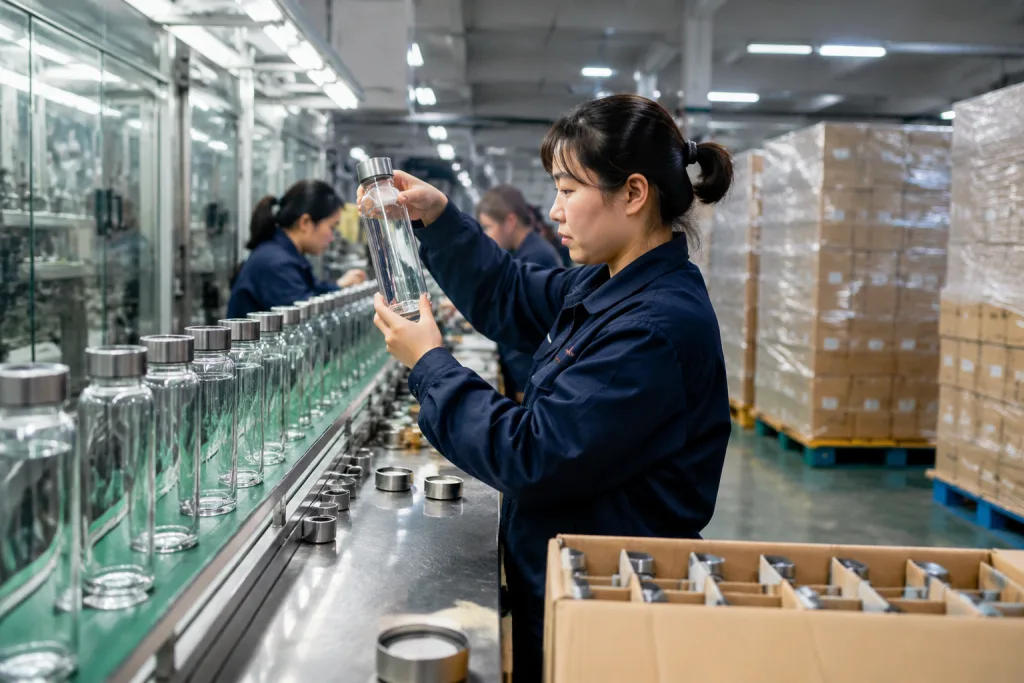
Key Takeaways
- Typical FOB China pricing for a 500 ml borosilicate bottle runs about USD 1.20 to 3.80 at 3,000 to 10,000 units
- Most borosilicate projects need 25 to 45 days after sample approval, and custom molds add 12 to 20 days
- A practical MOQ starts at 1,000 pcs for stock shapes and 3,000 pcs for customized glass, cap, or pack combinations
- REACH, food-contact declarations, and AQL 2.5/4.0 checks matter more than decorative claims when you buy for export
If you are sourcing a borosilicate glass bpa free water bottle factory, the real question is not “can you make it?” It is “what will this cost, how long will it take, and where do the hidden delays show up?” Glass is not plastic. A 1.5 mm wall instead of 1.8 mm, a bamboo cap instead of PP, or a single-color logo instead of full wrap print changes the unit price and the schedule fast.
That is why serious buyers in Europe and North America ask for a costed BOM, a real lead time, and a production sample before they talk about volume. We see this on the line all the time: QC pulled the sample, the buyer flagged a 2 mm logo shift, and the PO typo turned “5000 pcs” into a pricing headache. A competent canteen factory or canteen manufacturer should quote within 24 to 48 hours, with MOQ tiers from 1,000 to 10,000 units and lead times from 25 to 45 days depending on tooling and decoration. The math does not work any other way.
What Drives Your Bottle Price
Glass pricing starts with the material, but it does not end there. For a borosilicate glass bottle, the cost stack is bottle body, closure system, print method or logo method, packing, and inspection. A Zhejiang factory will usually quote the body first, then cap parts, then decoration, then inner carton and master carton. That order matters. It stops you from comparing a bare bottle price with a full export-ready set.
For standard 350 ml to 500 ml bottles, a plain clear body often sits around USD 0.55 to 1.10 at higher volume. A shaped body with thicker walls can land at USD 0.90 to 1.60. Add a bamboo lid, stainless lid, or silicone sleeve and the set price can move up another USD 0.20 to 0.85. Screen print is still the cheapest route for one or two colors; laser engraving and ceramic decal cost more, and they hold up better on the line. If you are buying customized drinkware for retail, do not lowball packaging. A full-color printed box can add USD 0.15 to 0.45, and a mailer-safe carton usually adds more. We had one buyer flag a PO typo on “500ml” versus “500 ml” and it changed the carton spec, so the math matters.
- Body thickness: 1.8 mm is the low-cost build; 2.2 mm to 2.8 mm feels heavier and more premium.
- Closure: bamboo and stainless lids cost more than PP, but buyers read that as a better bottle.
- Decoration: one-color print is the floor; wrap print and etching push the unit price up.
- Pack-out: export cartons and drop-test inserts add cost, but QC pulled the sample and the breakage rate dropped.
If you are building custom drinkware for Amazon, wholesale, or distributor programs, ask the factory to break pricing by component. A supplier that will not split those lines is hiding margin, not giving you a clean quote. We run into this all the time, and the buyer’s first question is usually the wrong one: “What is your bottle price?” Ask for the full stack instead.
MOQ Tiers That Actually Matter
MOQ is where buyers burn days. A serious canteen manufacturer will quote different minimums for a stock bottle, a customized bottle with your logo, and a full custom shape. For a stock-shaped borosilicate glass bottle with printed logo, 1,000 to 2,000 pcs is standard in China. For a customized canteen with a new cap color, sleeve, or box art, plan on 3,000 to 5,000 pcs. If you want a new mold or a fully customized growler-style glass body, 5,000 to 10,000 pcs is the number that matches the line.
There is a hard reason. Glass runs are touchy on furnace setup, mold change, and breakage control. We run this every week: if the buyer wants three colors at 1,000 pcs each, the line gets split and the math stops working. A canteen factory in Zhejiang can still handle low MOQ, but unit cost jumps fast once you fragment production. If you want distributor drinkware pricing, one SKU at 3,000 pcs beats three SKUs at 1,000 pcs. Same rule for canteen custom projects: one cap finish, one carton spec, one logo method.
Practical ranges:
- 1,000 pcs: stock shapes, simple print, and pilot distribution.
- 3,000 pcs: the cleanest fit for canteen customizable orders with branded packaging.
- 5,000 pcs: better for chain retail, distributor canteen programs, and export replenishment.
- 10,000 pcs: fits stable canteen suppliers that can hold color and packing consistency.
If you are comparing canteen distributors versus direct factory sourcing, ask for MOQ by process, not by sales promise. We’ve seen this go sideways when a buyer flagged a 500 pcs quote, then QC pulled the sample and the real factory schedule only made sense at 1,000 pcs or more.
Lead Times by Order Type
Lead time is more predictable than price once the job path is clear. For a stock borosilicate glass bpa free water bottle factory order, sample prep usually takes 3 to 7 days and bulk production 20 to 30 days. For a custom logo or customized drinkware order with simple packing, we run 25 to 35 days after sample approval. For new molds, new sleeves, or a custom canteen design, 35 to 45 days is the safer call, and 50 days is normal when the first drawing comes back with revisions.
Buyers often miss two bottlenecks in China: artwork approval and carton confirmation. The line can have glass ready, but if the logo file is not print-ready or the barcode placement changes, everything stops. I’ve seen a PO typo on carton size add two extra days because the buyer flagged it after printing started. If you are selling through retail or e-commerce, add 7 to 10 days for pre-shipment inspection, especially when you want AQL 2.5 for major defects and AQL 4.0 for minor cosmetic issues. That is standard export work.
“Fast” in glass sourcing usually means the factory is organized, not that the process is skipped.
For a canteen promotional program with seasonal demand, order earlier than you think. A four-week production plan can turn into six weeks if you add new artwork, third-party testing, or a carton drop-test requirement. QC pulled the sample on one job because the print register was off by 1.5 mm, and that saved a bad shipment. Better factories in Zhejiang tell you that upfront; weaker ones promise a date and move it later. The math does not work any other way.
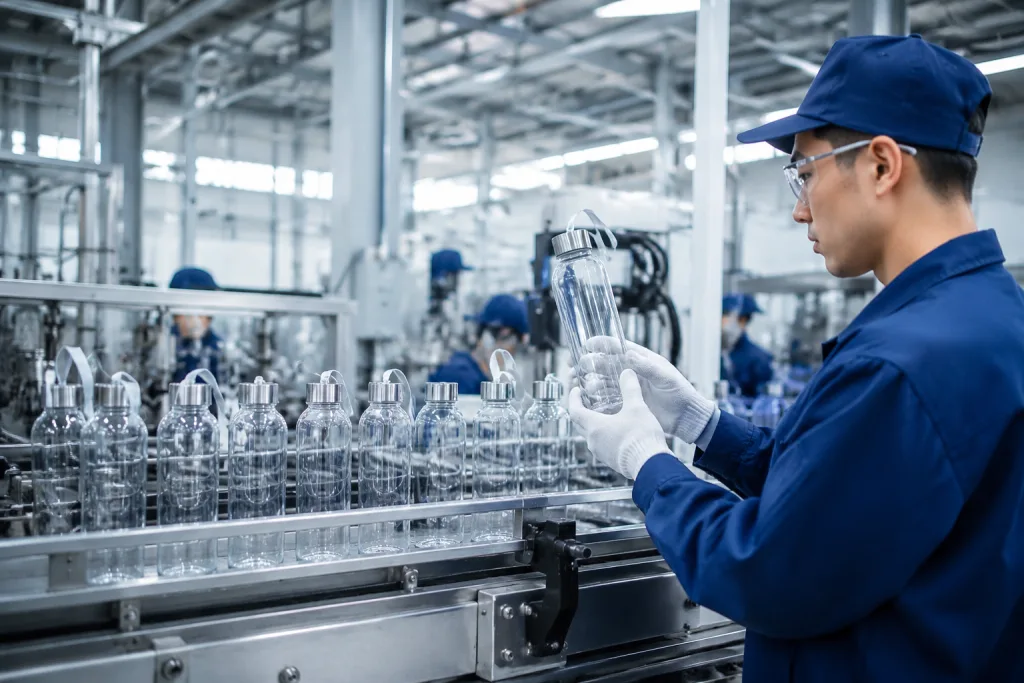
Compliance You Should Ask For
For Europe and North America, compliance is not a side document. Ask for food-contact declarations, REACH-related material data where it applies, and a signed BPA-free statement. Borosilicate glass does not carry BPA, but the closure, gasket, sleeve, and print inks still need control. We run into this on the line all the time. A real canteen supplier talks about the full assembly, not just the bottle body.
If you sell to retail chains or online marketplaces, ask whether the factory can back the order with LFGB, FDA food-contact expectations, or ASTM-style physical performance checks based on the market and buyer brief. For glass drinkware, breakage resistance, thermal shock behavior, and cap leakage tests matter more than sales copy. On one 24,000-piece run, QC pulled the sample after a lid leak at 0.8 bar, and the buyer flagged it before shipment. Carton compression and drop testing should be part of the plan for distributor programs that ship more than once.
- Ask for: material declaration, food-contact compliance, and batch traceability.
- Check: silicone grade, lid seal material, and ink suitability.
- Verify: production photos, inline QC, and final packing audit.
If your buyer says “we just need a BPA free bottle,” push back. That is the wrong question to ask. We’ve seen this go sideways when the PO had a typo on the cap spec and the order mixed glass, metal, bamboo, and silicone. You need an assembly-level spec.
How Customization Changes Cost
Customization is where canteen customized and canteen customizable projects start drifting in cost if the brief is fuzzy. We run this on the line every week: logo placement is still the cheapest lever. A simple one-color silk-screen print may add only USD 0.05 to 0.18 per unit at volume. Laser engraving on stainless parts costs more, but the finish is clean and the abrasion risk stays low. Full-wrap ceramic decal or multi-color print can add USD 0.20 to 0.60. Change the bottle shape, and the math jumps fast because mold work, sampling, and yield loss all move together. QC pulled the sample at 2.5 mm off-center once, and the buyer flagged it before we shipped.
Think in layers. A custom canteen with stock body, custom lid color, branded box, and one-color logo is still manageable for a distributor canteen program. A customized canteen with new bottle geometry, bamboo lid, silicone sleeve, and retail packaging is a different job. Add a custom growler format or a larger 750 ml format, and carton size, pallet loading, and breakage rate all shift. We had a PO typo once — 750 ml was printed as 700 ml — and that one line sent the sample back. That is why a canteen vendor should quote decoration separately from structure; otherwise the buyer is comparing apples to a new mold.
For canteen promotional campaigns, stock body plus print is usually the lowest-cost route. For long-term retail, a modest tool investment can pay back if you lock in 2,000 to 5,000 unit repeat orders. The wrong question is “how cheap can we make it”; the better one is “which 2 changes move the sell-through.” Custom drinkware gets expensive when every line item changes at once, and we’ve seen that go sideways on a 3,000-unit order.
How To Buy Without Wasting Weeks
If you want smoother sourcing from a borosilicate glass bpa free water bottle factory in China, send a complete brief on day one. Put the target capacity, wall thickness, lid material, logo method, carton size, target market, and test requirements in the first email. On our line, that kind of brief cuts back-and-forth fast. A Zhejiang factory can usually quote in 1 to 2 business days and map the sample plan in 3 to 5 days.
Do not ask for ten open-ended variations. That is the wrong question to ask. Pick the lane first. If you are building distributor drinkware, ask for three options: economy, mid-tier, premium. If you want custom growler or canteen support, ask whether the same body can take two lid types, because one mold, one carton spec, and two lids beats three unrelated SKUs when MOQ and stock pressure hit.
A practical sourcing checklist:
- Confirm FOB port, not just factory gate price.
- Ask for breakage allowance and overrun tolerance.
- Require pre-production sample approval before bulk.
- Lock artwork, barcode, and master carton spec before production.
The factories that win repeat orders are the ones that say no to vague requests. QC pulled the sample, and the buyer flagged a 2 mm carton mismatch before bulk started. Good sign. It means they know how to run production without wasting a week on avoidable fixes.
Get a real factory quote, not a guess
Send your spec sheet, target MOQ, and market requirements. We will price the bottle, cap, packaging, and lead time clearly.
Frequently asked questions
What is a normal FOB price for a borosilicate glass bottle?
At 3,000 to 10,000 units, a plain 500 ml borosilicate bottle from a China factory often lands around USD 1.20 to 3.80 FOB, depending on wall thickness, lid type, and decoration. A thicker 2.2 mm to 2.8 mm body, bamboo lid, and printed logo can move it higher. If you need full retail packaging, add USD 0.15 to 0.45 for the box and more if the pack must pass drop testing. Always ask the canteen supplier to split body, closure, print, and carton pricing so you can compare offers cleanly.
How long does a custom order take?
For stock shapes with logo print, expect 25 to 30 days after sample approval. For a canteen customizable order with special lid colors or packaging, 30 to 35 days is more realistic. If you need a new mold or a customized drinkware shape, plan 35 to 45 days, sometimes longer if artwork changes midstream. Sample development usually takes 3 to 7 days, and mold work can add 12 to 20 days. A buyer who needs both compliance documents and final inspection should leave at least one extra week in the schedule.
What MOQ should I expect from a factory in Zhejiang?
For stock bottle bodies, 1,000 pcs is common. For canteen custom projects with branded packaging, 3,000 pcs is a more realistic planning number. For a fully customized growler or a new mold shape, 5,000 pcs or more is normal. Zhejiang factories often have enough equipment and labor to handle smaller runs, but the unit price rises sharply below the main production threshold. If you are a canteen distributor, ask whether the factory can combine multiple colors under one base body to improve MOQ efficiency.
Is borosilicate glass really BPA free?
Yes, borosilicate glass itself does not contain BPA. The issue is the full assembly: lid, gasket, sleeve, print inks, and any coating must also be reviewed. A borosilicate glass bpa free water bottle factory should give you material declarations for the closure system and any food-contact components. If the bottle is sold as canteen promotional or customized canteen product, ask for the same documentation across all parts, not just the glass body. That is what buyers in Europe and North America usually need for compliance files.
How do I compare canteen manufacturers fairly?
Compare them on the same spec sheet: capacity, wall thickness, lid material, logo method, carton type, testing standard, MOQ, and lead time. A canteen manufacturer quoting a lower number may be excluding packaging or assuming a lighter body. Ask for AQL criteria, sample policy, and overrun tolerance. For distributor canteen or distributor drinkware programs, request a production photo set and final inspection report before shipment. If one canteen vendor cannot clearly explain the difference between body price and full export price, the quote is not ready for purchase decision.