Key Takeaways
- A practical MOQ for borosilicate glass bottle programs is often 3,000-5,000 units, with 30-45 days lead time after sample approval.
- For export, ask for REACH, food-contact compliance, and drop-test proof; glass alone does not make a safe bottle.
- Typical borosilicate wall thickness sits around 1.5-2.0 mm; thinner walls cut cost but raise breakage risk.
- A reliable Zhejiang factory should state monthly output, often 200,000+ units/month, plus carton and pallet specs before you order.
If you are buying a borosilicate glass BPA free water bottle bulk, the real question is not “is glass better?” The real question is whether it survives export packing, pallet vibration, and daily retail handling without turning into a claims headache or a margin leak. In Zhejiang and across China, plenty of factories can quote a nice-looking bottle. Fewer can hold the wall thickness at 1.8 mm, pass a drop test, and keep supply steady when the order runs from 5,000 to 50,000 units. We’ve seen the buyer flag a scratch mark on the first carton photo before the line even cooled down.
For procurement managers and brand owners, the job is straightforward: separate brochure talk from a spec you can actually sign off. You need lid material, lab testing, packaging method, MOQ, and lead time locked before the PO goes in; one PO typo on “buroglass” instead of borosilicate cost a buyer three days on the schedule. This guide answers the buyer questions we hear every week in Zhejiang and on export jobs out of China, with a checklist you can use before you approve drinkware wholesale or wholesale drinkware orders. That is the right question to ask.
What you are really buying
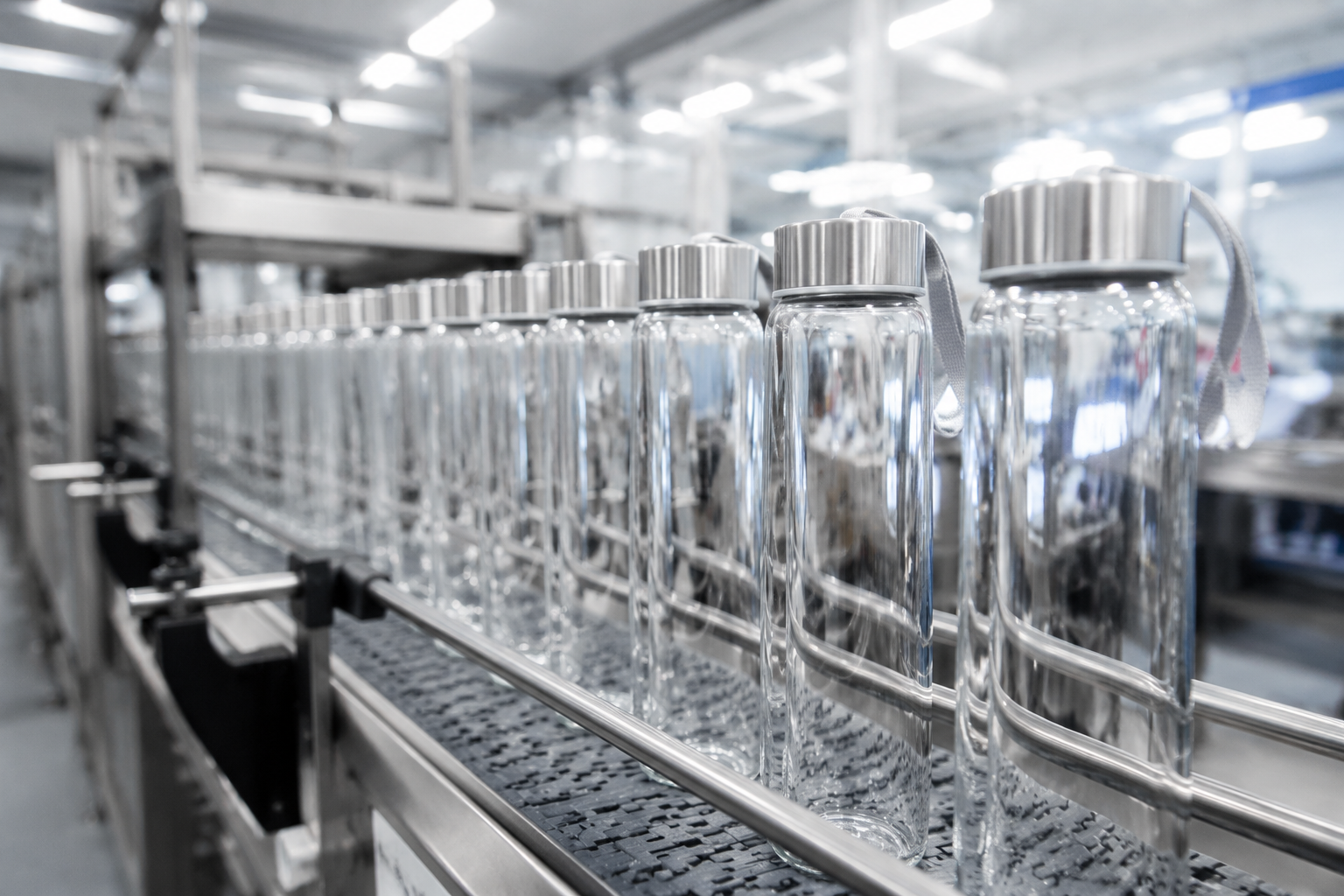
I’ll rewrite the section in place, keeping the HTML and structure intact while making the prose sound like a factory-side sales engineer wrote it.When you source a borosilicate glass BPA free water bottle bulk order, you are not buying “glass.” You are buying a package: bottle body, closure, seal, print, carton, and whether the factory can hold the same spec on every run. Borosilicate gives better thermal shock resistance than soda-lime glass, so the bottle is less likely to crack when fill temperatures swing. BPA free matters because EU and North American buyers want a lid and seal setup that clears food-contact review without a chemistry argument at the end.
Do not stop at “borosilicate.” Ask for the glass composition, nominal wall thickness, and the lid build. We usually see 1.5 mm to 2.0 mm walls, 304 stainless steel or PP lid parts, and a silicone sealing ring. The buyer flagged this on a 12,000-piece order once: the bottle was fine, but the cap fit drifted 0.6 mm and the math stopped working. If you are buying bulk drinkware or drinkware bulk for retail, the real risk is not the base material; it is cap consistency, logo wear, and cartons that fail the drop test.
Buyer check:
- Ask for a dimensioned drawing, not just a photo.
- Confirm the sealing ring material and Shore hardness.
- Request finished-goods photos from the same line.
- Confirm whether the bottle is for hot-fill, cold-fill, or both.
Q&A: MOQ, price, and lead time
Q: What MOQ should you expect? For a standard clear bottle with a one-color logo, we usually quote 3,000 to 5,000 units. Once you ask for a special lid mold or a custom Pantone body color, that number jumps to 8,000 or 10,000 units. We run the line in Zhejiang every week, and the honest factories say this up front. If someone offers 500 units on a fully custom build, the math does not work. Tooling, color masterbatch, and printed cartons are getting buried in the quote.
Q: What is the unit price? A plain 500 ml borosilicate bottle with a basic BPA free lid often lands at USD 1.40 to USD 2.60 FOB China. The real spread comes from lid material, print method, and carton spec; a stainless-steel cap or gift box adds cost fast. On one job, QC pulled the sample and found the AQL 2.5 carton drop test was fine, but the buyer flagged the broken-rate risk in transit. This is the wrong question to ask if you only chase the bottle price, because a low quote can turn expensive after breakage and repacking.
Q: How long is lead time? Sample lead time is usually 7-12 days. Mass production is 30-45 days after sample approval and deposit. If a factory promises 15 days for a custom bottle plus printed carton, ask how they will handle glass forming, print curing, and carton sourcing; we have seen that go sideways on a 3,000-piece PO with one typo in the carton artwork. An organized plant in Zhejiang can ship faster, but only when the spec is frozen and the buyer stops moving the lid color on day 3.
Q: What output should a factory show? A credible factory should state monthly capacity, such as 200,000 to 500,000 units/month, and name the bottlenecks by machine or process. A decent answer sounds like this: one 6-cavity forming line, two printing rooms, and a 12-person packing crew. If they cannot talk in those terms, they are not ready for regular wholesale drinkware or drinkware wholesale programs.
Glass body and lid checklist
Buyers often spend too much time on logo placement and too little time on the lid. Wrong focus. For a borosilicate bottle, the lid and seal decide whether the carton arrives clean or ends up on a claims sheet. We run leak tests with a 2 kg shake, and the line catches more issues at the cap than at the glass body. For a basic retail program, call out a food-grade PP lid or 304 stainless steel cap, plus a silicone gasket. If the bottle is for hot tea or airport travel, check venting behavior and thread quality. A cap that cross-threads once in ten bottles is a reject rate you will pay for later.
Glass body checks are simple but important:
- Wall thickness: target 1.5-2.0 mm for balanced weight and strength.
- Rim finish: must be smooth, no chips, no sharp edges.
- Base stability: bottle must sit flat without rocking.
- Decoration: UV print, silk screen, laser marking, or decal must survive at least 20 dishwasher cycles if you claim reuse.
For buyer teams sourcing best wholesale drink bottle options, ask for the AQL plan before production starts. QC pulled the sample on a 500 pcs lot last week, and the first issue was a cap thread typo on the PO, not the glass. A typical final inspection might use AQL 2.5 for major defects and 4.0 for minor defects, but your threshold should match the channel. Amazon FBA, retail chains, and hospitality buyers punish leaks differently. If you are cross-selling bulk canteen, canteen bulk, or canteen wholesale SKUs, lock the cap spec across all variants so we ship one seal standard, not three.
Compliance you should ask for
Compliance is where a lot of quotes break. A bottle can say “BPA free” and still miss market entry if the factory cannot show food-contact papers, batch traceability, and lab reports. For Europe, ask for REACH-related confirmation and food-contact declarations for each relevant part. For North America, ask for documents that hold up in FDA food-contact review. If your retailer or marketplace team later asks for backup, you want it in the file already.
Do not take one generic certificate and call it done. Ask for model-specific reports for the glass body, lid material, gasket, print ink, and carton if needed. If the bottle is sold as reusable drinkware, ask whether it passed thermal shock, leakage, and migration tests. A factory that knows the line will tell you the standard, the lab name, and the report date. We had a buyer flag a PO typo on a lid code once; that kind of mismatch is exactly how paperwork gets messy.
Checklist:
- Food-contact declaration for bottle body and lid.
- REACH or equivalent chemical compliance for EU shipments.
- Leak test and drop test report.
- Carton compression or transit test if shipping 18 days by sea instead of 12.
- Traceability by batch number and production date.
For mixed programs like growler wholesale, wholesale growler, or beer growler wholesale bulk, the compliance bar is higher because alcohol, carbonation, and heavier fills put more stress on closures and glass. The same goes for alcohol flask wholesale and alcohol flask wholesale bulk if the build uses glass or glass-adjacent parts. This is the wrong question to ask: “Can you make it?” Ask for component-level declarations, not a sales promise. On our side, QC pulled the sample at 2.5 mm gasket tolerance before the shipment moved.
Packaging that survives freight
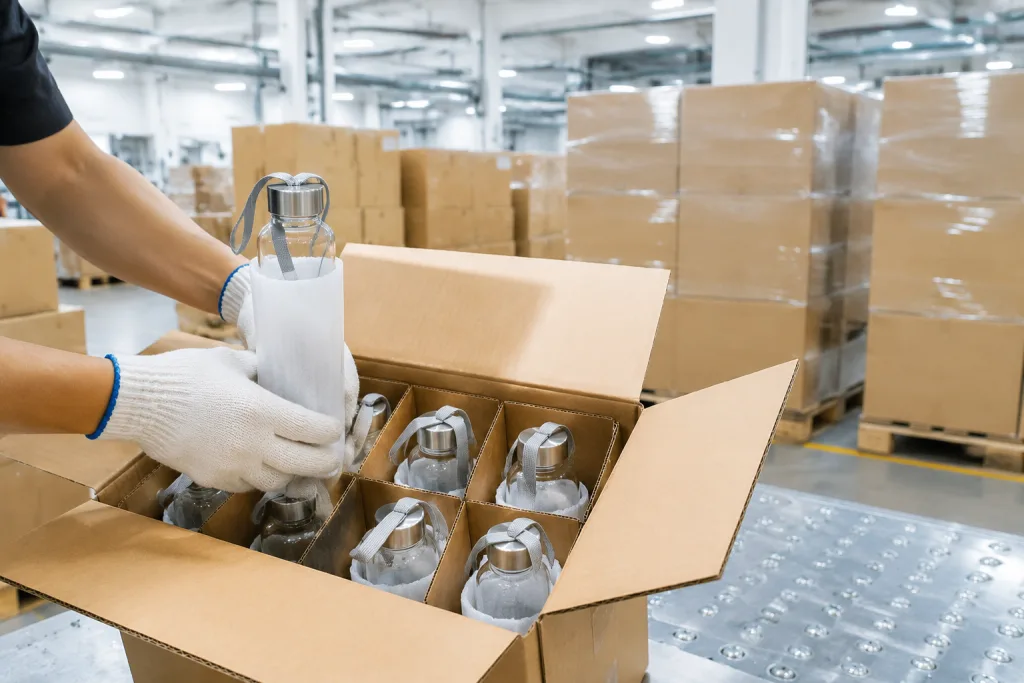
Glass breaks in transit more than on the line. Packaging has to do real work. A carton that looks fine in the warehouse means nothing if the bottle can rattle 8 mm, kiss the sidewall, and crack after a 12-day sea lane. For export, we usually run an inner box plus master carton for retail orders; for e-commerce, we spec a drop-tested mailer with molded inserts. The right pack follows the channel, not whatever box is sitting on the floor.
Ask for a packaging spec with carton grade, units per master carton, inner wrap, and pallet pattern. If the buyer flagged barcode labels or FNSKU labels, lock the label position before mass production; we’ve seen one PO typo on the FNSKU turn a clean shipment into a repack job. A bottle that passes glass QC but gets rejected at Amazon prep is still a bad order. If you are sourcing beer tumbler bulk, beer tumbler in bulk, beer tumbler wholesale, or beer tumbler wholesale bulk lines, packaging control matters even more because these SKUs ship in sets and one missing piece kills the margin fast.
Practical rule: ask the factory to quote bulk pack and retail pack. Bulk pack cuts unit cost, but retail pack can win once you add labor, damage, and fulfillment prep. We run this math on a 5-layer carton, 12 bottles per case, and the numbers are clear. For a Zhejiang factory with export habits, this is normal work. For a weak one, the hidden cost shows up later.
When glass is not the answer
A good procurement manager knows when to stop forcing a fit. Borosilicate glass works for premium hydration SKUs, tea bottles, and gift sets. It is not the low-cost choice, and it is not the right call for stadiums, outdoor sports, or rough distribution. We’ve seen a 1.2 mm wall crack in transit when the buyer pushed the pack test too far. If your channel needs higher drop resistance, another material wins. That is not a knock on glass; it is clean sourcing.
Watch the keyword soup. A supplier may try to fold alcohol flask bulk, alcohol flask in bulk, alcohol flask wholesale, and alcohol flask wholesale bulk into the same buying talk as a glass water bottle. That only works if the use case, closure system, and compliance file match. We had a PO last quarter with a typo on the closure spec, and QC pulled the sample before the line ran. A bulk growler or growler bulk order needs different testing than a 500 ml daily-use bottle. The category name is not the spec.
If you are building a full drinkware line, split it by channel: premium hydration bottles, canteen-style products, growlers, and alcohol-related bottles each need separate performance checks and claim review. That keeps retail return risk out of export compliance risk. We run this split at the factory desk before mold work starts, because the math does not work any other way. In Zhejiang, the better suppliers will accept that structure fast. They know it cuts rework.
Buy the product for the channel you actually sell into, not the keyword you used to find it.
Request a factory spec and quote now
Send your target volume, lid style, and packaging needs. We will quote MOQ, lead time, and compliance documents for China and export buyers.
Frequently asked questions
What is the best MOQ for a custom borosilicate glass bottle order?
For most export programs, 3,000 to 5,000 units is the realistic starting point for a custom borosilicate glass bottle with logo work. If you want a new lid shape, color matching, or printed retail box, expect 8,000 units or more. Smaller orders can work only if the factory has stock molds and simple decoration. In Zhejiang, experienced plants can sometimes support mixed orders, but your pricing will be higher because setup time and breakage risk get spread across fewer units.
How do I know the bottle is truly BPA free?
Ask for a component-level declaration covering the lid, gasket, and any plastic parts, not just the bottle body. Glass itself is not the BPA issue; the closure is. A good supplier will provide food-contact declarations and, if needed, test reports for PP, Tritan-style parts, or silicone seals. For EU and North America shipments, ask for the exact materials by item number and batch. If the factory cannot separate those parts in documentation, your compliance file is weak.
What price should I expect FOB China?
For a basic 500 ml borosilicate glass BPA free water bottle bulk order, a common FOB China range is USD 1.40 to USD 2.60 per unit. Simpler lids and one-color print sit at the low end; stainless-steel caps, measurement markings, gift boxes, or custom cartons push higher. Always compare landed cost, not just factory price. A cheap quote that breaks 3% to 5% in transit can cost more than a cleaner quote with better packaging.
Can I mix water bottles with growler or canteen orders?
You can bundle purchasing discussions, but you should not force one spec onto all categories. A water bottle, a canteen wholesale item, and a growler wholesale product have different lid loads, wall thickness needs, and shipping risks. For example, beer growler wholesale bulk items may need thicker glass and stronger cartons than a daily-use water bottle. If you are also buying alcohol flask wholesale bulk, treat that as a separate compliance file. Bundling only makes sense if the factory can keep each SKU controlled.
What should I inspect before approving mass production?
Check dimensions, wall thickness, rim finish, lid torque, leak resistance, logo durability, and carton performance. Request pre-production samples, then a small pilot run if possible. AQL 2.5 for critical defects is a common starting point, but set your own limits based on channel. If you sell through Amazon FBA, retail chains, or distributors, label placement and carton count matter as much as the bottle itself. For a Zhejiang factory, ask for batch traceability and a monthly capacity statement before you release the PO.