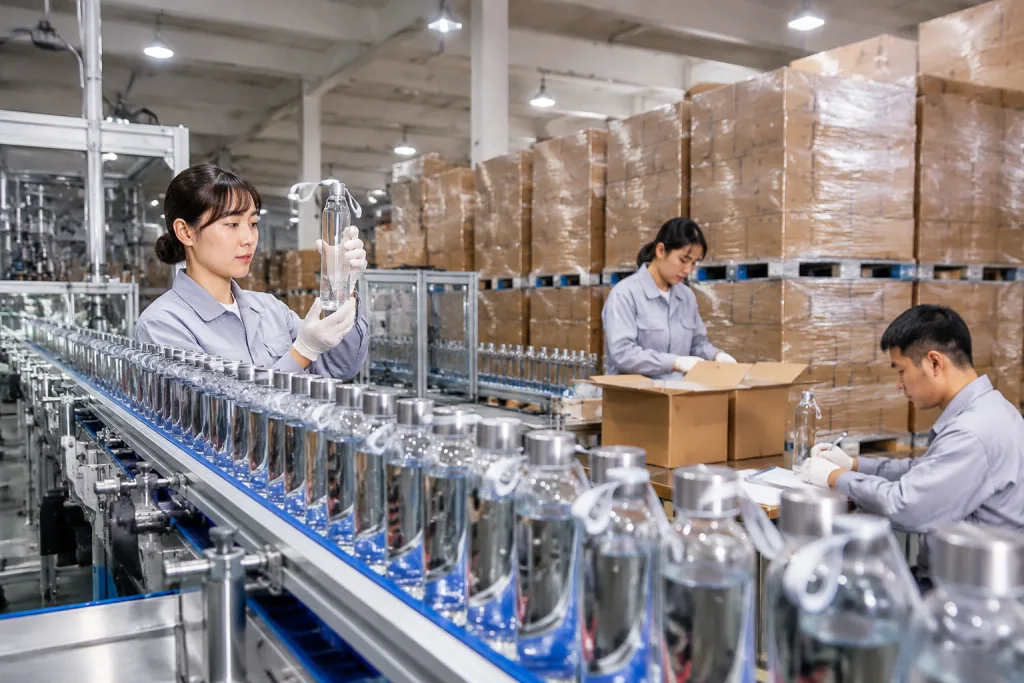
Key Takeaways
- Typical borosilicate glass bottle wholesale price sits around USD 0.72-1.65 at 3,000-10,000 pcs, depending on lid and decoration.
- MOQ usually starts at 1,000-3,000 pcs for a custom borosilicate glass bottle, with 25-35 day lead time after sample approval.
- Wall thickness, usually 1.5-2.2 mm, changes breakage risk, shipping weight, and final cost more than the bottle shape itself.
- A Zhejiang borosilicate glass bottle factory can often produce 200,000-500,000 units per month if the lid and print specs are standard.
If you are pricing a borosilicate glass bottle wholesale order, the quote sheet rarely tells the full story. Two bottles that look the same in a photo can land at different costs by 18% because of glass wall thickness, lid tooling, print method, carton spec, and whether you are dealing with a real borosilicate glass bottle factory or a trader reselling stock. On our line, QC pulled the sample twice before the final quote changed.
For wellness brands and sustainable retailers, that gap hits hard. A $0.82 bottle at 3,000 units can turn into a $1.14 landed unit once you add custom printing, leak-proof lids, and export cartons. We quote by spec, not by guesswork. That is the right question to ask. You want a custom glass water bottle that holds up under hot-fill use, survives transit, and still leaves margin after freight, duty, and Amazon FNSKU labeling.
Start With the Glass Spec
I’ll rewrite the section in place, keep the HTML exactly as-is, and tighten the sales-engineer tone while adding concrete shop-floor detail.The first price lever in borosilicate glass bottle wholesale is not the logo. It is the glass formula and wall spec. Real borosilicate glass has a low expansion coefficient, so it takes thermal shock better than soda-lime. That cuts claims from hot tea, dishwasher cycles, and the cold-to-hot swings buyers see in North America and Europe. We’ve seen that on the line: the QC gauge and the furnace setting matter more than the print file.
Ask for wall thickness in millimeters, not “thick glass.” A common custom glass water bottle spec is 1.8 mm to 2.0 mm wall thickness with a 2.8 mm to 3.2 mm base. Go thinner and the carton cost may drop, but breakage risk climbs fast. Go thicker and you add weight, and the freight math stops working. On a 500 ml bottle, an extra 40 g can push palletized shipping up by 6%-9%. The buyer flagged a 1.6 mm sample once; QC pulled the sample again and the neck chipped in drop test.
A serious borosilicate glass bottle manufacturer will tell you the annealing curve and whether the bottle passed drop and thermal shock tests. For export orders, ask for ASTM checks or the factory standard sheet, plus food-contact support such as REACH and LFGB where needed. If the answer stays fuzzy, the quote is not complete. We run this check with a simple go/no-go sheet, and a PO typo on the wall spec has burned more time than any logo issue.
Bottle Shape Changes Cost
I’ll rewrite the HTML in place, keep the tags and list structure unchanged, and tighten the wording so it sounds like a factory-side sales engineer wrote it.Shape is where a lot of buyers bleed margin without seeing it. A straight cylinder costs less to mold and packs cleaner than a contoured yoga-style bottle or a profile that tries to look like double-wall. A standard 350 ml or 500 ml bulk borosilicate glass bottle with a straight body usually means simpler tooling, steadier output, and fewer surprises on the line.
When you ask for a custom borosilicate glass bottle, the body often needs a new mold, and that mold usually lands around USD 400-1,200, depending on cavity count and neck finish. That is not your unit price, but it hits the first PO hard and changes how fast you recover tooling. We’ve seen buyers chase a fancy curve, then the math doesn’t work once QC pulls the sample and the buyer flags the lid fit. If you are a borosilicate glass bottle distributor buying for retail channels, pick a shape that can take multiple lids and decoration options. You keep more stock moving and less sitting in cartons.
- Round straight-wall bottles are usually the cheapest to tool.
- Wide-mouth formats can raise lid cost by USD 0.08-0.22 per unit.
- Odd shoulder curves often slow inspection and packing by 10%-15%.
In Zhejiang, the lines that ship the most usually steer buyers toward shapes that run through automatic forming and packing with fewer hand checks. That is not us being stubborn. It is how we keep the borosilicate glass bottle wholesale price sharp and the rejection rate down.
Lids Decide Real Margin
The lid can take 20%-35% of finished bottle cost, and buyers usually leave it alone until sample stage. We’ve seen that go sideways. Bamboo, stainless steel, PP, and aluminum outer caps push the quote in different directions, and the line feels it in both tooling and assembly time. If you are selling a customizable glass water bottle into retail, lid choice changes the shelf look and the leak test result.
For a borosilicate glass bottle promotional run, a plain PP lid can hold the unit price around USD 0.72-0.95 for 500 ml at volume. A bamboo-stainless hybrid moves that same bottle toward USD 1.08-1.45. That is the math. If you need silicone sealing for hot and cold drinks, ask whether the gasket is food-grade platinum silicone or standard silicone; QC pulled the sample apart on a 38 mm cap last week and the better gasket came back cleaner for odor and compliance, but it costs more.
Check whether the lid is stock or a custom tool. Stock parts keep the borosilicate glass bottle supplier quote steady, while a custom lid brings lead time, extra sample rounds, and a heavier first-order cash load. We ship faster on standard caps. If your brand is moving through a borosilicate glass bottle distributor network, keep lids consistent across SKUs and the spare-part mess stays smaller.
Decoration Adds More Than Ink
Decoration is where a borosilicate glass bottle custom program starts paying back on the shelf, and it also changes the cost stack fast. One-color silkscreen on glass is still the lowest-cost route. Fired decal or high-temperature transfer costs more, but it survives dishwasher cycles better. Laser engraving on caps or metal parts is a premium move. It does not replace bottle print if the buyer needs bottle-side branding.
For a customized borosilicate glass bottle, basic one-color print usually adds about USD 0.05-0.12 per unit at 3,000+ pcs. Multi-color print moves that to USD 0.14-0.30. Full-wrap artwork, gradients, or matte spray finishes push it higher because the line has to hold tighter yield. We run this with a 2.5 mm registration check on print alignment, and QC pulled the sample if color drift shows up. Ask for AQL inspection levels on print alignment and color consistency. A decent borosilicate glass bottle factory will quote AQL 2.5 for major defects and AQL 4.0 for minor appearance issues, though your retailer standard may be tighter.
Do not buy decoration first and glass second. The math does not work when the cheapest plain bottle turns into the highest landed cost after 8% of the batch fails print approval.
If you sell through wellness boutiques, the surface finish often sells the bottle faster than a busy graphic. A frosted body or soft matte coat gives more shelf value, and we’ve seen the buyer flag a PO typo on the finish code because one word changed the whole look. That is the right place to spend money when you want a customizable borosilicate glass bottle that reads premium without making production messy.
MOQ and Price Tiers
Wholesale pricing only works when you tie it to MOQ. A borosilicate glass bottle wholesale quote at 1,000 pcs is not the same structure as 10,000 pcs. We run this every week in Zhejiang: the first tier pays for mold setup, line changeover, and packing labor, then the unit price drops as volume climbs.
For a 450-500 ml custom glass water bottle, these reference ranges help:
- 1,000 pcs: USD 1.10-1.65 each, depending on lid and print.
- 3,000 pcs: USD 0.82-1.28 each for standard spec.
- 10,000 pcs: USD 0.72-1.05 each if components stay stable.
Those are real numbers, not brochure math, but they assume a normal borosilicate glass bottle manufacturer with export experience, not a trading layer adding margin on top. Ask one direct question: does the MOQ apply to each color, each lid, or the full order? We had a buyer flag a PO typo on a 3,000 pcs order because the carton spec and lid color were split across two SKUs, and QC pulled the sample back to the line. A borosilicate glass bottle supplier that allows 2-3 artwork variants under one carton spec gives seasonal retail more room; a supplier that forces a high minimum per SKU pushes inventory risk onto you.
For fast-moving brands, 25-35 days after sample approval is realistic for standard customization. New lid tooling or heavier packaging can move that to 45-60 days. The math does not work any other way if your launch date is fixed, and we have seen a 0.05 USD savings get wiped out by one missed ship week.
Export Quality You Can Verify
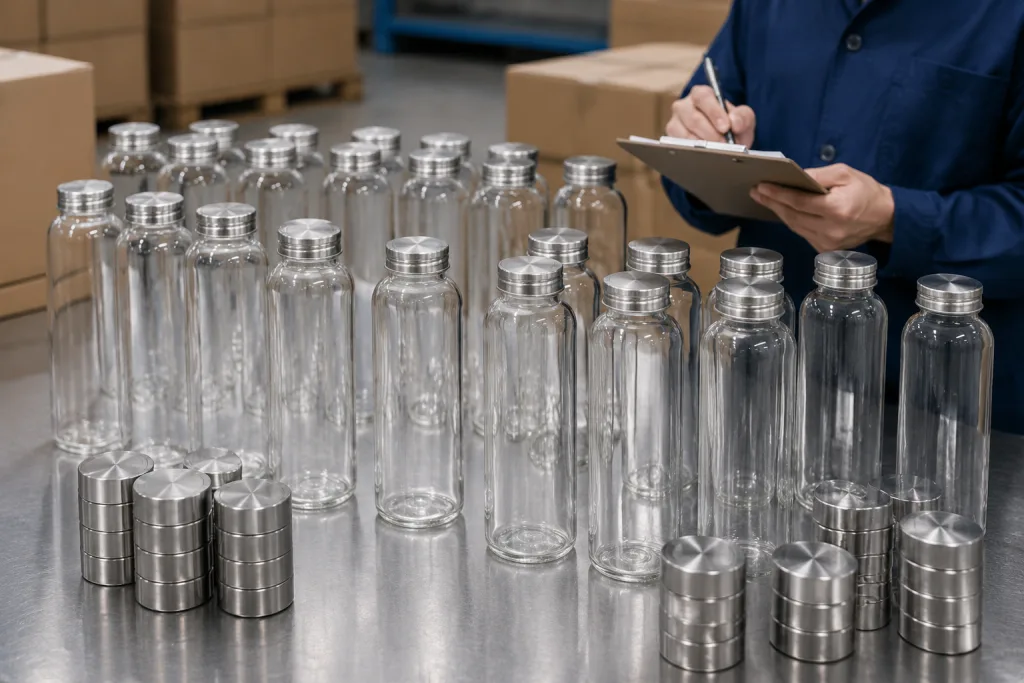
Price without paperwork is a rumor. If you are sourcing from a borosilicate glass bottle vendor in China, ask for what the factory can prove: food-contact declarations, REACH support, LFGB if needed, and a written QC standard. A borosilicate glass bottle manufacturer worth your time should also show production photos, in-line checkpoints, and packaging drop-test results. QC pulled the sample at the lehr once and found a 1.2 mm lip variation; that is the kind of detail that tells you whether the line is under control.
Check the carton spec as closely as the bottle. A custom borosilicate glass bottle packed in a thin inner tray with weak dividers will break in transit, and breakage cuts margin faster than a price difference of a few cents. We run molded pulp trays and thick partitions on a lot of Zhejiang shipments. The add-on is usually USD 0.03-0.08 per unit, and the math still works when the buyer flags damage claims after the first 2,000 pcs.
If you sell in the U.S. market, set up FNSKU or barcode labeling at source when the SKU goes into Amazon. If you sell through EU retail, confirm pallet size, carton mark format, and whether your distributor borosilicate glass bottle orders need multilingual packaging. This is the wrong question to ask if you only care about unit price. A PO typo on carton marks can hold a booking for 5 days, and we’ve seen that go sideways at the warehouse gate.
Check whether the factory is a real borosilicate glass bottle factory or a trading company. A plant with monthly output of 200,000-500,000 units can usually hold cost and lead time better than a small broker, because glass lines do not like stop-start production. One annealing kiln can sit on 24-hour cycles, and that changes the quote. That is why the direct factory quote is the better starting point.
Request a factory quote by spec today
Send your target capacity, lid choice, artwork, and carton needs. We quote clear FOB China pricing from our Zhejiang production line.