Key Takeaways
- Typical MOQ for a borosilicate glass bottle wholesale bulk order is 3,000-5,000 pcs, with lead time around 25-35 days after sample approval.
- A 2.0-2.5 mm wall thickness is common for a custom glass water bottle; thinner walls lower cost but increase break risk in transit.
- FOB China pricing for a basic custom borosilicate glass bottle often sits around USD 1.20-2.80 per piece depending on lid, print, and packaging.
- QC should include AQL 2.5 for major defects, cap fit testing, leak testing, drop testing, and REACH-compliant material confirmation for EU shipments.
You are not buying “a glass bottle.” You are buying a unit cost, a failure rate, and a delivery promise. For borosilicate glass bottle wholesale bulk, the real work starts when you lock in 250 ml or 750 ml, screw cap or bamboo lid, straight wall or sleeve-ready shape, and whether the bottle has to pass Amazon inbound, retail shelves, or 50 dishwasher cycles. We run these specs on the line every week, and the wrong size choice can blow up carton counts fast.
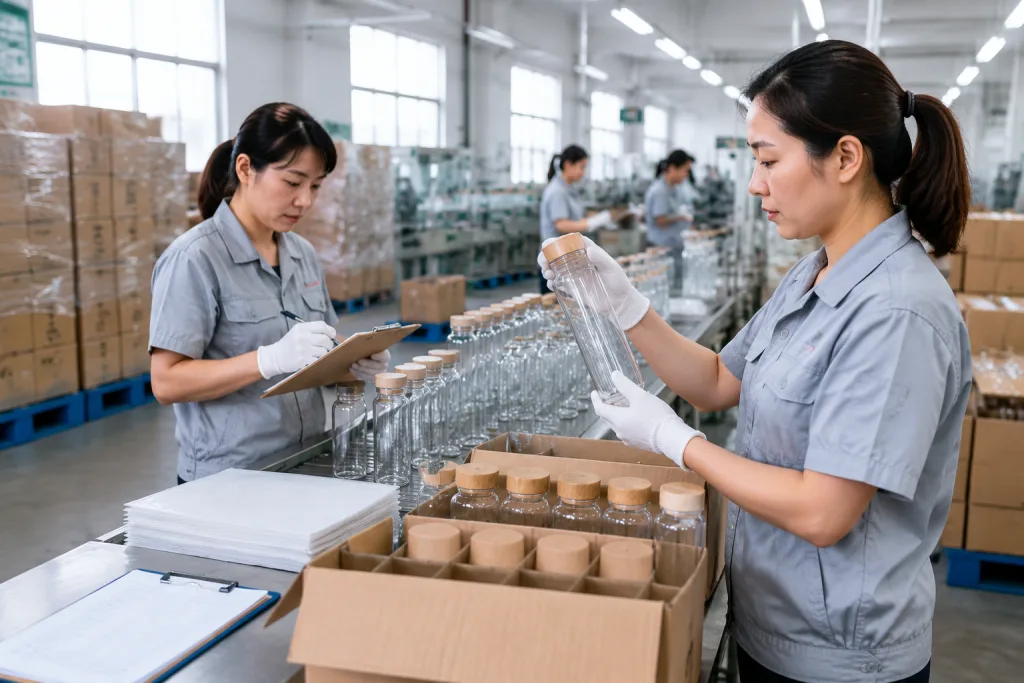
If you source from a borosilicate glass bottle factory in Zhejiang or elsewhere in China, the gap between a clean launch and a messy one is usually not the glass itself. It is the draft spec, the cap torque, the drop-test standard, and print placement before production starts. QC pulled a sample last month with a 1.5 mm offset on the logo, and the buyer flagged it before we cut tooling. A serious borosilicate glass bottle manufacturer asks for that detail early, because the math does not work if you wait until mass production.
Start with the buyer scenario
Picture a wellness brand launching a 500 ml customizable glass water bottle for retail and DTC. They want clear borosilicate, a bamboo lid, one-color logo print, and an optional silicone sleeve in two colors. The first mistake is asking a borosilicate glass bottle supplier for “best price” with no use case. Wholesale bulk glass bottles are not priced like caps off the shelf; geometry, decoration, accessories, and breakage risk all sit in the quote. We run this every week.
Define the order like a procurement manager, not a shopper. Ask: is this borosilicate glass bottle a promo item, a shelf product, or a repeat-purchase SKU? A promo piece can live with a 1.0 mm print tolerance and simpler packaging. A retail bottle often needs tighter visual checks, carton drop resistance, and cleaner label placement. If you work with borosilicate glass bottle distributors, watch the gap: some are traders, not makers. You still need factory data: furnace output, 3 production lines or 8, daily capacity, and what happens when a color or cap is backordered. The buyer flagged it on one PO typo before we even started sampling.
For Zhejiang factories, a realistic production setup can be 80,000-150,000 units per month, depending on line configuration. That matters because a 5,000-piece trial order should not sit behind a 50,000-piece export run. We have seen that go sideways. If the borosilicate glass bottle manufacturer cannot reserve capacity, your launch date is a guess, and the math does not work.
Lock the bottle spec first
The bottle spec sets the whole job. For a custom borosilicate glass bottle, lock three numbers first: capacity, wall thickness, and neck finish. A 350 ml bottle usually moves cheaper and packs more units per carton, while 500 ml and 750 ml fit wellness and hydration programs better. We run a lot of bulk borosilicate glass bottle work at 2.0 mm or 2.5 mm wall thickness. Go thinner only when the pack-out is tight and the transit lane is clean.
Then pin down the neck. A standard screw neck with a 48 mm or 55 mm opening opens up more lid choices. If the buyer wants a bamboo cap, check whether the insert is stainless steel or PP, because the seal changes. For a customizable borosilicate glass bottle with a sleeve, leave enough diameter tolerance so the sleeve goes on without wrinkling. QC pulled the sample on one 500 ml run because the sleeve gap was 1.5 mm short. That's the kind of detail a good borosilicate glass bottle factory should ask during sampling.
- Common capacity: 250 ml, 350 ml, 500 ml, 750 ml
- Typical wall thickness: 2.0 mm-2.5 mm
- Common neck finish: 48 mm, 55 mm, or custom thread
- Usual order format: bottle + lid + carton insert + shipping master carton
Do not over-spec the glass if the item is retail-first. A 3.0 mm wall looks premium, but it adds weight and freight cost. The math doesn't work on 20,000 pieces when each bottle picks up extra grams. We saw this go sideways on a Europe PO where the buyer flagged the carton weight before booking, and the line had to rework the pack plan.
Quote the real landed cost
Most buyers stop at FOB and miss the landed number. That is the wrong question to ask. For borosilicate glass bottle wholesale, the bottle may quote at USD 0.95-1.80, but the lid, logo print, sleeve, inner box, and export carton can add another USD 0.35-1.20 per unit. On one 20,000-piece run, QC pulled the sample and found the bamboo lid added 8 mm to the carton height, which changed the load plan. A customized glass water bottle with bamboo lid and one-color silkscreen often lands around USD 1.60-3.20 FOB China, depending on quantity and decoration.
If you are comparing borosilicate glass bottle wholesale offers, push the same checklist on every quote. Ask for mold fee, sample fee, print fee, lid color surcharge, and packing method. We ship quotes every week, and the ones with a single round number usually bury cost somewhere else. We have seen it go sideways as a packaging change, a longer lead time, or a surcharge for “special handling” after the PO typo lands on the wrong carton spec.
For North America, add FNSKU labeling, carton labeling, and any prep fee if the cargo goes to Amazon. For Europe, check whether the carton dimensions and pallet pattern fit your warehouse lanes. A clean quote from a borosilicate glass bottle supplier should show carton count, gross weight, and CBM per 1,000 units. If they cannot give that on the first round, the line is not ready for wholesale, and the math does not work.
Treat sampling like a gate
Sampling is where a borosilicate glass bottle custom order gets won or lost. We have seen buyers approve a sample because the logo looked clean on the table, then the first carton popped open in transit. Check the lid seal, thread engagement, glass clarity, and whether the shoulder shape matches the drawing. If the bottle is meant for reuse, run a hot-cold test: 80°C water, then cold rinse after cooling. Borosilicate handles thermal shock better than soda-lime, but the full assembly still decides the result.
A proper sample gate usually includes at least three checks:
- Visual check: bubbles, cords, scratches, and rim finish within 0.3 mm
- Functional check: leak test after 24 hours on the cap and seal
- Packaging check: carton fit, divider strength, and drop resistance from 80 cm
If you need a borosilicate glass bottle customizable solution, ask for both a pre-production sample and a decorated sample. Do not sign off on print from a blank bottle alone; the ink behaves differently on curved glass, especially on wrap print or a fine logo line. We ship samples in 7-10 days, and the clock slips when the cap or sleeve needs a new mold. The buyer flagged a wrong Pantone once, and the whole sample round had to restart.
Approve the sample only after you test the assembly, not just the glass.
Build QC into production
For bulk borosilicate glass bottle orders, QC cannot start at the end. We run it inside the production plan. On the line, that means incoming material inspection, in-process checks, and final inspection to AQL 2.5 for major defects and 4.0 for minor defects. Rim flatness, thread consistency, print adhesion, and the rubber or silicone seal all get checked by lot; if the seal is off by 0.5 mm, the buyer will flag it fast.
When you work with a borosilicate glass bottle manufacturer in Zhejiang or another Chinese production hub, ask for a control sheet before mass production. It should list the bottle drawing number, glass thickness tolerance, target weight, cap torque range, and carton drop-test standard. I’ve seen PO typos on the cap code turn into a week of back-and-forth, so this is not paperwork for show. If the bottle goes into wellness retail, ask for REACH confirmation for EU-bound components and food-contact declarations for the bottle and lid materials. The compliance file should be cleaner than the packaging art.
Use a practical defect filter. Chips on the rim, uneven logo placement, cap cross-threading, and sleeve slippage are the four checks that matter at receiving. A dependable borosilicate glass bottle supplier will tell you their reject rate by defect type. If they say “almost zero” without numbers, the math doesn’t work. QC pulled the sample and found the same issue on 3 out of 50 pieces; that is the kind of number you need before you place a replenishment order.
Pack for transit, not the sample table
Glass bottles crack in transit more often than on the line, so packaging needs its own spec. A custom borosilicate glass bottle program should use inner dividers, edge guards, and a master carton cut to bottle height, with no headspace that lets the neck slam. For 500 ml bottles, we usually run an E-flute inner box with molded pulp or a card divider; loose packing looks cheap until QC pulls the sample after the drop test. If the bottle carries a bamboo lid, bag it or pack it separately. Bamboo rub marks show up fast.
For export from China, ask the borosilicate glass bottle factory to run a carton drop test at 60 cm or 76 cm based on your channel spec. We’ve seen buyers push back on this, then lose 3% to 5% of cartons on arrival. If you ship to Amazon, lock the carton label and FNSKU placement before the first run, not after the PO typo goes live. If you ship to distributors, confirm pallet height and carton count so the borosilicate glass bottle distributor can receive, stack, and rework without wasting labor.
Packaging also drives margin. A borosilicate glass bottle promotional project can use a plain tuck box and one insert card to keep the unit cost down. A premium retailer may want a printed sleeve and molded tray. The math decides it, not taste. A Zhejiang factory will often quote two pack levels in one sheet: export-safe standard pack and retail-ready upgrade. That gives you a real choice, and the buyer can see the delta in 1 carton, 2 prints, 3 cents per unit—no guesswork.
Close the order like a sourcing manager
Once the order is approved, keep the paperwork tight. The PO should spell out material, volume, wall thickness, print method, lid type, carton spec, tolerance, inspection level, and ship date. For a borosilicate glass bottle wholesale bulk order, I would also add the approved reference sample code and a photo pack of the signed artwork. We had one buyer flag a PO typo on the carton size, and that 2 mm difference turned into a week of back-and-forth at the line. If there is a dispute later, the factory needs a signed sample on the table, not memory.
Good buyers lock payment to production stages: 30% deposit, 70% balance before shipment is common, though some borosilicate glass bottle manufacturers will talk on repeat orders. On one 50,000-piece run, QC pulled the sample after the first kiln batch and caught a lid mismatch before packing started. For a long program, keep one version-control file for artwork and one for packaging. We run it that way because six months later the buyer often forgets whether the old print plate was 1-color or 2-color, and that is the wrong question to ask if you want clean reorders.
The best sourcing outcome is not the lowest unit price. It is a stable bottle that arrives on time, passes receiving, and stays in the program. If your borosilicate glass bottle wholesaler can show QC records, a lead time they can actually hit, and steady supply from China, you can scale without reworking the spec every season. We’ve seen this go sideways when a buyer chased a cheaper quote and then lost 12 days to carton rework and lid replacement. Clean numbers beat cheap promises.
Request your borosilicate bottle quote now
Send your size, lid style, print art, and target market. We will turn it into a clear spec, sample plan, and FOB China quote.
Frequently asked questions
What is the usual MOQ for borosilicate glass bottle wholesale bulk?
For most borosilicate glass bottle wholesale bulk programs, MOQ is 3,000-5,000 pcs per SKU. If you need custom color lids, printed logos, or special packing, the real MOQ can move to 8,000 pcs or more. A borosilicate glass bottle factory in Zhejiang may accept a lower trial order for sampling, but the price per unit usually rises 15%-30%. For a multi-SKU launch, split the order by capacity only if the cap and carton structure stay identical.
How much does a custom borosilicate glass bottle cost FOB China?
A basic custom borosilicate glass bottle with standard lid and one-color print often falls around USD 1.20-2.80 FOB China, depending on size and packaging. Add USD 0.20-0.60 for sleeve or accessory changes, and another USD 0.10-0.35 for upgraded retail packaging. If you need a customized glass water bottle with premium lid materials or complex decoration, the price can go above USD 3.00. Freight and duties are separate and should be quoted by CBM and carton weight.
How do I check quality before placing a large order?
Ask for a pre-production sample, then test cap fit, leak resistance, rim finish, and thermal shock. For mass production, use AQL 2.5 for major defects and define rejection points for chips, cracks, print misalignment, and thread defects. A proper borosilicate glass bottle supplier should also provide material declarations for the bottle and seal, especially if you sell in the EU or North America. If the factory can share in-process QC photos and final inspection records, that is a better sign than a perfect sales pitch.
Is borosilicate glass better than regular glass for reusable bottles?
Yes, for most reusable water bottle programs it is the safer choice. Borosilicate handles thermal shock better and is typically more stable for hot-cold cycling than soda-lime glass. That matters when a user rinses with hot water or fills with cold water after cleaning. For a bulk glass water bottle, the better material still needs the right lid, seal, and package design. The bottle can be strong and still fail in transit if the carton spec is weak.
Can a borosilicate glass bottle distributor handle custom branding?
Some borosilicate glass bottle distributors can manage artwork and simple customization, but many are not the factory. They may quote faster and handle communication well, yet you still need to confirm who owns the mold, who runs the decoration line, and who handles QC. If you want a true borosilicate glass bottle customized program, ask for factory photos, monthly output, and sample approval workflow. A distributor is useful for coordination; the manufacturer is what determines consistency.