Key Takeaways
- A 5,000-piece borosilicate glass bottle bulk order normally needs 35-50 days after artwork approval
- Quote glass wall thickness, capacity tolerance, cap material, sleeve material, and carton drop-test level before comparing vendors
- For retail orders, use AQL 2.5 for major defects and AQL 4.0 for minor defects as a practical baseline
- Expect custom printing setup costs of USD 50-150 per color or plate, depending on logo method and artwork size
You need a glass bottle that matches a wellness brand: clean shelf look, no plastic taste, a reusable story, retail box, and a logo that still passes a 3M tape test after 90 days. Sounds simple. The problem is that 12 borosilicate glass bottle vendors can quote the same 550 ml shape with prices that differ by USD 0.35–0.90 because wall thickness, silicone sleeve weight, cap insert, printing method, export carton, and AQL 2.5 inspection are not being quoted on the same basis.
Here is a real sourcing case we run often: 5,000 pieces of a customized glass water bottle for a sustainable retailer in Europe or North America. We write from Hangzhou, Zhejiang, where our export team sees the same mistakes on the line every month: a 2D drawing with no tolerance in mm, a drop-test request copied from a plastic bottle PO, and no pre-shipment AQL plan until QC pulled the sample and found sleeve color drift under the light box.
Start with the bottle job
A buyer often opens with “a 500 ml glass bottle with bamboo lid.” Too thin. A borosilicate glass bottle supplier cannot price that cleanly because the bottle job is still missing. Before you contact borosilicate glass bottle vendors, put the commercial use on one page: retail shelf for a wellness chain, yoga studio welcome pack, or ecommerce parcel shipping one unit at a time. We run different drop-test and carton plans for each case; last month QC pulled a 550 ml sample after the bamboo cap chipped at the carton corner.
For this scenario, the order is 5,000 pieces for a sustainable retailer: 550 ml clear borosilicate body, stainless steel tea strainer option, bamboo outer cap, food-grade silicone seal, single-color logo on the glass, kraft retail box, and 24 pieces per export carton. The buyer wants a clean “low plastic” message, but the bottle still has to survive parcel delivery. Fair ask. The carton compression math matters here: 24 pieces per export carton usually puts the gross weight near 13-15 kg, so we check divider thickness and shake-test results before saying yes.
Now the vendor can quote a real item instead of guessing. A common 550 ml borosilicate glass bottle wholesale price may sit around USD 2.10-3.40 FOB China depending on sleeve type, cap structure, logo print size, retail packaging, and inspection level. If you add a neoprene sleeve, color box with insert tray, and stainless infuser, the same bottle can move above USD 4.00. That does not prove one borosilicate glass bottle manufacturer is expensive and another is cheap. They may be quoting different builds; we have seen this go sideways when a PO says “kraft box” but the buyer expected a die-cut window box with 1.5 mm insert card.
For wellness brands, I push buyers to fix these before sampling: target retail price with margin; bottle capacity in ml; dishwasher claim and test basis; cap material, including bamboo grade and stainless grade if used; printing method with logo size in mm; packaging format with carton pack; market compliance. Your product page might say “borosilicate glass bottle custom made for daily hydration.” Good. Your purchase spec should be just as plain, or the line will fill the gaps for you.
Lock the technical specification
Borosilicate glass is chosen because it takes temperature shock better than ordinary soda-lime glass. Still, “borosilicate” is not a spec. Ask your borosilicate glass bottle factory to confirm material grade, wall thickness, bottom thickness, annealing control, capacity tolerance, and cap sealing structure on the PI or tech sheet. For a 550 ml custom glass water bottle, we run 1.8-2.2 mm wall thickness as a practical range, with a heavier base to cut breakage during filling and carton drop tests. QC checks this with a digital caliper, not by eye.
Define capacity by usable fill volume, not only brimful volume. A bottle sold as 550 ml may hold 580 ml to the rim but only 540-550 ml at a comfortable fill line. Put the tolerance in writing, for example ±5%. Also define mouth diameter, because it decides whether the buyer can add ice cubes, clean with a standard bottle brush, or fit an infuser basket without rubbing the glass. We have seen a PO say “wide mouth” with no mm value; the buyer flagged it after samples, and the line had to remake the mold drawing.
Cap details need more attention than buyers usually give them. Bamboo sells well, but bamboo is natural and color will shift piece to piece. If you need a close visual match across 5,000 pieces, say so before sample approval and ask for a shade range under D65 light. Inner cap material may be PP, stainless steel, or a mixed structure. The silicone ring should be food-grade and removable if you want easier cleaning. For North America and Europe, ask for LFGB, FDA food contact, or relevant migration test support depending on your market. One pushback: asking for “perfect same bamboo color” is the wrong question to ask; set an acceptable range, then QC can inspect it.
For a customizable borosilicate glass bottle, define the decoration position before artwork output. A 40 mm wide logo on a straight body is simple. A wrap print near a curved shoulder is harder and may raise rejection, especially when the screen fixture cannot hold the bottle square within 1 mm. Good borosilicate glass bottle manufacturers will warn you before mass production, not after the print comes out wavy and QC pulled the sample from the first carton.
Compare quotes without fooling yourself
Send the same RFQ sheet to all three borosilicate glass bottle suppliers. Use quantity breaks such as 1,000, 3,000, 5,000, and 10,000 pieces, and list the exact bottle size, cap type, logo position, packing style, and ship term. Most China factories we deal with set MOQ around 1,000-3,000 pieces for stock-shape bottles with custom logo, while a new mold can require 5,000-10,000 pieces and mold fees from USD 800 to several thousand dollars. At our Zhejiang coordination office, a normal stock-shape glass bottle project runs 80,000-120,000 units per month across scheduled production lines, but custom packaging can slow the line fast. Last March, QC pulled the sample because the 68 mm gift box insert was 2 mm loose. The bottle was fine. The packing was not.
Ask each borosilicate glass bottle vendor to split costs into bottle body, cap, sleeve or infuser, logo, retail box, export carton, testing, and freight terms. FOB Ningbo or FOB Shanghai is common for Zhejiang and nearby China supply chains. If one quote is EXW and another is FOB, the math doesn't work. We see this mistake often: one buyer compared a USD 1.42 EXW quote against a USD 1.56 FOB Ningbo quote and thought the first supplier was cheaper, then the local trucking, customs handling, and warehouse loading added USD 0.19 per piece. Check the Incoterm line on the PI. Check it twice.
Decoration cost is another trap. A single-color silk screen logo may add USD 0.08-0.20 per piece plus a screen fee. Laser engraving on bamboo caps may add USD 0.10-0.30 per piece depending on size. Decal printing and gradient color coating cost more because the line needs slower handling, more drying space, and tighter inspection under the 3M tape test. Full-wrap designs also need more QC time, especially around the seam. For a promotional borosilicate glass bottle, cheaper decoration might pass. For a retail wellness line, print alignment and durability matter more. We have seen a buyer flag a 1.5 mm logo shift on a 500 ml bottle, and he was right to do it.
Do not chase the lowest unit price if the carton is weak. This is the wrong question to ask. Glass losses in parcel delivery can erase a USD 0.15 saving after one rough courier lane. For ecommerce or distributor glass water bottle programs, specify an inner tray or molded pulp protection and test the final packed product, not only the bare bottle. We run a 1.2 m drop test on the packed carton, then open it on the QC table and count cracked shoulders, chipped mouths, and cap dents. If the outer carton uses soft 5-ply board under 12 kg gross weight, the buyer usually pays for it later.
Approve samples like a buyer
Sample approval is not a photo exercise. Ask for one physical pre-production sample that matches the real customized borosilicate glass bottle: final cap, final silicone seal, final logo size, final box structure, final barcode or FNSKU if required. On our line, QC puts the approved sample next to a 150 mm digital caliper and the signed color sheet before bulk starts. If you approve a plain bottle first and artwork later, you are approving half a product.
For this 5,000-piece order, the sample checklist should include at least 12 points: capacity, height, diameter, weight, wall thickness, mouth finish, cap fit, leak test, logo size, logo position, sleeve fit if used, and retail box fit. Write measured numbers beside the approved sample, such as 550 ml capacity, 68 mm body diameter, 1.8 mm wall thickness, and 24 mm logo height. “Looks good” is useless when mass production starts 20 days later. The buyer flagged this on a PO once because the carton artwork said 600 ml while the sample measured 550 ml.
Leak testing is simple. Fill the bottle to the intended level, close the cap, invert it for 30 minutes, then shake it in different positions. If the bottle will be sold as gym-bag safe, run a tougher test: 2 hours horizontal, 10 shakes after inversion, then check the tissue under the cap thread. We have seen bamboo-lid bottles pass upright daily use and still leak after 45 minutes sideways in a backpack. Your product claim must match the structure; “leakproof” is the wrong word if the seal only handles desk use.
Decoration durability needs checking before you release the deposit balance. For screen print, ask for a tape test and rub test; QC pulled one sample last month after 3M tape lifted a corner of a white logo. For coating, ask whether the finish is dishwasher safe or hand-wash only, and get that answer on the care label artwork. Be careful with absolute claims. A glass body may tolerate dishwasher heat, but bamboo caps generally should not be washed in a dishwasher. A careful borosilicate glass bottle manufacturer will help you word care instructions honestly, and the math works better than paying for returns later.
Build QC into the order
Agree QC before deposit, not after 312 cartons are taped and sitting by the dock. For a bulk glass water bottle order, put the inspection plan in writing with AQL levels: AQL 0 for critical defects, AQL 2.5 for major defects, and AQL 4.0 for minor defects. Critical defects mean broken glass, sharp edges, serious contamination, or unsafe cap materials. Major defects mean leakage, wrong logo, wrong capacity, cracked bamboo, badly deformed caps, or retail box damage that affects saleability. QC pulled one sample last year with a 0.8 mm burr on the mouth; the buyer was right to reject it.
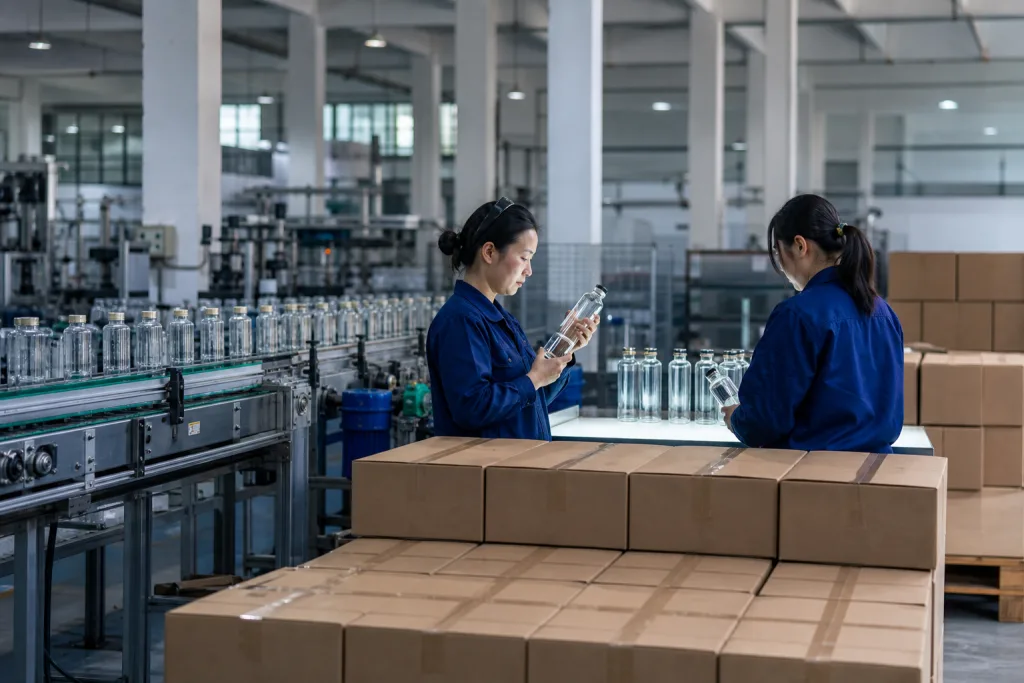
For 5,000 pieces, a third-party or buyer-side pre-shipment inspection usually samples according to ANSI/ASQ Z1.4 or ISO 2859-1. The inspector should open export cartons from different pallet positions, including bottom and middle rows, not only the clean top layer. Check bottle dimensions with a caliper, print alignment against the approved artwork, cap torque, smell, barcode scanning, carton markings, and packaging protection. If your goods go to Amazon or a distributor borosilicate glass bottle warehouse, carton label accuracy matters as much as the bottle. One wrong FNSKU sticker can block 40 cartons at receiving.
Drop testing should use the packed retail unit and the master carton. A common export carton test is a 76 cm drop on corners, edges, and faces, but glass packaging needs honest routing review before you approve the box. Stores and parcel delivery are not the same risk. If you sell through stores only, the risk profile is different from single-piece ecommerce shipping, where one bottle may ride 6 trucks and hit 3 sorting belts before the customer opens it. The math doesn't work if the carton saves USD 0.06 but creates 2% breakage.
Our practical rule from China production: inspect early enough to fix problems. Simple. If you find logo misalignment after all 5,000 pieces are packed, the repair is slow and expensive. If you check the first 100 printed bottles during production, the line can adjust the screen fixture in 20 minutes instead of repacking for 2 days. Good borosilicate glass bottle distributors and brand buyers both benefit from that discipline. We ship cleaner orders when the buyer lets QC stop the line before the mistake becomes inventory.
Plan compliance and packaging
Compliance comes before print quality. Europe buyers usually ask for REACH, LFGB food contact, packaging waste rules, and their own restricted substance list. For the United States, FDA food contact and California Proposition 65 screening often sit in the same email thread. If the bottle is for children, the bar goes up again: ASTM or CPSIA-related requirements can apply based on age grade and design. A kids’ glass bottle is not just a smaller adult bottle. On our line, QC pulled the sample and checked the rim at 1.8 mm with a caliper before we sent it for approval.
Packaging carries the sustainability claim, but it still has to protect glass. Kraft paper looks clean, yet a thin kraft box with no insert can pass a sample photo and fail in a truck. We have seen that go sideways. Molded pulp, corrugated inserts, and honeycomb paper sleeves cut plastic use and hold the bottle better in transit. If you spec a silicone sleeve, lock the color with Pantone and ask for migration and odor checks when the market needs them. We ran a drop test from 80 cm on packed cartons, and the box with no insert cracked at the corner on the second drop.
For a borosilicate glass bottle customized for retail, put every packaging detail in the approval pack: logo, capacity, material statement, care instruction, country of origin, barcode, recycling marks, and importer details. The line does not forgive loose paperwork. One buyer flagged a PO where the barcode had two digits flipped, and the carton had to be reprinted before shipment. “Designed by your brand, Made in China” is common, but your local legal team should sign off on the exact wording. Do not leave this to the carton artist.
Lead time follows the number of moving parts. A plain custom borosilicate glass bottle with a stock cap and one-color logo can often ship in 30-40 days after deposit and artwork approval. Add custom color coating, new box artwork, a special infuser, and compliance testing, and 45-60 days is the safer number. If a borosilicate glass bottle supplier promises 15 days for everything in peak season, ask what is already on the shelf. Our coating booth needs a 24-hour cure before packing, and that alone kills a fake rush order.
Choose the vendor you can manage
The best borosilicate glass bottle vendors are not always the ones with the nicest catalog. We run orders by asking who owns the mold, where the glass is formed, where printing happens, and who packs the retail box. On a 500 ml bottle, a 1.2 mm neck tolerance or a loose cap spec can turn into leakage complaints fast. Some borosilicate glass bottle manufacturers keep most steps in-house; others split work across several workshops. Both models work if one person owns the final sample. If nobody does, the handoffs become your problem.
For a first order, I prefer a stock-shape bottle with strong customization instead of a brand-new mold. You can still make it feel yours with a custom glass water bottle logo, sleeve color, cap engraving, box design, insert card, and bundle packaging. We once saw a PO typo turn “5,000 pcs” into “500 pcs,” and the line stopped while sales cleaned it up. After sales data proves demand, then pay for a proprietary shape. That is the safer move for most sustainable retailers.
Check communication habits too. A reliable borosilicate glass bottle vendor should answer technical questions with numbers, not just “yes, can do.” You want updates at deposit, sample, material preparation, printing start, packing start, inspection, and shipment booking. If they need 48 hours to answer a wall-thickness question, that is already slow. For a China team in Zhejiang, Ningbo port access helps, but Chinese New Year still eats 7 to 10 days, and the schedule slips if no one plans around it. QC pulled the sample at 3 pm and checked a 1.0 mm base before carton drop test.
The right partner will push back. If your logo sits too close to a curved edge, or your kraft box is too weak for ecommerce, they should say so. We have seen this go sideways: a buyer flagged a box that passed a normal shelf check but failed a 1-meter drop test after a 280 g bottle was added. That kind of friction protects your margin, your launch date, and the reviews that decide whether the second order becomes 20,000 pieces instead of another small trial.
Send your glass bottle brief for a factory quote
Share capacity, logo method, packaging, quantity, and target market. We will review the spec and return practical MOQ, pricing, and lead time.
Frequently asked questions
What MOQ should I expect from borosilicate glass bottle vendors?
For a stock-shape borosilicate glass bottle custom order, expect MOQ around 1,000-3,000 pieces per design when you only add a logo or standard packaging. If you need a custom color coating, special silicone sleeve, new retail box, or engraved bamboo cap, 3,000-5,000 pieces is more realistic. A fully new mold for a customized borosilicate glass bottle often starts at 5,000-10,000 pieces, plus mold fees. Some vendors accept 500 pieces, but the unit price can be 25-60% higher and packaging choices are limited. For wellness retail launches, 3,000 or 5,000 pieces usually gives a better balance between price, QC effort, and inventory risk.
How much does a bulk borosilicate glass bottle order cost?
A simple 500-600 ml bulk borosilicate glass bottle with stock shape, bamboo-style cap, and one-color logo often falls around USD 2.10-3.40 FOB China at 5,000 pieces. Add a silicone sleeve, stainless steel infuser, premium gift box, full-wrap print, or custom coating and the price may move to USD 3.80-5.50. Testing, inspection, and better packaging also cost money but reduce breakage and returns. Always ask for itemized pricing: bottle, cap, decoration, box, carton, testing, and freight term. A quote that is USD 0.30 cheaper may be worse if the carton fails a drop test or the cap leaks.
Can a borosilicate glass bottle be dishwasher safe?
The glass body often can tolerate dishwasher use, but the full bottle may not be dishwasher safe. Bamboo caps, printed logos, coatings, silicone sleeves, and adhesive labels may have different limits. If you want to claim dishwasher safe, test the final assembled bottle through a realistic cycle count, such as 20-30 dishwasher cycles, and inspect printing, cap fit, coating color, odor, and leakage. Many brands choose a safer instruction: glass body dishwasher safe, cap hand wash only. That wording is less exciting, but it is more honest and reduces customer complaints. Ask the borosilicate glass bottle manufacturer for test evidence before printing care claims on packaging.
What should I inspect before shipping a custom glass water bottle order?
Inspect the product, packaging, and labels. For the bottle, check capacity, dimensions, wall thickness, sharp edges, bubbles, scratches, black spots, cap fit, silicone seal, leakage, and logo placement. For packaging, check retail box strength, insert protection, barcode scanning, country of origin, carton marks, carton weight, and pallet condition. Use AQL 0 for critical defects, AQL 2.5 for major defects, and AQL 4.0 for minor defects unless your retailer requires stricter levels. For ecommerce, run drop tests on the final packed unit. Do not inspect only loose bottles on a table; most glass complaints come from sealing, decoration, or packaging failures.
Is borosilicate glass better for sustainable retailers?
Borosilicate glass is a good fit when you need a reusable, taste-neutral bottle with better thermal shock resistance than ordinary glass. It supports a clean wellness position and pairs well with bamboo, stainless steel, silicone, and plastic-reduced packaging. But it is still glass, so packaging design and consumer instructions matter. If your retail channel involves heavy parcel shipping, budget for stronger inserts and realistic drop testing. If your customers use bottles in gyms or outdoor settings, consider a silicone sleeve. Sustainable retailers should avoid vague claims like “zero impact.” A stronger message is durable, reusable, food-contact tested, and packed with reduced plastic where practical.