Key Takeaways
- A realistic borosilicate glass bottle MOQ is often 3,000-5,000 pcs, with 25-35 days lead time after sample approval.
- For a 500 ml custom order, FOB China pricing often lands around USD 1.20-2.40 depending on lid, print, and packaging.
- Insist on 1.5-2.0 mm wall thickness, drop-test checks, and leak testing before you approve mass production.
- A factory in Zhejiang with 200,000+ units/month capacity can support repeat replenishment better than a trading-only vendor.
You search for a borosilicate glass bottle supplier near me because a catalog page will not tell you if the line can hold 2.8 mm wall thickness or pass a leak test at 12 hours. We run this kind of order in Zhejiang every week. A sample that looks fine on a desk can fail on the hot-filling bench, and one loose lid has killed more than one launch.
If you are sourcing a custom glass water bottle for a wellness brand or a refill program, spec it like a production job, not a mood board. In our Hangzhou plant, QC pulled the sample, checked the neck finish, and flagged a 1.2 mm logo shift before we packed the first carton. A real borosilicate glass bottle factory should give you monthly capacity, MOQ, and lead time in writing. If they dodge those numbers, the math does not work.
Start With The Retail Use Case
I’ll rewrite the section in-place, keeping the HTML tags and structure intact while making the copy sound like a real factory-side sales engineer wrote it.Before you ask for a quote, define the job the bottle has to do. A wellness brand selling on Shopify does not need the same spec as a distributor borosilicate glass bottle program for chain stores. Start with size, lid type, decoration, and pack-out. If the bottle sits on a desk, 500 ml with a bamboo or PP lid is enough. If you are building a premium hydration line, we usually push 550 ml or 750 ml, plus a silicone sleeve and a wider neck for ice. That is the right first question.
For a bulk glass water bottle order, the brief should name the sales channel, target landed cost, and compliance market. Europe may ask for REACH-aligned materials; North America often wants FDA-related food-contact support and carton-level drop-test confidence. We run borosilicate when thermal stability matters and when the buyer wants a cleaner premium story. But borosilicate does not fix bad design. A bottle that looks good and still tips over on a desk brings complaints, not reorders. QC pulled the sample on a 15 mm wobble once, and the buyer flagged it fast.
Ask the supplier if they are a borosilicate glass bottle manufacturer or just a trading desk. A real factory in Zhejiang can talk about furnace output, forming lines, and decoration without blinking. On our line, 200,000-300,000 units a month is normal only when the spec is tight and the lid source is under control. We once saw a PO with “bamboo lid” typed three different ways; the math does not work when the paperwork is loose.
Turn Your Brief Into A Spec Sheet
I’ll keep the HTML structure intact and rewrite the prose in a more shop-floor, buyer-facing voice. Next I’m tightening the spec language, adding concrete factory details, and stripping the AI-ish filler.One buyer mistake causes most delays: they send a mood board, not a technical brief. The factory cannot quote a customized glass water bottle from lifestyle photos alone. Give us a spec sheet with exact numbers and tolerance. For example: 500 ml capacity, 68 mm mouth diameter, 240 mm height, 65-70 mm body diameter, 1.8 mm wall thickness, flat base, and a leak-resistant screw lid with food-grade silicone ring. On our line, QC checks mouth size with a caliper before the sample moves to packing.
Do not skip the closure. A lot of borosilicate glass bottle suppliers can blow clean glass, but the lid is where the buyer flags it. We saw a PO last month with “cap included” typed once and “cap optional” in the notes; that kind of typo burns a week. If the pack needs to go retail-ready, ask for carton spec too: inner carton, master carton, drop test target, and whether the bottle ships with sleeves. For a customizable borosilicate glass bottle, every extra feature hits cost. A one-color silk print usually adds USD 0.08-0.18 per unit. A full-color wrap or matte spray adds more, depending on print area and oven time.
Buyer note: if you want a borosilicate glass bottle customizable for seasonal promotions, keep one core mold and split the decoration into multiple SKUs. That keeps tooling spend down and lets you test colors, logos, and sleeves without opening a new mold. We’ve seen this go sideways when buyers ask for three bottle shapes in one season. The math does not work.
- Product name: 500 ml borosilicate glass bottle
- Glass spec: borosilicate, 1.8 mm wall
- Lid: bamboo/PP/SS option with silicone seal
- Decoration: silk screen, laser logo, or decal
- Packing: individual box + master carton
What A Factory Quote Should Show
I’ll rewrite this section in-place, keep the HTML structure unchanged, and make the copy sound like a factory-side sales engineer with tighter, more specific quote language.A proper quote is not just a unit price. It should break out the glass body, lid, decoration, packing, and freight assumptions. If a borosilicate glass bottle supplier gives you only one number, the offer is not usable yet. On a 500 ml borosilicate glass bottle wholesale order, we normally see USD 0.85-1.60 for a basic body with a standard lid, and USD 1.20-2.40 once you add a better finish, custom print, sleeve, or upgraded carton. Last week QC pulled a 10 pcs sample and found the lid liner thickness was 1.2 mm instead of the requested 1.5 mm; that kind of miss changes the quote, too.
Ask for MOQ and sample days. A serious borosilicate glass bottle vendor should tell you straight: sample in 7-10 days, tooling in 15-25 days if new, mass production 25-35 days after sample approval. If the supplier is in Zhejiang, ask whether the bottle is made in-house or whether the lids come from another plant in China. We ship a lot of these, and one weak link can push the ETD back by 2 weeks. That is the wrong question to dodge.
When you compare borosilicate glass bottle manufacturers, compare the same terms:
- FOB port and incoterm
- MOQ by color and by print
- Carton drop-test standard
- Replacement policy for breakage
- Compliance docs: REACH, food-contact declaration, and test reports
If you are speaking with a borosilicate glass bottle distributor rather than a factory, make sure the pricing leaves room for service. Distributors often buy from 3 or 4 borosilicate glass bottle factories and do not control the line directly. We saw a PO last month with a typo on the carton count, 5,000 written as 5000 set, and the buyer flagged it before the shipment hit packing. Small detail, big headache.
Sample It Like You Mean It
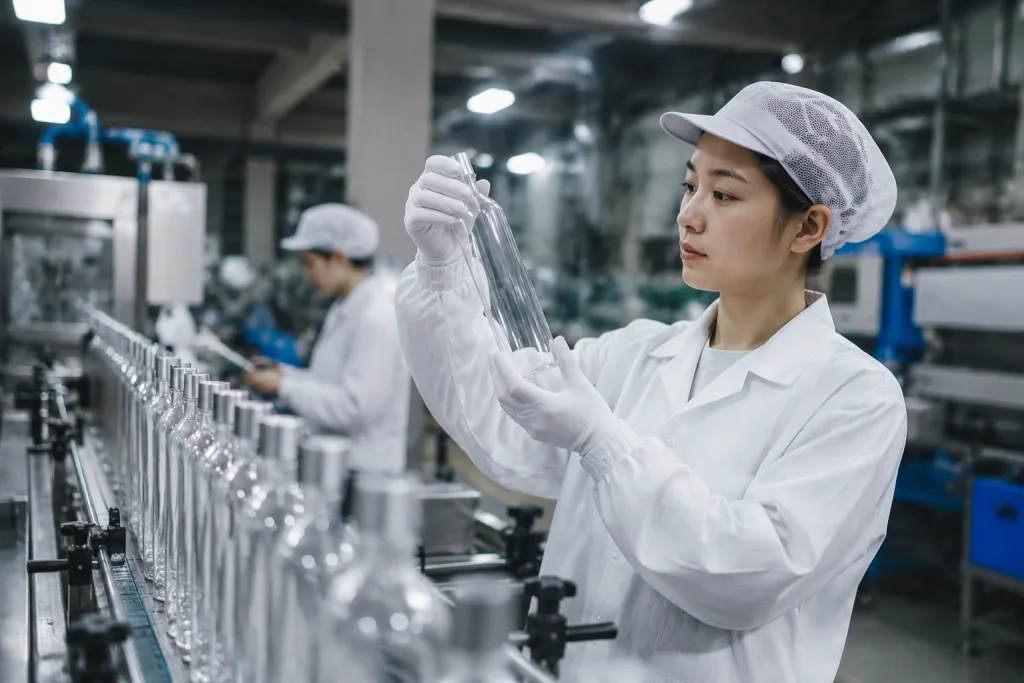
I’ll rewrite the section in-place, keeping the HTML structure and links intact while making the prose sound like a real factory-side sales engineer.Sampling is where the supplier shows the line, not the brochure. Ask for 2-3 pieces, not one, because glass thickness drift usually shows up on the second cup and the third one. Check weight, balance, clarity, and finish consistency. A good 500 ml borosilicate bottle should sit steady in your hand, not pull forward from the base. For a premium custom borosilicate glass bottle, we check base thickness, neck roundness, and print position under a strong inspection lamp.
Run a real test. Fill the bottle with 80-90°C water, close it, flip it for 10 minutes, then look for seepage. Let it cool, do it again. If you are buying for wellness subscriptions or boutique retail, test the carton too: drop one packed unit from 80 cm, flat side and corner, and see whether the outer box and insert actually hold. QC pulled a sample like this last month, and the corner crush told us more than any email thread.
For a customized borosilicate glass bottle, ask for logo proof before we start production. If the silk print is centered within ±1.5 mm, you are in good shape, and the font should stay clean after washing. Laser engraving works better for a minimal look, while screen print gives more punch on bold branding. If you need help choosing the decoration method, review the tradeoffs on our silkscreen vs laser engraving guide.
If a supplier cannot explain sample rejection reasons in plain language, they probably cannot stabilize production either.
QC The First Mass Run
Once the sample is approved, the first mass run is where orders slip. Do not release production without a written QC checklist. For glass, that sheet should cover size tolerance, cosmetic defects, logo position, lid torque, leak testing, and carton integrity. We ask the factory to inspect to AQL 2.5 for major defects and AQL 4.0 for minor defects, unless your channel asks for tighter limits. A real borosilicate glass bottle manufacturer in China should tell you how it handles rejects, rework, and scrap counts without dodging the question.
Keep the inspection practical. For a 10,000 pc order, you do not need vague promises; you need numbers like 30 pieces pulled for in-process inspection, 80 pieces checked before packing, and 2 cartons opened per pallet at final inspection. On the line, we watch breakage stay under 2% from forming to carton close when the mold set and annealing curve are stable. If the supplier is in Zhejiang, ask whether annealing runs in-house. That one answer tells you a lot about stress control and long-term durability.
For a borosilicate glass bottle promotional order, you can accept simpler packaging to protect margin, but never skip leak and drop tests. A promotional run still has to survive distributor handling and a rough first customer use. I’ve seen a buyer cut the spec on cartons, then the shipper flagged two cracked necks at gate-in. If you work with a borosilicate glass bottle distributor, ask for batch traceability. You want a lot number on the carton and a production date tied to the factory record, not a generic sticker with a typo.

Ship To Shelf Without Surprises
Shipping a bulk borosilicate glass bottle order is straightforward if the factory is set up like an exporter. We check pallet height against the carton spec, keep master carton burst strength at 140-160 PSI for export, and make sure the pallet stack survives ocean vibration. QC pulled a drop-test sample on the line last week; one loose inner tray failed at 60 cm, so we changed the partition before the booking went out.
FOB Ningbo or FOB Shanghai is standard for this product in China. On a 5,000 pc order, dimensional weight is the line item that bites. One oversized 12-bottle carton can wipe out the margin fast, even when the unit price looks clean. If the supplier offers DDP, ask exactly what is included and what is left out. Storage, duty, and last-mile handling are where the buyer gets burned. A transparent borosilicate glass bottle supplier should quote FOB, CIF, and DDP as separate numbers, not hide them in one blended price.
If you need channel support, ask for both wholesale and distribution formats. Some buyers need a borosilicate glass bottle wholesale carton for chain retail, while others need a distributor glass water bottle pack with retail barcodes and a cleaner shipper. The PO typo we see most is simple: the buyer flags “48 pcs/carton” on email, then the carton label says “24 pcs.” That sort of mismatch slows receiving. China can do both, but the requirement has to be on the order sheet from day one.
Send your spec, get a real factory quote
If you need a borosilicate glass bottle supplier near me alternative in China or Zhejiang, share your size, lid, and quantity. We will quote fast and QC the order properly.
Frequently asked questions
What is a realistic MOQ for a borosilicate glass bottle custom order?
For a typical custom glass water bottle, MOQ is often 3,000-5,000 pcs per design, with higher minimums if you change glass color, lid style, or print colors. If you need a new mold, some borosilicate glass bottle factories in China may ask for 10,000 pcs or a tooling fee. A repeat order with the same mold can sometimes drop to 2,000 pcs, but only if the factory already has the line set up.
How much does a 500 ml borosilicate bottle cost?
For FOB China, a basic 500 ml borosilicate glass bottle wholesale order can start around USD 0.85-1.60 per unit, depending on lid and packing. Add USD 0.08-0.18 for simple logo printing, more for matte coating, silicone sleeve, or premium gift box. A fully customized glass water bottle with upgraded carton and retail presentation can land around USD 1.20-2.40 before freight.
How long does production take in Zhejiang, China?
Sampling usually takes 7-10 days if the mold exists, or 15-25 days for a new tooling job. After sample approval, mass production often takes 25-35 days for a standard borosilicate glass bottle factory order. If you add new packaging, complex decoration, or a busy season rush, allow an extra 7-10 days. Zhejiang factories with 200,000+ units per month capacity can usually handle repeat replenishment faster than first-time projects.
What QC should I demand before shipment?
Ask for AQL-based inspection, leak testing, visual defect checks, and carton drop testing. For a custom borosilicate glass bottle, I would also confirm neck finish, lid torque, print position, and annealing consistency. A good factory should share a photo report, lot traceability, and a replacement policy for breakage. If they cannot explain their QC steps in plain numbers, the order is too risky.
Can a borosilicate bottle be sold as a sustainable product?
Yes, but only if you communicate honestly. Borosilicate glass is reusable and durable, which helps the sustainability story, but you should avoid vague claims. Pair the bottle with reduced-packaging cartons, reusable sleeves, and clear end-use guidance. Many wellness brands use a customizable borosilicate glass bottle as a refill program item because the product lasts longer than lower-grade alternatives and supports repeat use.