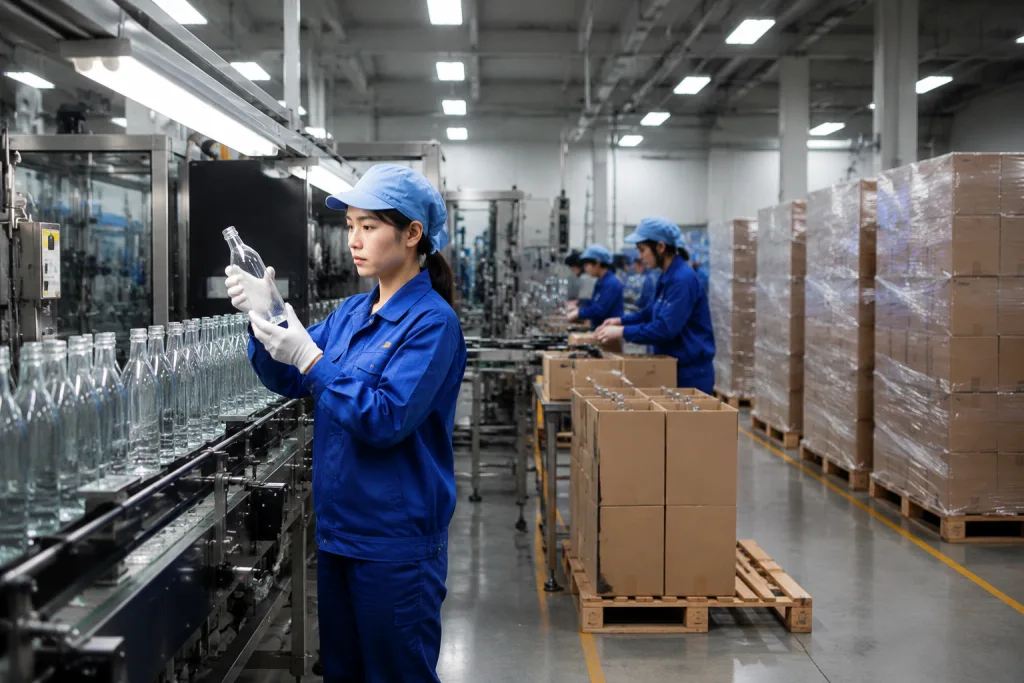
Key Takeaways
- Typical FOB pricing for a 500 ml borosilicate glass bottle bulk order lands around $1.35-$3.20, depending on closure and decoration
- Most Zhejiang factories quote 3,000-5,000 pcs MOQ for custom glass water bottle projects; stock models can start at 500-1,000 pcs
- Standard lead time is 20-35 days after sample approval, but printed cartons, custom caps, and lab testing can push it to 40-50 days
- A real borosilicate glass bottle factory should share wall thickness, annealing range, AQL target, and breakage control numbers without hesitation
If you are buying a borosilicate glass bottle online wholesale, the first surprise is usually not the glass itself. It is the spread between a $1.80 bottle and a $4.20 bottle that look almost identical on a product page. That gap comes from wall thickness, closure quality, decoration, testing, and packaging discipline. We checked one 550 ml sample at 1.2 mm wall and another at 2.0 mm; the thinner one shaved cost, then QC flagged three chips after a drop test from 80 cm. If you are a wellness brand or sustainable retailer, price the landed unit, not the nice-looking sample.
We work in Zhejiang, and most serious borosilicate supply still runs through China’s glass and packaging network. The good factories can turn 30,000 to 80,000 units per month, but they do not all quote the same way. Some are true borosilicate glass bottle manufacturers, others are trading companies posing as a borosilicate glass bottle supplier. The difference shows up in MOQ, lead time, and whether your customized glass water bottle survives transit and retail handling. The buyer flagged one PO typo last month—“screw top” on the order, “flip cap” on the artwork—and the whole line had to stop for a closure check. That is the wrong question to ask if you only compare unit price.
What actually drives unit cost
I’ll rewrite the section in-place, keep the HTML tags untouched, and tighten the sourcing language so it reads like a factory-side sales engineer.For borosilicate glass bottle online wholesale, the glass body is only part of the cost stack. A plain 450-500 ml bottle in clear borosilicate glass usually starts around $0.85-$1.40 ex-factory at 5,000 pcs or more. Add a bamboo lid, stainless steel cap, silicone sleeve, or carry loop and the quote moves fast. A PP cap might add only $0.10-$0.18, while a stainless cap with a food-grade silicone sealing ring can add $0.35-$0.70. Screen printing is often $0.08-$0.25 per color; laser engraving on the lid costs more, but it survives daily wash cycles better. QC pulled one sample with a 22 mm lid thread mismatch last month, and the buyer flagged it before we shipped.
Packaging is the part buyers underquote. On a custom borosilicate glass bottle, cartons and inserts can take 10%-22% of landed cost. A single-wall carton with molded pulp insert runs leaner than a premium gift box, but the gift box is the right call if the bottle goes through retail or ecommerce. Ask for bottle weight in grams, lid material, and the carton drop-test standard; that is the real quote check. A 500 ml bottle with 1.8-2.2 mm wall thickness is common for everyday use. Go thicker and the glass feels better in hand, but freight jumps and carton breakage risk goes up. We’ve seen this go sideways when the buyer asked for “heavier” without checking the case pack.
China pricing also hides compliance labor. In Zhejiang and nearby supply hubs, REACH declarations, food-contact statements, and carton barcode setup are not big ticket items, but they still take time on the line. A borosilicate glass bottle manufacturer with export habits will list those charges clearly. If the quote is vague, you are likely talking to a borosilicate glass bottle vendor who is passing along someone else’s numbers. The math does not work any other way.
MOQ tiers that make sense
I’ll rewrite this section in place, keep the HTML structure intact, and tighten the sales tone with more concrete sourcing detail.MOQ has to fit the channel, not the factory schedule. For a stock borosilicate glass bottle wholesale program, 500-1,000 pcs is a workable start if you take the existing mold, the lid color we already run, and standard carton art. For a custom borosilicate glass bottle with your logo and carton, 3,000 pcs is the normal entry point. If you want a new shape, a special sleeve, or a proprietary lid, plan on 5,000-10,000 pcs and a 12-18 day longer setup before the line settles down.
- 500-1,000 pcs: stock shape, one logo method, standard carton
- 3,000 pcs: borosilicate glass bottle custom order with branding and custom insert
- 5,000-10,000 pcs: new mold or custom closure, higher engineering input
That ladder matters because the first run always eats time on mold testing, print alignment, and drop-breakage checks. We run a 1.5 mm wall sample through QC before we greenlight production, and a serious borosilicate glass bottle factory in Zhejiang will quote a sample fee of $30-$120 and deduct it after order confirmation. The buyer flagged a 300 pcs “custom” quote with no setup charge, and the math does not work. Real borosilicate glass bottle distributors can still help, but only if they say who makes the bottle and who owns the mold.
For wellness brands, the safe rule is simple: if your target retail price needs a landed bottle under $4.00, do not pile on every decoration at once. Pick two priorities: visual quality and shipping strength, or premium packaging and lower MOQ.
Lead times by project type
I’ll rewrite the section in-place, keeping the HTML tags and structure unchanged while making the prose sound like a hands-on factory sales engineer.Lead time is where online wholesale quotes get sloppy. A stock glass water bottle can ship in 7-12 days if we have inventory on hand, but a real custom borosilicate glass bottle usually needs 20-35 days after artwork approval and deposit. If the order brings new tooling, custom cartons, or two print positions, 35-50 days is the honest number. Ocean freight is separate. It can add 18-35 days to North America and 20-30 days to much of Europe, depending on port and routing.
A practical timeline looks like this: 3-5 days for sample confirmation, 2-4 days for artwork and carton proof, 10-18 days for production on a standard custom borosilicate glass bottle, and 5-7 days for final inspection and pallet booking. If you need Amazon prep, add another 3-7 days for FNSKU labeling, carton master label checks, and palletization. We had a buyer flag a PO typo on carton count once, and that cost a full day while QC pulled the sample again. A distributor glass water bottle program can shorten the first quote stage, but the line still runs on molding and firing. In Zhejiang, a borosilicate glass bottle supplier with a stable kiln schedule can give tighter dates than a middleman, because they know if the annealing line is already booked.
Don’t confuse fast reply time with fast production. Some borosilicate glass bottle suppliers send a quote in one hour and then need three weeks to find a factory slot. Ask for a production calendar, not just a price. If they can tell you monthly capacity, say 50,000-80,000 pcs, and the current backlog, you are talking to someone who knows export operations. If they dodge that question, the math does not work.
How to compare real factory quotes
I’ll rewrite the section in-place, keep the HTML structure unchanged, and make the copy sound like a factory-side sales engineer wrote it.When you compare borosilicate glass bottle manufacturers, put every quote on the same base: FOB port, same capacity, same closure, same print method, same carton. A bottle priced at $1.22 FOB Ningbo without a lid is not cheaper than a $1.46 FOB with a leak-tested bamboo lid. The math does not work. We had a buyer flag a PO once because the supplier wrote “lid included” in email, then left it off the proforma invoice. Ask every borosilicate glass bottle supplier for these items: unit weight, material grade, thermal shock range, lid seal type, sample lead time, and inspection standard.
- Material: 3.3 borosilicate, food contact declaration
- Testing: thermal shock, lid leak, drop test, carton compression
- Inspection: AQL 2.5 major, 4.0 minor is common for consumer drinkware
- Shipping basis: FOB, EXW, or DDP stated clearly
For a wellness brand, the lowest quote usually hides one of three issues: thin glass, loose cap tolerance, or weak packaging. A 1.6 mm wall looks clean on paper, but it takes less abuse in transit than a 2.0 mm design. We run both on the line and QC pulled the sample after one drop test split at the shoulder. A custom glass water bottle with a full-wrap print can sell online, but if the print fails after dishwasher cycles, returns jump fast. Good borosilicate glass bottle manufacturers will talk through these tradeoffs in plain language and show test data, not just mockups.
If you source from China on a regular basis, a borosilicate glass bottle vendor in a trading district can still work for repeat stock orders. For a custom borosilicate glass bottle program with brand claims and retail packaging, direct factory control in Zhejiang gives you clearer cost breakdowns and fewer handoff mistakes. We ship a lot of these from Hangzhou, and the difference shows up fast when the buyer changes one carton spec and the quote moves by 6%.
Packaging choices that change margin
I’ll rewrite the prose inside the existing tags, keep the structure intact, and tune it to sound like a factory-side sales engineer.Packaging is not decoration. It stops breakage and protects margin. A bulk glass water bottle packed 24 pcs per outer carton with molded pulp usually ships cheaper than a gift-boxed unit, but if you sell wellness sets or premium hydration kits, the better box can carry a 15%-30% retail uplift. We have seen buyers push hard to save $0.12 on cartons, then eat $0.80 in breakage. That math does not work.
For ecommerce, ask whether your customized glass water bottle needs a polybag, insert card, barcode label, and carton drop-test readiness. Amazon FBA wants clean FNSKU placement and carton weight under 50 lb. If you ship into a distributor borosilicate glass bottle network, master carton consistency matters even more; the buyer will flag mixed lot packing fast. A stable carton spec should use 5-layer board for export, corner protection, and an outer box that passes a 70 cm drop test from multiple angles.
We usually use a simple rule on the line: if your product lands under $6, keep packaging lean; if it lands above $6 or sells as a gift, spend on presentation. A borosilicate glass bottle promotional item can run with simpler packing, but a premium wellness SKU cannot take dented corners or print scuffing. In Zhejiang, the better factories quote carton and bottle together because QC pulled the sample and the carton spec changed the breakage rate, not just the look.
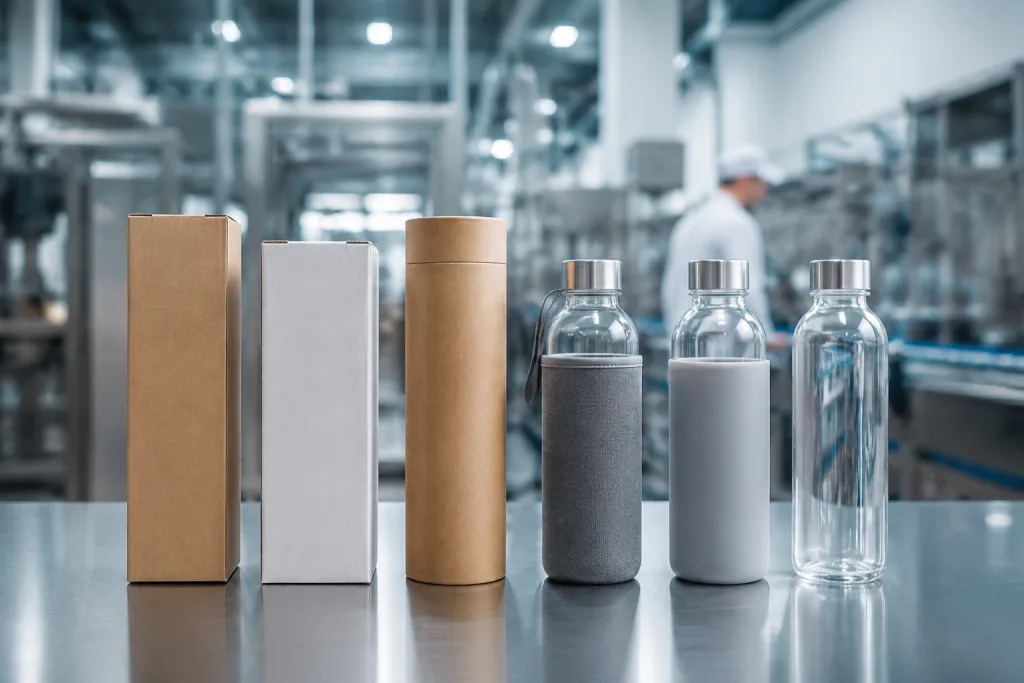
What a serious supplier should show you
You do not need a pretty catalog; you need proof. A real borosilicate glass bottle manufacturer should send sample photos, line drawings, carton specs, and one clean inspection report. QC pulled the sample on a 500 ml bottle last week, measured capacity at 512 ml, and the buyer flagged a 3 mm neck offset before we packed the carton. If the order is serious, ask for BSCI status, REACH documents, and a production sample with measured capacity. For export to Europe and North America, food-contact records matter more than marketing copy. If the bottle is meant for hot and cold use, ask for thermal shock data, usually around 120°C to 150°C for higher-grade borosilicate builds, depending on shape and wall thickness.
Ask how they handle defects. A factory that can explain its AQL process, rework policy, and breakage allowance is usually safer than a supplier who just says 99% quality. We run a 1.5% breakage allowance into some borosilicate glass bottle wholesale quotes because the line always loses a few units at annealing and packing; pretending that never happens is the wrong question to ask. That is where direct factory sourcing in Zhejiang helps: you talk to the people running the kiln, the print line, and the packing team, not just the sales desk. One PO typo on a recent order turned “3000 pcs” into “300 pcs”; QC caught it before loading, and that saved a messy rerun.
If you need a borosilicate glass bottle customizable for a wellness launch, ask the factory to show two options: a lower-cost stock platform and a branded version with an upgraded seal and carton. That gives you a real margin comparison, not a slide deck guess. We’ve seen this go sideways when buyers approve the first sample and skip the carton test; a 50 x 50 x 220 mm insert can change freight math fast. The best buyers use the first sample round to kill expensive assumptions early, not after the first shipment lands.
Get a factory quote with clear MOQs
Send your size, lid type, decoration, and target market. We’ll return a clean borosilicate glass bottle wholesale quote with cost and lead time.
Frequently asked questions
What is a realistic price for borosilicate glass bottle online wholesale?
For a 450-500 ml plain bottle, FOB pricing usually sits around $0.85-$1.40 at 5,000 pcs. Add a bamboo or stainless lid, print, and export carton, and many orders land at $1.35-$3.20 FOB. If you need a custom glass water bottle with premium packaging, budget higher. Air freight can easily add $1.80-$4.50 per piece depending on packout and destination.
What MOQ should I expect for a custom borosilicate glass bottle?
A stock borosilicate glass bottle wholesale program may start at 500-1,000 pcs. A borosilicate glass bottle custom order with logo and custom carton is usually 3,000 pcs minimum. New mold or special closure projects are often 5,000-10,000 pcs. If a borosilicate glass bottle factory accepts 300 pcs with no cost penalty, ask how they are absorbing setup and print loss.
How long does production take in Zhejiang?
For a standard customized glass water bottle, expect 20-35 days after artwork approval and deposit. If you need new tooling, special packaging, or multiple decoration steps, plan for 35-50 days. Add 18-35 days for ocean freight to North America and 20-30 days to Europe. Stock borosilicate glass bottle suppliers can sometimes ship in 7-12 days if inventory is available.
How do I know if I am dealing with a factory or a trader?
Ask for capacity, kiln schedule, and inspection data. A true borosilicate glass bottle manufacturer can usually tell you monthly output, typical lead time, and wall thickness without delay. They should also share sample photos from the line, not just studio renders. A borosilicate glass bottle distributor or vendor may still be workable, but you want to know who actually owns the mold and controls production.
What quality checks matter most for glass water bottles?
Focus on thickness, lid seal, thermal shock, drop performance, and carton compression. For consumer drinkware, AQL 2.5 for major defects and 4.0 for minor defects is common. A good borosilicate glass bottle supplier should also confirm REACH or food-contact documentation, especially for Europe. If the bottle is for hot drinks, ask for thermal shock data and leak testing before you place a bulk borosilicate glass bottle order.