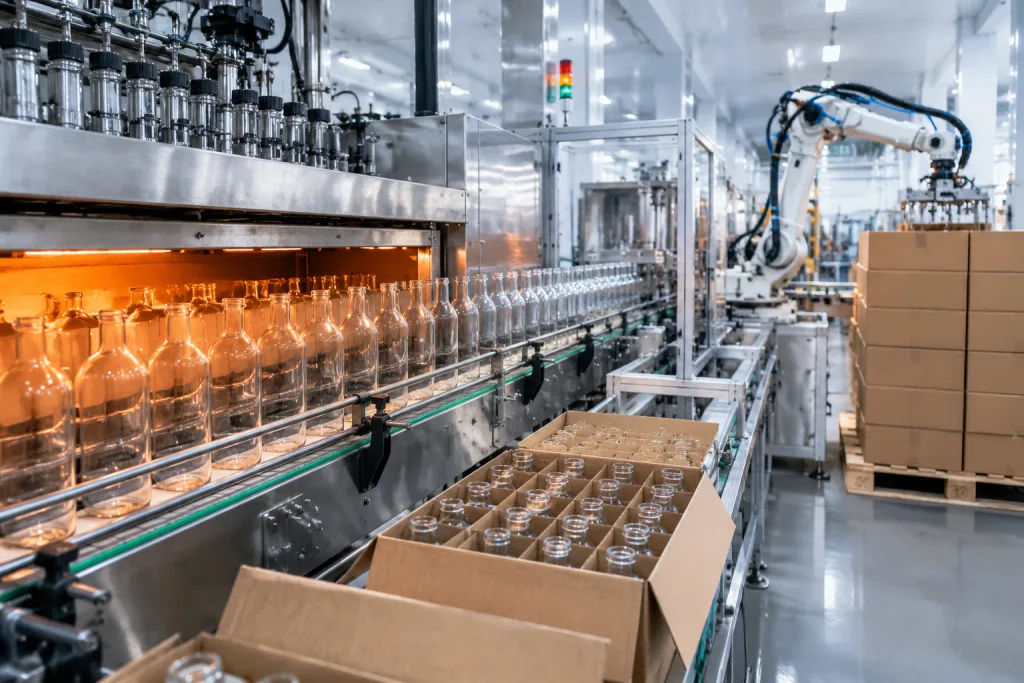
Key Takeaways
- A 500 ml bottle should usually start at 1.5-2.0 mm wall thickness, not thinner.
- Ask for AQL 2.5 major and 4.0 minor, plus 100% visual checks on rims and seams.
- Typical OEM lead time from a Zhejiang factory is 25-40 days after sample approval.
- Plan MOQ around 3,000-10,000 pcs per SKU for a custom borosilicate glass bottle.
Buying a custom glass water bottle looks easy until the first 20-foot container arrives with chipped rims, haze in the glass, or caps that leak after 3 days on a truck. With a borosilicate glass bottle oem factory china, the job is not “finding a supplier.” It is locking down failure points before mass production starts. You need wall thickness, annealing control, cap torque, and the inspection standard written into the PO, not just a clean render and a low FOB number.
In Zhejiang and across China, a good factory can run a clean borosilicate glass bottle bulk order every day. A weak one can too, until QC pulled the sample and the buyer flagged a 0.4 mm wall drift. If you are a wellness brand or sustainable retailer, spec thermal shock, dimensional drift, decoration adhesion, and transit breakage as separate risks. A serious borosilicate glass bottle factory talks tolerances, AQL, and drop-test results, not promises. We see this go sideways when the PO says “matte finish” and the line ships three shades in one carton.
Where borosilicate bottles fail first
The first failures usually hide on the sample table. A custom glass water bottle can look fine and still crack later because the annealing was short, the neck went oval by 0.8 mm, or the rim was cut too hot. Borosilicate gives thermal stability, but only when the forming curve and cooling tunnel are under control. We run into this every season in Zhejiang: the sample passes, then the buyer flags it after 5,000 pcs because the line drifted.
Watch the weak points:
- Rim chips from rough cutting, poor tray loading, or a 2 mm drop edge that gets hit in packing.
- Stress lines from fast cooling or uneven wall thickness, often found when QC pulled the sample under polarized light.
- Base wobble from mold wear, usually after the mould cavity has run too long.
- Cap mismatch from neck tolerance drift, and this is where PO typos on neck finish can turn into a real headache.
If you are buying a borosilicate glass bottle wholesale program, ask for a dimensional sheet: bottle height, max diameter, neck finish, wall thickness, and capacity tolerance. For a 450-550 ml SKU, I would not take more than ±2 mm on height and ±3% on fill volume unless there is a clear commercial reason. A borosilicate glass bottle manufacturer that cannot quote those numbers is not ready for export-scale work. The math does not work.
Specify the glass, not the marketing
“Borosilicate” gets stretched on quotes and PO sheets. Ask the factory to state the glass type, the composition range, and what the bottle is built to handle. For drinkware, the real issue is daily hot-and-cold use, not a brochure line saying lab-grade. We run this check on the line with a caliper and a heat test, because the buyer flagged a “borosilicate” sample that turned out to be soda-lime. If your customer will pour in boiling water, say it plainly and request a thermal shock test.
Useful specs to put in writing:
- Material: borosilicate glass, with written confirmation of soda-lime exclusion if that matters to your brand.
- Wall thickness: 1.5 mm minimum for light bottles, 1.8-2.0 mm for more robust retail SKUs.
- Thermal shock: request a pass/fail target, such as 120°C differential for your intended use.
- Surface finish: glossy, frosted, or coated, with adhesion requirement after 50 dishwash cycles if decorated.
For a borosilicate glass bottle custom project, do not let the factory swap technical wording for “high quality glass.” That phrase does not clear customs, and it does not solve a breakage claim when a distributor’s PO has a typo on the spec line and the carton starts failing in transit. We’ve seen this go sideways. Put the numbers on paper and make the factory sign them.
Avoid cap and seal mistakes
Most breakage complaints get blamed on the glass, but leaks usually start at the closure. A borosilicate glass bottle supplier should treat the cap, gasket, and neck finish as one set. If the thread pitch is off by 0.2 mm, the cap can feel tight at the sample stage and still leak after 48 hours in a hot warehouse. We’ve seen this go sideways on a borosilicate glass bottle promotional run when the buyer swapped lids to save 8 to 12 cents per set.
Ask for these checks:
- Torque test on the actual production cap.
- Leak test after inverted holding and vibration simulation.
- Gasket material declaration: silicone, TPE, or other food-contact material.
- Thread match on sample, pre-production, and mass run.
If you need a customizable glass water bottle for retail, keep the closure simple. Bamboo, stainless, and strap combinations look neat in photos, but they add failure points on the line. A clean two-piece cap with a verified gasket usually ships better and holds up better in use. If a borosilicate glass bottle vendor can show cap torque data, that beats lifestyle shots every time.

Decoration can kill the margin
Decoration is where a borosilicate glass bottle custom program quietly eats margin. Day one, the print looks clean. After packing, after a few dishwasher cycles, the buyer flags scratches or flaking. We run tape tests on the line for a reason. If you are launching a custom borosilicate glass bottle for wellness retail, check decoration before artwork sign-off. Screen print, decal, laser, and frosting fail in different ways on borosilicate, and the wrong choice shows up fast.
What to specify:
- Decoration method with a sample approval standard.
- Ink or coating adhesion after tape test and dishwasher test.
- Print location tolerance in millimeters, so logos do not drift.
- Color control with Pantone reference and batch delta target.
For a borosilicate glass bottle promotional order, the cheapest print is often the most expensive once returns start. This is the wrong question to ask: “What is the lowest decoration price?” Ask which process survives shipping, hand washing, and carton rub. Keep the design area away from impact points like the base and rim shoulder. QC pulled the sample after a 2 mm logo shift, and that small miss would have turned into a claim. A firm borosilicate glass bottle manufacturer will tell you this before you ask, because we have seen the line go sideways before.
Test shipping before the ocean
Glass can pass production and still crack in cartonization. We see it on the line. That is why shipping tests matter more than product tests for a bulk glass water bottle order. Pack it the way it leaves the factory: inner box, master carton, pallet pattern, and moisture control. On one export run, QC pulled the sample and found the carton shift was 12 mm after a 1.2 m drop, while the sample room pack had looked fine. In China, the buyer flagged it fast when samples were packed loose and mass orders were tightened to save freight. If your borosilicate glass bottle wholesale model feeds Amazon or retail DCs, carton strength matters as much as bottle thickness.
Request a packaging plan with:
- Drop test on packed cartons from at least 60 cm.
- Carton spec such as 5-ply or 7-ply, with edge crush target.
- Divider material or molded pulp protection.
- Pallet count and max stacking height for container loading.
For a borosilicate glass bottle distributor or distributor glass water bottle program, one cracked carton can wipe out the first container margin. The math does not work any other way. We run packing trials with a tape measure, a corner crush tester, and the actual 20 ft or 40 ft pallet pattern, because a pretty sample pack is not the question. You want the load to be boring, dense, and repeatable. A Zhejiang factory that has exported for years will understand that if you ask for ISTA-style packing discipline or a practical internal equivalent.
Build QC into the PO
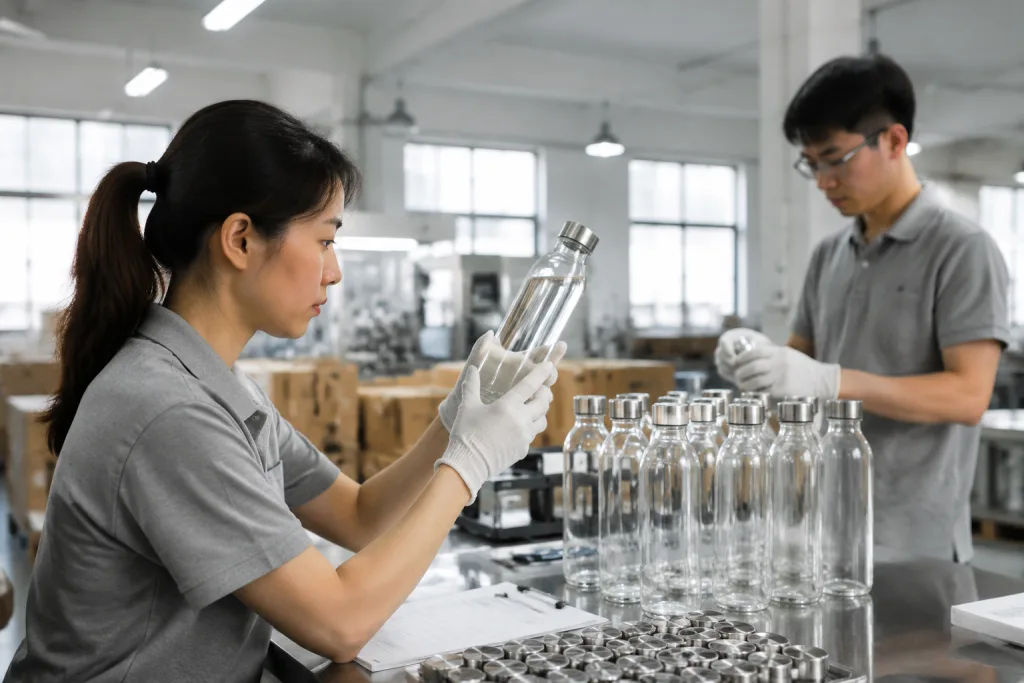
QC is not a slogan on the wall. It is paperwork, checkpoints, and one person signing each gate. For a borosilicate glass bottle custom order, the PO should spell out inspection points, defect limits, and who signs off at every stage. We had a buyer flag a missing line for neck finish tolerance once, and the whole lot sat for 3 days while we rechecked the caliper records. If the factory has its own quality team, good. If not, hire a third-party inspector in China before shipment, especially on the first two runs. New buyers ask for a cheaper PO; that is the wrong question to ask.
Use a practical QC setup:
- IQC for raw tube, caps, and decoration materials.
- IPQC on forming, annealing, and print alignment.
- FQC with AQL 2.5 major, 4.0 minor as a starting point.
- Pre-shipment inspection on random cartons from the top, middle, and bottom of the stack.
A reliable borosilicate glass bottle factory in Zhejiang can usually support 25,000 to 80,000 pcs per month, depending on mold count and decoration complexity. We run this against the annealing line and the silk-screen booth, not on a sales promise. Ask for monthly capacity, sample lead time, and whether they can keep the same glass source across reorders. QC pulled the sample on a 2 mm mouth-ring deviation last month; that is the kind of thing that saves a claim later. Consistency is the real product.
Price the order like a buyer, not a shopper
The wrong way to buy is to compare only unit price. A borosilicate glass bottle supplier may quote USD 1.05 on the bottle and hide cost in decoration, packaging, or a cap MOQ that jumps to 20,000 pcs. We run quotes by the full landed program: FOB unit cost, mold amortization, inner box, carton, pallet, inspection, and ocean freight. For a simple 500 ml bottle, a real program often lands around USD 1.20-2.80 FOB, depending on print method and closure. That range is normal. What matters is what sits inside it.
Questions to ask before you commit:
- MOQ: is it 3,000 pcs, 5,000 pcs, or 10,000 pcs per SKU?
- Lead time: is the production window 25 days, 35 days, or 42 days?
- Mold ownership: who owns it after deposit?
- Reorder stability: can the factory hold dimensions within the same tolerance on the next batch?
There are plenty of borosilicate glass bottle manufacturers and borosilicate glass bottle suppliers in China, but the useful ones answer these questions directly. QC pulled the sample on a 0.8 mm wall check before shipment; that is the kind of detail that tells you whether the line is controlled. In Zhejiang, better factories will also tell you where they see risk. That's the right question to ask, because a low opening quote that changes at packing time is not a bargain.
Send your bottle spec for a quote
We can review your dimensions, decoration, and packaging, then quote a borosilicate glass bottle wholesale program with realistic MOQ and lead time.
Frequently asked questions
What MOQ should I expect for a custom borosilicate glass bottle?
For a new mold or a new decoration setup, expect 3,000-10,000 pcs per SKU. If you want a custom lid, frosted finish, and printed logo, the MOQ usually rises because the factory must cover setup and scrap risk. A simple reorder from the same mold can sometimes drop lower, but do not plan a launch around that. For a borosilicate glass bottle oem factory china, the practical MOQ is tied to line efficiency, not just the glass itself.
How do I check if the bottle is really borosilicate?
Ask for a written material declaration, production photos, and a sample test plan. For serious programs, request thermal shock testing and confirm the bottle behavior under hot-to-cold transitions. You can also request a basic composition statement from the borosilicate glass bottle manufacturer. If the factory avoids specifics and only says “heat-resistant glass,” treat that as a warning. For exports to Europe and North America, documentation matters as much as the sample.
What lead time is normal from China?
A realistic lead time is 25-40 days after sample approval for a standard custom glass water bottle program. Add time if you need new molds, special decoration, or a complex cap system. Shipping from Zhejiang to your warehouse will add ocean transit plus customs clearance, so your calendar should include at least 6-9 weeks from PO to port arrival in most cases. Fast promises are common; stable delivery is rarer.
Which QC standard should I use?
Use AQL 2.5 for major defects and 4.0 for minor defects as a starting point, then tighten it if your brand is premium or if the item is fragile in retail packaging. You should also define 100% checks for rim chips, severe scratches, and obvious cracks. A borosilicate glass bottle factory that understands export work will accept a clear defect matrix. Without that, inspectors end up arguing over opinion instead of measuring defects.
Can I sell these bottles through distributors and retail channels?
Yes, but your spec has to be distributor-friendly. A borosilicate glass bottle distributor or distributor glass water bottle buyer will care about breakage rates, packaging efficiency, and reorder consistency. If you plan wholesale, make sure the bottle, cap, and carton sizes fit pallet patterns and shelf economics. For Europe and North America, keep food-contact declarations, carton labels, and shipment documents organized from the first batch so your distributor borosilicate glass bottle program does not stall at receiving.