Key Takeaways
- A 550 ml borosilicate bottle normally uses 1.8-2.2 mm wall thickness and a 2,000-3,000 pcs MOQ for custom color parts
- Borosilicate glass bottle bulk pricing is usually driven more by cap, sleeve, and packaging than by the glass body alone
- For EU and North American retail, ask for LFGB or FDA food-contact documents plus REACH checks on silicone and coatings
- AQL inspection should include mouth chips, cap leakage, print abrasion, carton drop testing, and barcode scan checks
A glass bottle looks simple on a retail shelf. The PO behind it is not. For a wellness brand or sustainable retail range, you are buying wall thickness in mm, cap thread fit, silicone sleeve tolerance, print adhesion, 5-ply carton strength, and AQL defect risk. Miss one line on the spec sheet and your “eco premium” product can land with loose lids, chipped mouths, or sleeves that smell like rubber. QC pulled one 550 ml sample last month where the mouth chip was only 1.2 mm, but the buyer still flagged it. Fair call.
As a borosilicate glass bottle manufacturer in Zhejiang, China, we see the same mistake about 8 times a month: buyers ask first about logo and price, then discover later that annealing time, thermal shock testing, and 1.2 m packaging drop tests decide whether the order makes margin. A useful custom glass water bottle RFQ should read like an engineering sheet, not a mood board. “Can you make it look premium?” is the wrong question to ask; send the capacity, diameter, cap material, print method, sleeve hardness, MOQ, and target carton weight, then the line can quote without guessing.
Start with glass grade
The first spec line should not be capacity or logo. Put glass composition first. For a borosilicate glass bottle supplier, the buyer-facing claim usually sits on high borosilicate glass, often around 3.3 expansion coefficient glass. On the line, we check this before artwork, because thermal expansion is what shows up when a customer pours hot tea, adds cold fruit water, or puts the bottle through a dishwasher cycle.
Standard soda-lime glass costs less and works for jars, but it is not the same product. If you sell a customizable glass water bottle into wellness retail, borosilicate gives you a cleaner technical claim: better thermal shock resistance, lighter wall options, and a more premium hand feel. Still glass. It breaks on tile. Do not accept “unbreakable” wording from any borosilicate glass bottle vendor; we have seen that phrase flagged by a buyer’s compliance team and it turns into return risk fast.
For most custom borosilicate glass bottle programs, we quote 500 ml, 550 ml, 650 ml, and 750 ml first. A 550 ml bottle commonly uses 1.8-2.2 mm wall thickness, with mouth diameter from 35-45 mm depending on whether you need fruit infusing, ice cubes, or a narrow drinking profile. A wider mouth cleans better with a bottle brush, but it also changes cap tooling and the feel in hand. QC pulled one 550 ml sample last month at 2.45 mm on the shoulder, and the weight jumped enough for the buyer to notice in the carton cost.
Ask the borosilicate glass bottle factory to state glass type, wall thickness tolerance, bottle weight tolerance, annealing process, and intended use temperature. A useful RFQ line looks like this: “High borosilicate glass, 550 ml, wall 2.0 mm ±0.2 mm, heat resistant for common beverage use, dishwasher-safe glass body, silicone sleeve optional.” That one sentence blocks 6 out of 10 cheap but wrong quotations we see, especially when a PO typo says “glass cup” instead of “borosilicate bottle.”
Capacity changes more than volume
Capacity is not just a number on the product page. It drives carton size, freight cube, shelf facing, sleeve mold, and how the end user actually carries the bottle. A 350 ml bottle fits handbag retail and yoga studios. A 550 ml bottle is the safer mainstream size for wellness brands because the body height still works with most cup-holder claims and standard neoprene sleeve cutting dies. A 750 ml or 1,000 ml bulk glass water bottle looks practical for office and gym, but the packed carton gets heavy fast; QC pulled one 1,000 ml sample last May after the corner crush test because the inner divider was only 1.5 mm E-flute.
Buyers comparing borosilicate glass bottle wholesale offers often put a 500 ml bottle from one China factory beside a 550 ml bottle from another and call the price gap unfair. Sometimes it is. Often the math is different. Extra height can mean a thicker export carton, a larger silicone sleeve, 18 mm more print area, and a higher CBM charge. We had one buyer flag a USD 0.09 FOB gap, then ignore the carton cube; ocean freight added more than USD 0.14 per bottle on the taller spec.
At our Zhejiang production partner lines, a common export carton for sleeved 550 ml bottles is 24 pcs per master carton. Depending on the sleeve and gift box, that carton may land near 13-16 kg gross weight. Move to 750 ml with individual retail boxes and the line may need 12 pcs instead of 24 pcs to pass a reasonable drop test. Simple change. Big cost. That doubles handling, adds more carton labels for the warehouse team, and changes the landed cost calculation before the PO even reaches production.
For a distributor glass water bottle program, keep the first range tight. Two capacities and three colorways are easier to sell through than six shapes with shallow stock, and we have seen this go sideways when a buyer launched 18 SKUs with only 300 pcs per SKU. If you are a borosilicate glass bottle distributor serving independent sustainable stores, 500-550 ml is the easiest reorder size. If you sell corporate wellness kits, 650-750 ml gives stronger perceived value, but check gift box dimensions before promising kit pricing; a 2 mm artwork bleed error on the PO can be the difference between a clean insert fit and a box that bulges on the packing table.
Caps decide daily complaints
The cap is where 7 out of 10 customized glass water bottle complaints start in our after-sales file. The glass body can pass annealing and thickness checks, but one bad thread, loose gasket, or bamboo insert with poor glue control will cause leakage. A borosilicate glass bottle custom order should name cap material the same way it names glass material: PP, stainless steel outer shell, bamboo top, acacia wood, silicone gasket, or a defined mixed construction. On the line, we check thread fit with a go/no-go sample bottle before mass packing.
Bamboo caps look sustainable and sell well in wellness retail. They also change by grain, color, and moisture. If your brand wants the same cap color across 5,000 pcs, bamboo is the wrong promise. Set an acceptable shade range instead. Natural material will not behave like injected plastic. We once had a buyer flag “two colors” in one carton; QC pulled the sample and it was normal bamboo variation, not a production defect. For EU sales, check the wood coating and adhesive against food-contact expectations, while silicone gaskets should be LFGB or FDA-grade depending on market.
Leak testing belongs in the purchase order. We run 100% inline water leak check for screw caps and an AQL final check after packing. A practical method is filling the bottle to 80-90%, tightening the cap to normal hand torque, inverting it for 30 minutes, then checking seepage around the gasket and thread. Simple test. Big difference. For sports flip lids, add shake testing because hinge and vent designs fail in another way; our QC table uses a 30 cm hand-shake cycle before the carton is sealed.
Do not approve a cap only from renderings. Ask your borosilicate glass bottle suppliers for pre-production samples with the final gasket hardness, final cap finish, and final thread. A cap that works on an empty sales sample can still fail after hot-fill simulation or 10 dishwasher cycles, and we have seen this go sideways when the PO said “same as sample” but the gasket hardness was never written down. If you want a borosilicate glass bottle promotional giveaway, a basic PP cap may be fine. If you want premium retail at USD 18-25 shelf price, the cap needs more engineering attention than the logo.
Customization has price tiers
“Custom” is too broad for sourcing. On our line, a one-color logo, a silicone sleeve in a matched shade, a cap engraving, a new bottle mold, and a fully exclusive shape all sit in different cost brackets. QC pulled the sample and checked the print placement with a 0.5 mm gauge. A buyer will ask for “one custom bottle” and then get surprised by the tooling line item. That is the wrong question to ask.
For a standard bottle with one-color screen print, MOQ starts around 1,000-2,000 pcs per design if the glass shape is already in stock. A custom silicone sleeve color usually sits at 2,000-3,000 pcs per color because pigment matching and sleeve runs need batch efficiency. A new glass mold is 10,000 pcs or more, with tooling cost often from USD 1,500-5,000 depending on shoulder shape, base thickness, and wall transitions. We have seen buyers push for 300 pcs and a new mold. The math does not work.
Logo methods have to fit the product, not the other way around. Screen printing is a good fit for solid marks, but fine gradients break down fast. Heat transfer gives more color, and we run abrasion tests with a Scotch-Brite pad before we sign off. Laser engraving works on stainless caps or some coated parts; it is not a cure-all for glass bodies. Decals can look premium, but if the kiln curve is off or the ink batch is weak, dishwasher claims fail fast. QC has caught that on the first burn.
For wellness and sustainable retailers, I tell buyers to keep the glass body standard on the first order and put the brand money into sleeve color, cap material, retail box, and the story on the carton. You get faster sampling, lower tooling risk, and cleaner reorders. A strange shape is not what makes a bottle feel proprietary. We ship cleaner when the body stays fixed, and the buyer stops worrying about a 20-day mold delay. What matters is a cap that seals, color that matches, and packaging that survives the route.
Our typical lead time in Zhejiang, China is 25-35 days after sample approval for 3,000-10,000 pcs using existing bottle shapes, and 45-60 days when new tooling or custom retail packaging is involved. Peak season can add 7-14 days, especially before major holiday shipment windows. On one recent PO, the buyer typed the carton height as 240 mm instead of 2400 mm, and the packing spec had to be fixed before the line could start. That kind of typo burns a day fast.
Packaging is part of the product
Glass bottle packaging is not decoration. It is damage control. A borosilicate glass bottle bulk order that saves USD 0.12 on packaging can lose USD 1,800 on a 10,000 pcs shipment through breakage, retailer chargebacks, or one-star reviews. We have seen this go sideways. The right pack depends on the sales channel: e-commerce single parcel, retail shelf display, distributor case pack with 24 pcs per carton, corporate gifting, or Amazon-style fulfillment. Last month QC pulled the sample after a 72 mm bottle rubbed through a thin white box during vibration testing.
For retail, we usually run individual color box plus inner partition plus five-layer export carton. For e-commerce, use an individual mailer or molded pulp support with a tighter neck hold; a loose 3 mm gap at the shoulder is enough to create chips. For a borosilicate glass bottle distributor shipping mixed cartons to stores, barcodes and carton labels matter as much as cushioning. If warehouse staff cannot spot color and capacity in 5 seconds, your cartons get opened, mixed, taped again, and damaged. The buyer flagged this once because “amber 750 ml” was printed as “amber 570 ml” on the PO label.
Drop testing should match the real route. A full master carton can be tested from 60-80 cm depending on gross weight and buyer standard. Single retail boxes for parcel channels may need 90-120 cm testing, especially if they ship without outer protection. If your supplier says “no problem” but cannot tell you carton burst strength, flute type, or test height, keep asking. This is the wrong question to ask: “Is the carton strong?” Ask for the ECT value, carton paper grade, and photos after the corner-drop test.
Print the packaging spec line clearly: box material, GSM, corrugated flute, inserts, carton size, gross weight limit, barcode type, warning label, recycling mark, and country-of-origin wording. For North America, 8 out of 10 retail buyers ask for scannable UPC and clean product claims before they release packing approval. For EU, make sure recycling symbols and language requirements are reviewed by your importer. A borosilicate glass bottle manufacturers list may show 60 factories, but maybe 12 can handle packaging engineering and export labeling without weekly buyer correction. We ship better when the spec sheet says “K=K five-layer carton, 12 kg max gross weight” instead of just “strong carton.”
Testing should be named
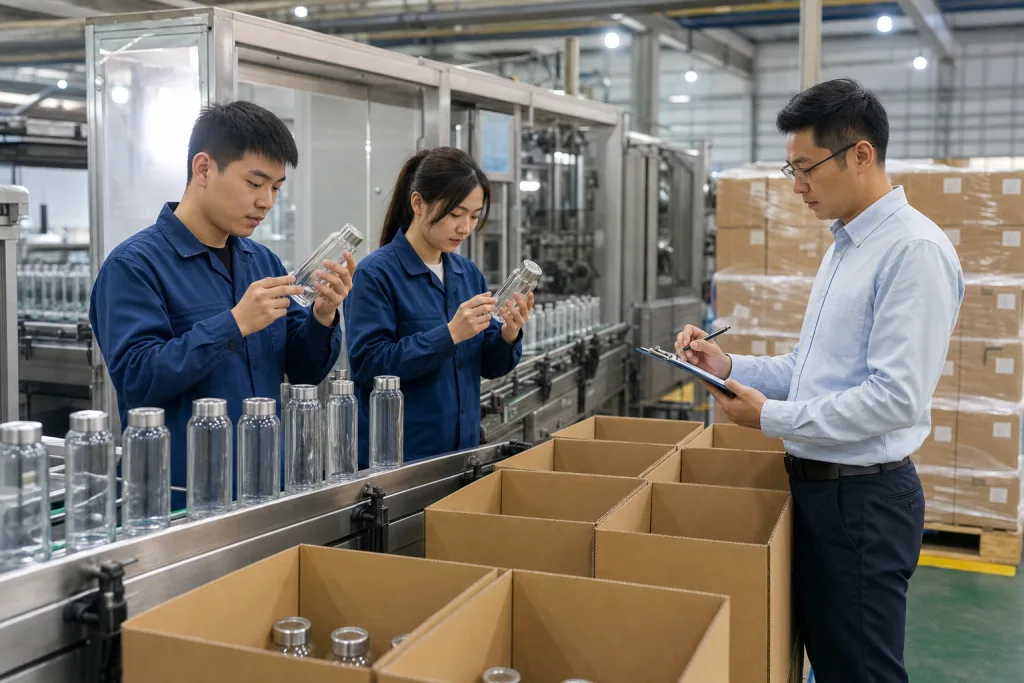
Do not write “quality as approved sample” on the PO and think you are covered. That line is too weak. Approved samples help, but bulk production needs measured checkpoints: incoming glass tube OD checked with a digital caliper, inline checks every 2 hours, and final AQL inspection before shipment. A serious borosilicate glass bottle supplier should accept incoming material checks, inline inspection, and final AQL inspection before shipment.
For glass bottles, inspect mouth chips, cracks, bubbles, stones, deformation, capacity, weight, print position, print adhesion, sleeve fit, cap torque, leakage, odor, and packaging. We usually set bubble limits in mm and position, not “looks okay”; for example, 1 bubble under 1.0 mm on the body may pass, while any bubble near the rim gets pulled. Sharp chips on the mouth are not acceptable. QC pulled 32 samples from one line last year where the bottle looked fine, but the silicone sleeve sat 3 mm too low after packing. A buyer who does not define defect levels leaves the call to the factory inspector, and for retail goods that is the wrong question to ask.
AQL 2.5 for major defects and 4.0 for minor defects is common for general drinkware, though premium retail may ask for tighter inspection. Critical defects should be zero tolerance: broken glass, sharp edges, contamination, or serious leakage. If you sell to children or family retailers, you may also need ASTM or CPSIA-related review depending on design, age grading, decoration, and market claims. For food-contact, request FDA or LFGB test reports for glass, silicone, plastic, coatings, and inks as relevant. For EU sustainable retail, REACH and packaging waste compliance are not optional paperwork. We have seen this go sideways when the buyer approved the bottle body report but forgot the ink report for a 1-color logo print.
Factory audits also matter. BSCI, Sedex, ISO 9001, or buyer-specific audits can support distributor borosilicate glass bottle programs where retailers ask about social compliance. Not every borosilicate glass bottle factory will hold every certificate, and some certificates belong to a trading company rather than the production site. Ask whose name and address appear on the report. Check the address against the business license and the carton shipping mark; one typo on a PO can turn into 12 days of document chasing before booking. That small detail avoids awkward documentation problems later.
Costing must be landed
FOB unit price is one line on the costing sheet. For borosilicate glass bottle vendors, the quote can look sharp at USD 2.40 until the buyer adds the gift box, silicone sleeve, logo screen setup, pre-shipment inspection, Yiwu-to-Ningbo trucking, ocean freight, duty, breakage allowance, local 3PL handling. We had one wellness brand push back on a 500 ml bottle because their margin was built on FOB USD 2.40; after freight and handling, the landed cost sat at USD 4.10-4.80. The math did not work. QC also pulled 9 cracked inner boxes from a drop-test sample that week, so cutting the carton spec was the wrong question to ask.
For reference, a standard 500-550 ml borosilicate glass bottle wholesale project from China might quote around USD 1.80-3.20 FOB depending on cap type, sleeve weight in grams, print method, retail packaging. A bamboo cap with a silicone gasket, 1.2 mm silicone sleeve, and 350 gsm color retail box pushes the price upward. A clear bottle with PP cap and one-color logo sits lower. A fully customized glass water bottle with new mold, premium box, multi-color decoration belongs in a different budget; we run that as a project, not a quick stock quote.
Ask your borosilicate glass bottle manufacturer for a line-by-line quotation: glass body, cap, gasket, sleeve, logo, box, master carton, tooling, sample fee, MOQ, lead time, payment terms, HS code suggestion. If you are a distributor borosilicate glass bottle buyer, ask for tier pricing at 2,000, 5,000, and 10,000 pcs, then check where the cost break comes from. Sometimes 5,000 pcs saves only USD 0.08, while 10,000 pcs saves USD 0.25 because the carton order hits the paper mill MOQ, the sleeve line runs fewer color changes, and cap purchasing moves into a full-batch price. We have seen this go sideways when a PO typo showed 5,000 gift boxes but 10,000 bottles.
At BottleForge Industrial, our drinkware network capacity exceeds 300,000 units per month across stainless steel, glass, and plastic lines, but glass scheduling still needs discipline because annealing, packaging, and inspection cannot be rushed safely. Send a complete spec sheet first: bottle height in mm, mouth diameter, cap material, sleeve Pantone, logo size, carton drop-test requirement. Then negotiate. You will get a cleaner price, a lead time we can defend, and fewer surprises when the container leaves Zhejiang.
Send your glass bottle spec sheet for review
We will check MOQ, compliance, packaging, and FOB China cost before you lock the design or promise retail delivery dates.
Frequently asked questions
What MOQ should I expect for borosilicate glass bottle bulk orders?
For existing bottle shapes, a realistic MOQ is usually 1,000-2,000 pcs for a simple one-color logo and standard cap. If you need a custom silicone sleeve color, MOQ often moves to 2,000-3,000 pcs per color. New glass molds normally start around 10,000 pcs because tooling, trial production, annealing setup, and defect sorting need volume. Some suppliers quote 500 pcs, but the unit price is high and customization choices are limited. For a first wellness retail launch, 3,000 pcs across one capacity and two colors is usually more practical than spreading 3,000 pcs across six SKUs.
Is borosilicate glass really better for a custom glass water bottle?
For reusable drink bottles, borosilicate glass is usually the better choice if your retail story includes tea, fruit water, clean taste, and premium clarity. It handles temperature change better than ordinary soda-lime glass and can be made relatively light while keeping good strength. That said, it is not unbreakable. You still need proper wall thickness, annealing, carton protection, and clear customer warnings. A 550 ml bottle with 2.0 mm wall thickness and a protective silicone sleeve is a common balance. If your product is only for cold beverages and extreme low price matters, soda-lime glass may be considered, but the positioning is different.
Which logo method works best on a customized borosilicate glass bottle?
For most orders, one-color or two-color screen printing is the safest starting point. It is cost-effective, clean, and works well on straight bottle walls. Heat transfer can handle more color but should pass abrasion and dishwasher simulation before you claim durability. Decals can look premium, but they add process risk and cost. Laser engraving is better for stainless steel caps, bamboo caps, or coated metal parts than for clear glass decoration. For a borosilicate glass bottle promotional project, keep the logo under 60 x 80 mm if possible. Large wraparound prints require better bottle roundness control and stricter print alignment checks.
What tests should I request before shipment from China?
At minimum, request AQL final inspection, leak testing, visual glass inspection, logo adhesion check, sleeve fit check, and packaging drop test. AQL 2.5 major and 4.0 minor is common for drinkware, with zero tolerance for sharp glass, cracks, contamination, or serious leakage. For food-contact compliance, ask for FDA or LFGB reports for glass, silicone, plastic, coating, and ink where relevant. For EU retailers, REACH review is important for sleeves, coatings, and packaging inks. If the bottle will ship through parcel networks, test the individual retail box as well as the master carton. Many failures happen after the factory, not inside it.
How long does a borosilicate glass bottle custom project take?
For an existing bottle shape with standard cap, logo, and retail packaging, plan 25-35 days after sample approval and deposit. Sampling often takes 7-12 days if components are available. Custom sleeve colors, custom cap finishes, or special packaging can add 7-15 days. New glass tooling usually pushes the schedule to 45-60 days before mass shipment, assuming the first mold trial is acceptable. Add ocean freight time separately: roughly 25-40 days to many North American or European ports, depending on routing. If you need launch inventory by a fixed retail date, approve the spec sheet before discussing final artwork details.