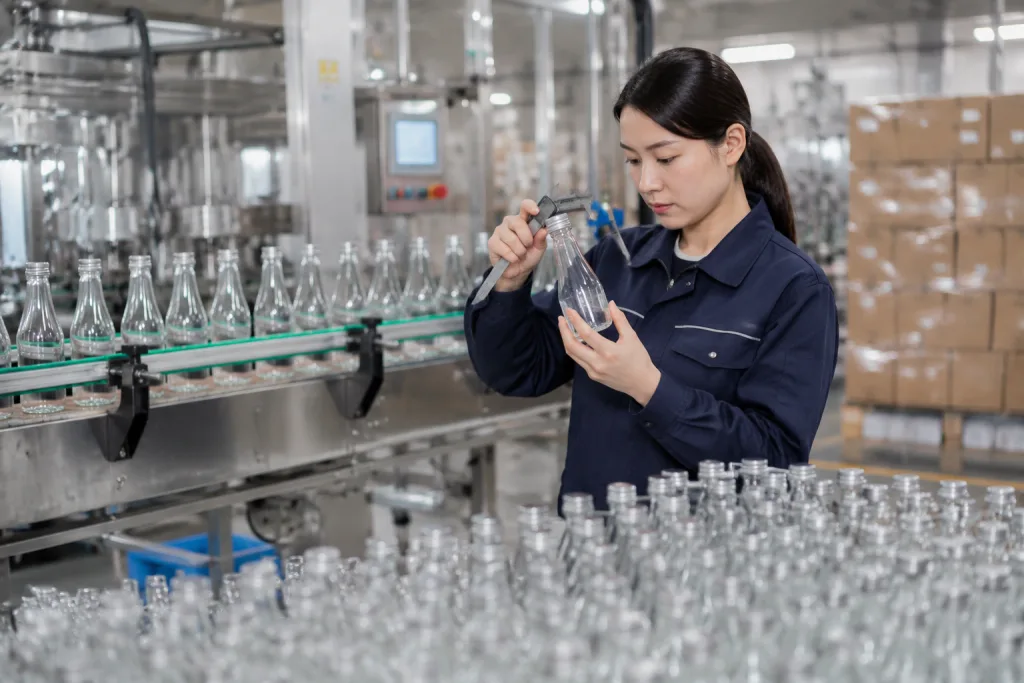
Key Takeaways
- MOQ for a custom borosilicate glass bottle typically starts at 3,000-5,000 pcs per SKU
- A workable lead time is 25-35 days after sample approval and deposit
- Ask for AQL 2.5/4.0 inspection, REACH declarations, and drop-test data before you approve bulk
- Decoration costs often range from USD 0.18-0.85 per piece depending on print method and coverage
If you buy drinkware for a wellness brand or a sustainable retail line, borosilicate glass looks simple until you start sourcing it at scale. The bottle is only half the job. The real risk sits in wall thickness, closure fit, print wear, breakage, and whether your supplier can hold tolerance across a 5,000-unit run. We have seen a clean pre-production sample go sideways once the line starts running 12 mm necks against a loose spec, and that is the wrong place to find out.
Buying a borosilicate glass bottle in bulk needs a step-by-step sourcing process, not a loose email chain. If you work with a borosilicate glass bottle factory in Zhejiang or another export hub in China, push the job from RFQ to sample to PO line items with hard numbers. That is how you get better pricing, fewer surprises, and a custom glass water bottle you can ship, reorder, and scale without chasing leak complaints later.
Start With the RFQ Sheet
I’ll keep the HTML exactly as-is and rewrite only the prose to sound like a field-tested buyer/sales engineer. Next I’m tightening the RFQ language, adding concrete sourcing details, and trimming the AI-ish phrasing.Good sourcing starts with a clean RFQ, not a long chat thread. If you want a borosilicate glass bottle bulk quote you can compare line by line, state the bottle size, target capacity, wall thickness, closure type, lid material, decoration method, packaging style, and annual forecast. A supplier cannot price a customizable glass water bottle off a photo and a “similar size” note; we run into that every week, and the quote falls apart once the real spec shows up.
For a serious buyer, the RFQ should include:
- Capacity: 350 ml, 500 ml, 650 ml, or 750 ml
- Glass spec: borosilicate 3.3, wall thickness 1.2-1.8 mm
- Closure: bamboo lid, PP lid, stainless lid, or silicone sleeve
- Decoration: silk screen, decal, frosted finish, laser mark
- Target order: 3,000 pcs, 5,000 pcs, or 10,000 pcs
If you work with a borosilicate glass bottle supplier in China, ask for FOB Ningbo or FOB Shanghai pricing, not just ex-factory. Zhejiang suppliers usually quote fast because the glass plant, cap factory, and carton mill sit within the same shipping radius. A proper RFQ lets a borosilicate glass bottle manufacturer show where the price moves: mold, print colors, lid tooling, or carton spec. That is the real question, and we’ve seen buyers waste a week because the first quote hid the lid upgrade.
Ask for the price broken out by bottle, lid, insert, carton, and decoration. If the quote is bundled, you lose leverage on every change request.
Choose the Right Bottle Spec
I’ll rewrite this section in-place, keep the HTML unchanged, and make the copy read like a factory-side sales engineer wrote it.Do not start a borosilicate glass bottle custom project from the prettiest sample. Start from use case. A wellness brand usually wants a light bottle for cold brew, lemon water, and desk carry. A retail buyer often asks for a thicker body, a sleeve, and a carton that survives 1.2 m drop testing. The spec has to fit the channel.
Borosilicate glass handles heat better than soda-lime glass, but the math still matters. We run 500 ml bottles at about 1.5 mm wall and a 42 mm neck for daily use. Go thinner and impact resistance drops; go thicker and freight climbs fast. A Hangzhou buyer once pushed for a 1.2 mm wall to save cost, then QC pulled the sample after the corner chip test. That is the wrong question to ask if the bottle is going into bulk export.
For bulk glass water bottle orders, lock three points first: neck finish, lid sealing method, and decoration zone. Those are the items that cause returns, not the artwork. A bad thread or weak gasket will turn into leakage claims on the first carton. We’ve seen that go sideways on a 20,000-piece PO because the buyer flagged a typo on the cap spec and the line ran the wrong insert for two days.
Approve Samples Before Tooling
I’ll rewrite the section in-place, keep the HTML exactly as-is, and tighten the language so it reads like a factory-side sales engineer wrote it. Next I’m checking for any repo-specific instructions, then I’ll patch the prose.I’ve got the target text. No code logic here, so I’m doing a clean prose rewrite only and preserving the tag structure and list order.Do not skip samples just because the quote looks fair. A borosilicate glass bottle for retail should go through 2 rounds: an appearance sample and a pre-production sample. The first one checks shape, capacity, print position, and cap feel. The second one checks production risk on the line—color match, gasket compression, and carton fit.
Ask the borosilicate glass bottle manufacturer to put every sample line item in writing. We mean sample bottle cost, courier cost, mold cost if any, and sample lead time. For standard references, sample charges usually sit at USD 50-150; custom molds or a special lid can add USD 200-800, depending on the parts. If the vendor will not say what is free and what is chargeable, the math does not work.
Test the sample like you mean it. Fill it with water at 95°C, leave it overnight, check for seal deformation, then run a 1-meter drop test on carton-packed units. We’ve seen buyers skip the hot-fill test and then the gasket shrinks in transit. A borosilicate glass bottle distributor can talk about bulk consistency all day, but approval has to rest on numbers, not sales talk. In Zhejiang, the better factories know this and QC pulled the sample the same day.
- Confirm printed logo position within ±2 mm
- Check lid torque and leak resistance after 24 hours
- Measure actual capacity against claimed capacity
- Verify outer carton stack strength if you ship by sea

Lock the PO Line Items
The purchase order is where a lot of buyers bleed margin because they treat it like paperwork. On a borosilicate glass bottle wholesale order, the PO needs line-item detail. Bottle body, lid, gasket, sleeve, deco, inner box, master carton, and export marks should each sit on their own line or a clean sub-line. If the vendor later says the sleeve was “not included,” the paper trail should shut that down fast.
At minimum, the PO should state:
- Product name and SKU
- Quantity and tolerance, such as 5,000 pcs ±3%
- Unit price and Incoterms, usually FOB or CFR
- Packing spec, carton quantity, and drop-test requirement
- Quality standard, such as AQL 2.5 major / 4.0 minor
- Inspection method and third-party acceptance
For a customized glass water bottle, we also put the artwork approval version, Pantone code, and approved sample reference number on the PO. That avoids back-and-forth when the buyer flags a color shift on the line. If you are buying through a borosilicate glass bottle distributor instead of a direct factory, ask who owns production. Trader of record or actual factory? That is the question.
In Zhejiang, a direct factory usually gives tighter control on lead time and pack changes. We run 25-35 days after sample approval and deposit when the lid is standard and the decoration is not complicated. QC pulled the sample, the cap thread checked out, and the line stayed on schedule.
Price the Real Landed Cost
The unit price only matters after you price the full landed cost. A custom glass water bottle that shows USD 1.12 FOB can land near USD 1.65 once you add cartons, palletizing, inland freight, and inspection. We see this all the time on the line. For a borosilicate glass bottle promo run tied to a wellness launch, a buyer will accept a higher unit price if the carton holds up and the damage rate stays under 1.5%.
Use a working range, not a wish list: plain bottle USD 0.85-1.35, lid USD 0.18-0.55, sleeve USD 0.20-0.60, one-color print USD 0.08-0.18, frosted finish USD 0.12-0.30. Add a special mold or a thick bamboo lid with laser branding, and the math moves fast. QC pulled the sample on a 2 mm wall bottle and the buyer flagged a PO typo on carton count, which would have changed the landed cost anyway. If you compare borosilicate glass bottle suppliers, force the same carton count and pallet standard, or the quote is noise.
Distributors chase margin per piece. Retailers watch damage rate, repack labor, and whether the next order ships on time. That is the wrong question to ask: “What is the cheapest bottle?” A distributor glass water bottle program needs reserve stock, and for a 20,000 pcs forecast I’d rather ship 5,000 pcs per release with a locked repeat mold than overbuy once and jam the warehouse.

Inspect, Ship, Reorder
The last step is not shipping. It is checking whether the order can be repeated without drama. Before release, ask for a pre-shipment inspection with random carton photos, drop-test proof, and a count check against the PO. We run AQL 2.5 for major defects, but for retail-facing custom borosilicate glass bottle shipments, define cosmetic rejects up front. A 2 mm bubble in the base might pass. A neck chip will not.
For export from Zhejiang or other China manufacturing hubs, ask for:
- Commercial invoice matching PO SKU names
- Packing list with carton dimensions and gross weight
- REACH and food-contact declarations if your market needs them
- FSC or recycled packaging statements if your brand claims them
If you plan to scale, keep one golden sample, one sealed pre-production sample, and one signed artwork proof in your own file cabinet. QC pulled the sample twice on a 1,200-piece order when the buyer flagged a PO typo in the carton mark, and that saved a week. Reordering gets messy when a borosilicate glass bottle distributor or factory changes hands internally, so keep your own paper trail. You are not buying a one-off item; you are building a repeatable supply line.
For brands that ship through Amazon or similar channels, carton labeling and FNSKU prep should be settled before production starts. A borosilicate glass bottle distributor that knows retail logistics saves real time; the line moves faster when labels, inner box counts, and pallet size are fixed before the first carton is taped. If they cannot pack for pallet optimization, they are the wrong fit for scaled wholesale programs.
Send your RFQ and get a factory quote
Share your capacity, lid, artwork, and target MOQ. We’ll quote your borosilicate glass bottle in bulk with clear line items and lead time.
Frequently asked questions
What is the usual MOQ for a borosilicate glass bottle in bulk?
For standard shapes, MOQ is usually 3,000-5,000 pcs per SKU. If you need a custom mold, expect 5,000-10,000 pcs to make the tooling worthwhile. A simple logo change on an existing body can sometimes stay at 3,000 pcs. In Zhejiang, many factories quote faster when the lid and carton are standard. If you ask for a fully custom lid, sleeve, and print package, the MOQ rises because each component has its own setup cost.
How much does a custom borosilicate glass bottle cost?
A plain bulk borosilicate glass bottle often sits around USD 0.85-1.35 FOB depending on size and wall thickness. Add USD 0.18-0.55 for the lid, USD 0.08-0.18 for one-color printing, and USD 0.20-0.60 for a sleeve. A more customized borosilicate glass bottle with frosted finish or premium packaging can move above USD 1.60 FOB. The exact number depends on capacity, decoration, and carton spec, not just the glass itself.
How long does bulk production take in China?
A normal lead time is 25-35 days after sample approval and deposit. If the shape is existing and the decoration is simple, some Zhejiang suppliers can ship faster. Custom mold work adds time: usually 15-30 days for tooling, then another 25-35 days for mass production. If you are ordering near peak season, add a buffer because bottle making, lid production, and carton printing do not always move at the same speed.
What quality checks should I require?
Ask for AQL 2.5 major / 4.0 minor, a leak test, carton drop testing, and dimensional checks on neck finish and capacity. For glass, you should also confirm wall thickness and visible defect limits. A good borosilicate glass bottle manufacturer should provide a pre-shipment report with photos, carton count, and random sample results. If you sell in Europe or North America, request REACH or food-contact declarations where applicable.
Should I buy from a factory or distributor?
If you need speed and a standard bottle, a borosilicate glass bottle distributor can be convenient. If you need consistent pricing, repeatability, and better control over tooling, a direct borosilicate glass bottle factory is usually stronger. In China, especially Zhejiang, direct factories are often better for custom work because they control production and packaging. Distributors are useful when they already stock the body you want and can bundle smaller MOQs, but they can be less transparent on true production cost.