Key Takeaways
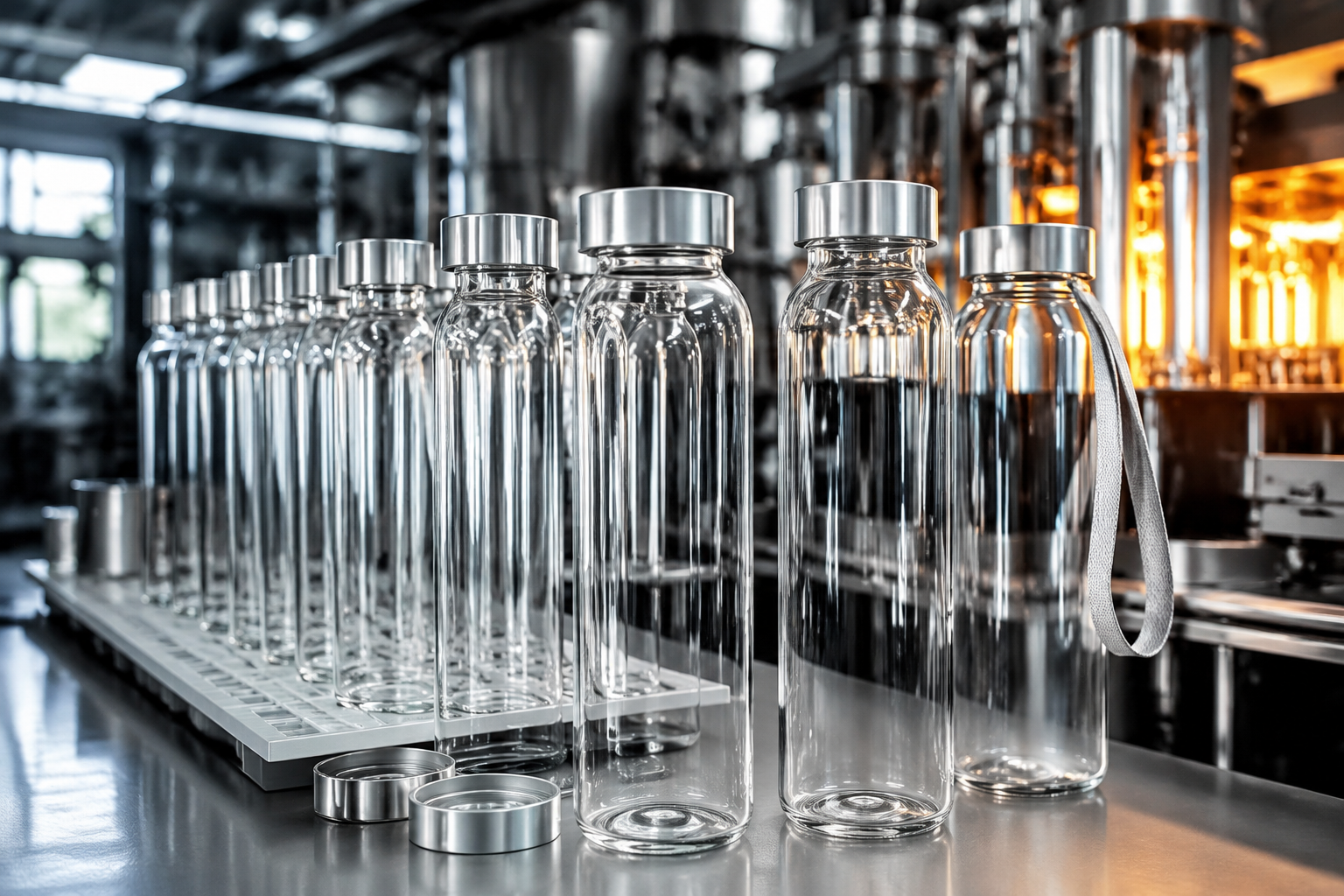
- A 350 ml borosilicate glass bottle usually weighs 180-260 g, with MOQ often starting at 1,000-3,000 units.
- For promotional gifts, a 2.0-2.5 mm wall and a PP or bamboo lid usually give the best balance of cost and durability.
- FOB China pricing for a custom borosilicate glass bottle often lands around USD 1.20-3.80, depending on print, lid, and packaging.
- Expect 25-35 days for production after sample approval from a qualified glass bottle factory in Zhejiang or elsewhere in China.
You are not buying a pretty bottle. You are buying a promo item that has to survive freight, print cleanly, feel premium in hand, and stay out of the complaint pile six weeks after launch. That is why a borosilicate glass bottle for promotional gifts usually fits better than soda-lime glass when the brief says “sustainable,” “giftable,” and “brand-safe.”
The catch is simple: glass sourcing punishes vague specs. Ask for a custom glass water bottle and suppliers in China or Zhejiang will quote different wall thickness, lid quality, and decoration methods. A serious borosilicate glass bottle manufacturer should give you the wall thickness, thermal shock range, MOQ, and test standard before you send a deposit. We run into this all the time on the line, and the buyer flagged it fast when a 1.2 mm bottle came back against a 1.8 mm PO callout. That is the level you need if you want a promotional gift that still looks good after export, warehousing, and end-user handling.
Spec table: what actually changes
If you compare borosilicate glass bottle options the right way, the decision gets easier fast. The bottle is only one line on the spec sheet. Lid type, capacity, wall thickness, print method, and packaging can move landed cost more than the glass grade. For wellness brands and sustainable retailers, the real question is not “glass vs glass.” It is which bottle hits gift expectations without pushing breakage, margin, or lead time out of line.
| Spec | Good promo range | Why it matters |
|---|---|---|
| Capacity | 350-500 ml | Easy to gift, easy to ship, fits daily use |
| Wall thickness | 2.0-2.5 mm | Thicker feels premium, thinner cuts weight and freight |
| Weight | 180-320 g | Affects shipping cost and breakage rate |
| Lid | PP, bamboo, stainless steel | Drives price, sealing, and brand perception |
| Decoration | 1-color print, laser, decal | Sets MOQ and artwork complexity |
If you want a borosilicate glass bottle promotional program that scales, ask your borosilicate glass bottle supplier to quote the same artwork in three package levels: bottle only, bottle plus retail box, and bottle plus gift box with insert. QC pulled the sample at 2.3 mm once and the buyer flagged the carton cost, not the bottle, so we ship these quotes line by line. That shows where the money sits. In China, a clean export quote should separate unit price, packaging, carton rate, and sample fee. In Zhejiang, a decent borosilicate glass bottle factory will also tell you whether the bottle is hand-blown or machine-made, because that changes finish consistency and lead time.
Borosilicate versus standard glass
For promotional gifts, borosilicate earns its place because it handles thermal shock better and stays clearer after repeated hot-and-cold use. A standard glass water bottle can cost less on the PO, but it is less forgiving when the end customer pours in hot tea, cold brew, or does a fast temperature swing. If the brand position is wellness or sustainability, that extra margin on durability matters more than a few cents. We have seen buyers miss this and then get burned on returns.
Here is the practical view: a bulk glass water bottle made from borosilicate is easier to defend when a retailer asks about durability, especially if the bottle moves through a distributor borosilicate glass bottle channel or ends up in corporate gifting. Good factories in China will quote a thermal shock range around 120-150°C for the glass body, though the lid and seal still decide the real-use result. QC pulled the sample on the line when the cap gasket failed at 92°C. A weak lid can ruin an otherwise solid bottle, so borosilicate glass bottle wholesale buyers should treat the lid as part of the technical spec, not an accessory.
Buy the bottle for the use case, not for the sample table.
If the audience is office gifting or trade show giveaways, a 400 ml customized glass water bottle with a simple screen print often beats a heavier model with too much decoration. If the audience is premium retail, a custom borosilicate glass bottle with a bamboo lid and kraft box feels more credible. We run into buyers who ask for the cheapest bottle first; that is the wrong question to ask.
Promotional gifts need print discipline
Gift programs live or die on decoration quality. A borosilicate glass bottle customizable enough for logo printing still needs hard limits. On curved glass, one-color silkscreen is usually the safest choice for a borosilicate glass bottle bulk order. We run that line every week, and the buyer usually accepts one clean logo faster than a crowded layout. Laser engraving works better on stainless lids than on clear glass. Decals can look upscale, but they add 2 extra steps and push MOQ up.
The mistake I see most often is asking for too much artwork on a small bottle. That is the wrong question to ask. If you want a borosilicate glass bottle custom project to ship on time, keep the logo area simple and define the print size in millimeters, not “large.” For a 500 ml bottle, a 40 x 50 mm print zone usually covers a retail logo and one line of messaging. QC pulled the sample on a 28 mm neck bottle once because the artwork wrapped too far and the edge lifted after curing. If you need a distributor glass water bottle program, ask for a print proof on the final bottle, not just on a flat sample card.
- Best for speed: 1-color silkscreen
- Best for premium feel: frosted body plus small logo
- Best for low complaint risk: simple artwork, no full wrap print
- Best for custom retail sets: bottle, sleeve, and gift box matched by Pantone
In Zhejiang, a borosilicate glass bottle manufacturer with export experience should give you a print tolerance and a curing method. If they cannot explain ink adhesion or dishwasher risk, they are not ready for your brand. We ship this kind of order through inspection every month, and the buyer flagged it once when a PO typo moved the logo 5 mm off center. Ask for the test data, not promises.
MOQ, pricing, and lead time
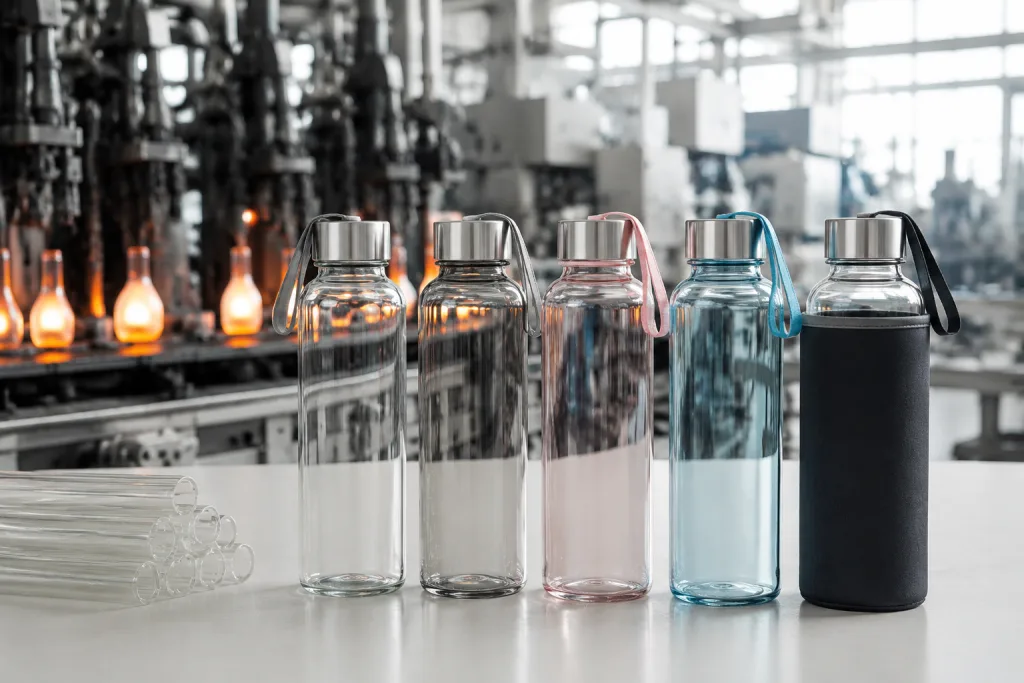
For sourcing, the numbers decide the project. A typical customized borosilicate glass bottle order in China starts at 1,000 units. If you stay with stock shapes and simple decoration, some borosilicate glass bottle manufacturers will take 500 units. For a new mold, 3,000-5,000 units is the number we quote on the line. Sample lead time is usually 7-12 days, and mass production runs 25-35 days after approval.
On FOB China terms, a plain borosilicate glass bottle wholesale quote for a 350-500 ml bottle may start around USD 1.20-1.80. Add a bamboo lid, retail box, and print, and the number moves to USD 2.20-3.80 fast. We’ve seen buyers push back on a “cheap” quote, then the math falls apart once the lid, carton, and breakage allowance get added. A premium retail-ready custom glass water bottle can go higher if you specify double-wall sleeves, a special finish, or molded packaging. The right question is not which borosilicate glass bottle vendor is lowest; it is whether every borosilicate glass bottle supplier is quoting the same structure so you can compare line by line.
Ask for these line items every time: unit price, mold fee if any, sample fee, outer carton spec, drop-test packaging, and spare parts rate. If the supplier in China does not split them out, the landed cost is not clear yet. QC pulled the sample on a 2 mm bottle mouth tolerance last month, and that kind of detail changes the real cost more than a pretty quote does. A serious borosilicate glass bottle factory in Zhejiang will know exactly how much a molded pulp tray adds per unit and whether it cuts breakage better than a simple divider carton.
Which use case fits which bottle
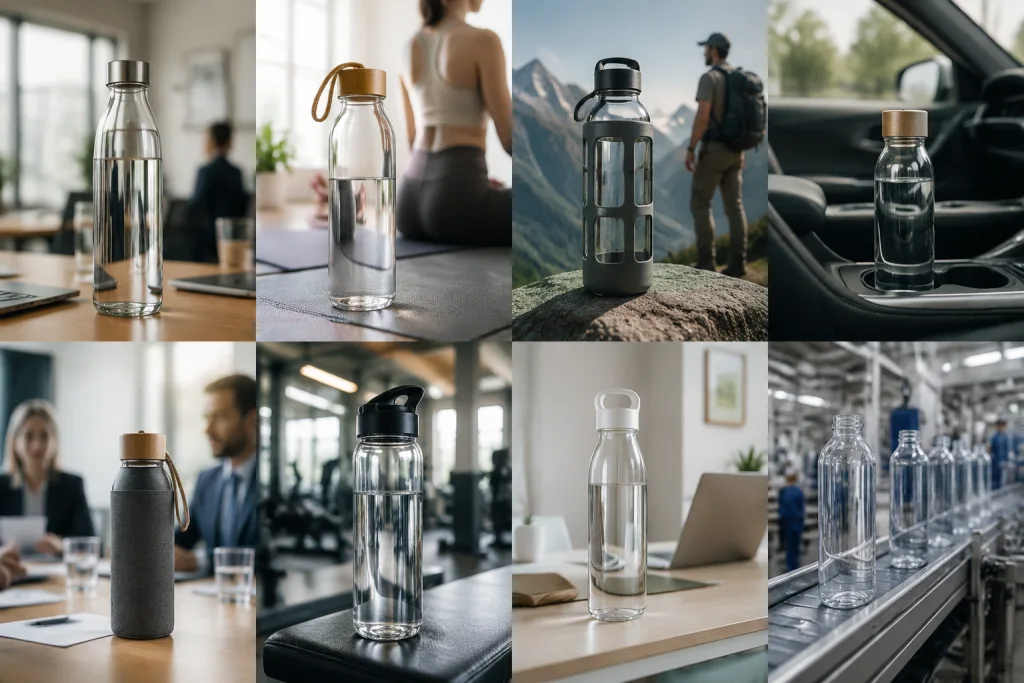
Not every buyer needs the same bottle. Use case is the fastest way to stop overbuying. For employee wellness packs, a 500 ml customizable glass water bottle with a leak-resistant lid is enough. For premium retail, a 350 ml customized borosilicate glass bottle with a matte sleeve and boxed presentation sells better as a gift. For mass promotional events, keep the shape simple and the box light; we’ve seen freight kill the margin on a “nice” pack.
Here is the blunt version. If the bottle sits on a desk, choose lighter weight and an easy-open lid. If it goes to shelf as a reusable lifestyle item, pay for decoration and packaging that hold up in QC. If your customer is a distributor borosilicate glass bottle buyer, carton-to-carton consistency matters more than a flashy sample. A distributor glass water bottle order needs repeatable finish, not just a good prototype. The line can make both, but the spec has to be clear.
| Use case | Best spec | Why it fits |
|---|---|---|
| Corporate gifts | 400-500 ml, bamboo lid, gift box | Premium look, freight stays manageable |
| Wellness kits | 350-400 ml, lightweight, 1-color print | Lower breakage, simple branding |
| Sustainable retail | 500 ml, frosted finish, recyclable pack | Better shelf pull and cleaner position |
| Trade show giveaways | Stock shape, minimal print | Fast launch and lower MOQ risk |
If you are sourcing from a borosilicate glass bottle supplier in China, ask for use-case-specific samples instead of one “best seller.” QC pulled the sample, and the buyer flagged the same issue twice: good on a table, weak in the channel. That is the wrong question to ask. Ask which bottle matches the job, then price it against the real shipping box.
Factory checks that save you money
Do not judge a borosilicate glass bottle factory by the sample alone. Judge it by how it controls variation. We look for glass wall thickness within a tight band, lid torque checks, leak testing, and carton drop tests. On one export run, QC pulled the sample at 1.8 mm and 2.1 mm, and the buyer flagged it before we shipped. For export accounts, ask whether the factory works to ISO 9001, can support REACH paperwork, and understands AQL inspection levels. For the EU, REACH and food-contact declarations matter. For North America, you may need supporting documents for CPSIA-adjacent retail programs or specific buyer compliance checks.
A good borosilicate glass bottle manufacturer in Zhejiang should be comfortable quoting a pre-production sample, production sample, and third-party inspection plan. If you are ordering 5,000 units or more, request AQL 2.5 for major defects and 4.0 for minor defects unless your buyer has a tighter standard. That is a normal starting point for promotional goods. We once saw a PO with “5000pcs, same as sample” and no tolerance note; the math does not work, because the line still needs a clear spec. If the factory refuses inspection or says “all same quality,” treat that as a red flag, not a reassurance.
You also want to know whether the factory runs 100,000 units per month or 300,000 units per month. Capacity does not guarantee quality, but it tells you whether a promotion deadline is realistic. A smaller borosilicate glass bottle manufacturer may give better attention to detail, while a larger one may give better line stability. We run both kinds of lines in Zhejiang, and a 12-day lead time can slip to 18 days if the packing crew is short or the cap supplier misses. Match the factory size to your launch risk.
Get a borosilicate quote that matches reality
Send your capacity, lid, print, and carton spec. We will price the bottle properly, from China factory floor to FOB export terms.
Frequently asked questions
What is the usual MOQ for a borosilicate glass bottle for promotional gifts?
For a stock mold, many suppliers start at 1,000 units, and some borosilicate glass bottle suppliers will do 500 units if the logo is simple. For a fully custom mold, 3,000-5,000 units is more realistic. If you need a retail box, insert, and multi-color print, the economic MOQ often rises because setup costs get spread across fewer pieces. Always ask whether the MOQ applies per color, per lid type, or per carton style.
How much does a custom glass water bottle cost FOB China?
A plain custom glass water bottle in borosilicate may start around USD 1.20-1.80 FOB China for 350-500 ml, depending on shape and lid. Add print, a bamboo or stainless lid, and retail packaging, and the price often moves to USD 2.20-3.80. If you want frosting, decals, or a special gift box, expect higher. The cleanest way to compare borosilicate glass bottle wholesale quotes is to keep bottle shape, decoration, and packaging consistent across suppliers.
Is borosilicate really better for promotional gifts than regular glass?
Usually yes, if the bottle will be handled as a daily-use gift item. Borosilicate is more resistant to thermal shock and tends to look clearer over time. That matters for a borosilicate glass bottle promotional program where the end user may rinse with hot water or use it for tea. Standard glass can be cheaper, but the lower risk of cracking and the more premium feel often justify the extra cost in wellness and sustainable retail channels.
What documents should a China supplier provide?
At minimum, ask for commercial invoice, packing list, and a product specification sheet. For export or retail programs, a serious borosilicate glass bottle factory should also support food-contact declarations, REACH-related documentation if needed, and test reports from a recognized lab when required by your market. If you are buying from China into the EU or North America, ask early about material compliance, carton marks, and whether the supplier can match your buyer’s inspection checklist.
How long does production usually take?
For a stock-shape borosilicate glass bottle customized with simple printing, sample approval to shipment is often 25-35 days. Add 7-12 days for samples first. If you need a new mold, special packaging, or a busy season slot, the schedule can stretch to 45-60 days. Zhejiang factories with stronger export schedules often give more reliable dates, but only if you lock the artwork and packaging early.