Key Takeaways
- A workable borosilicate glass bottle factory direct order usually starts at 3,000 units MOQ and 25-35 days lead time after sample sign-off
- For a 500ml custom glass water bottle, factory pricing often lands around USD 1.25-2.10 FOB depending on cap, print, and packaging
- Use AQL 2.5 for critical defects and ask for thermal shock, drop, and leak tests before shipment
- A real Zhejiang borosilicate glass bottle supplier will quote bottle, lid, carton, and insert separately instead of hiding costs
You are not buying “a glass bottle.” You are buying margin, freight damage, and the complaint rate. If you source a borosilicate glass bottle factory direct, the deal only works when specs, decoration, packaging, and the inspection plan are locked before we start the line. We’ve seen buyers save $0.18 a unit and give it back in breakage, print errors, or a missed launch by 12 days.
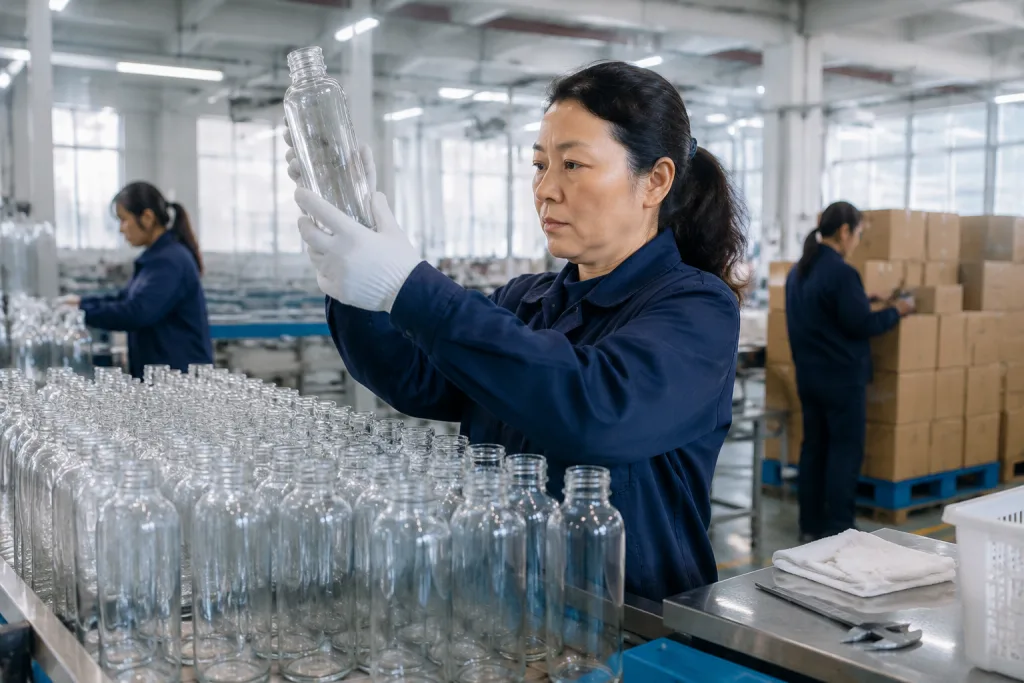
That is why a serious borosilicate glass bottle manufacturer in Zhejiang should walk you through one order from start to finish: 5,000 units, one lid style, one carton spec, one test standard, one ship date. In China, the factories that do this well usually show real output, not talk. At BottleForge Industrial in Hangzhou, our line runs 120,000 units/month, MOQ is 3,000 pieces, and standard lead time is 25-35 days after sample approval. QC pulled the sample on a 0.2 mm finish issue last week; that is the kind of detail you want before you place a bulk borosilicate glass bottle order.
Start with the use case
I’ll rewrite the prose in place, keep the HTML structure untouched, and make it sound like a factory-side sales engineer wrote it.The fastest way to waste money is to ask for a “nice bottle” before you define how it will sell. A wellness brand pushing detox water, a sustainable retailer chasing shelf impact, and a distributor building a private-label borosilicate glass bottle line do not want the same spec. Start with the use case: retail shelf, e-commerce shipment, gym bundle, or corporate gift. That choice sets the neck finish, lid type, print area, and carton strength.
For a custom glass water bottle, I start with four numbers: capacity, wall thickness, closure type, and drop-pack requirement. A 500ml body with 2.0-2.2 mm wall thickness is common for retail; a 3.0 mm wall feels solid, but it also adds weight and freight cost. QC pulled the sample, and the buyer flagged the carton after a 1.0 m six-face drop test because the insert was too loose by 3 mm. If you ship through Amazon or DTC, that detail matters on day one. A borosilicate glass bottle factory direct quote should show that gap clearly, not hide it until the first sample cracks.
Do not accept a generic “customizable glass water bottle” promise without naming the job. Ask if the bottle is for chilled drinks only, hot-and-cold cycling, or promotion. A borosilicate glass bottle promotional order usually needs lower decoration cost and faster turn; a premium retail line needs cleaner finish control and stricter visual inspection. We’ve seen this go sideways when the PO says “blue lid” but the artwork calls for “navy,” and that typo burns a week on the line.
Lock the bottle spec first
I’ll rewrite the prose in place, keep the HTML exactly as-is, and tighten the language around factory-floor details and concrete specs.Before you talk logo placement, lock the bottle structure. For borosilicate glass bottle bulk sourcing, the body shape, neck finish, and lid interface decide whether the job runs clean or turns into rework. Borosilicate glass handles thermal shock better than soda-lime glass, but the real result still comes down to wall thickness, annealing control, and the edge grind. If the bottle is for hot tea and cold water rotation, spell out the thermal shock target in degrees Celsius, not “heat resistant.” We ask for a 120°C to 20°C test with no visible cracking.
Ask the borosilicate glass bottle factory for the exact neck finish code and tolerance. A loose closure fit leaks; a tight one chips the rim during capping. On the line, we have seen a 0.3 mm mismatch cause the buyer to flag the whole lot. For a 500ml bottle, buyers usually pick 28mm or 38mm neck openings based on the closure. If you plan to add a silicone sleeve or bamboo cap, approve those drawings together. A custom borosilicate glass bottle is a system, not one part.
Buyer checklist:
- Capacity: 300ml, 500ml, or 750ml
- Wall thickness: 2.0 mm standard, 3.0 mm premium
- Finish: glossy, frosted, or color sprayed
- Closure: PP, stainless steel, bamboo, or silicone
- Print method: silkscreen, decal, or laser
This is where many borosilicate glass bottle manufacturers split from real suppliers. A good factory in Zhejiang will tell you which spec adds a 1-2% breakage rate and which one only changes the look. We run that math before sampling, because the wrong request burns time fast.
Price the order honestly
Factory direct means a clean quote, not a magic number. For a 500ml bulk glass water bottle, the sheet should split bottle body, lid, decoration, insert, and master carton. In our shop, we run quotes this way because the buyer always spots the gap later if you hide it. A plain borosilicate bottle at 3,000-5,000 pieces usually sits around USD 0.72-1.05 FOB, while a custom glass water bottle with logo print and an upgraded lid can move to USD 1.25-2.10 FOB. Add bamboo, a silicone wrap, or retail box printing, and you are usually looking at another USD 0.18-0.45.
If a borosilicate glass bottle supplier sends one neat number with no breakdown, push back. That is the wrong question to avoid. You need to know which parts change with MOQ, because some items eat setup cost and some do not. QC pulled the sample on a 24mm lid last month and the buyer flagged the print fee, not the bottle itself. Screen printing often carries a plate fee of USD 35-80 per color, while laser engraving can cost more per unit but skips ink problems. If you are comparing borosilicate glass bottle wholesale options, compare landed cost, not unit price. A bottle that is 8% cheaper but needs an extra carton insert and a higher breakage allowance is not cheaper.
For a distributor borosilicate glass bottle order, ask for pricing at 3,000, 5,000, and 10,000 units. That shows whether the factory is quoting from a real cost table or just guessing. We ship a lot of tiered quotes, and the solid factories do not flinch when you ask for them. A PO typo on “5,000 pcs” versus “5000pcs” can also expose sloppy paperwork fast. In China, the good factories already know their numbers.
Sample before mass production
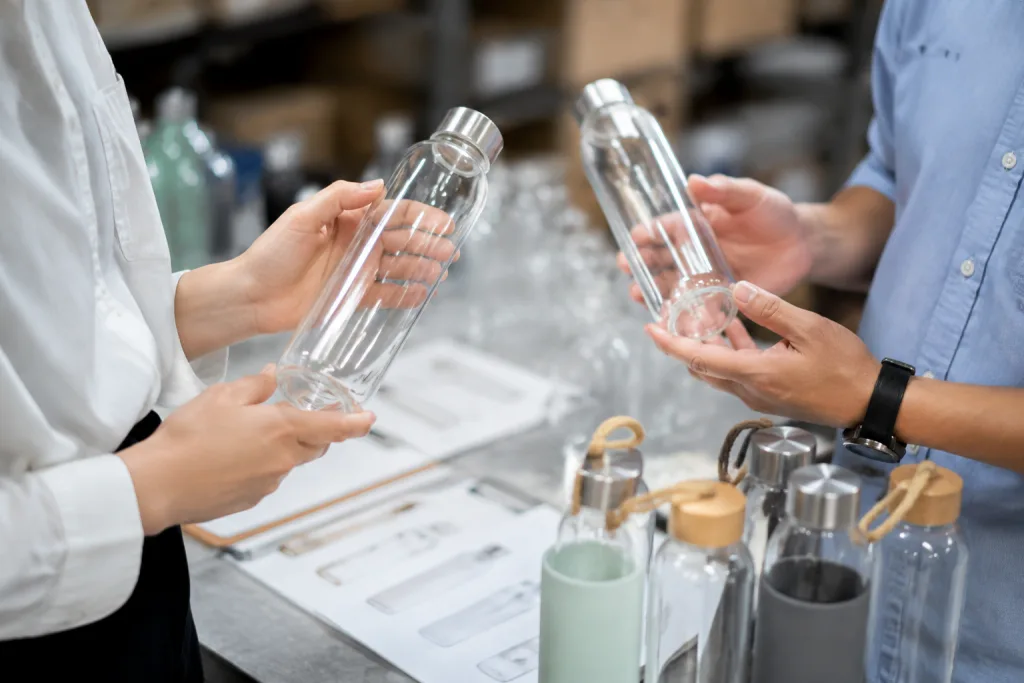
Do not approve a bulk borosilicate glass bottle order from a PDF alone. We need a physical sample, usually a pre-production sample with final decoration and final closure. If you are buying a customizable borosilicate glass bottle for a retail launch, check hand feel, cap torque, print alignment, and carton fit on the sample table. QC pulled a 500 ml sample last week; the cap sat 1.5 mm high, and that tiny gap would have turned into a leak complaint.
Ask for three sample stages if the order matters: plain bottle sample, decorated sample, pre-production sample. A plain sample confirms shape and wall thickness. A decorated sample confirms logo placement and ink adhesion. The pre-production sample confirms the full package, including drop test performance. If you need a customized glass water bottle for a brand launch date, put the sample approval deadline in writing. Five lost days on sign-off can turn into a two-week miss once the line backs up in Zhejiang.
“If the sample is not final, the price and lead time are not final either.”
Some borosilicate glass bottle vendors skip this part, and that is the wrong question to ask. A serious borosilicate glass bottle manufacturer will spell out what changed between sample and production, and whether that change affects color, weight, or leak performance. We ship enough PO revisions to know one typo on the carton spec can send the whole job sideways.
QC the production run
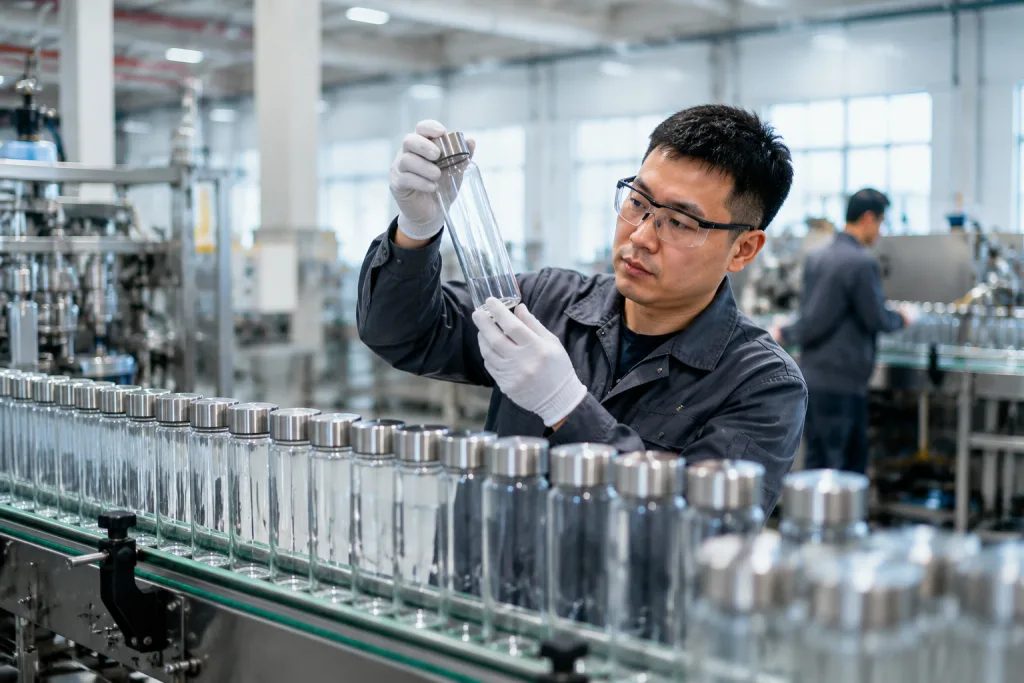
Quality control is where margin lives or dies. For a borosilicate glass bottle custom order, we inspect incoming raw tubes or formed bodies, then check dimensions during the run, then close with packing and carton checks. Use AQL 2.5 for major defects and AQL 4.0 for minor cosmetic issues. Cracks, sharp rims, and leaking closures get zero tolerance. That is not a premium standard; it is the baseline if you want the order to survive export.
Ask for these checks on every order:
- Dimensional check: height, diameter, neck finish, and weight
- Thermal shock test: cold-to-hot and hot-to-cold cycling
- Leak test: inverted hold with filled water
- Drop test: outer carton and packed unit
- Decoration test: tape adhesion or dishwasher rub, if relevant
If you are buying from a borosilicate glass bottle factory in China, ask for inline photos and final QC photos before balance payment. We run 120,000 units/month in Zhejiang on a line that logs sample retention, carton compression, and packing station checks, so the buyer can see the control plan instead of guessing. If a factory cannot send that plan, the math does not work. You are not buying confidence; you are buying risk.
Also ask how breakage is counted. Some borosilicate glass bottle wholesalers only log visible cracks; we count edge chips and cap mismatch too. The buyer flagged this on one PO because the word “bottle” was typed as “botte” in the packing list, and the claim got messy fast. Count tight, or the problem shows up in your warehouse.
Prepare export and delivery
Once QC clears the run, logistics takes over. Most buyers working with a borosilicate glass bottle supplier in Zhejiang run FOB Ningbo or FOB Shanghai, then book their own freight forwarder. If you need the factory to arrange the booking, lock the incoterm before deposit. One PO typo on the ship-to name can hold a full 20GP at the gate, and we’ve seen that go sideways more than once.
For retail programs, the carton spec carries as much weight as the bottle. Ask whether the master carton is 5-ply or 7-ply, how many units go in each carton, and whether the pallet pattern fits a 1.1 m warehouse fork lane. If you need FNSKU labels for Amazon, say it before print. A buyer once flagged the UPC as 2 mm too low on the side panel; the line had to reprint 8,000 sleeves. The wrong question is “can you pack it?” The real question is whether the pack survives the first handoff at the DC.
Typical export lead time from approval to ship is 25-35 days for standard custom glass water bottle programs, 12 days to 18 days longer if you add mold changes or special lids. Air freight can save a launch, but it cuts margin hard. For sustainable retail buyers, sea freight plus a controlled 3,000-piece MOQ is usually the cleaner move.
Choose the right factory partner
Not every borosilicate glass bottle factory deserves your order. You want a borosilicate glass bottle factory direct partner that answers technical questions without hiding behind sales talk. The clean test is simple: tube quality, annealing, tolerance, decoration yield, and carton failure rate, each backed by numbers. That is the standard you should expect from a borosilicate glass bottle manufacturer in Zhejiang or anywhere else in China.
Here is the split we run on the line. A borosilicate glass bottle vendor may resell stock shapes and handle basic logo work. A borosilicate glass bottle manufacturer should own forming, annealing, and packing. A borosilicate glass bottle distributor can help with mixed SKUs, but for a custom borosilicate glass bottle, the factory or a factory-backed team is the safer call. Ask for monthly capacity, sample lead time, and defect handling. If they can say 120,000 units/month and keep 3,000-unit MOQ discipline without dodging the question, they are set up for export. If they cannot, move on.
For wellness brands and sustainable retailers, that split matters. You are buying repeatability, not just glass. We have seen this go sideways when a buyer chased a low quote and the next order arrived with a 2 mm neck drift. In China, especially Zhejiang, the factories that win repeat business treat each borosilicate glass bottle wholesale order like a production problem with controls, not a casual sales order.
Send your bottle spec for a factory quote
Get a line-by-line quote, sample plan, and QC checklist for your borosilicate glass bottle custom order within 24 hours.
Frequently asked questions
What is the MOQ for a borosilicate glass bottle factory direct order?
A realistic MOQ is usually 3,000 pieces for a standard custom borosilicate glass bottle, sometimes 5,000 if you want special decoration or a new closure. For stock shapes, some factories will quote 1,000 pieces, but the unit price is usually 12-20% higher. If you need multiple colors, each color can behave like a separate SKU. A Zhejiang borosilicate glass bottle supplier should tell you whether the MOQ is driven by the bottle mold, print setup, or packaging, because those are not the same cost.
How much does a custom glass water bottle cost at factory level?
For a 500ml bulk glass water bottle, plain FOB pricing often starts around USD 0.72-1.05. Add a logo, better lid, and retail carton, and you are commonly in the USD 1.25-2.10 range. A frosted or colored customized glass water bottle can add another USD 0.10-0.35 depending on the finish. If you are buying from a borosilicate glass bottle manufacturer in China, ask for a price ladder at 3,000, 5,000, and 10,000 units so you can see where the real break point is.
What QC tests should I require before shipment?
At minimum, ask for dimensional inspection, leak testing, thermal shock testing, and packed carton drop testing. For export orders, AQL 2.5 is a sensible target for major defects, with zero tolerance for cracks, sharp rims, or leaking lids. If the product is a borosilicate glass bottle promotional item, you still need the same structural checks. Decoration should also be tested for rub resistance if the bottle will be washed or handled often. A factory in Zhejiang should be able to send photo evidence and a QC report before you release final payment.
Can I get a customized borosilicate glass bottle with my logo and packaging?
Yes. Most borosilicate glass bottle manufacturers can handle silkscreen, decal, laser engraving, frosting, and custom cartons. The most common setup is a logo on the body and one retail carton with insert. Expect a plate fee of USD 35-80 per color for silkscreen and a small packaging upcharge of USD 0.08-0.25 per unit for printed retail packaging. If you need a truly customized glass water bottle, approve the bottle sample, then the decorated sample, then the pre-production sample before mass run.
Should I buy from a supplier, vendor, distributor, or factory?
If you need a standard stock item, a borosilicate glass bottle distributor or vendor can work. If you need a custom borosilicate glass bottle or a new retail program, you should go direct to the borosilicate glass bottle factory or a manufacturer with direct production control. The difference is speed, cost, and accountability. A factory direct quote is easier to audit, and you can tie the order to exact specs, cartons, and QC terms. For long-term replenishment, direct sourcing from China is usually more stable and cheaper than layered buying.