Key Takeaways
- A realistic MOQ for a custom borosilicate glass bottle is usually 3,000 to 5,000 pcs per SKU, with sample lead time of 7 to 12 days.
- For bulk glass water bottle sourcing, FOB China pricing often starts around USD 1.10 to 2.80 depending on size, cap, and print complexity.
- A proper RFQ should specify capacity, wall thickness, cap material, logo method, REACH request, and carton test requirements before sampling.
- Well-run China suppliers in Zhejiang can move from approved sample to bulk in 20 to 35 days, while poorly defined specs can add 2 weeks or more.
If you are buying for a wellness brand or a sustainable retail line, the hard part is not finding a pretty bottle. It is finding a borosilicate glass bottle factory direct from China that holds tolerances, ships on time, and does not turn your first container into a claims problem. Glass looks simple until you specify 3 mm wall thickness, a leak-proof cap, food-contact compliance, and a decoration method that still passes abrasion checks after 50 cycles.
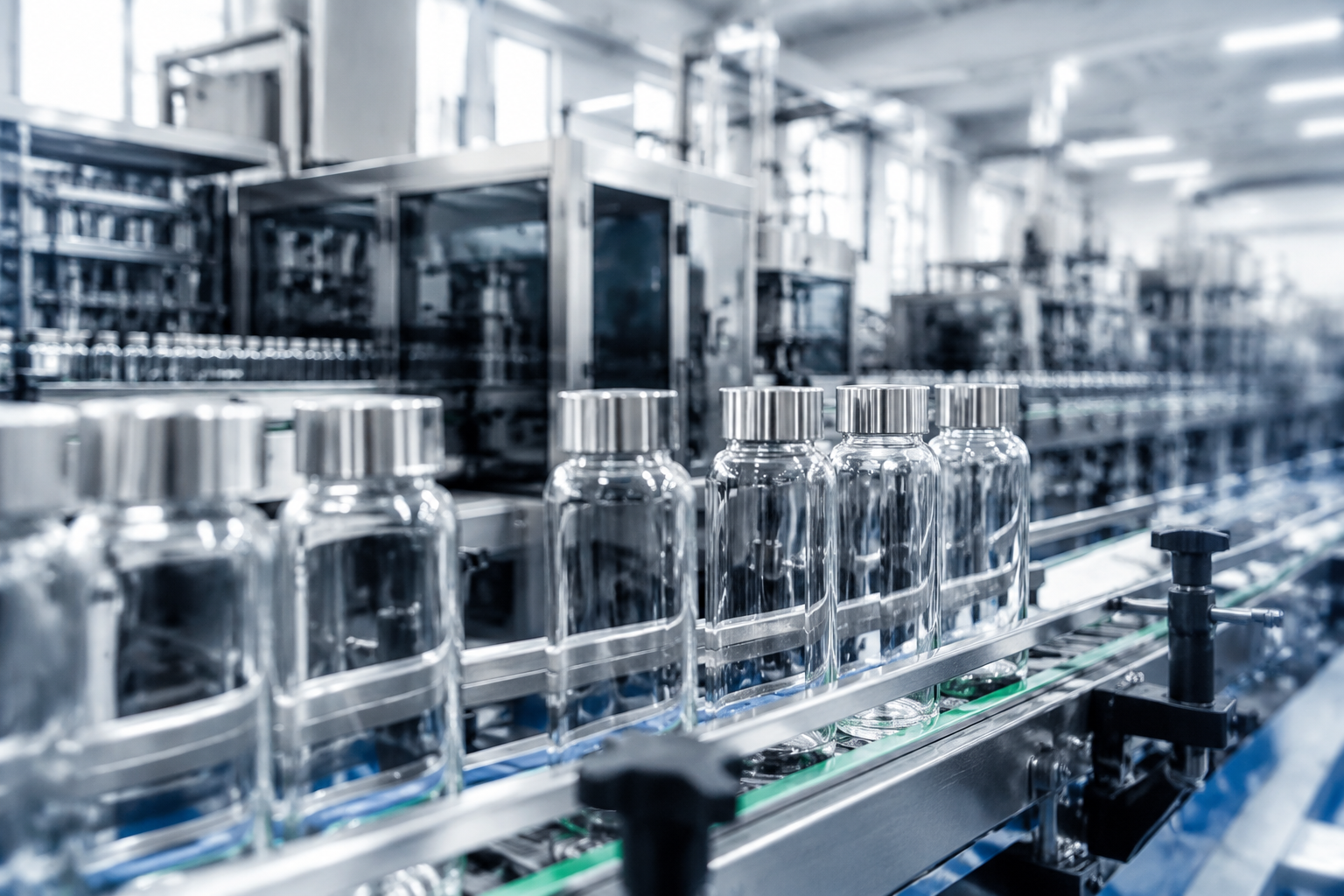
The right way to source is to run it like a controlled process, not a price hunt. In Zhejiang and across China, the factories that handle a borosilicate glass bottle custom program well ask the real questions on day one: capacity, closure type, decoration area, drop test target, and monthly volume. At BottleForge Industrial in Hangzhou, our glass-bottle line runs 120,000 units per month with a 25-day standard lead time for bulk orders after sample approval. We have seen buyers skip that check and the math does not work. Ask for the numbers before you send a PO.
Start With The Product Brief
Before you talk to any borosilicate glass bottle supplier, write a brief a factory engineer can use on the line. If you only say “custom glass water bottle,” you get random quotes for different capacities, different glass grades, and different caps. We see that go sideways fast. It kills comparison work.
Your brief should list capacity in ml or oz, target retail channel, cap style, color, logo method, and whether you need a customizable glass water bottle with sleeves, tea infusers, or a clean body. Add the use case too. A borosilicate glass bottle promotional item for a campaign does not need the same packaging or finish as a premium retail line. QC pulled the sample on a 500 ml run once because the buyer skipped the channel detail.
- Capacity: 350 ml, 500 ml, 750 ml, or 1,000 ml
- Glass wall thickness: 2.2 mm, 2.8 mm, or 3.0 mm
- Closure: bamboo cap, stainless cap, PP cap, or silicone seal
- Decoration: silk screen, laser engraving, decal, or frosted finish
- Packaging: individual box, egg-crate tray, or bulk carton
State whether you need a customized borosilicate glass bottle for direct-to-consumer sales or a borosilicate glass bottle wholesale program for distributors. The factory will quote differently if your packing must pass Amazon prep, FNSKU labeling, or shelf-ready retail display. That is normal. A PO typo like “5000 pcs” instead of “500 pcs” can blow up the math. China factories are not mind readers; Zhejiang suppliers work best when you give hard numbers, not taste words.
Send An RFQ That Gets Real Quotes
A serious RFQ reads like a parts list, not a marketing note. Ask the borosilicate glass bottle manufacturer for unit price at 3,000, 5,000, and 10,000 pcs. Ask for FOB Ningbo or FOB Shanghai so the export point is clear. If you need a distributor borosilicate glass bottle program, ask for carton loading data and pallet counts too. We ship those numbers off the line every week, and the buyer usually finds the real gap there.
Good RFQs split the bottle body from the closure and decoration. That shows where the money goes. A plain bottle may sit at USD 0.85 to 1.40 at volume, while a stainless cap, custom box, and 2-color print can push the landed factory price above USD 2.20. That is fine if you want a clean cost stack. We had a buyer flag a PO once because the cap line was buried in the total; the math did not work.
PO line items to request in the quote
- Bottle body: borosilicate, capacity, weight, and wall thickness
- Cap assembly: material, gasket, and finish
- Decoration: logo size, color count, and print position
- Packing: inner box, master carton, drop-test standard
- Compliance docs: REACH, LFGB if needed, food-contact declaration
Ask the borosilicate glass bottle factory to state whether tooling is required for a custom borosilicate glass bottle. A lot of shapes run from existing molds, which keeps MOQ lower. If tooling is needed, expect a one-time mold fee of USD 300 to 1,500, depending on cavity detail and neck finish. A borosilicate glass bottle factory direct from China should put that fee on the quote before sample approval, not after QC pulled the sample at 2 mm tolerance and everyone had already moved on.
Judge Samples Like A Buyer
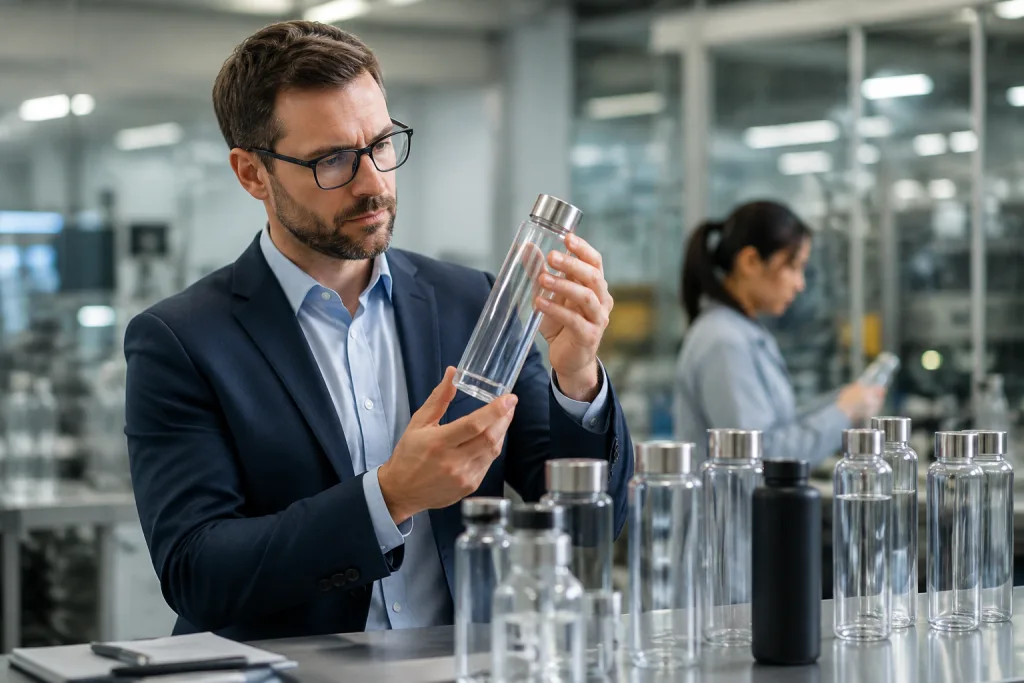
I’m rewriting the section with a buyer-sound checklist voice and keeping every HTML tag intact. I’ll make it read like a factory-side sales engineer, with a few concrete shop-floor details and no AI filler.Samples are where a lot of buyers get lazy. They stare at the look and miss the details that drive returns later. When your borosilicate glass bottle customized sample lands, check it against a checklist, not your memory. We do this on the line with a caliper and a scale, and it saves everyone a headache.
Start with dimensions. Measure fill line, mouth diameter, and total height. Check whether the cap closes in 3 to 4 full turns and whether the gasket sits flat all the way around. Then test the bottle empty and filled. A good borosilicate bottle should feel balanced, not top-heavy. For a 500 ml bottle, a finished weight around 260 to 340 g is common, depending on wall thickness and base design. If the buyer says weight “looks fine,” that is the wrong question to ask.
Run simple field tests: hot water at 90°C, ice water, one drop test from 80 cm onto carton, and a shake test for leakage. If the product goes into the wellness channel, this matters more than fancy packaging. A customizable borosilicate glass bottle can still fail if the neck finish is off by 0.3 mm. We’ve seen that go sideways fast.
Do not approve a sample because the print looks good. Approve it because the bottle, cap, and carton all pass the same standard twice.
Ask for two or three samples from the same batch if your order will be large. A decent borosilicate glass bottle supplier should be fine with that. Factories in China that push back on repeat samples are usually hiding process variation. In Zhejiang, the better plants keep sample and bulk process aligned, which cuts surprises when the line runs 10,000 pieces.
Lock Specs Before Bulk
Once the sample is approved, turn it into a written spec sheet. That sheet keeps a borosilicate glass bottle wholesale order from drifting. Put it inside the PO packet. Attach artwork files, approved sample photos, cap color code, carton marks, and inspection points.
For a bulk glass water bottle order, the PO should show quantity by SKU, unit price, packing configuration, payment terms, inspection standard, and delivery date. If you buy as a borosilicate glass bottle distributor, add reserve stock terms and overrun/underrun tolerance. We’ve seen POs fail on a typo in the carton mark, then the buyer flagged the whole batch. For glass decoration, ±5% on print registration is a common industrial tolerance, but that is the wrong question to ask if the logo is small or multi-color; tighten it first.
- PO item 1: bottle body, 5,000 pcs, approved sample ref no.
- PO item 2: bamboo cap with silicone ring, 5,000 pcs
- PO item 3: 1-color silk screen logo, 5,000 pcs
- PO item 4: custom kraft box, 5,000 pcs
- PO item 5: master carton mark and FNSKU if required
Ask for an AQL inspection plan before production starts. For consumer glassware, AQL 2.5 major and 4.0 minor is a common starting point, but a brand may want tighter limits on chips, seal leaks, or label defects. On our line, QC pulled the sample at annealing and again at packing; that is where the weak spots show up. A borosilicate glass bottle manufacturer in China should state the checks at forming, annealing, printing, packing, and the final carton drop test. If they cannot, you are not talking to a real factory.
Price The Order Correctly
Most buyers chase the lowest unit price, then freight, packaging, and claims wipe out the margin. Price the landed item. For a borosilicate glass bottle factory order, we run the math in five buckets: body, cap, decoration, packaging, inland/export freight.
A 500 ml plain bottle usually lands around USD 0.90 to 1.30 ex-factory in China. Add a stainless cap and simple print, and you are closer to USD 1.45 to 2.10. Add a custom box, protective insert, and premium finish, and USD 2.50+ is normal. QC pulled a 500 ml sample at 1.2 mm wall thickness last week, and the carton dropped 2 cm in the compression test. Standardize the parts that do not sell the bottle. That is the right question.
If you are comparing borosilicate glass bottle suppliers, send the same spec to each one: same carton count, same logo method, same tolerance, same FOB port. One quote that looks 18% cheaper usually means thinner glass, weaker packaging, or missing compliance paperwork. The buyer flagged a PO typo once: FOB Ningbo got entered as FOB Shanghai, and the freight math broke immediately. In Zhejiang, the factories that know their numbers will show the dependency instead of hiding behind “price depends.”
A customized glass water bottle with a narrow neck and tight-color print can cost more to run than a larger plain model. That is process reality, not bad sourcing. We ship those neck molds every week, and a 28 mm opening with a clean print hit takes more setup time than a straight-sided blank. Pay where the design needs it. Cut where it does not.
Move To Production And Shipment
After approval, write the production schedule into the PO. A normal bulk run in China takes 20 to 35 days after sample sign-off, depending on tooling and decoration. If the order needs a new mold, add 7 to 15 days. We’ve seen a borosilicate glass bottle factory direct from China with 120,000 units a month still miss a ship date because artwork landed late and the buyer kept changing carton copy. That is the real bottleneck.
During production, ask for three checkpoints: pre-production material confirmation, mid-line inspection, and final random inspection. Keep photos and lot codes on file. QC pulled the sample at the line and found one print shade off by 0.5 mm on a sleeve, which is the kind of issue that turns into a claim later. If you run a borosilicate glass bottle distributor model, this paperwork matters because your buyers will ask for traceability later.
Shipping should match the sales calendar. For wellness brands launching a promotion, sea freight FOB China is usually the right starting point unless the drop date is urgent. Air freight works for 500 to 1,000 sample-prep units or a fast restock, but it will hurt margin. A good borosilicate glass bottle vendor in Zhejiang will talk through the tradeoff instead of steering you to the most expensive option. We ship both ways every week.
When the goods are ready, confirm carton count, net/gross weight, pallet height, and whether the shipment needs moisture protection. Glass is durable. Packed badly, it breaks. We had a buyer flag a PO typo on pallet height once, and the math did not work at the warehouse gate, so the truck sat for half a day.
Send your RFQ for a clean factory quote
Share capacity, cap style, logo file, and target quantity. We’ll return a practical Zhejiang quote, sample plan, and bulk timeline without guesswork.
Frequently asked questions
What MOQ should I expect for a custom borosilicate glass bottle from China?
For most borosilicate glass bottle custom projects, MOQ is 3,000 to 5,000 pcs per SKU. If you use an existing mold and simple one-color logo, some factories in Zhejiang may accept 2,000 pcs, but the unit price usually rises 10% to 25%. If a new mold is needed, expect a one-time mold fee and a slightly longer sample schedule. For multi-SKU launches, many buyers split MOQ across colors or cap styles, but the factory may still set one master order size. Ask for MOQ by body, cap, and carton separately so you know where the real constraint is.
How long does sample development usually take?
A standard borosilicate glass bottle customized sample usually takes 7 to 12 days if the factory already has a similar mold. If the shape needs new tooling, allow 15 to 25 days for the first sample round. Add 3 to 5 days if you need printed logos, frosted treatment, or a special cap. In China, many delays come from artwork revisions, not production itself. Send vector files, Pantone references, cap color codes, and packaging dimensions together so the sample does not bounce back and forth. A clean first RFQ saves at least one week.
What compliance documents should I request?
At minimum, ask for a food-contact declaration, material specification, and test report if your market needs it. For Europe, REACH documentation is common, and many wellness brands also ask for LFGB-ready test support. If the bottle uses silicone parts, request the silicone material grade and any migration test data. For North America, buyers often request ASTM-related or internal QC references plus traceability by lot. The exact document set depends on your channel, but a borosilicate glass bottle manufacturer that works with export accounts should know how to prepare a file pack without guessing.
How much does a bulk glass water bottle cost FOB China?
A bulk glass water bottle made from borosilicate glass often starts around USD 0.90 to 1.30 for a plain body at volume, then rises with caps, print, and packaging. A complete retail-ready item may land around USD 1.45 to 2.80 FOB China depending on capacity and finish. A bamboo cap, custom box, and multi-color logo will move the number up quickly. Compare quotes only when all suppliers use the same assumptions: same thickness, same cap material, same packing count, and same export port. Otherwise, the cheapest quote is usually not the same product.
Can I work with a borosilicate glass bottle distributor instead of a factory?
You can, but the pricing and control structure change. A borosilicate glass bottle distributor may be useful if you need mixed-SKU consolidation, small top-up orders, or quicker communication. However, if you want a true custom glass water bottle program, direct factory sourcing usually gives you better control over MOQ, tooling, decoration, and packaging. Distributors may add 8% to 20% margin, which is acceptable when service matters more than cost. For a serious private-label program, I would still start with the factory, then use a distributor only if the order logic or geography demands it.