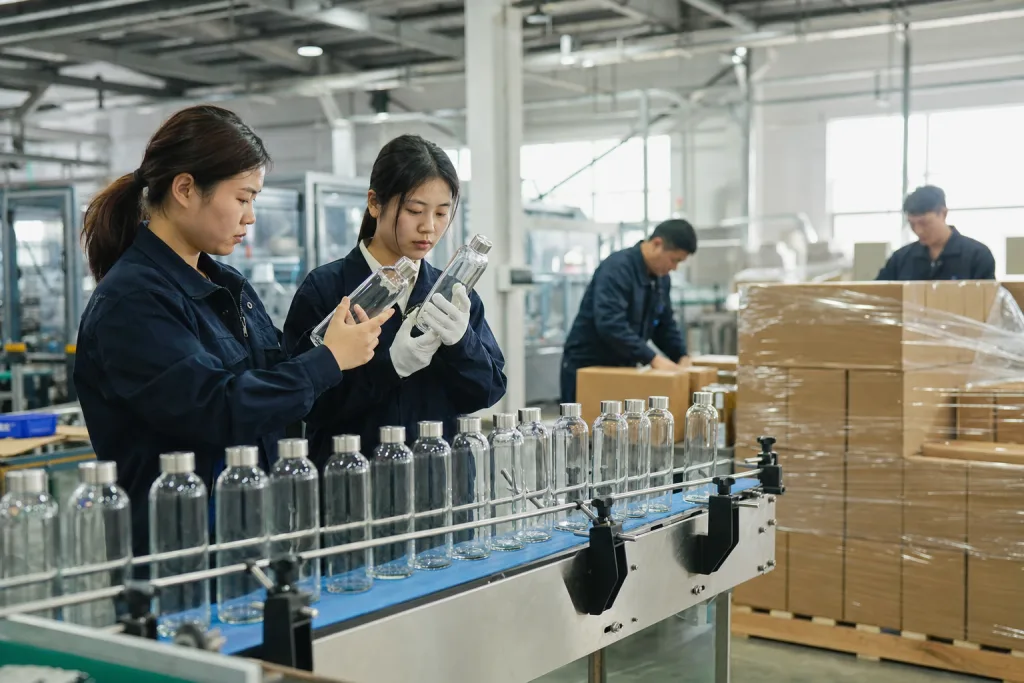
Key Takeaways
- For borosilicate glass bottle bulk orders, practical MOQ usually starts at 1,000 units per color or lid style
- A 550 ml custom glass water bottle typically lands around USD 1.65-3.20 FOB China depending on sleeve, lid, and carton spec
- Borosilicate glass is better for wellness retail than soda-lime glass when buyers expect hot tea, infusers, or temperature swings
- AQL 2.5/4.0 inspection and 1.2 m carton drop testing reduce avoidable claims before shipment
If you sell into wellness retail, refill shops, yoga studios, corporate gifting, or sustainable e-commerce, glass looks simple until the first shipment lands with 3 mm lid wobble, sleeves that split at the seam, GS1 barcode typos, or cartons crushed after a 1.2 m drop test. We have seen QC pull 32 bottles from a mixed-color carton and find 5 loose caps before lunch. A borosilicate glass bottle distributor is buying more than a container. You are buying shelf trust, repeat orders, and fewer customer service emails.
Most borosilicate glass bottle manufacturers in China can quote a 500 ml bottle within 24 hours. Fewer can talk through 1.8 mm versus 2.2 mm wall thickness, lid gasket compression, silk-screen logo rub tests, REACH paperwork, and FOB cost impact without passing the buyer between three desks. That handoff is where orders go sideways. BottleForge works from Hangzhou, Zhejiang, with partner glass lines in China and in-house packing control for export orders from 1,000 to 80,000 units; on the line, we run cap torque checks, sleeve fit checks, and carton weight checks before the pallets leave for Ningbo or Shanghai.
Borosilicate versus ordinary glass
The choice starts with the glass body. A borosilicate glass bottle uses glass with a lower thermal expansion rate than normal soda-lime glass, so it handles temperature changes better. For your buyer, that matters when someone pours 60-80°C lemon water, adds hot tea to an infuser, or rinses the bottle under tap water that jumps from 12°C to 35°C. It does not mean unbreakable. It means more forgiving. QC pulled one 500 ml sample last month after a rim chip showed up under the LED inspection lamp, and that is still glass behaving like glass.
For wellness brands and sustainable retailers, borosilicate is usually the safer retail story. A distributor glass water bottle made from soda-lime glass can work for cold water, juice, or low-price promotional programs. If your packaging says tea, detox, office hydration, travel, or reusable lifestyle, customers expect higher performance. We normally specify borosilicate body wall thickness at 1.8-2.2 mm for common 350-750 ml formats, checked with a digital caliper at the mouth, shoulder, and base. Going thinner saves cost. The math doesn't work if the line loses 3 cartons during assembly or your buyer sends photos of cracked bottles after the first refill.
Here is the practical comparison we use on RFQs:
- Borosilicate: better thermal shock resistance for warm drinks and rinsing, lighter hand feel in 350-750 ml sizes, stronger premium shelf positioning, usually higher unit cost.
- Soda-lime: lower cost and heavier feel, fine for cold-fill programs or giveaway orders, weaker story when the buyer is selling wellness or daily reuse.
- Tritan or stainless: tougher for gym bags and kids' sports use, but they do not give the same plastic-free, taste-neutral message as glass.
If you are a borosilicate glass bottle distributor selling to refill stores, boutique gyms, spa groups, or eco retailers, the extra USD 0.25-0.60 per unit often makes sense. The cost is visible in the product quality, not hidden in paperwork. We ship enough mixed OEM orders to see where this goes sideways: glass can chip at the mouth, silicone sleeves can trap moisture after washing, and bamboo lids need controlled humidity before packing. One buyer flagged a PO that said “bamoo lid” instead of bamboo lid; small typo, but it delayed artwork approval by 2 days.
Spec table buyers should compare
Most RFQs for borosilicate glass bottle wholesale are too vague. “500 ml glass bottle with logo” is not enough for a serious quote. The line has to guess the neck, wall, lid, and pack-out, and every guess turns into a price change later. We run into this in Hangzhou all the time; QC pulled a sample last week and the buyer had written “food lid” on the PO, no material, no gasket spec.
Core head-to-head spec table:
- Capacity: 350 ml, 500 ml, 550 ml, 750 ml, or 1,000 ml. State brimful or usable fill, or the quote will be off by 20-40 ml.
- Glass type: borosilicate, usually 1.8-2.2 mm wall thickness for retail bottles. We check this with a caliper at the line; a 0.2 mm swing changes breakage rates.
- Opening: narrow mouth 28-35 mm for commuting, wide mouth 45-60 mm for fruit, ice, or cleaning. One buyer wanted 30 mm for lemon slices, then flagged the fit when the test cut jammed at 32 mm.
- Lid: stainless steel, PP, bamboo outer with PP inner, or aluminum. Food-contact surfaces matter more than the outer finish; a lid can look premium and still fail on the insert.
- Seal: silicone gasket, normally LFGB or FDA-grade depending on market. We have seen a 1.5 mm gasket seat cause leaks after 200 shake tests, so we do not treat this as a small line item.
- Sleeve: silicone, neoprene, felt, cork, or no sleeve. Sleeve choice changes carton size and drop-test results, and the pack-out team feels it first.
- Logo: screen print, heat transfer, laser on lid, decal, or paper wrap. A buyer once sent a PO with the logo file name misspelled, and the print plate had to be remade.
- Packaging: white box, kraft box, color box, gift tube, or e-commerce mailer. The wrong carton spec can push freight up fast; we saw a 1,000-piece order jump one pallet after the insert changed.
A customizable glass water bottle is not automatically expensive. The cost comes from loose specs: six lid colors, three sleeve materials, four box designs, and a 1,200-unit trial order. That math does not work. We tell buyers to lock one bottle mold and one lid structure first, then change sleeve color or box graphics by account. One mold, one lid, clean QC. We had a case where the buyer wanted bamboo lid, neoprene sleeve, and color box on a 1,000-piece run, and the carton cube grew 18% before we even printed.
For a bulk glass water bottle program, our starting point is 1,000 units for stock shape with custom logo, 3,000 units for custom sleeve color, and 5,000-10,000 units for private color box printing. New mold development is possible, but it only makes sense when annual demand is above 30,000 units. The toolroom here checks neck finish to ±0.15 mm, and below that volume the tooling payback gets ugly fast.
Use-case fit by sales channel
A borosilicate glass bottle customized for an online wellness brand is not the same product a distributor should put in front of a national retail chain. The comparison starts with what happens after the carton leaves Ningbo or Shanghai. Shelf bottles need tight visual consistency: same sleeve shade, same print position, no lid color drift under retail lighting. E-commerce bottles need stronger packing; we run a 1.2 m drop test on the mailer before we trust it. Promotional bottles need logo speed and reorder pricing that does not jump after the first 3,000 pcs.
For wellness brands, the best fit is usually a 500-650 ml custom borosilicate glass bottle with a 2.0 mm silicone sleeve, bamboo-look lid, and one-color logo. The sleeve gives grip and a color block the brand can own. The bamboo look sells the natural story, but the inner lid should still be PP or stainless with a silicone gasket. Raw bamboo against liquid is a bad place to save USD 0.08; QC pulled samples before where the bamboo smell came through after 48 hours of warm-water testing.
For sustainable retailers, we prefer a cleaner design: transparent or amber glass, stainless lid, minimal ink, recyclable kraft box, and clear material labeling. These buyers ask about REACH, food-contact declarations, and packaging plastic reduction before they approve artwork. Last month a buyer flagged a PO that said “bamboo cap” while the approved spec was stainless outer with PP inner, and that one typo delayed sampling by 3 days. A borosilicate glass bottle manufacturer that cannot send material declarations before production will slow your launch later.
For corporate promotional programs, a borosilicate glass bottle promotional order often uses screen printing or decal logos, white box packing, and 30-45 day production. The buyer cares about deadline and logo accuracy more than an exotic lid. We check the logo with a Pantone book and a 30 cm visual distance, because a 1 mm shift looks small on the line and ugly in a gift set. For marketplace sellers, the same bottle needs FNSKU labeling, carton weight control under 15 kg, and drop-tested mailer packaging. A 750 ml glass bottle in a thin color box is a complaint generator if shipped as a single parcel.
Use-case fit is where 6 out of 10 new distributors lose margin. They buy the cheapest FOB unit, then pay for replacements, repacking, and customer appeasement in the destination market.
A good borosilicate glass bottle vendor should challenge your channel assumptions before taking the deposit. That is not being difficult. That is protecting the reorder. If a supplier says every channel can use the same packing, the math does not work.
Customization choices that actually matter
The word custom gets abused in drinkware. A borosilicate glass bottle custom project can be as simple as a 1-color logo and a kraft box. A true customized glass water bottle may need a new mold, new lid tooling, exact Pantone sleeve, retail barcode, multilingual insert, and ISTA-style packing. Those are different jobs, and quoting them as one line item is where we’ve seen this go sideways; last month QC pulled a pre-production sample because the PO said “clear lid” while the approved sample had brushed 304 stainless.
For most distributor borosilicate glass bottle programs, the best-return custom options are logo, sleeve color, lid finish, and packaging. Screen printing on glass works well for 1-2 colors, usually with a setup charge around USD 50-120 per artwork, and we run a 3M tape test after curing. For complex artwork, heat transfer or decal can look sharper, but abrasion resistance must be tested before bulk production. Laser engraving is a good choice on stainless lids. Not glass bodies. On transparent borosilicate, it leaves a light frosted mark, so the buyer needs to approve that look on a real sample, not a PDF mockup.
Sleeve customization deserves more attention than it gets. Silicone sleeves are durable, washable, and good for wellness retail; our line usually checks sleeve thickness at 1.8-2.2 mm with a digital caliper. Neoprene sleeves add insulation, but cheap material can smell when cartons sit closed for 18 days on the water. Cork sleeves look sustainable, but they need clean gluing and humidity control. Felt sleeves photograph well and look tired after rough retail handling. If you want a customizable borosilicate glass bottle for several accounts, choose one glass body and rotate sleeve Pantone colors by client; the math works better than opening 3 body shapes at MOQ 3,000 pcs each.
Packaging is where distributors win or lose buyer confidence. A color box with 350 gsm paperboard, internal divider, and barcode placement costs more than a plain white box, but retail buyers notice it; one buyer flagged a barcode that sat 6 mm too close to the box fold because their scanner missed it on shelf. For e-commerce, we often add honeycomb paper wrap or molded pulp, then test cartons at 1.2 m drop height on corners, edges, and faces. BottleForge can pack mixed SKUs from Zhejiang for export, but we prefer no more than 4 SKUs per master carton unless your warehouse receiving plan is clear. Mixed cartons sound efficient. The math doesn’t work if pickers need 12 minutes to sort every case.
Price, MOQ, and lead time reality
Here is the FOB China price band we quote for borosilicate glass bottle bulk orders. A plain 500-550 ml bottle with a stainless or PP lid, no sleeve, and one-color logo usually lands at USD 1.35-2.10 FOB. Add a silicone sleeve and kraft retail box, and you are closer to USD 1.85-2.80. Add a bamboo-look lid, color box, insert, barcode label, and heavier e-commerce packing, and USD 2.40-3.60 is normal. The wrong question is “why is one quote so low?” A low quote usually strips out something real: 2.2 mm glass wall, gasket quality, inspection time, or carton strength. QC pulled one sample last week and the lid seal failed a 1.2 m drop test because the gasket was too soft.
MOQ changes with the customization point. For stock glass and stock lid, a borosilicate glass bottle wholesale order can start at 1,000 units if the logo is simple. For a custom Pantone sleeve, plan on 3,000 units. For printed retail packaging, 3,000-5,000 units makes more sense because plate setup and paper waste eat margin fast. A new bottle mold is a different animal: tooling usually runs from USD 2,000-6,000, and MOQ commonly starts at 10,000 units. We had one buyer flag a PO that said “pantone slv.” instead of the actual sleeve code, and the line stopped until the drawing was corrected.
Lead time is never one number. Pre-production sample time is usually 7-12 days after artwork confirmation. Mass production is 25-40 days after sample approval and deposit for normal orders. Before Q4 retail shipping, add 7-10 days or you will miss the vessel cut-off. Our Zhejiang coordination team handles up to 120,000 units/month across stainless, glass, and plastic lines, but glass still moves slower because the pack-out crew has to check each tray, sleeve, and inner carton by hand. We run it that way on purpose.
Payment terms for a new borosilicate glass bottle distributor are usually 30% deposit and 70% before shipment after inspection. FOB Ningbo or Shanghai are the common ports for our China shipments. If you need DDP, bring it up early, because glass freight, duty code, and insurance change the landed cost fast. We also see buyers forget the carton mark or ship-to address on the PI; that small typo can hold a booking for a day. It is not a theory problem. It is a paperwork problem.
Quality checks before shipment
Glass bottle quality is bigger than visible cracks. We check dimensions with a digital caliper, confirm capacity on a 500 ml fill line, test lid fit, leakage, coating adhesion, logo position, carton strength, barcode scan, and random drop results. For distributor borosilicate glass bottle orders, we normally use AQL 2.5 for major defects and AQL 4.0 for minor defects unless the buyer has stricter retail requirements. QC pulled one sample last month with a 1.8 mm logo shift; retail passed it, but a gift-box buyer rejected the same tolerance.
Common major defects include chipped mouth, cracked body, leaking lid, wrong capacity, unsafe sharp edge, wrong logo, and carton quantity mismatch. Minor defects include small bubbles inside agreed limits, 1–2 mm print offset, light sleeve dust, or box scuffing. Define this before production. Waiting until final inspection is the wrong question to ask, because then a 3 mm scratch turns into a 26-email argument while the line is already packed.
Food-contact compliance should match the destination market. For Europe, ask about LFGB or EU food-contact testing for silicone and plastic parts, and REACH/SVHC declarations where relevant. For North America, FDA food-contact expectations and California Proposition 65 risk review may apply depending on materials and claims. If the lid includes bamboo, remember that 7 of 10 “bamboo lids” we ship are decorative outer shells with inner PP or stainless contact surfaces; that design survives repeat washing better and gives fewer odor complaints after the buyer’s 48-hour soak test.
For bulk borosilicate glass bottle shipments, packing inspection matters as much as product inspection. We check inner box fit, master carton burst strength, carton gross weight, pallet plan, and container loading with the actual 5-ply carton, not a sample-room mockup. A 12 kg carton is easier to handle than a 19 kg carton full of glass. If your warehouse requires pallet labels, carton barcodes, or mixed SKU packing lists, provide the template before the first sample is approved; we have seen one PO typo on SKU color hold a 40HQ for 2 days at loading.
Choosing the right factory partner
There are plenty of borosilicate glass bottle suppliers in China, but not all are set up for distributor orders. Some run gift sets for the home market. Some make the glass body and let packaging slip. Some are trading desks that answer fast and then stall when the buyer flags a leak test or sleeve shade issue. The right borosilicate glass bottle factory depends on what you need on the PO: unit price, custom work, retail compliance, or the same SKU repeated over 12 months.
Ask straight questions. What is the real wall thickness, 0.8 mm or 1.2 mm? Is capacity marked to the brim or the working fill line? Which parts touch liquid? Can the supplier send a sealed pre-production sample before mass production starts? What defect rate do they see after packing, on a 1,000-piece run? Do they inspect silicone gaskets and lids on incoming? Can they handle FOB terms, FNSKU labels, and third-party AQL inspection? Buyers ask for “best price” first, and that is the wrong question to ask.
A borosilicate glass bottle manufacturer worth working with can talk through imperfect details. Bamboo lids shift in grain from batch to batch. Clear glass can show small bubbles. Silicone sleeves can leave a 0.3 mm parting line. We run a light-box check at 6,000K for this. If those points are defined in writing, fine. If not, they turn into chargebacks. QC pulled the sample, the buyer saw one bubble, and suddenly the whole lot was under review. That happens.
As a Hangzhou, Zhejiang drinkware exporter, BottleForge sits between buyer specs and the line. We help compare borosilicate glass bottle vendors, lock the spec sheet, pull samples, manage packaging, and prepare export documents from China. On our packing line, we check carton burst strength at 14 kg before shipment. If you are building a custom glass water bottle range, start with the spec table, the channel use-case, and the inspection standard. Do not start with the lowest quote. The math does not work when a 1.5 mm gasket, a retail sleeve, and a second carton drop test were never priced in.
Send your glass bottle spec for factory review
Share capacity, lid, sleeve, logo, packaging, and target market. We will return MOQ, FOB range, lead time, and risk notes.
Frequently asked questions
What MOQ should borosilicate glass bottle distributors expect?
For a stock shape with a simple one-color logo, 1,000 units is a practical starting MOQ. If you need a custom silicone sleeve color, plan for 3,000 units. Printed retail boxes usually become cost-effective at 3,000-5,000 units because print setup and paper waste are fixed costs. A new mold is a different level: tooling may cost USD 2,000-6,000 and MOQ often starts near 10,000 units. If your first order is below 1,000 units, use stock bottles and keep packaging simple.
How much does a custom borosilicate glass bottle cost FOB China?
For a normal 500-550 ml custom borosilicate glass bottle, expect about USD 1.35-2.10 FOB for bottle, lid, and basic logo without sleeve. With silicone sleeve and kraft retail box, USD 1.85-2.80 is more realistic. With bamboo-look lid, color box, insert, barcode, and stronger e-commerce packing, USD 2.40-3.60 is common. Prices move with glass thickness, lid material, sleeve weight, packing method, order quantity, and exchange rate. Always compare quotes against the same spec table.
Is borosilicate glass safe for hot drinks?
Borosilicate glass handles temperature change better than ordinary soda-lime glass, which is why it is often used for tea bottles and infuser bottles. Still, it is not magic. We normally advise buyers not to market standard bottles for boiling water unless the exact product has been tested for that claim. A wall thickness around 1.8-2.2 mm is common for retail drink bottles. The lid gasket, infuser, and sleeve also need food-contact review because safety is not only about the glass body.
Which logo method works best on glass water bottles?
For most wholesale orders, one-color screen printing is the best balance of cost, speed, and appearance. Setup is often around USD 50-120 per artwork, depending on the factory and color count. Heat transfer or decal printing works better for complex artwork but should be tested for abrasion and dishwasher claims. Laser engraving is better on stainless lids than on the glass body. If your product will be sold in retail, approve a physical pre-production sample, not only a digital mockup.
What quality standard should I use for bulk glass water bottle orders?
AQL 2.5 for major defects and AQL 4.0 for minor defects is a reasonable starting point for distributor orders. Major defects should include cracked glass, chipped mouth, leakage, wrong logo, wrong capacity, sharp edges, and incorrect carton quantity. Minor defects can include small acceptable bubbles, slight sleeve marks, or light box scuffs. Add leakage testing, barcode scanning, carton drop testing, and packaging checks. For glass, a strong product with weak packing can still become an expensive shipment.