Key Takeaways
- A practical custom borosilicate glass bottle MOQ is usually 1,000-3,000 pcs per SKU, not 100 pcs
- Confirm glass thickness, drop-test method, carton spec, and AQL level before paying the sample fee
- For retail distribution, packaging can add USD 0.35-1.20 per unit depending on sleeve, box, insert, and labeling
- A good PO should list bottle capacity, cap material, decoration method, inspection standard, and FOB port
A borosilicate glass bottle looks simple on a retail shelf. The PO is not. In one order you are buying fragile glass bodies, food-contact silicone seals, bamboo or PP lids, color decoration, inner boxes, export cartons, and sometimes FNSKU labels with 38 mm barcode placement. QC pulled the sample last month because one carton drop test cracked 7 bottles at the shoulder. One weak detail turns a clean wellness product into a claims problem.
If you distribute borosilicate glass bottles in Europe or North America, “send price list” is the wrong question to ask. Ask about glass wall thickness, lid torque, silicone hardness, FDA or LFGB test scope, carton compression, and how the line controls color drift on decals. From our Zhejiang, China production network, a realistic custom glass water bottle program usually starts at 1,000-3,000 pcs per SKU, with 25-35 days bulk lead time after approved samples. We run samples with calipers on the mouth diameter before quoting bulk. It saves arguments later.
Start the RFQ like a buyer
Most problems start with a vague RFQ. “We need a 500 ml glass bottle with logo” is not enough for a borosilicate glass bottle manufacturer to price correctly. We see this 6 or 7 times a week. The line then has to guess the mold, wall thickness, cap seal, print position, and carton spec, and the factory will price the safest cheap version instead of the bottle you expected.
For a borosilicate glass bottle distributor, your first RFQ should include capacity, mouth diameter, bottle height limit, target retail price, cap preference, sleeve material, decoration area, packing method, destination country, and target order quantity. If you sell to wellness shops or refill stores, say so. A boutique retail shelf may need a 350 gsm kraft box with barcode space and drop-test margin; a low-cost event giveaway usually gets a thinner box and simpler logo print. This is where buyers ask for “best price,” but that is the wrong question to ask before the cap torque and box size are fixed.
Your PO draft at this stage should not be formal yet, but it should already list the intended line items. We once had QC pull the sample because the buyer’s PO said “white sleeve,” while the approved artwork showed Pantone 7527 C. Small typo. Big delay.
- Item: 550 ml borosilicate glass bottle customized with silicone sleeve
- Glass: high borosilicate, clear, heat-resistant, approx. 2.0-2.2 mm wall thickness
- Cap: bamboo outer cap with food-grade PP inner thread and silicone seal
- Decoration: one-color logo by screen printing, 45 x 35 mm, measured from the lower sleeve edge
- Packaging: individual kraft box, 24 pcs per export carton, with carton weight checked before booking
- Trade term: FOB Ningbo or FOB Shanghai
Hangzhou and the wider Zhejiang supply base work well for packaging coordination, silicone parts, printing, and export consolidation. Glass forming itself may come from partner furnaces in other parts of China, but final assembly, decoration, packing, and inspection can be managed through a Zhejiang export operation. We run logo checks with a 0.1 mm film ruler, sleeve fit checks by hand, and carton marking checks before the goods leave for Ningbo. That matters when you need steady replies and retail packaging that does not go sideways at the last inspection.
Check the bottle specification first
Before you talk logo, lock the bottle spec first. Borosilicate glass handles thermal shock better than soda-lime, but it is still glass, and on our line QC will pull a sample and check the wall before we print anything. For a bulk glass water bottle program, you need to choose where you want to spend the money: lower weight, lower freight, or a cleaner premium look.
Retail buyers usually ask for 350 ml, 500 ml, 550 ml, 650 ml, or 750 ml. For wellness brands, 500-650 ml moves better because it fits bags and cup holders; one buyer flagged a 1 L sample because it missed a 240 mm shelf gap by a small margin. A standard 550 ml borosilicate glass bottle wholesale item may use 2.0 mm wall glass, while a heavier retail version may go closer to 2.2-2.5 mm. That extra glass feels solid in hand, but the carton weight goes up fast, and the line starts to feel it on packing day.
Ask your borosilicate glass bottle supplier to put these points in writing:
- Capacity tolerance, for example 550 ml ±5%
- Glass wall thickness range, not just “thick glass”
- Bottle weight tolerance, for example 280 g ±15 g
- Thermal shock claim and test condition, such as 0°C to 80°C water change
- Cap leak test, usually inverted for 4-8 hours with room-temperature water
- Silicone sleeve hardness, usually 50-60 Shore A
Do not approve a customizable glass water bottle from a catalog photo alone. Ask for a technical drawing with height, diameter, mouth opening, print area, and carton size, then compare it against your shelf or mailer spec; a 3 mm mismatch has killed more than one packing plan. We once had a PO typo on the print area, and the buyer pushed back hard when the sleeve artwork sat 8 mm too low.
Practical rule: lock the bottle body before you design the artwork. If the glass mold or sleeve changes after artwork approval, you burn 7-14 days and the sample room has to start over.
Price the custom work separately
A serious borosilicate glass bottle custom quotation should price the base bottle and cap first, then show separate lines for the sleeve, decoration, retail box, export carton, and testing. If a supplier sends one blended price, changing the sleeve color or dropping the cap logo means the quote has to be rebuilt. We see this on real RFQs: buyer asks for 550 ml today, marketing changes to 650 ml tomorrow, and the old USD price is suddenly useless. For distributors borosilicate glass bottle programs, split pricing also lets you build good-better-best offers for retail accounts without guessing where the margin went.
As a rough FOB China range, a standard 500-650 ml bottle with bamboo cap and silicone sleeve may land around USD 1.80-3.20 per pc depending on volume, glass weight, sleeve coverage, and packaging. A simple logo print may add USD 0.06-0.18. Laser marking on bamboo caps may add USD 0.08-0.20. A custom color silicone sleeve can add a small setup charge and usually needs 1,000-3,000 pcs per color. Full custom paper box packaging may add USD 0.35-1.20 per unit. The math changes fast: a 92 g sleeve uses more silicone than a 68 g sleeve, and QC pulled the sample last month because the sleeve sat 1.5 mm too high against the glass shoulder.
Your RFQ table should separate each PO line item. Do it before price negotiation starts.
- Base clear borosilicate bottle, 550 ml
- Bamboo cap with PP insert and silicone gasket
- Silicone sleeve in Pantone sage green
- One-color screen print logo on glass
- Laser logo on cap top
- Retail kraft box with barcode sticker
- Export carton, 5-ply, with shipping marks
This structure lets you compare borosilicate glass bottle suppliers fairly. One borosilicate glass bottle vendor may look cheaper because the quote uses a 3-ply carton, no egg-crate inner dividers, or a loose 24 pcs/ctn pack that fails the drop test. Another vendor may include stronger export packing and AQL inspection support. The second option often costs less after breakage claims; we have seen a buyer save USD 0.09 per pc on paper, then lose 7 cartons in the first LCL shipment.
Approve samples without rushing
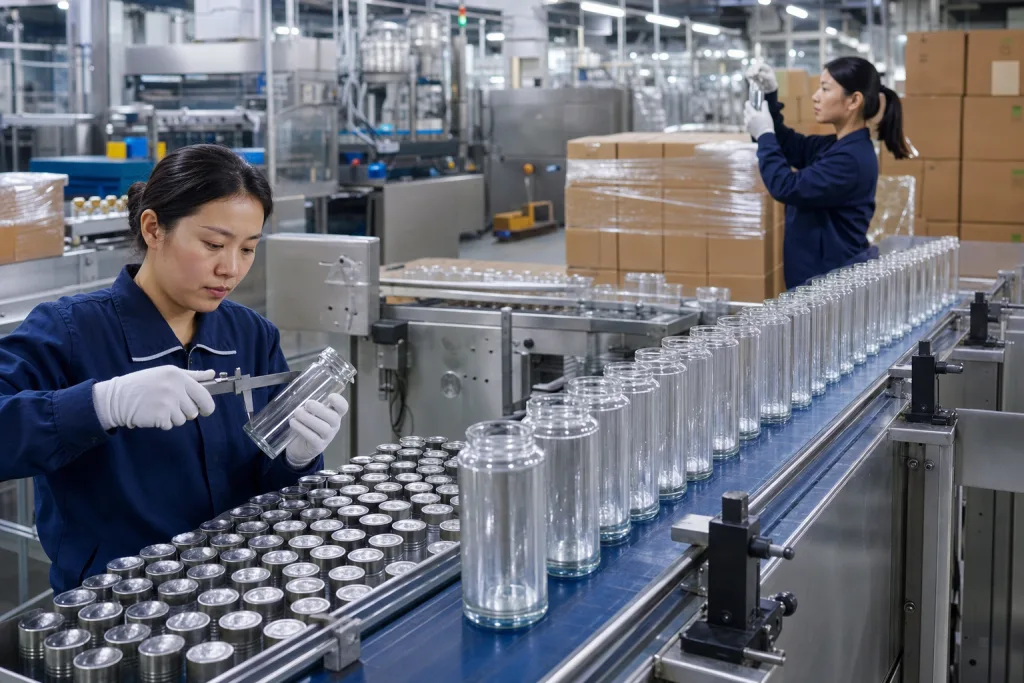
Sampling is where you protect the bulk order. A custom borosilicate glass bottle sample is a process check, not just a pretty photo for the buyer’s WhatsApp group. For a new borosilicate glass bottle factory relationship, plan 7-12 days for stock-body samples with your logo, and 15-25 days if custom sleeve color, custom cap finish, or printed box proofing is involved. We run the first pieces against the drawing with a digital caliper, usually checking mouth OD, thread height, sleeve position tolerance within 1.5 mm, and whether the cap sits flat after 20 open-close cycles.
Ask for two sample types. First, a construction sample using available parts to confirm size, grip, cap fit, drinking comfort, and carton concept. Second, a pre-production sample using the final artwork, final sleeve color, final cap, and final packaging. Do not combine these approvals unless your launch timeline is tight. We have seen this go sideways: one buyer approved a clear sleeve mockup, then changed to PMS 5425C, and QC pulled the sample because the sleeve smell failed our 24-hour closed-carton check.
Your sample PO or proforma should state:
- Sample quantity: 3-5 pcs per design
- Logo artwork file: AI or PDF vector, with Pantone code
- Decoration method: screen print, decal, laser, or pad print
- Box dieline: supplier to provide before artwork placement
- Courier term: freight collect or prepaid DHL/FedEx
- Approval basis: physical sample plus signed specification sheet
Small wording matters. Put the approval terms into the sample PO, not just the email thread. We once received a PO with “matte black lid” typed as “matt back lid,” and the buyer flagged it only after the sample photos were sent. For a 3-5 pcs sample set, write the carton size target, barcode size, logo position in mm from the base, and the courier account number so the merchandiser does not guess.
For a borosilicate glass bottle promotional order, buyers often accept a faster sample and lighter testing. For retail distribution, I would not. That is the wrong place to save 3 days. Put water in the sample, invert it overnight, place it in your target gift box, scan the barcode, and hand it to someone who has never seen the product. If they struggle with the cap thread or complain about sleeve smell, fix it before bulk. On our line, a 2 mm logo drift or one leaking cap in 5 samples is enough reason to stop and reset before the 3,000 pcs order starts.
Write a PO that controls risk
Your purchase order is not just for accounting. It is the document we open first when the line, the inspector, or the warehouse finds a problem. For borosilicate glass bottle bulk orders, write it so your China supplier, the AQL inspector, and your receiving team are checking against the same bottle, not three different interpretations.
For a distributor glass water bottle program, put the exact SKU name, capacity in ml, full material list, logo method with Pantone number, packaging version, testing requirements, inspection level, delivery term, and rework or chargeback agreement. If you ship to Amazon, a 3PL, or a retailer DC, add FNSKU, carton label position, pallet height, and master carton weight limits. A lot of North American warehouses set 15 kg as the carton limit. For glass bottles, we usually run export cartons at 10-13 kg; when we pushed one 18 kg carton on a 750 ml bottle order, QC pulled cracked inner boxes after the drop test.
Write the AQL wording clearly. A common setting is General Inspection Level II, AQL 2.5 for major defects and 4.0 for minor defects. Critical defects should be 0. Critical defects include glass cracks, sharp edges, unsafe broken packaging, wrong food-contact material, or severe leakage. Major defects include wrong logo color, leaking cap, badly scratched glass, or the wrong retail box version. Minor defects include small print specks within the approved tolerance, such as one black dot under 0.5 mm outside the logo area. Do not leave this to “factory standard.” That is the wrong question to ask after 8 pallets are already packed.
Your PO line items should include:
- FOB port: Ningbo or Shanghai, with the booked port matching the carton mark and commercial invoice
- Payment: 30% deposit, 70% after passed inspection before shipment, not before QC releases the lot
- Lead time: 30 days after deposit and sample approval, counted from the signed sample, not from the first email quotation
- Inspection: third-party pre-shipment inspection allowed, with sealed samples and the PO available on the factory floor
- Compliance: LFGB or FDA food-contact support, REACH for silicone if required, tied to the actual lid gasket and sleeve material
China suppliers are used to detailed export POs. We see 20-page retailer manuals and single-line Alibaba orders in the same week. If a borosilicate glass bottle vendor pushes back on basic written specifications, treat that as a warning; we have seen this go sideways over one typo on a PO, like “matte black lid” becoming “black bottle” at packing.
Inspect packing before shipment
Glass bottle quality is only half the job. Packing decides whether your products arrive saleable. A nice customized glass water bottle in a weak carton is still a bad buy. For wholesale distribution, inspect the bottle and the packing setup before you pay the balance; we have seen one PO typo, “12 pcs/ctn” printed as “24 pcs/ctn,” create a carton weight problem before the line even started packing.
For bulk borosilicate glass bottle shipments, the usual build is individual retail box, inner divider or molded paper support if needed, then 5-ply export carton. Carton burst strength and edge crush strength need to match the gross weight, not the buyer’s target freight cost. For a 24 pc carton of 550 ml bottles, a 5-ply K=K or similar export carton is usually safer than a light domestic carton, and we normally check the carton wall with a caliper at the packing table. If your order ships by courier or small parcel, ask for a stricter drop test than a full-container sea shipment. The math doesn't work if you save USD 0.18 on a carton and then replace broken retail packs after delivery.
Ask your inspector to check:
- Carton drop test from 60-76 cm, depending on carton weight and buyer standard
- Correct assortment and color against the packing list, plus SKU, barcode, and shipping mark against the approved artwork
- Logo adhesion by tape test or rub test; QC should record the tape brand and rub count
- Leak test on selected samples, filled to the shoulder line and left upside down for 30 minutes
- Glass cracks and bubbles under a light box, plus deformation and sharp mouth edges checked by hand
- Retail box scuffing and crushed corners, with insert fit checked after one full carton is opened
Our Zhejiang team typically handles 80,000-120,000 drinkware units per month across stainless steel, plastic, and glass projects, and glass gets stricter packing checks. No shortcut here. QC pulled the sample from a 24 pc master carton last month and found 4 crushed gift boxes near the bottom layer; catching that before loading is cheaper than issuing credits to retailers after a container arrives with 6% crushed gift boxes.
Plan repeat orders and assortment
The first order proves the product. The second order proves whether the supply chain works. For borosilicate glass bottle distributors, repeatability is where margin survives. If you change sleeve colors, cap materials, box artwork, and carton quantity every order, the line starts from zero again. We’ve seen this go sideways over a 2 mm sleeve height change that QC pulled during fit testing.
Build a controlled assortment. For wellness brands and sustainable retailers, a practical launch might be three colors in 550 ml, one neutral box design, and one shared cap type. Keep the same bottle body across SKUs. That lets the borosilicate glass bottle manufacturer hold glass inventory with less waste and helps you reach MOQ faster. For example, 3,000 pcs total split into three sleeve colors may be possible if the base bottle is shared, while three fully different bottle shapes may require 3,000 pcs each. Simple sells. The buyer may want six colors at launch, but the math often does not work once you add printed sleeves, separate inner boxes, and mixed-carton packing.
Forecast honestly. A borosilicate glass bottle wholesale reorder usually needs 25-35 days production after deposit, plus 28-40 days ocean transit to Europe and North America ports such as Rotterdam, Hamburg, Los Angeles, and New York. If you wait until your warehouse has two weeks of stock, you are already late. Share a 3-month forecast with your borosilicate glass bottle supplier, even if it is not binding. We run production slots by furnace capacity, decal schedule, and carton delivery date, not by hope. Last peak season, one PO typo changed 550 ml to 500 ml, and the buyer flagged it only after the pre-production sample photo was sent.
Protect your artwork assets too. Keep approved Pantone codes, dielines, barcode files, cap laser files, and inspection photos in one folder. When your buyer asks for a customized borosilicate glass bottle refill order six months later, you should not be rebuilding the SKU from old emails. Good sourcing is not dramatic. It is boring, documented, and repeatable. We ship cleaner repeat orders when the folder includes the signed carton mark, the 300 dpi logo file, and the last AQL 2.5 inspection report.
Send your glass bottle RFQ for review
Share capacity, logo, packaging, MOQ, and target market. We will reply with practical FOB options and sampling steps.
Frequently asked questions
What MOQ should a borosilicate glass bottle distributor expect?
For a stock bottle body with a custom logo, expect 1,000 pcs per SKU as a workable starting point. If you need a custom silicone sleeve color, printed retail box, or cap customization, 2,000-3,000 pcs is more realistic. A fully custom mold can require 10,000 pcs or more, plus mold cost and longer development time. Some China suppliers may accept 500 pcs, but the unit price, sample cost, and domestic handling fees usually make it unattractive for serious wholesale distribution.
Is borosilicate glass better than regular glass for water bottles?
For drink bottles, borosilicate glass is usually the better choice because it handles thermal shock better and feels cleaner for wellness positioning. It is commonly used for bottles that may see warm tea, infused water, or daily wash cycles. That said, it is not unbreakable. You still need correct wall thickness, sleeve protection, and export packing. Ask for a stated thermal shock test, such as room temperature to 80°C water change, rather than accepting broad marketing claims like “high temperature resistant.”
How long does a custom glass water bottle order take?
For a custom borosilicate glass bottle using an existing body, plan 7-12 days for logo samples and 25-35 days for bulk production after sample approval and deposit. Custom sleeve colors, new box artwork, or special cap finishes can add 5-10 days. Sea freight to Europe or North America often adds 28-40 days port-to-port, plus customs and inland delivery. If you need retail launch stock by a fixed date, start the sourcing process at least 90 days before your warehouse deadline.
What compliance documents should I ask from suppliers?
For Europe, ask about LFGB food-contact testing and REACH support for silicone sleeves or coated parts. For the United States, FDA food-contact documentation is commonly requested. If you sell children’s drinkware, ASTM or CPSIA-related checks may apply depending on design and market claims. Also ask for BSCI, ISO 9001, or factory audit documents if your retailer requires social or quality management evidence. Do not assume one certificate covers the full bottle, cap, sleeve, ink, and packaging.
Can I mix colors in one wholesale order?
Yes, but the structure matters. If the bottle body, cap, and packaging stay the same, many suppliers can split 3,000 pcs into two or three sleeve colors. If each color needs a separate printed box, barcode, carton mark, and cap logo, the factory workload increases and the MOQ may rise. For a first distributor borosilicate glass bottle order, keep the base bottle shared and limit the assortment to three colors. It reduces sample approvals, inspection confusion, and leftover packaging risk.